

Why Concrete Slab Construction Is the Foundation of Every Great Build
Concrete slab construction is the process of building a flat, horizontal concrete surface that supports everything from patio furniture to semi-trailer trucks — and getting it right starts with understanding the key steps.
Here’s a quick overview of how to build a concrete slab:
- Prepare the subgrade — compact the soil and add a gravel base
- Install formwork — set wood or metal forms to define the slab shape
- Place reinforcement — lay rebar or wire mesh on proper supports (like rebar chairs)
- Pour and distribute concrete — fill forms evenly and vibrate to remove air pockets
- Screed and finish — level the surface, then float and trowel to the desired finish
- Cut joints — add control and expansion joints within 4–12 hours of finishing
- Cure — keep the slab moist for at least 7 days; full strength is reached at 28 days
A concrete slab sounds simple on paper. But skip one step — like proper compaction or correct rebar placement — and you’re looking at cracking, settlement, or a slab that fails under load.
Whether you’re pouring a backyard patio or an industrial warehouse floor, the principles are the same. The details are what separate a slab that lasts decades from one that fails in a few years.
I’m Jordan Harris, a licensed Professional Engineer with a master’s degree in structural engineering and five years of hands-on experience designing large-scale concrete projects. As part of the team behind Hercules Rebar Chairs, I’ve spent years focused on the reinforcement side of concrete slab construction — helping contractors get it right the first time.
Basic concrete slab construction glossary:
Understanding the Types of concrete slab construction
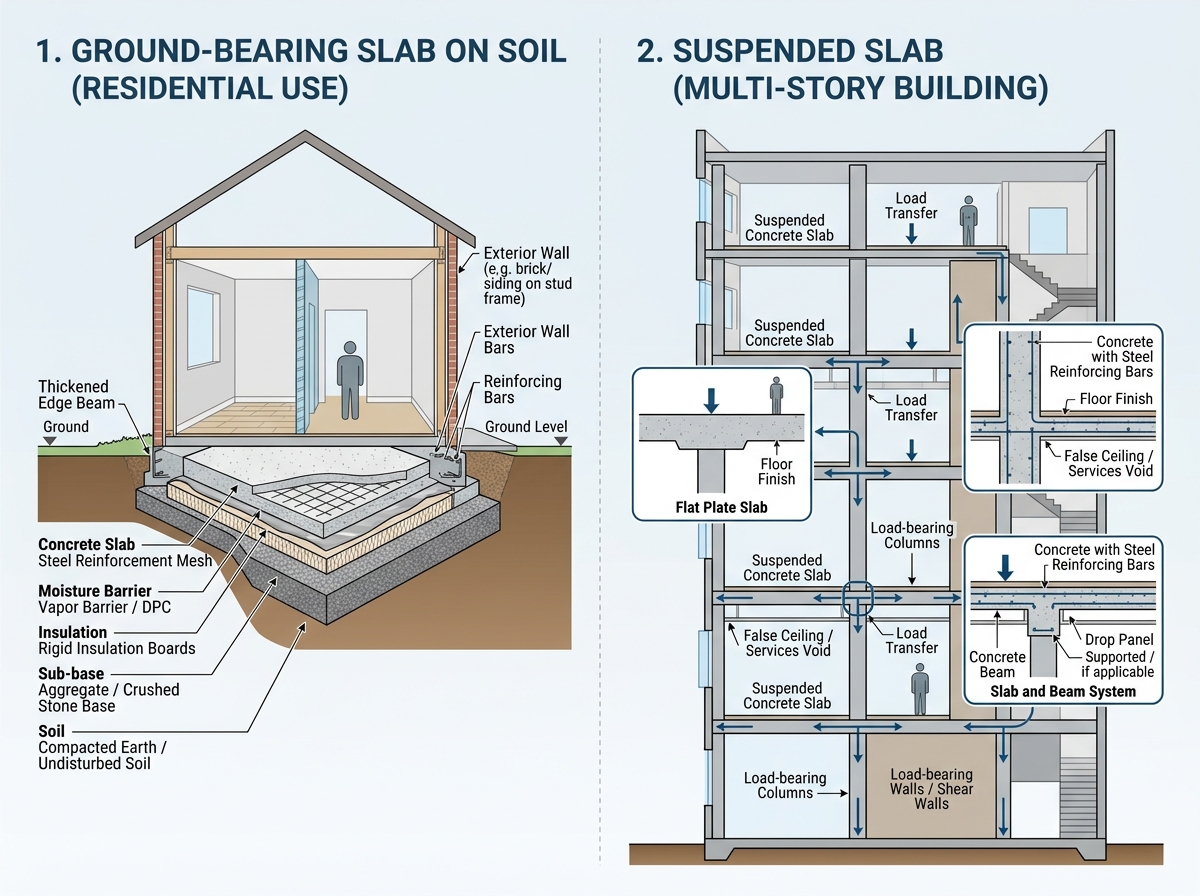
Before we grab the shovels, we need to know what kind of slab we’re actually building. In concrete slab construction, not all flat surfaces are created equal. The type of slab you choose depends on the load it needs to carry and the structure it supports.
Ground-Bearing Slabs
This is the most common type for residential projects like driveways, patios, and garage floors. As the name suggests, the slab rests directly on the ground (well, on a prepared subgrade and base). These are typically 4 to 6 inches thick. Because they rely on the soil for support, the ground preparation is absolutely critical to prevent settlement.
Suspended Slabs
These slabs don’t touch the ground. They are supported by walls or columns and are common in multi-story buildings. Think of a second-story floor or a balcony. These require complex formwork and heavy reinforcement because they have to support their own weight plus the “live load” of people and furniture without sagging.
One-Way vs. Two-Way Slabs
This is where we get into the engineering “fun.”
- One-way slabs are rectangular. If the long side is more than twice the length of the short side, the load primarily travels in one direction to the supporting beams. These are economical for spans between 6 to 18 feet.
- Two-way slabs are more square-like. The load is distributed in both directions. These are great for bigger spaces, spanning 15 to 40 feet when supported by beams.
Waffle and Hollow Core Slabs
- Waffle slabs look like an upside-down waffle from underneath. They use a grid of ribs to provide incredible stiffness for long spans (up to 54 feet) without the massive weight of a solid slab.
- Hollow core slabs are precast planks with hollow tubes running through them. They are lightweight, provide great sound insulation, and speed up construction significantly.
| Slab Type | Typical Span | Common Application | Formwork Complexity |
|---|---|---|---|
| Ground-Bearing | N/A (rests on soil) | Driveways, Patios, Garages | Low |
| One-Way Solid | 6 – 18 feet | Residential floors, walkways | Medium |
| Flat Plate | 12 – 24 feet | Hotels, Apartments | Low |
| Waffle Slab | 24 – 54 feet | Industrial buildings, Museums | High |
| Hollow Core | Variable | Multi-story commercial | Low (Precast) |
For more technical details on high-quality builds, check out Concrete Slab Construction – How to Build High Quality Slabs.
Choosing the Right concrete slab construction for Your Project
Choosing the right slab is a balancing act between cost, capability, and conditions.
- Residential Patios and Walkways: A standard 4-inch ground-bearing slab is usually plenty. We often recommend a 35 MPa mix for backyard projects to ensure durability against the elements.
- Driveways and Garages: You’ll want to bump the thickness up to 5 or 6 inches to handle the weight of vehicles.
- Industrial Floors: These often require 6 to 8 inches of reinforced concrete to handle heavy machinery and “hard-wheeled” traffic like forklifts.
- Soil Reactivity: If you’re building on “reactive” soil (like heavy clay that expands when wet), you might need a thicker slab or a “waffle pod” design to prevent the ground from cracking your concrete.
- Thermal Mass: Concrete has high thermal conductivity (0.8 to 2.0 W m⁻¹ K⁻¹). In many U.S. climates, we can use this to our advantage. A thick slab can soak up heat during the day and release it at night, helping regulate indoor temperatures.
Essential Preparation: Subgrade, Formwork, and Reinforcement
If you want a slab that lasts, you have to spend 80% of your time on the stuff people will never see. The preparation phase is the most important part of concrete slab construction.
Subgrade and Base
First, we clear the area of all organic matter—grass, roots, and “bad dirt” have to go. Then, we compact the soil. If you’re in a freeze-thaw state like Maine or Michigan, you may need to dig down to the frost line (sometimes 4 feet deep!) and replace that soil with crushed gravel to prevent frost heave.
For most standard slabs, we lay a 4-to-6-inch base of crushed gravel. This provides drainage and a stable “platform” for the concrete. We compact this in “lifts” (layers) of about 6 inches at a time. A well-compacted base prevents the slab from settling and cracking later.
Vapor Barriers and Formwork
Before the concrete goes in, we often install a vapor barrier (usually a 10-mil thick polyethylene sheet). This stops moisture from the ground from seeping up through the concrete, which is vital if you plan on putting carpet or hardwood over the slab later.
Next comes the formwork. We use 2×4 or 2×6 lumber to create the “mold” for the concrete. We stake these firmly into the ground and use a laser level to ensure everything is perfectly flat (or slightly sloped for drainage). For more on the basics of setting up your pour, How to Pour a Concrete Slab is a great resource.
The Critical Role of Reinforcement in concrete slab construction
Concrete is like a body: the cement is the flesh, but the reinforcement is the skeleton. Concrete is incredibly strong in compression (pushing), but weak in tension (pulling). Reinforcement provides that missing tensile strength.
- Rebar Mats: For heavy-duty slabs, we use a grid of steel rebar.
- Welded Wire Mesh: For lighter residential slabs, wire mesh helps control shrinkage cracks.
But here is the “pro tip” that many DIYers (and even some pros) miss: Reinforcement only works if it’s in the middle of the slab. If your rebar is sitting on the dirt, it’s doing nothing but rusting. That’s where we come in. At Hercules Rebar Chairs, we manufacture the supports that hold your rebar or mesh at the perfect height during the pour.
Using our “America’s #1” red chairs ensures you meet building codes and achieve maximum structural integrity. We’ve sold over 14 million units because they save time and prevent the reinforcement from sinking to the bottom.
Check out these guides for deep dives into reinforcement:
- Slab Strong: Mastering Rebar Placement for Durable Concrete
- Why Your Slab Needs Rebar Chair Supports
- How to Calculate Rebar for Slab the Right Way
- Reinforcing Your Concrete: Everything You Need to Know About Wire Mesh
The Step-by-Step Pouring and Finishing Process
Once the prep is done, it’s “go time.” Concrete waits for no one, so we have to work efficiently.
1. The Pour
We distribute the concrete evenly across the forms. If it’s a large area, we might use a pump truck. We want a “peanut butter” consistency—not too runny, not too stiff. We also use a vibrator tool to shake out any air pockets that could weaken the slab.
2. Screeding
Immediately after pouring, we “screed” the concrete. This involves two people using a long, straight board (a screed) to “saw” back and forth across the top of the forms, pulling excess concrete away and leaving a flat surface.
3. Bull Floating
Once the surface is level, we use a bull float—a large, flat tool on a long pole. We push and pull it across the wet concrete to push down the large aggregate (rocks) and bring the “fines” (the smooth cream) to the top. For a detailed walkthrough of this process, see Concrete Slab – How to install a slab from start to finish.
4. Edging and Troweling
As the concrete begins to “set” (harden), we use an edger tool to create a rounded edge along the forms. This prevents the edges from chipping later. Once the “bleed water” (excess moisture on top) disappears, we use a steel trowel to get that smooth, dense finish you see on garage floors.
To make sure your reinforcement stays put during all this activity, follow our Step-by-Step Guide to Mastering Your Rebar Placement.
Managing Joints and Curing for Maximum Strength
Even the best concrete slab construction will crack if you don’t give it a place to “move.” Concrete shrinks as it dries, and it expands and contracts with the temperature.
- Control Joints: These are the lines you see in sidewalks. We cut these about 1/4 of the way through the slab thickness. They create a “weak point” so that when the concrete cracks (and it will), it cracks neatly in the line where we want it to.
- Expansion Joints: These are used where the slab meets a wall or another slab. We fill them with a flexible material to allow the slab to expand without crushing itself.
- Timing: We usually cut joints 4 to 12 hours after finishing—before the concrete gets too hard.
The 28-Day Rule
Curing is the process of keeping the concrete moist so the chemical reaction (hydration) can finish.
- 2 Days: You can usually walk on it.
- 7 Days: It has gained about 70% of its strength; you can put furniture on it.
- 28 Days: The slab has reached its full “design strength.”
We recommend moist curing (sprinkling with water or covering with plastic) for at least the first 7 days to prevent the surface from drying too fast and cracking. For more on the tools that keep your slab structurally sound during this phase, see The Ultimate Guide to Rebar Chairs: Types, Uses, and Sizing for Concrete Slabs.
Frequently Asked Questions about Concrete Slabs
How thick should a standard concrete slab be?
The “standard” answer is 4 inches for most residential applications like walkways, patios, and deck landings. However, if you’re parking a heavy truck on it or building a garage, we recommend 6 inches. Industrial floors can go up to 8 inches or more.
Want to know if you can skip the steel? Check out Why Your 4-Inch Slab Might Not Need Rebar (and When It Does).
How long does it take for a slab to fully cure?
As mentioned, while it’s “hard” within 24 hours, it takes 28 days to reach its full strength. Environmental factors play a huge role here. In hot, dry weather, concrete can dry too fast and lose strength. In cold weather (below 50°F), the curing process slows down significantly. Always aim for a “sweet spot” of 60°F to 75°F for the best results.
When should I hire a professional vs. DIY?
If you’re pouring a small trash can pad or a 3×3-foot landing for stairs, go for it! It’s a great weekend project. But once you get over 25–40 square feet, things get difficult fast. Concrete is heavy (about 150 lbs per cubic foot), and it sets quickly. If you’re doing a house foundation, a driveway, or a large patio, hiring a professional is usually worth the cost-benefit of knowing the job was done with the right equipment (like laser screeds and power trowels).
Conclusion
Mastering concrete slab construction is about respecting the process. From the first scoop of dirt to the final pass of the trowel, every step counts toward a foundation that will stand the test of time.
At Hercules Rebar Chairs (T.J. Harris Co.), we’re proud to be America’s #1 choice for concrete supports. With over 14 million units sold across the USA—from the heat of Arizona to the frost of Alaska—our red chairs are the industry standard for ensuring your reinforcement stays exactly where it belongs. We help you save time and money while ensuring your project is fully code-compliant.
Ready to start your next build? Make sure your reinforcement is supported by the best. Check out our Rebar Placement Guide to get started, or browse Our Products to find the perfect fit for your slab. Let’s build something that lasts!