

The Fast Answer: What Are Rebar Standoffs?
Rebar standoffs are small supports placed under reinforcing steel bars to hold them at the correct height inside a concrete form before and during a pour.
Here’s a quick breakdown:
| Feature | Details |
|---|---|
| Also called | Rebar chairs, rebar supports, rebar spacers |
| Primary job | Hold rebar at the right elevation inside concrete forms |
| Common heights | 1″ to 6″+ depending on application |
| Materials | Steel, plastic, or steel with plastic-dipped legs |
| Rebar compatibility | #3 to #8 bars (3/8″ to 1″ diameter) |
| Placement spacing | Every 2 to 3 feet along the rebar |
| Left in concrete? | Yes — permanently |
Without standoffs, rebar sinks to the bottom of the form. That means no concrete cover, which leads to corrosion, cracking, and structural failure down the road.
They’re a small part of the job. But they matter a lot.
Whether you’re pouring a simple slab or a tilt-up wall pool, the right standoffs keep your rebar exactly where the plans say it needs to be — every single time.
I’m Jordan Harris, a licensed PE and structural engineer with hands-on experience specifying and building with rebar standoffs on large-scale concrete projects before joining my family’s rebar support manufacturing business. Keep reading and I’ll walk you through everything you need to choose the right standoffs for your next pour.
What Are Rebar Standoffs and Why Are They Essential?
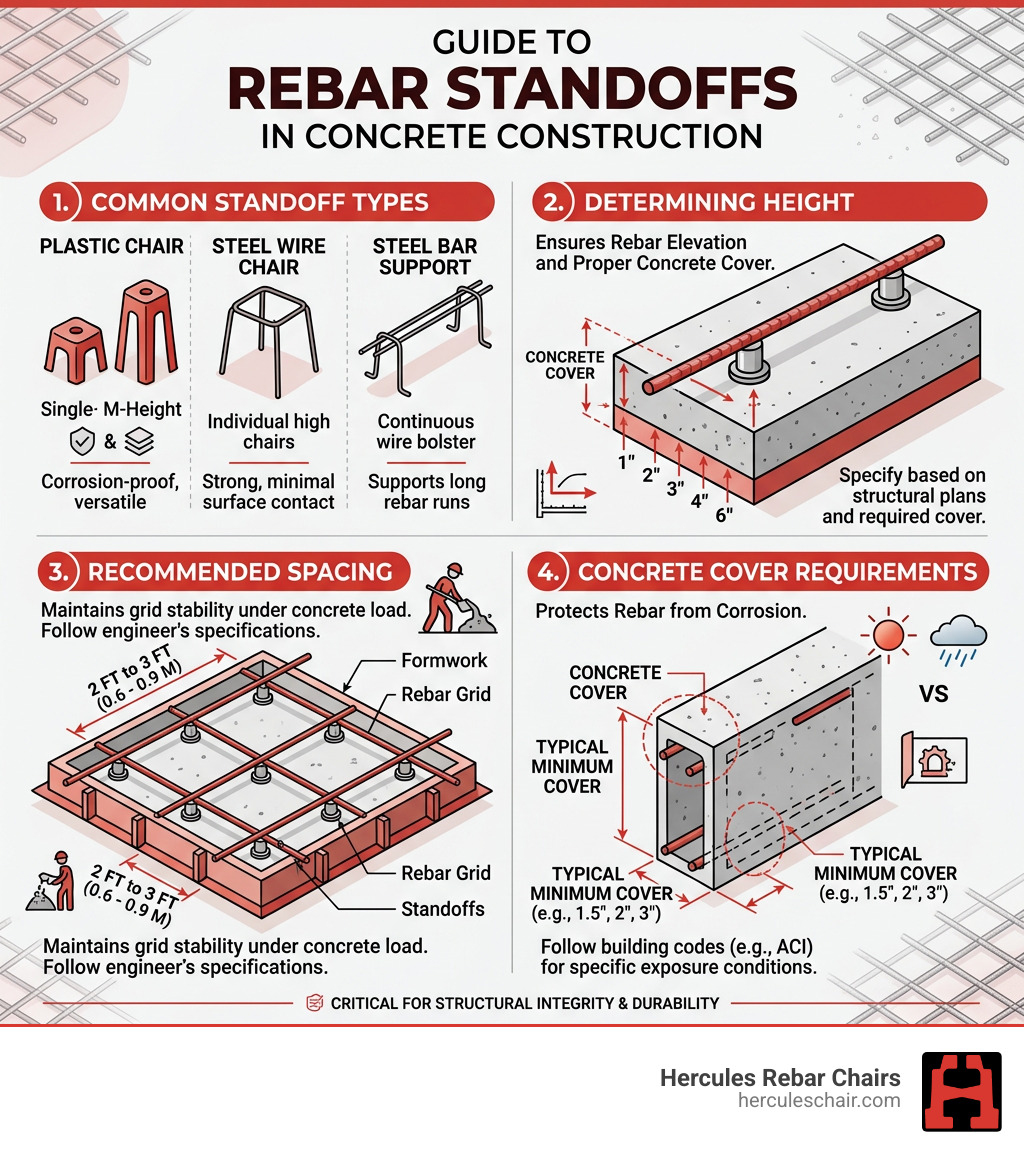
In concrete construction, “close enough” isn’t good enough. The primary purpose of rebar standoffs is to ensure that reinforcing steel remains at the precise elevation required by the structural design. When we talk about rebar elevation, we are really talking about “concrete cover”—the distance between the outer surface of the concrete and the steel reinforcement.
Proper concrete cover is vital because it protects the steel from moisture and air, which cause rust. If your rebar sits too low (touching the dirt) or too high (near the surface), the structural integrity of the entire build is compromised. Rebar standoffs provide the stability needed to resist the weight of the steel and the force of the concrete as it is poured, ensuring the bars don’t shift or sink.
Furthermore, these supports facilitate better concrete flow. By lifting the rebar, they allow the wet mix to wrap entirely around the bar, creating a mechanical bond that is the backbone of reinforced concrete. Following ACI specifications isn’t just a suggestion; it’s a requirement for safety and longevity. Using professional rebar supports ensures your project stays in compliance and stands the test of time.
Rebar Standoffs vs. Rebar Chairs
You will often hear the terms “standoffs,” “chairs,” and “spacers” used interchangeably on the job site. While they all serve the same general goal—holding steel in place—there are some subtle differences in terminology and application.
“Rebar chairs” is the most common industry term, often referring to individual supports like saddle chairs that cradle a single intersection of rebar. Rebar standoffs is a term frequently used when discussing the specific height or “standoff distance” the bar needs from the formwork.
Whether you call them chairs or standoffs, the application usually dictates the shape. For example, a “saddle” style support is perfect for single bars, while a “bolster” is a long, continuous support used for heavy mats or long runs of steel. Understanding these support systems helps you communicate more effectively with your supplier and your crew.
Main Types of Rebar Standoffs for Construction
Not all concrete projects are created equal, and neither are the supports used to build them. Choosing the right material and shape can mean the difference between a smooth inspection and a costly “tear-out.”
| Support Type | Material | Best Use Case | Key Benefit |
|---|---|---|---|
| Individual Chair | Metal or Plastic | Slabs, Footings | Versatile, easy to place |
| Slab Bolster | Metal Wire | Heavy Mats, Decks | Continuous support, high load |
| Solo Chair | Plastic/Metal | Single Bars | Rust-free base options |
| Mesh Chair | Steel | Wire Mesh Slabs | Specifically for thin wire |
There are a wide variety of types available, ranging from simple “dobies” (concrete blocks) to sophisticated multi-positioning metal stands.
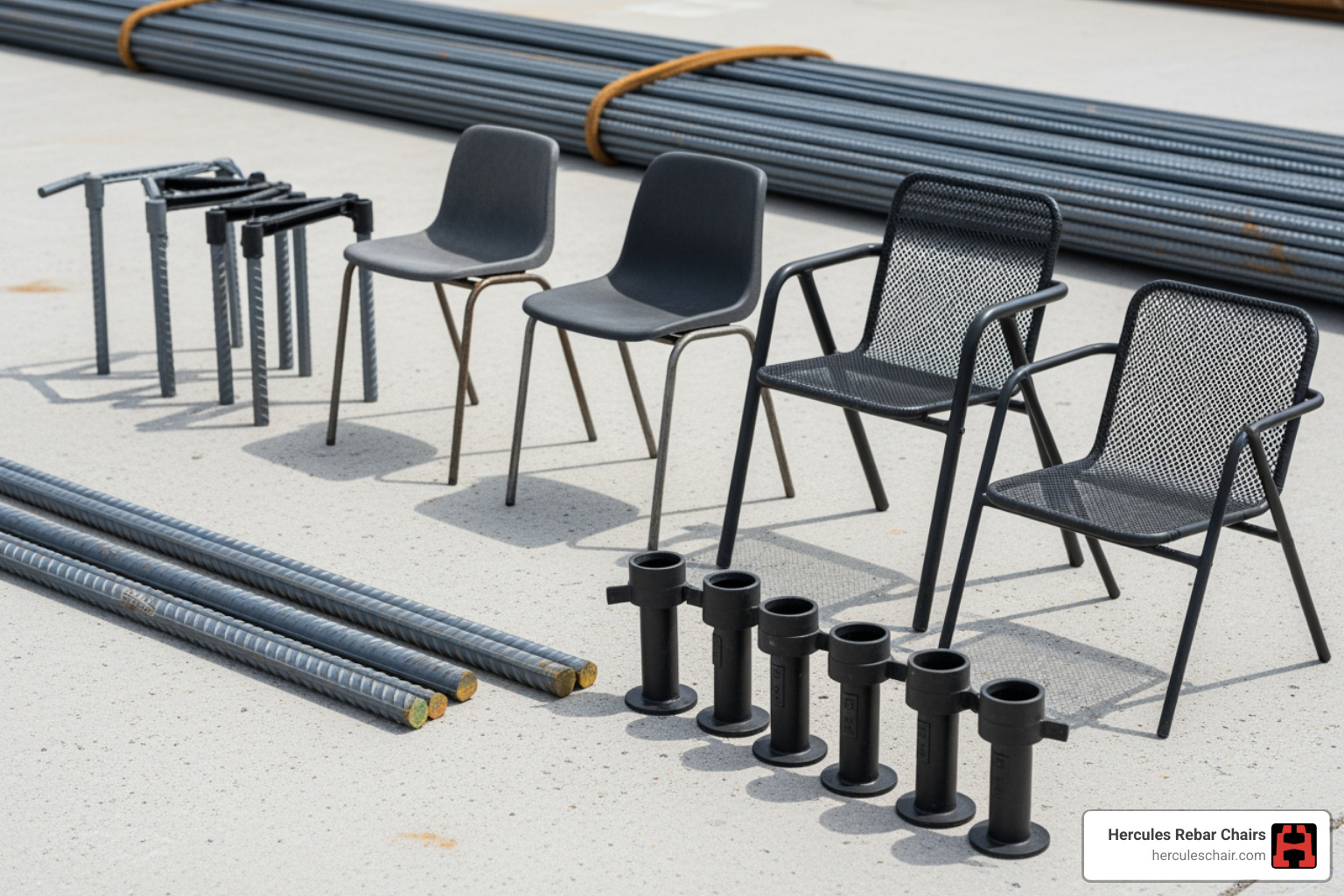
Metal Rebar Standoffs with Plastic-Dipped Legs
For many professional contractors, metal is the gold standard. High-quality metal rebar standoffs are typically manufactured from heavy-duty 6-gauge steel wire. This provides the strength necessary to support heavy #5 or #8 bars without buckling under the weight of workers walking on the grid.
One of the most important features to look for is “plastic-dipped legs.” Since the tips of the metal legs sit against the bottom of the form, they are technically exposed to the elements once the forms are stripped. Without protection, these tips can rust, leaving unsightly orange stains on the finished concrete ceiling or floor. Plastic-dipping creates a barrier that prevents this corrosion while maintaining the strength of steel.
All-Plastic Rebar Standoffs and Spacers
Plastic options have gained massive popularity because they are completely corrosion-resistant and generally more economical. They are lightweight, making them easy to transport around a large job site, and they “snap” onto the rebar, which can speed up installation.
While they may not always have the same raw load-bearing capacity as a heavy-duty steel bolster, plastic rebar chairs are excellent for residential slabs, driveways, and precast panels where rust-proof performance is the top priority.
Key Specifications for Selecting Rebar Standoffs
When you are ready to order, you need to have your specs ready. Picking the wrong size can result in rebar that is too high, preventing you from finishing the concrete smoothly, or too low, failing inspection.
- Height Increments: Standoffs typically come in heights ranging from 1 inch to over 6 inches. Some specialized bolsters are available in 1/4-inch increments for precision work.
- Rebar Size Compatibility: Ensure the “cradle” or “saddle” of the standoff fits your bar. Most standard chairs support #3 (3/8″) to #5 (5/8″) bars, but heavy-duty versions can accommodate up to #8 (1″) bars.
- Material Gauge: For metal supports, 6-gauge steel is the industry standard for durability.
- Leg Spacing: For slab bolsters, legs are typically spaced 5 inches on center to provide balanced weight distribution.
If you are unsure which size to get, following a simple sizing guide can save you a lot of headaches during the pour.
Calculating Spacing and Quantity
How many rebar standoffs do you actually need? A general rule of thumb for standard slabs and footings is to place them 2 to 3 feet apart. If you space them too far, the rebar will “sag” in the middle, losing its required elevation.
For specific applications like footings using steel stakes, the recommended spacing may increase to 5 feet, provided the bar size is large enough (like a #5 bar) to maintain its own rigidity. To estimate your project, calculate the total linear feet of rebar and divide by the spacing interval. It is always wise to order 10% extra to account for breakages or unexpected adjustments. Finding the right size and quantity is the key to a level, structural pour.
Common Applications in Concrete Projects
Rebar standoffs are used across almost every sector of construction. Their versatility makes them a staple in:
- Flat Slabs: From garage floors to warehouse foundations, standoffs keep the reinforcement centered.
- Footings: In excavated trenches, standoffs (often called footer stands) keep the steel off the dirt before the concrete is poured.
- Tilt-Up Walls: Precision is key here; standoffs ensure the steel is perfectly positioned so the wall maintains its strength once lifted.
- Elevated Slabs: In multi-story buildings, mesh chairs and bolsters are used to support steel on corrugated metal decking.
- Precast Panels: Manufacturers use plastic spacers to ensure every panel is identical and rust-free.
- Bridge Decks & Retaining Walls: High-stress environments require heavy-duty metal standoffs to handle massive loads.
Frequently Asked Questions about Rebar Standoffs
Are rebar standoffs left in the concrete after pouring?
Yes, they are! Rebar standoffs are permanent “left-in-place” accessories. Once the concrete is poured, they become an integral part of the structure. They are designed to be chemically compatible with concrete, ensuring they don’t create “voids” or weak spots. Their job is to hold the steel during the pour, but their presence afterwards provides continued stability and ensures the steel never shifts over the decades.
Can rebar standoffs be used with wire mesh?
Absolutely. In fact, using mesh chairs is the only way to ensure wire mesh actually stays in the middle of a slab. Many DIYers try to “pull up” the mesh with a hook during the pour, but this is notoriously inaccurate. Using a dedicated 2-inch steel mesh chair provides a stable platform that workers can walk on without pushing the mesh back into the dirt.
What are the pricing and bulk purchase options?
Pricing for rebar standoffs varies significantly based on material and quantity.
- Retail: Small packs (20-50 count) are available at big-box stores like Home Depot or through Amazon for small residential projects.
- Wholesale/Bulk: For large-scale projects, buying in bulk is essential. Prices can drop from nearly $0.75 per unit for small orders down to $0.30 per unit when purchasing in large quantities (50,000+ units).
- Lead Times: While standard sizes are often in stock, custom heights or massive orders of 10,000+ units may require a lead time of up to 60 days.
When you are ready to buy rebar chairs, always check for bulk discounts to keep your project under budget.
Conclusion
At the end of the day, a concrete structure is only as strong as its reinforcement. If that reinforcement isn’t positioned correctly, the concrete is just a ticking time bomb of cracks and corrosion.
At Hercules Rebar Chairs, we’ve dedicated ourselves to being “America’s #1” choice for concrete supports. With over 14 million units sold, our products are trusted by contractors across the USA to save time, save money, and ensure total code compliance. You can easily spot our chairs on the job site by our signature red color—a mark of heavy-duty quality and reliability.
Whether you need a simple 2-inch chair for a driveway or complex bolsters for a high-rise, we have the inventory and expertise to support your build. Don’t leave your structural integrity to chance; pull up a chair with the pros.
Check out Our Products today to find the perfect match for your next pour.