

What Is 3/8 in x 10 ft Rebar — and Why Does It Matter for Concrete?
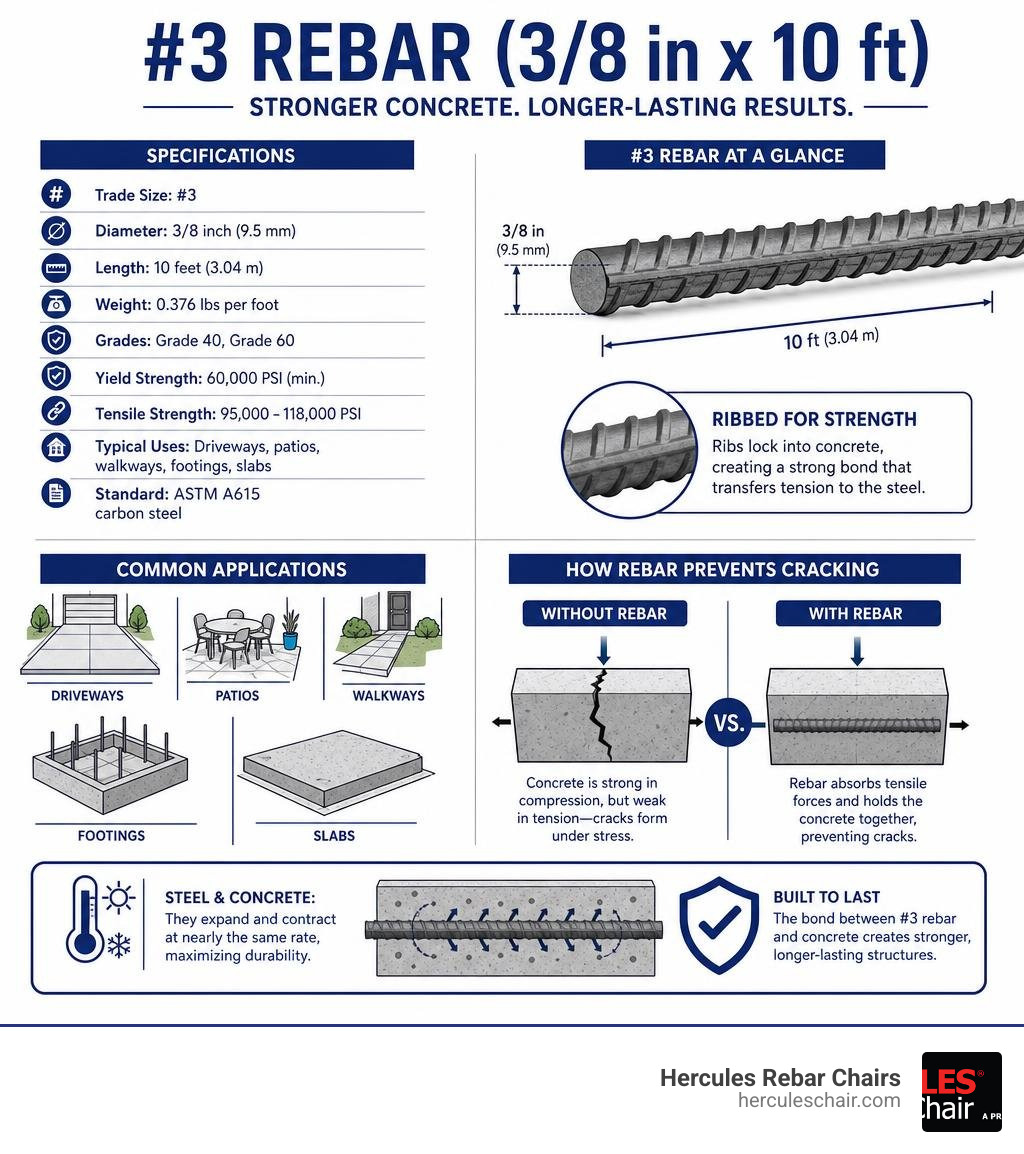
3/8 in x 10 ft rebar (also called #3 rebar) is one of the most widely used steel reinforcement bars in residential concrete work. Here’s a quick summary of what you need to know:
| Spec | Detail |
|---|---|
| Trade Size | #3 |
| Diameter | 3/8 inch (9.5 mm) |
| Length | 10 feet (3.04 m) |
| Weight | 0.376 lbs per foot |
| Common Grades | Grade 40 and Grade 60 |
| Yield Strength | 60,000 PSI (minimum) |
| Tensile Strength | 95,000 – 118,000 PSI |
| Typical Uses | Driveways, patios, walkways, footings, slabs |
| Material Standard | ASTM A615 carbon steel |
Concrete is incredibly strong under compression — but it’s weak under tension. When the ground shifts, temperature swings, or loads bear down, concrete wants to crack. Rebar is what holds it together.
The ribbed surface of #3 rebar locks into the concrete as it cures. That bond transfers tensile stress from the concrete to the steel, where it can be handled safely. The result: slabs that last decades instead of years.
Steel and concrete also expand and contract at nearly the same rate with temperature changes. That compatibility is one reason steel rebar has been the go-to reinforcement solution for over a century.
I’m Jordan Harris, a licensed Professional Engineer (PE) with a master’s degree in structural engineering and five years of hands-on experience designing large-scale concrete and steel structures. Today I work at T.J. Harris Company, where I help develop rebar support products used alongside 3/8 in x 10 ft rebar on job sites across the country. Let’s break down everything you need to know to use this material correctly and confidently.
Glossary for 3 8 in x 10 ft rebar:
Understanding the Specifications of 3 8 in x 10 ft Rebar
When you walk down the building materials aisle or browse online catalogs, you will see a variety of codes, numbers, and grades stamped onto steel reinforcement. To ensure your concrete projects survive the test of time, you need to understand exactly what these standards mean.
The primary standard governing carbon steel reinforcement in the United States is ASTM A615. This specification ensures that the steel meets strict chemical and physical properties, giving engineers and builders a predictable level of performance. Whether you are working on a simple backyard patio in June 2026 or a structural foundation, using certified ASTM A615 steel is critical for structural integrity.
To help you choose the right material for your next pour, let’s look at how different steel reinforcement specifications compare. For a deep dive into other sizes, check out The Essential Guide to Rebar Sizes and Grades.
| Specification | Grade 40 Steel | Grade 60 Steel |
|---|---|---|
| Minimum Yield Strength | 40,000 PSI | 60,000 PSI |
| Tensile Strength | 70,000 PSI | 90,000 PSI (up to 118,000 PSI) |
| Elongation (in 8 inches) | 11% – 12% | 8% – 9% (12% – 14% for carbon steel) |
| Primary Application | Light residential, landscaping, arbors | Structural slabs, commercial, seismic |
| Corrosion Resistance | Standard carbon steel | Standard carbon steel |
Physical Dimensions and Weight of #3 Rebar
In the steel reinforcement industry, rebar sizes are designated by a “bar number” system. The number represents the nominal diameter of the bar in eighths of an inch. Therefore, a #3 bar has a diameter of 3/8 of an inch (9.5 mm).
When you purchase 3/8-in x 10-ft Steel #3 Rebar, you are handling a highly portable, versatile piece of carbon steel. According to standard #3 steel rebar specifications, this bar weighs exactly 0.376 lbs per foot. This means a single 10-foot bar weighs just under 3.8 pounds.
Its lightweight nature makes it incredibly popular for DIY enthusiasts and residential contractors. You don’t need heavy machinery to transport, carry, or position 10-foot lengths of #3 rebar. It fits easily in the bed of a standard pickup truck or even on a roof rack, making it the perfect choice for home-improvement projects.
Grade 40 vs. Grade 60 Steel Strength Ratings
The “grade” of a rebar refers to its minimum yield strength, measured in kilopounds per square inch (ksi).
- Grade 40 steel has a minimum yield strength of 40,000 PSI.
- Grade 60 steel has a minimum yield strength of 60,000 PSI.
Interestingly, many modern 3/8-inch steel rebar product details show that even bars sold as Grade 40 are often manufactured with a minimum yield strength of 60,000 PSI to streamline modern mill production.
High-quality carbon steel #3 rebar features a tensile strength ranging from 95,000 to 118,000 PSI, coupled with an elongation rate of 12% to 14%. This elongation is critical. It measures how much the steel can stretch before it actually snaps. This ductility is what allows concrete structures to absorb energy and deform slightly during ground settling or minor seismic events, rather than failing catastrophically.

How #3 Rebar Prevents Concrete Cracking and Failure
To understand why rebar is necessary, we have to look at how concrete behaves. Concrete is a composite material that boasts exceptional compressive strength—it can support immense vertical weight. However, its tensile strength (resistance to being pulled apart or bent) is only about 10% of its compressive strength.
Without steel reinforcement, a concrete slab subjected to bending forces, soil movement, or heavy loads will quickly develop cracks. Once a crack starts, it propagates rapidly, leading to structural failure.
When you place 3 8 in x 10 ft rebar inside your concrete formwork, you are creating “reinforced concrete.” The steel acts as a tension-absorbing skeleton. When a load is applied to the top of a slab, the bottom of the slab is placed under tension. The steel rebar, positioned in the lower half of the slab, steps in to carry that tensile stress. To make sure you place it perfectly, read our guide on How to Place Rebar Like a Pro.
Key Applications for 3 8 in x 10 ft Rebar in Residential Projects
Because #3 rebar is highly flexible yet strong, it is the absolute standard for light-duty residential concrete projects. You will commonly find it used in:
- Driveways: Prevents cracking from passenger vehicles and heavy delivery trucks.
- Patios and Walkways: Keeps decorative concrete slabs flat and prevents shifting over time.
- Residential Foundations and Footings: Strengthens the perimeter of homes and additions.
- Retaining Walls and Masonry Block Walls: Threaded through concrete blocks to resist lateral earth pressure.
Before starting any slab project, it is essential to calculate your material layout. Learn more about planning your project with our guide on How to Calculate Rebar for Slab the Right Way.
Thermal Expansion and Concrete Adhesion
One of the most fascinating aspects of civil engineering is the relationship between steel and concrete. They have almost identical coefficients of thermal expansion. This means that when the temperature rises in the summer heat of June 2026, both materials expand at the same rate. When the winter freeze hits, they contract together. If they expanded at different rates, the internal stress would tear the concrete apart from the inside.
Furthermore, #3 rebar is manufactured with raised ridges or deformations along its outer surface. These ridges are not decorative; they are engineered to provide maximum concrete grip. As wet concrete cures around the bar, it locks into these ridges, preventing the steel from slipping. This mechanical bond ensures that stresses are transferred seamlessly between the two materials.
Best Practices for Installing #3 Rebar
Getting the best performance out of your 3/8 in x 10 ft rebar depends entirely on how it is installed. Simply tossing steel bars into a muddy trench right before pouring concrete is a recipe for disaster. If the steel sits on the ground, it will not bond with the concrete, and moisture from the soil will cause it to rust and fail prematurely.
To achieve proper structural reinforcement, you must elevate and secure the steel grid. For a comprehensive overview of these principles, check out our Rebar Placement Guide.

Spacing and Calculating Rebar Needs
For most residential slabs, such as patios and driveways, #3 rebar is laid out in a grid pattern. The standard spacing for a residential grid is typically 16 inches to 24 inches on-center, depending on local building codes and the expected load.
To calculate how much steel you need for your project, you can map out your grid manually or utilize handy online tools. We highly recommend using a Mastering the Rebar Calculator for Your Next Concrete Project to determine your exact quantities. To make sure you don’t run short mid-pour, you can also consult The Rebar Length Calculator You Need – Never Run Short Again.
Splicing and Overlapping 10-Foot Bars
Because concrete projects are often much larger than 10 feet, you will need to join multiple bars together to create continuous reinforcement. This process is called splicing.
You cannot simply butt the ends of two rebar pieces together. Instead, you must overlap them by a specific length so that tensile stress can transfer smoothly from one bar to the next through the surrounding concrete.
The standard lap splice length for #3 rebar is typically 12 to 18 inches (or 30 to 40 times the bar’s diameter), depending on structural requirements and local building codes. These overlapping bars must be securely tied together using steel tie wire. To master the math behind this process, read our guide on How to Master the Rebar Splice Length Formula.
Sourcing and Purchasing #3 Rebar
When sourcing materials for your project, you will find that 3/8 in x 10 ft rebar is readily available across the United States. However, the price, quality, and grading can vary significantly depending on where you shop.
For a complete breakdown of what to expect financially, check out How Much is 3 Rebar – A Cost Guide for Concrete Projects.
Where to Buy 3 8 in x 10 ft Rebar: Retailers vs. Specialty Suppliers
Depending on the scale of your project, you have several options for purchasing your steel reinforcement:
- Big-Box Retailers: Major home improvement stores offer convenient options for small to medium projects. You can easily pick up a few lengths of 3/8 in. x 10 ft. Rebar or 3/8-in x 10-ft Steel #3 Rebar directly from their building materials aisles.
- Specialty Online Suppliers: For larger quantities, online steel distributors like Steeldash offer factory-direct #3 rebar options with convenient flat-rate shipping on bulk orders.
- Local Lumberyards and Regional Suppliers: Regional building suppliers often carry specialty stock, such as ungraded 10-foot rebar listings or regionally specific inventory like REB310 (#3) Rebar, 3/8 in Dia, 10 ft L . These local yards are excellent if you need quick, local delivery of bundled steel.
Cost Factors and Price Ranges
The price of 3/8 in x 10 ft rebar fluctuates based on global steel markets, shipping distances, and purchase volumes.
- Individual Retail Pricing: Buying single bars at a local big-box retailer typically costs between $3.50 and $5.50 per 10-foot bar.
- Bulk Commercial Pricing: If you are purchasing in bundles (often 100 to 265 bars per bundle), the price per foot drops significantly, sometimes saving you 20% to 30% overall.
- Ungraded vs. Graded Steel: “Ungraded” steel is often cheaper but should only be used for non-structural work like garden stakes or landscaping. For any concrete slab or foundation, always buy certified Grade 40 or Grade 60 steel to ensure it meets structural code.
Alternatives and Complementary Reinforcement Products
While 3/8 in x 10 ft rebar is an outstanding product, it is not the only reinforcement option available, nor does it work alone. Depending on your budget and project requirements, you may consider alternatives or require complementary accessories to complete the job safely.
For instance, did you know that #3 rebar can also double as a heavy-duty staking solution? Learn more about this creative application in Why 3/8 x 12 Rebar is the Stake of Your Dreams.
Rebar vs. Welded Wire Remesh
For thin concrete slabs (under 4 inches thick) like basic walkways, builders often debate between using #3 rebar or welded wire remesh (WWM).
- Welded Wire Remesh: Consists of a grid of thin, welded steel wires. It is cheap, fast to install, and excellent for preventing hairline surface shrinkage cracks. However, it lacks the structural strength of rebar and can easily be stepped on and pushed to the bottom of the slab during the concrete pour.
- #3 Rebar: Offers far superior tensile strength and structural support. It is highly recommended for any concrete that will bear heavy loads, such as driveways or parking pads.
If you are dealing with heavy structural loads or commercial-grade pours, you may need to step up to larger bar sizes. Read our analysis on larger bars in Getting to Grips with 3/4 Rebar 10 Ft for Your Next Pour.
Essential Accessories: Ties and Supports
A rebar grid is only as good as its placement. To make sure your steel stays exactly where it belongs during the rough-and-tumble process of pouring concrete, you need two essential accessories:
- Tie Wire and Rebar Ties: 16-gauge steel wire is used to wrap around the intersections of your rebar grid, holding the bars firmly in place so they don’t shift when wet concrete is poured over them.
- Rebar Chairs: These are plastic or concrete supports that clip onto the rebar to hold it off the ground. Hercules Rebar Chairs are the industry gold standard. Identifiable by their bright red color, these strong, USA-made supports ensure your rebar grid stays perfectly elevated in the middle of the slab, guaranteeing code compliance and saving you massive amounts of time and labor.
Frequently Asked Questions About #3 Rebar
Can I use 3/8 in. rebar for driveways?
Yes! 3/8 in x 10 ft rebar is excellent for residential driveways. For the best results, lay the rebar in a 16-inch or 18-inch grid pattern, and make sure it is elevated into the center of your 4-inch or 5-inch thick concrete slab using high-quality rebar chairs. This prevents the concrete from cracking under the weight of standard cars and SUVs.
Does rust on 3/8 in. rebar affect its performance?
A light layer of tightly adhering surface rust is completely normal and actually improves the bond between the steel and the concrete by creating a rougher surface. However, loose, flaky rust or deep pitting that reduces the diameter of the steel is a sign of degradation and means the rebar should not be used for structural projects.
How do I cut and bend 10 ft. rebar?
Because #3 rebar is relatively thin, it is very easy to work with. You can cut it quickly using an angle grinder with a metal cutoff wheel, a reciprocating saw with a metal-cutting blade, or even a manual bolt cutter. To bend it, you can use a manual rebar bending tool (often called a hickey bar) or a pipe slipped over the end of the bar to get clean, cold bends on-site.
Conclusion
At the end of the day, concrete is only as strong as the steel inside it — and that steel is only as effective as the supports holding it up. When you are working with 3/8 in x 10 ft rebar, keeping the steel elevated in the middle of your pour is what makes the difference between a beautiful, lifelong slab and a cracked, crumbling mess.
At T.J. Harris Co., we manufacture Hercules Rebar Chairs to solve this exact problem. As America’s #1 rebar chair manufacturer with over 14 million units sold, our iconic red chairs are engineered to save you time, save you money, and ensure your project is 100% code-compliant. Whether you are a professional contractor or a weekend DIYer, don’t let your steel sink to the bottom.
Elevate your next concrete project and Buy Hercules Rebar Chairs today!