

What Does #3 Rebar Cost? Quick Price Guide (2026)
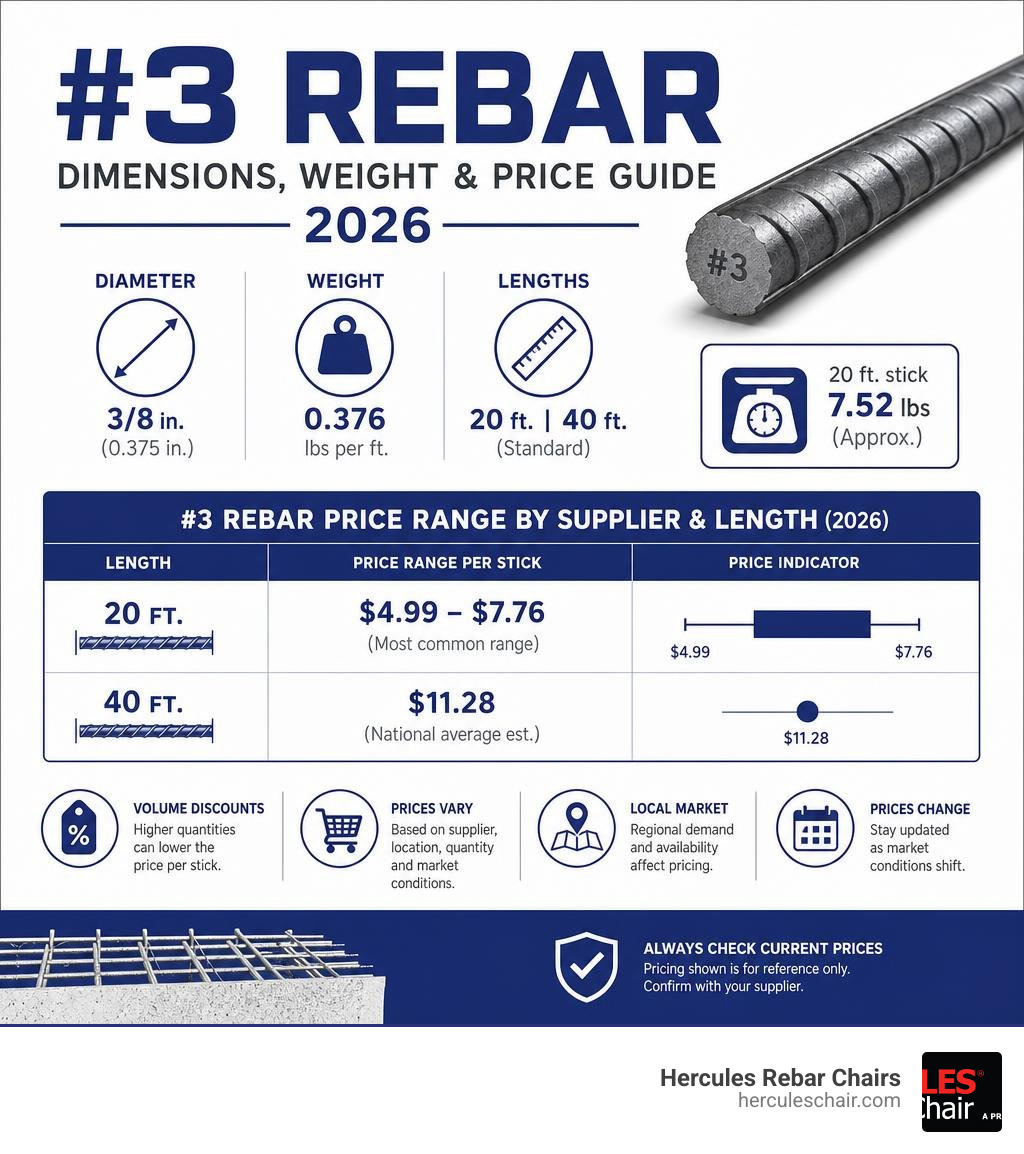
3 rebar price varies by supplier, length, and quantity — but here’s a fast snapshot of what you can expect to pay for a standard 20 ft. stick:
| Supplier | Length | Price per Stick |
|---|---|---|
| McCoy’s Building Supply | 20 ft. | $4.99 |
| National Average (est.) | 20 ft. | $5.64 |
| Online supplier (e.g., same-day delivery) | 20 ft. | $5.78 |
| Steel Supply LP (1–49 sticks) | 20 ft. | $7.38–$7.39 |
| The Home Depot | 20 ft. | $7.76 |
| National Average (est.) | 40 ft. | $11.28 |
Prices above are per stick. Volume discounts can drop the cost significantly — Steel Supply LP pricing falls to $5.42 per stick when ordering 200 or more pieces.
Planning a concrete project means getting your material costs right from the start. Whether you’re pouring a driveway, a patio, or a residential foundation, #3 rebar is one of the most commonly used sizes on the job — and its price can shift based on where you buy it, how much you need, and where you’re located in the country.
As a structural engineer and concrete industry professional, I’m Jordan Harris, and my hands-on experience with rebar on large-scale concrete and steel projects — combined with my work developing rebar support products at T.J. Harris Company — gives me a practical, real-world perspective on 3 rebar price that goes beyond the sticker. In this guide, I’ll walk you through exactly what drives the cost so you can buy smarter on your next pour.
Simple guide to 3 rebar price terms:
What is #3 Rebar? Specifications and Common Uses
Before pulling out your wallet, it helps to understand what you are actually buying. In the United States, rebar sizes are measured in eighths of an inch. Therefore, #3 rebar is exactly 3/8 of an inch (9.525 mm) in nominal diameter.
Key Physical Specifications
- Nominal Diameter: 0.375 inches (3/8 in.)
- Weight per Foot: 0.376 pounds per foot (0.561 kg/m)
- Weight of a 20 ft. Stick: 7.52 lbs (approx. 3.41 kg)
- Nominal Cross-Sectional Area: 0.11 square inches (71 square mm)
- Standard Grades: Grade 40 (40,000 PSI yield strength) and Grade 60 (60,000 PSI yield strength)
Because it is relatively thin and easy to bend by hand or with simple manual tools, #3 rebar is highly versatile. It features raised ridges (deformations) along its surface that help wet concrete grip the steel, forming a tight structural bond once cured.
Common Applications
We see #3 rebar utilized in a broad range of light-duty structural and flatwork projects:
- Residential Concrete Slabs: Patios, sidewalks, and residential driveways to prevent cracking.
- Swimming Pool Frames: The thin diameter allows installers to bend the steel into the complex, curved shapes required for pool shells.
- Garden and Agriculture: Used as heavy-duty stakes, vineyard trellising, or support structures.
- Masonry and Curbs: Reinforcing brick walls, decorative hardscapes, and concrete curbs or gutters.
To learn more about how this size fits into the broader hierarchy of steel reinforcement, check out The Essential Guide to Rebar Sizes and Grades.
Understanding the National 3 rebar price in 2026
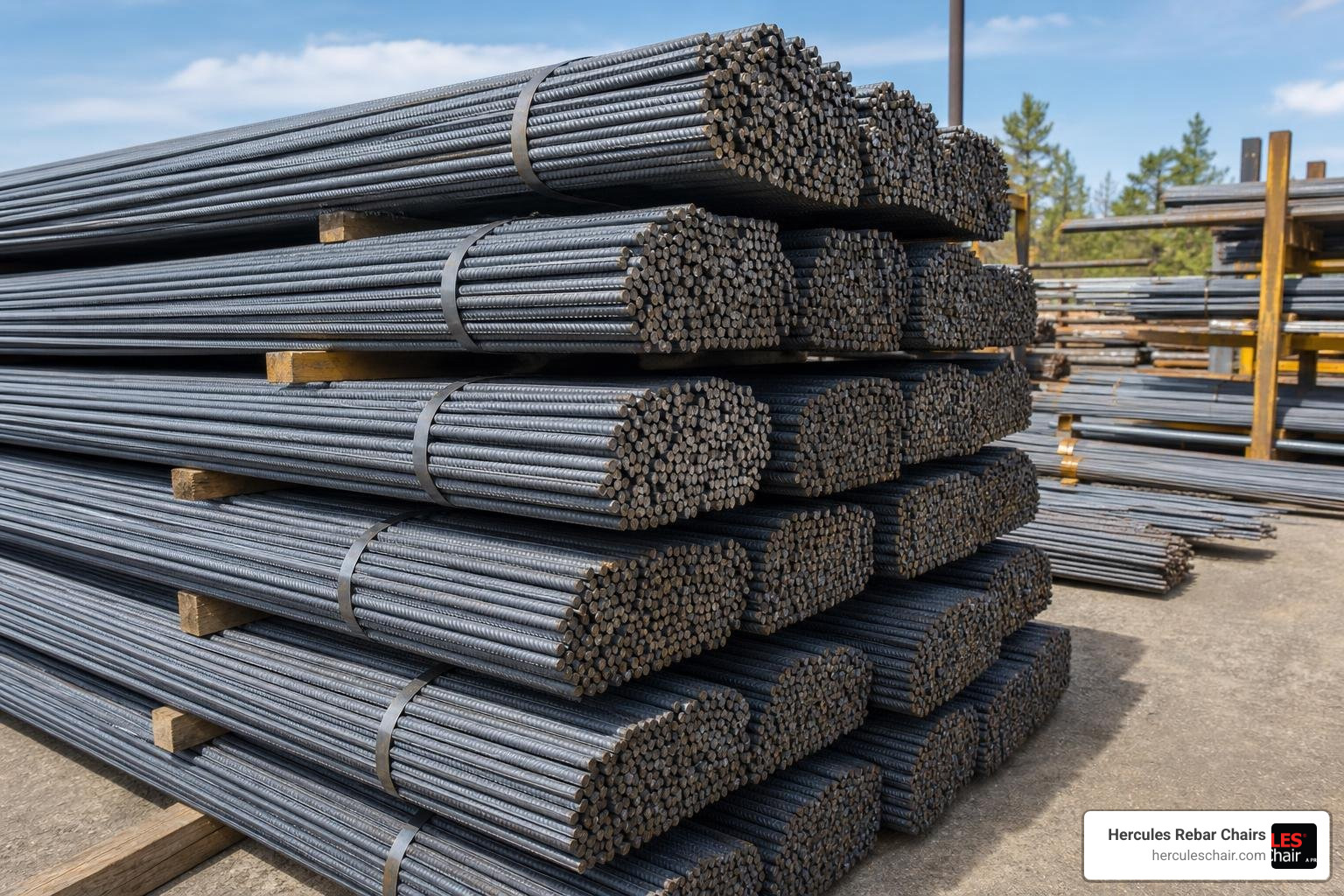
As of June 2026, the 3 rebar price in the United States sits at a national average of approximately $0.28 per linear foot when purchased in bulk, translating to about $5.64 for a standard 20-foot stick. However, unless you are buying by the bundle or truckload, the price you pay at the register will depend heavily on the length of the stick and the type of supplier you choose.
According to data from 2026 Rebar Prices Per Foot, Ton, & Project Size – HomeGuide, retail prices for single pieces can be higher, while commercial steel yards offer steep discounts for volume orders.
Average 3 rebar price by Length
Rebar is manufactured in several standard stock lengths. Choosing the right length for your project reduces waste and cuts down on the need for manual cutting or overlapping (lapping) on-site.
- 10-Foot Sticks: Often sold at retail stores for small DIY projects or quick repairs. These generally cost between $2.80 and $4.00 per stick, representing a higher price per foot due to retail markup.
- 20-Foot Sticks: The standard length for most residential and light commercial work. A single stick ranges from $4.99 to $7.76, depending on where you shop.
- 40-Foot Sticks: Typically purchased by commercial contractors from dedicated steel distributors. According to the Current Price of 40 foot size 3 Rebar, a 40 ft. Grade 60 stick averages around $11.28 as of early 2026.
Retail vs. Wholesale 3 rebar price
Where you buy your steel has a massive impact on your bottom line.
Big-Box Retailers
If you walk into a big-box store like Home Depot or Menards, you are paying for convenience. For example, a single piece of 3/8 in. x 20 ft. #3 Rebar 5911000 – The Home Depot is priced at $7.76. Home Depot also sells shorter, pre-cut lengths for small repairs, such as 3/8 in. x 1 ft. #3 Rebar and 3/8 in. x 3 ft. #3 Rebar, but these carry a massive premium per foot.
Specialty Steel and Construction Suppliers
For mid-to-large projects, sourcing from specialty suppliers like Steel Supply LP or McCoy’s Building Supply is far more economical. McCoy’s offers Grade 60 #3 rebar at an impressive cash-and-carry price of $4.99 per 20 ft. stick.
Furthermore, steel distributors utilize tiered volume pricing. At Steel Supply LP, a small order of 1 to 49 pieces of Grade 60 #3 rebar will cost you $7.38 per stick. However, if you purchase 200 or more pieces, that price drops to $5.42 per stick—saving you nearly $400 on a standard bundle.
Key Factors That Influence #3 Rebar Pricing
If you monitor steel markets, you will notice that the 3 rebar price fluctuates from month to month. Several major market forces drive these shifts:
- Steel Grade (Grade 40 vs. Grade 60): Grade 60 rebar has a higher yield strength (60,000 PSI) than Grade 40 (40,000 PSI). Interestingly, because Grade 60 is the modern industry standard, it is produced in much higher volumes. This means you will often find Grade 60 priced identically to—or even slightly cheaper than—Grade 40 due to economies of scale.
- Domestic vs. Imported Steel: Domestically manufactured steel (USA-made) typically carries a premium of 10% to 20% over imported steel. Many public works and municipal projects strictly require domestic steel to comply with “Buy American” regulations, driving up demand and price.
- Global Market Conditions: Raw material costs (recycled scrap metal and iron ore) directly impact production costs. Global supply chain shifts, such as export tariffs or mill closures in major steel-producing regions like South Vietnam, can trigger ripple effects in U.S. pricing. For instance, global trackers like Rebar Prices: South Vietnam(May 05, 2026 12:14) | Mysteel highlight how international mill rates set the baseline for import costs.
- Shipping and Logistics: Steel is incredibly heavy. Shipping 20-foot or 40-foot sticks requires specialized flatbed transport. Online suppliers like Steeldash list #3 rebar at €6.95 (approx. $7.50 USD) but require a flat-rate shipping fee of $249 for orders over $500, with standard delivery lead times of around three weeks.
Regional Variations and Delivery Options
Because shipping heavy steel is expensive, your geographical location plays a massive role in the final price. If you live close to a major steel mill or a port city, your local prices will generally be lower than in landlocked or rural states.
When buying #3 rebar, you typically have three delivery or pickup options:
- In-Store / Yard Pickup: The most cost-effective option for small-to-medium loads. If you have a heavy-duty truck or utility trailer, picking up your rebar directly from a local yard like McCoy’s or a regional supplier eliminates shipping fees entirely.
- Same-Day / Local Delivery: Many local construction suppliers offer flat-rate delivery within a specific radius. Specialty online portals like Rebar #3 3/8 in. x 20 ft Same-Day Delivery list 20-foot sticks at $5.78 and offer rapid local job site drop-offs, which is incredibly convenient for active contracting crews.
- Custom Fabrication and Bending: If your project requires complex bends (such as stirrups, corner hooks, or custom pool shapes), you can order pre-fabricated steel. Regional fabricators, such as those detailed by Rebar Fabrication – Steel Sales & Service- Westport, MA – Bozrah, CT, use industrial bending machines to shape the steel before it arrives at your site, saving valuable labor hours.
Frequently Asked Questions about #3 Rebar
How much does a 20-foot stick of #3 rebar weigh?
A standard 20-foot stick of #3 (3/8 in.) rebar weighs exactly 7.52 lbs (calculated at 0.376 lbs per linear foot). This light weight makes it exceptionally easy to handle, load, and place by hand without needing heavy machinery on the job site. A standard contractor bundle typically contains 264 pieces, weighing just under one short ton (approx. 1,985 lbs).
Can #3 rebar be welded for DIY projects?
It depends on the steel specification. Standard carbon steel rebar (ASTM A615) is not designed for structural welding, as the heat can weaken the steel and make it brittle. However, if you purchase low-alloy steel rebar (ASTM A706), it is specifically formulated to be weldable. For non-structural, creative DIY projects—such as welding a garden trellis or a fire pit grate using a short piece like the 3/8 in. x 3 ft. #3 Rebar—welding is common, though it should still be avoided for load-bearing structural joints.
How does #3 rebar compare to larger sizes like 3/4 rebar?
To compare the massive difference in weight, structural capacity, and pricing between these two sizes, refer to our detailed guides on 3/4 Rebar for Sale and Getting to Grips with 3/4 Rebar 10 Ft for Your Next Pour.
Conclusion
Getting the best 3 rebar price comes down to careful planning. By calculating your exact linear footage, factoring in standard lapping requirements, and purchasing in bulk from wholesale suppliers rather than buying single retail pieces, you can keep your material costs to a minimum.
But buying the steel is only half the battle. To ensure your concrete slab stands the test of time, the rebar must be suspended precisely in the middle of the pour—not resting on the ground. That is where we come in.
At Hercules Rebar Chairs (T.J. Harris Co.), we manufacture America’s #1 rebar support chairs. With over 14 million units sold across the USA, our iconic red concrete supports are engineered to save you time and money on-site while ensuring strict code compliance. Don’t let your steel sink to the bottom of the slab. Head over to our store to Buy Hercules Rebar Chairs and set your next project up for structural success!