

What a 6-Inch Concrete Slab Can Actually Hold (And Why It Matters)
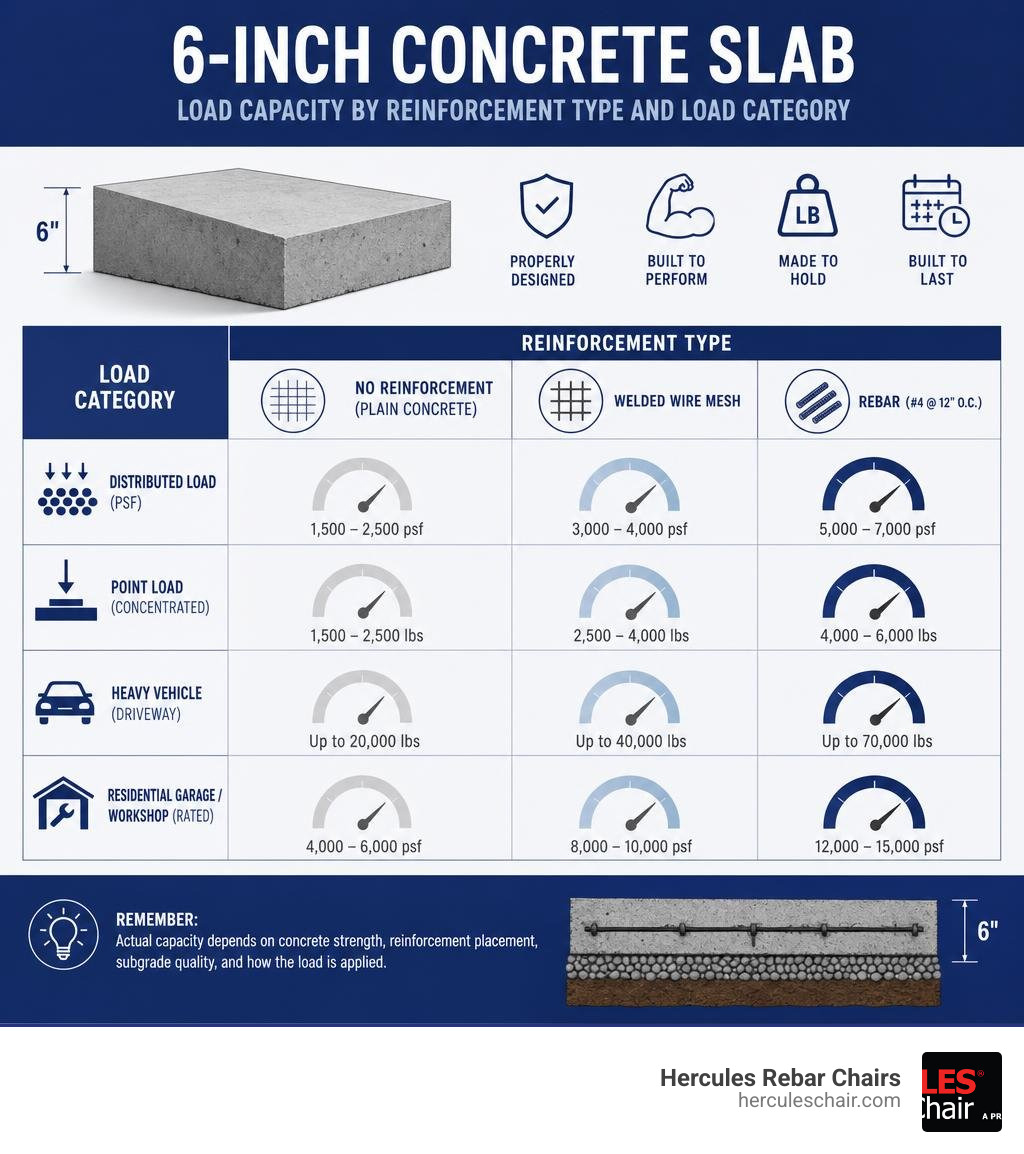
How much weight can a 6 inch concrete slab hold? Here’s the short answer:
| Condition | Approximate Capacity |
|---|---|
| Distributed load (properly reinforced, 3,000-4,000 PSI) | 5,000 – 7,000 psf |
| Point load (concentrated, e.g. equipment leg) | 4,000 – 6,000 lbs |
| Heavy vehicle (driveway, rebar-reinforced) | Up to 70,000 lbs |
| Residential garage / workshop (typical use) | 12,000 – 15,000 psf rated capacity |
Note: These are general ranges. Your actual slab capacity depends on concrete strength, reinforcement, subgrade quality, and how the load is applied.
These numbers tell part of the story — but only part. A 6-inch slab poured on loose soil with no rebar will perform very differently from one built to spec on a compacted gravel base. Thickness is just one variable in a system that includes concrete mix strength, reinforcement placement, subgrade preparation, and the type of load being applied. Getting any one of those wrong can mean cracked floors, failed equipment pads, or worse.
This guide breaks all of it down in plain language, so you know exactly what your slab can handle and how to build it right the first time.
I’m Jordan Harris, a licensed Professional Engineer in Tennessee with a master’s degree in structural engineering and five years of hands-on experience designing large-scale concrete projects. At T.J. Harris Company, I work daily on rebar support solutions that directly affect how much weight a 6 inch concrete slab can hold — and I’ve seen what separates slabs that last from ones that fail early.
How Much Weight Can a 6 Inch Concrete Slab Hold?
To determine exactly how much weight a 6 inch concrete slab can hold, we have to look at the slab as a complete, engineered system. When properly designed and reinforced, a 6-inch concrete slab can support a substantial load for many residential and light commercial uses, including garage floors, workshops, and barndominium applications.
However, there is no one-size-fits-all weight number that applies to every single pour. To estimate the structural limits of your specific layout, you can model different variables using a Concrete Slab Load Calculator (2026) – Dead & Live Loads.
Before we look at the external weight you can stack on top, we have to consider the slab’s own self-weight. According to Understanding The Weight Of Concrete Slabs: A Comprehensive Guide, standard concrete weighs approximately 150 pounds per cubic foot (pcf).
For a 6-inch thick slab, this translates to a dead load of exactly 75 lbs per sq ft (psf) that the subgrade must support before you even park a vehicle or set up a tool rack.
Calculating How Much Weight Can a 6 Inch Concrete Slab Hold in PSF
When engineers talk about uniform load capacity, we measure it in pounds per square foot (psf). This is a “distributed load,” meaning the weight is spread evenly across the surface.
Under ideal conditions — with a standard 3,000 to 4,000 PSI concrete mix, proper steel reinforcement, and a highly compacted gravel base — a 6-inch slab can support approximately 12,000 to 15,000 pounds per square foot of distributed load.
To run these calculations for your own project specs, you can use the Concrete Load Calculator – Free 2026 USA to analyze compressive strength limits.
It is vital to note that structural engineers never design a slab to operate at its absolute breaking point. We apply strict safety factors mandated by the American Concrete Institute (ACI 318 code standards). These safety factors typically reduce the allowable design load to a fraction of the theoretical ultimate capacity. For residential applications, a safety factor of 1.5 to 2.0 is common, while commercial and industrial designs often utilize a factor of 2.5 to 3.0 to account for unexpected stress, vibrations, and heavy machinery.
Real-World Limits: How Much Weight Can a 6 Inch Concrete Slab Hold for Vehicles?
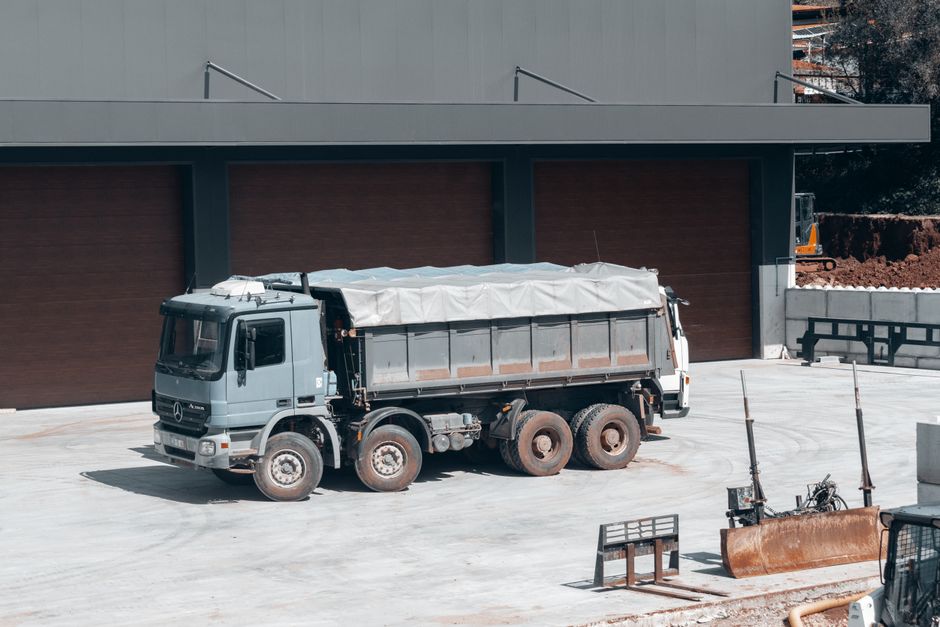
How does this math translate to your driveway or garage? A 6-inch thick concrete driveway can withstand heavy-duty trucks weighing around 70,000 pounds. This makes 6 inches the golden standard for heavy-duty residential applications, such as dedicated RV pads, multi-axle boat trailers, and commercial delivery routes.
However, vehicle weight is not a simple static distributed load. Slabs must handle two complex forces:
- Dynamic Loads: A moving vehicle exerts significantly more stress than a parked one. When a heavy-duty truck bounces over a threshold or brakes suddenly, the dynamic forces can spike the localized stress on the concrete by 50% or more.
- Tire Contact Patches: A 70,000-pound truck does not distribute its weight across the entire driveway. That massive weight is concentrated entirely on the small rubber contact patches where the tires touch the ground. A typical passenger car tire creates a static load of 20 to 30 psi on the concrete, but a heavy commercial vehicle can easily exceed 80 to 120 psi of localized pressure.
Because of these demanding forces, upgrading from a standard 4-inch slab to a reinforced 6-inch slab is highly recommended for vehicle-rated areas. According to the 6-Inch Concrete Slab Cost 2026: $5 to $9 Per Sq Ft (Driveway, Garage), investing in a 6-inch pour provides four to five times the bending capacity of a 4-inch wire-mesh slab, making it a highly practical starting point for a normal garage, shop house, or barndominium use case.
Structural Variables: What Determines a Slab’s True Capacity?

Thickness is only one piece of the puzzle. If you pour 6 inches of concrete over muddy topsoil with no steel inside, it will crack under the weight of a standard pickup truck. To maximize the structural integrity of your slab, you must optimize four critical structural variables: concrete strength, steel reinforcement, subgrade preparation, and load distribution.
Using high-quality materials is crucial, but where those materials sit inside the slab matters just as much. For example, steel reinforcement must be held precisely in the middle-to-upper third of the slab to resist tension forces.
This is why we always emphasize that Why Your Slab Needs Rebar Chair Supports is a non-negotiable step in the prep process. Elevating your steel ensures it performs exactly as engineered. For a deep dive into how to execute this layout, check out our guide on Slab Strong: Mastering Rebar Placement for Durable Concrete.
Concrete Compressive Strength (PSI)
Concrete is incredibly strong under compression (pushing forces) but naturally weak under tension (pulling or bending forces). The compressive strength of a mix is measured in Pounds per Square Inch (PSI) after a standard 28-day curing window.
The strength of your concrete is primarily determined by its water-to-cement ratio. Adding too much water on the job site makes the wet concrete easier to pour, but it leaves microscopic voids behind as it evaporates, drastically reducing the final cured strength.
- 3,000 PSI: Suitable for standard residential footpaths and light-duty patios.
- 4,000 PSI: The optimal sweet spot for residential garages, workshop floors, and driveways. It offers excellent resistance to freeze-thaw cycles and heavy vehicle loads.
- 5,000+ PSI: Reserved for heavy-duty industrial warehouses, commercial loading docks, and high-stress structural columns.
To make sure your mix reaches its full structural potential, you must follow proper placement and curing protocols. You can learn the step-by-step process in our guide Slab-Tastic: How to Build a Concrete Slab Like a Pro.
Reinforcement: Rebar vs. Wire Mesh
Because concrete has low tensile strength, it relies on steel reinforcement to handle bending and pulling forces. When a heavy load presses down on a slab, the bottom of the concrete stretches. Without steel to absorb this tension, the slab will snap.
- Welded Wire Mesh: Ideal for controlling hairline temperature cracks. However, wire mesh offers minimal structural load-bearing assistance and is easily pushed to the bottom of the slab during the pour if not supported correctly.
- Grade 60 Rebar: The industry standard for structural reinforcement. For a 6-inch slab carrying vehicle or equipment loads, we recommend using #3 (3/8-inch) or #4 (1/2-inch) rebar laid out in a continuous grid pattern spaced 16 to 18 inches on-center.
To calculate exactly how much steel your project requires, refer to our detailed walkthrough on How to Calculate Rebar for Slab the Right Way. If you are working with wire mesh instead of traditional rebar, you can still achieve excellent elevation control by using specialized Elevate Your Slab with Concrete Mesh Chairs to keep the mesh from sinking to the dirt.
Subgrade and Base Preparation
A concrete slab is only as strong as the ground beneath it. In fact, nearly 70% of premature slab failures are caused by poor subgrade preparation rather than a failure of the concrete itself.
Before pouring, all organic topsoil, roots, and loose debris must be excavated. The native soil must be thoroughly compacted, followed by the installation of a well-draining gravel base (typically 4 to 6 inches of crushed stone or gravel). This gravel base must be compacted in lifts to at least 95% standard Proctor density.
A properly prepared base provides uniform support, prevents localized settling, and allows water to drain away from the slab, reducing the risk of frost heaving in cold climates. To weigh the pros and cons of this foundation style, read our analysis on The Pros and Cons of Slab on Grade Foundations.
Distributed vs. Concentrated Loads
It is vital to understand the difference between a distributed load and a concentrated (or point) load.
- Distributed Loads: Weight spread over a large area (like a stack of plywood or a flat-bottomed water tank). The concrete easily transfers this weight directly to the subgrade.
- Concentrated (Point) Loads: Massive weight concentrated on a tiny footprint (like the steel legs of a heavy-duty two-post car lift, heavy machinery feet, or structural patio columns).
Point loads create intense bending stress directly under the load point. If a point load is too high, it can cause “punching shear failure,” where the heavy object literally punches a hole straight through the concrete.
To evaluate if your slab can safely handle a specific point load, you can run a simulation using the Calculate Your Project’s Safety with Our Free Concrete Slab Load Capacity Calculator – Grounded In Concrete.
To prevent punching failures under heavy point loads, we must ensure the rebar grid is held perfectly in place during the pour. Using heavy-duty spacers is the only way to guarantee this alignment. We explain why in our article Elevate Your Concrete: Why Bar Chairs Are Essential for Strong Slabs.
Comparing 4-Inch, 5-Inch, and 6-Inch Slabs
Choosing the correct slab thickness is a balancing act between budget and structural requirements. While a 4-inch slab is the default for standard home projects, a 6-inch slab offers vastly superior load-bearing capabilities.
| Slab Thickness | Typical Compressive Strength | Recommended Applications | Est. Distributed Load Capacity (PSF) |
|---|---|---|---|
| 4-Inch | 3,000 PSI | Patios, sidewalks, residential driveways (cars only) | 3,000 – 3,500 |
| 5-Inch | 3,500 PSI | Standard garages, light workshops, pickup truck parking | 4,000 – 5,000 |
| 6-Inch | 4,000 PSI | Heavy workshops, RV pads, barndominiums, commercial garages | 5,000 – 7,000 |
As the table shows, adding just two inches of thickness more than doubles the safe distributed load capacity of the slab. This exponential strength increase occurs because bending stiffness increases with the cube of the thickness.
For projects where budget is tight, you might wonder if a thinner slab can get the job done. We cover those scenarios in our guide Why Your 4 Inch Slab Might Not Need Rebar and When It Does. To understand the full spectrum of thickness standards across the industry, read The Skinny on Concrete Slab Thickness Guidelines for Success.
When is a 6-Inch Slab the Recommended Minimum?
A 6-inch slab is commonly discussed for garages, workshops, and shop houses because these spaces often deal with heavier loads than normal living areas. According to How much weight can a 6 inch thick concrete slab support? – BuildMax, 6 inches should be considered your absolute minimum starting point for:
- Barndominiums & Shop Houses: Where living quarters share a foundation with heavy utility storage or active workshop bays.
- Dedicated RV & Boat Parking: Where multi-ton vehicles sit parked for months at a time, exerting continuous static pressure on the concrete.
- Commercial Garages & Automotive Shops: Where heavy machinery, tool chests, and vehicle lifts are constantly in use.
Frequently Asked Questions About Concrete Slab Capacity
When planning a heavy-use slab, several common questions pop up regarding point loads and long-term durability. To run quick conversions or estimate concrete volume for these projects, you can use a Concrete Slab Load Capacity Calculator.
Can a 6-inch concrete slab support a vehicle lift?
Yes, a properly designed and reinforced 6-inch concrete slab can handle a significant amount of weight, including standard two-post or four-post automotive lifts (typically rated for 9,000 to 12,000 lbs).
However, you must pay close attention to the manufacturer’s installation specifications. Most lift manufacturers require a minimum concrete strength of 3,000 PSI (4,000 PSI is highly preferred) and a minimum slab thickness of 4.5 to 6 inches.
Furthermore, the expansion anchor bolts used to secure the lift legs require deep embedment to resist the intense pull-out forces when a vehicle is raised. If you plan to install a commercial-grade lift, always consult with a structural engineer to verify if local reinforcement (thickened footings under the lift posts) is required.
How long does a 6-inch concrete slab take to cure to full strength?
Concrete does not dry; it cures through a chemical hydration process. A standard 6-inch concrete slab takes exactly 28 days to reach its fully rated compressive strength (e.g., 4,000 PSI).
- Day 1 to 3: The concrete is highly vulnerable. Keep all traffic off the slab.
- Day 7: The slab has reached approximately 70% of its design strength. Light foot traffic and passenger cars can typically use the slab at this point.
- Day 28: The concrete has reached its full design strength. Heavy equipment, RVs, and point loads can now be safely introduced.
During the first 7 days, keeping the concrete damp (moist curing) is vital to ensure the hydration process continues smoothly, preventing surface cracking and maximizing final strength.
What happens if a 6-inch slab is poured without reinforcement?
If a 6-inch slab is poured without any steel reinforcement, it will still have high compressive strength but virtually zero tensile strength. As the concrete cures, it naturally shrinks and develops internal tension. Without steel to hold the concrete together, the slab will develop wide, structural cracks.
Over time, heavy vehicle traffic or minor subgrade settling will cause these unreinforced sections to shift, tilt, and eventually break apart, destroying the structural integrity of the floor.
Conclusion
Determining how much weight a 6 inch concrete slab can hold requires looking at the entire build as a unified system. While a well-built 6-inch slab can easily support up to 15,000 psf of distributed load or withstand a 70,000-pound truck, its true capacity relies on proper concrete mix design, thorough subgrade compaction, and precise steel reinforcement placement.
If you want your slab to stand the test of time, do not leave your reinforcement to chance. At Hercules Rebar Chairs (T.J. Harris Co.), we manufacture the strongest concrete supports in the industry. As “America’s #1” with over 14 million units sold, our iconic red rebar chairs are engineered to save you time and money while ensuring absolute building code compliance on every single pour.
Ready to build a slab that will last for decades? Check out our Rebar Slab Support Complete Guide to get the exact layout specs you need for your next project!