

Understanding the One Way Slab: Definition and Key Differences
To truly master the one way slab, we have to look at how it behaves under pressure. Imagine a piece of plywood resting on two parallel sawhorses. When you step on it, the wood bows in a single curve, like a half-pipe. This is exactly how a one way slab works. Because the distance between the two supports (the short span) is so much smaller than the length of the supports themselves, the concrete “prefers” to send the weight to those two closest beams.
In technical terms, we identify this by the span ratio. We take the longer span (Ly) and divide it by the shorter span (Lx). If the result is 2 or higher, we officially have a one way slab. Even if the slab is technically supported on all four sides by beams, a high ratio means the “two-way action” is negligible, and we design it as if only the two long parallel beams are doing the heavy lifting.
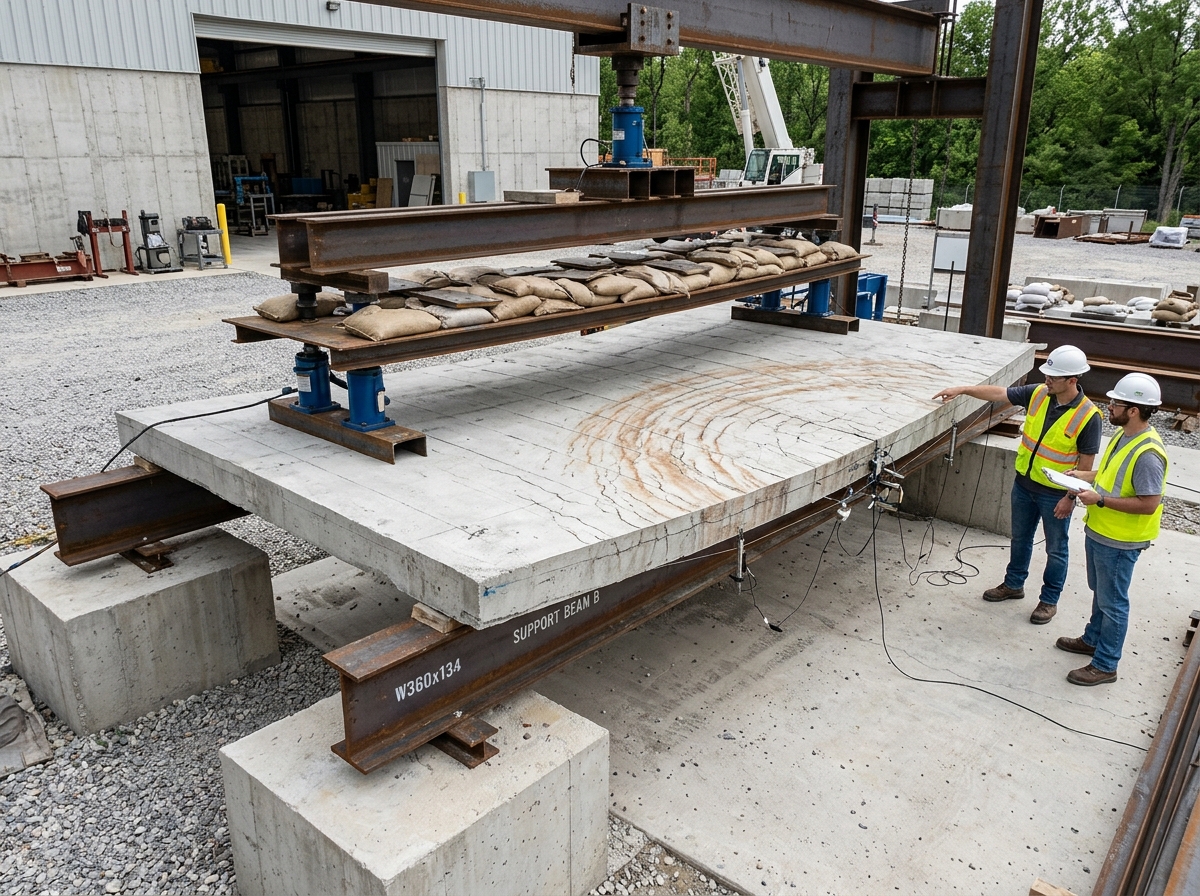
The way these slabs deflect is a dead giveaway. A one way slab exhibits “cylindrical deflection,” meaning it bends in one direction. A two-way slab, on the other hand, bends like a shallow bowl (spherical deflection). This difference is why we place the heavy-duty reinforcement in the short direction for a one way slab.
| Feature | One Way Slab | Two Way Slab |
|---|---|---|
| Support Mechanism | Supported on 2 opposite sides (or ratio ≥ 2) | Supported on all 4 sides |
| Load Transfer | Transfers load to 2 parallel beams | Transfers load to all 4 beams/columns |
| Bending Direction | Bends in one direction (perpendicular to supports) | Bends in two perpendicular directions |
| Main Reinforcement | Provided in the shorter span only | Provided in both directions |
| Thickness | Generally thinner for the same load | Generally thicker to handle two-way shear |
For a deeper dive into these structural mechanics, you can check out this One Way Slab Overview and Design Aspects – Structural Guide.
ACI 318-14 Standards for Thickness and Materials
In the United States, we live and breathe the ACI 318 code. When we start a project in states like Texas, Florida, or California, the first thing we look at is Table 7.3.1.1 for minimum thickness. Why? Because if your slab is too thin, it will sag (deflect) or vibrate. As the research suggests, building occupants hate vibrations—it makes them feel like the building isn’t safe, even if it’s technically strong enough.
According to ACI 318-14, the minimum thickness ($h$) depends on your support conditions for a span ($l$):
- Simply Supported: $l/20$
- One End Continuous: $l/24$ (Common for end bays)
- Both Ends Continuous: $l/28$ (Common for interior bays)
- Cantilever: $l/10$
For example, if we have a 24-foot span in an end bay, our minimum thickness would be $24 \times 12 / 24 = 12$ inches. However, many residential and light commercial slabs use spans of 6 to 20 feet, resulting in slab depths typically between 4 and 10 inches.
Regarding materials, we usually aim for a concrete compressive strength ($f’c$) of at least 4,000 psi (M25 or higher) for structural slabs. For the “bones” of the slab, we use Grade 60 rebar (yield strength of 60,000 psi). If you’re wondering whether your specific project needs that extra beefiness, read our guide on Why Your 4-inch Slab Might Not Need Rebar (and When It Does).
Once you’ve picked your slab thickness, you need to ensure your rebar stays exactly where the engineers intended. That’s where we come in. To keep that steel from sinking to the bottom of the pour, you need the right support height. You can learn How to Determine Bar Chair Sizes in 3 Easy Steps to make sure your “red chairs” are the perfect fit.
Step-by-Step Design Procedure for a One Way Slab
Designing a one way slab is actually very similar to designing a rectangular beam that just happens to be very wide (usually analyzed as a 12-inch or 1-meter wide strip).

The general procedure follows these steps:
- Determine the thickness based on ACI minimums to avoid deflection checks.
- Calculate the design loads (Dead, Live, and Superimposed).
- Compute moments and shears using ACI simplified coefficients (if the spans are relatively equal and loads are uniform).
- Design the flexural reinforcement (the main steel).
- Check for shear capacity (though concrete usually handles shear in one-way slabs without extra stirrups).
- Add temperature and shrinkage steel in the long direction.
For a comprehensive walkthrough of these formulas, One Way Slab and Two-Way Slab | Design Procedure | Example is an excellent resource.
Calculating Loads for a One Way Slab
We have to account for every pound.
- Dead Load (D): The self-weight of the concrete. If we have a 7-inch slab, it weighs about 87.5 lbs per square foot (assuming concrete is 150 lbs per cubic foot).
- Superimposed Dead Load (SDL): Permanent items like floor tiles, pipes, and ceiling fixtures.
- Live Load (L): Transient weights like people, furniture, or vehicles.
- Factored Load ($Wu$): We use the ACI load combination $1.2D + 1.6L$ to ensure a safety buffer.
Flexural and Shear Design for a One Way Slab
Once we have our factored moment ($Mu$), we calculate the required area of steel ($As$). We always want a “tension-controlled” section, meaning the steel will yield before the concrete crushes—giving people plenty of warning (in the form of visible cracks) if the slab is overloaded.
For shear, we verify that $\phi Vc \geq Vu$. In most one way slab designs, the concrete itself is strong enough to resist shear without needing those “zigzag” stirrups you see in beams. If $\phi Vc$ is more than double $Vu$, you’re usually in the clear.
Reinforcement Detailing and Spacing Limits
This is where the rubber meets the road—or rather, the rebar meets the concrete. Detailing is the “art” of placing the steel so it actually works. We’ve seen many slabs fail not because the math was wrong, but because the rebar shifted during the pour. To prevent this, check out our tips on Slab Strong: Mastering Rebar Placement for Durable Concrete.
Main Reinforcement in a One Way Slab
The main tension bars always run parallel to the short span. These bars take the brunt of the bending force.
- Bar Diameter: Usually #3, #4, or #5 bars. A good rule of thumb is that the bar diameter shouldn’t exceed 1/8 of the slab thickness.
- Spacing: ACI says the maximum spacing for main bars is the lesser of $3h$ (three times the slab thickness) or 18 inches.
To keep these bars at the correct “effective depth,” you’ll need reliable supports. Our Ultimate Guide to Rebar Chairs explains how to choose the right height to maintain your concrete cover.
Secondary Steel in a One Way Slab
Even though the load doesn’t “travel” in the long direction, we still need steel there. This is called shrinkage and temperature reinforcement. As concrete cures, it shrinks; as it sits in the sun, it expands. Without secondary steel, the slab would look like a roadmap of cracks.
- Minimum Ratio: For Grade 60 steel, we use a minimum area of $0.0018 \times \text{gross area}$.
- Spacing: The spacing for this secondary steel is more relaxed—the lesser of $5h$ or 18 inches.
Practical Applications, Software, and Economics
The one way slab is the workhorse of the construction world. You’ll find them in:
- Verandahs and Cantilevers: Where the slab is supported on only one side.
- Corridors: Where the width is much smaller than the length.
- Warehouses: Especially those with a “ribbed” or “joist” slab configuration.
While we love doing hand calculations to stay sharp, most modern engineering firms use software like spBeam to handle continuous spans. Software is great because it can perform “moment redistribution,” which can reduce the amount of negative reinforcement needed at the supports by up to 20%, saving the client money on steel.
Economic Tip: Sometimes, it’s actually cheaper to make a slab an inch thicker and use less rebar. Steel is expensive and labor-intensive to tie; concrete is relatively cheap. However, a thicker slab adds more weight to your columns and foundations, so it’s a balancing act.
Whatever the design, using Hercules Rebar Chairs ensures that your reinforcement stays in the “sweet spot” of the slab. We’ve sold over 14 million units across the USA—from the heat of Arizona to the humidity of Georgia—because contractors know that our red chairs save time and guarantee code compliance. Using proper supports is one of the easiest ways to Elevate Your Concrete.
Frequently Asked Questions about Slabs
What is the minimum thickness of a one way slab?
For a simply supported one way slab, the minimum thickness is usually $L/20$. For a 10-foot span, that’s 6 inches. This can vary based on the ACI support conditions (continuous vs. cantilever).
How do you determine if a slab is one-way or two-way?
Calculate the ratio of the long span to the short span ($Ly/Lx$). If it’s $\geq 2$, it’s a one way slab. If it’s $< 2$, it’s a two-way slab.
Which direction does the main reinforcement run in a one way slab?
It always runs in the short direction, perpendicular to the supporting beams or walls. This is the direction where the bending moment is the highest.
Conclusion
Mastering the one way slab isn’t just about passing an engineering exam; it’s about building structures that last for 50 years or more without cracking or vibrating. By following ACI 318-14 standards for thickness, calculating your loads accurately, and detailing your reinforcement with care, you ensure a high-quality build.
At Hercules Rebar Chairs, we take pride in supporting the American construction industry. Whether you are working on a small residential verandah in Arkansas or a massive industrial warehouse in Ohio, our goal is to help you save time and money while staying code-compliant. Our “America’s #1” red chairs are designed to be the strongest in the business, ensuring your rebar stays exactly where it belongs during the most critical part of the job: the pour.
Ready to get started on your next project? Check out our Mastering Rebar Placement Guide to ensure your slab is built to last.