

Why the Right Steel Rebar Chair Makes or Breaks Your Concrete Pour
A steel rebar chair is a small support device placed under reinforcing bar (rebar) to hold it at the correct height inside a concrete pour. Here’s a quick overview of what you need to know:
| Question | Quick Answer |
|---|---|
| What does it do? | Holds rebar at the correct height so concrete fully surrounds it |
| Why does it matter? | Prevents rebar from sinking, which causes cracking and rust |
| Common heights | 1.5″ to 15″, matched to your slab thickness |
| Spacing | Every 2–3 feet along the rebar, or at every crossing |
| Best for | Slabs, footings, tilt walls, elevated decks, precast panels |
| Leave in concrete? | Yes — they stay permanently embedded |
If rebar sinks to the bottom of a pour, moisture reaches it fast. Within a few years, rust expands the steel and cracks the concrete from the inside out. The right chair prevents that entirely.
Concrete contractors have dealt with this problem for decades using wire ties and makeshift supports — methods that are slow, inconsistent, and easy to get wrong. Modern rebar chair systems solve this with a simple snap-in design that holds rebar firmly in place, even when workers walk across the mat during the pour.
I’m Jordan Harris, a licensed Professional Engineer and structural engineer who spent five years designing large-scale concrete structures before joining the family business focused on steel rebar chair solutions. My hands-on background in both engineering and manufacturing means I can help you cut through the noise and find the right support system for your specific project.
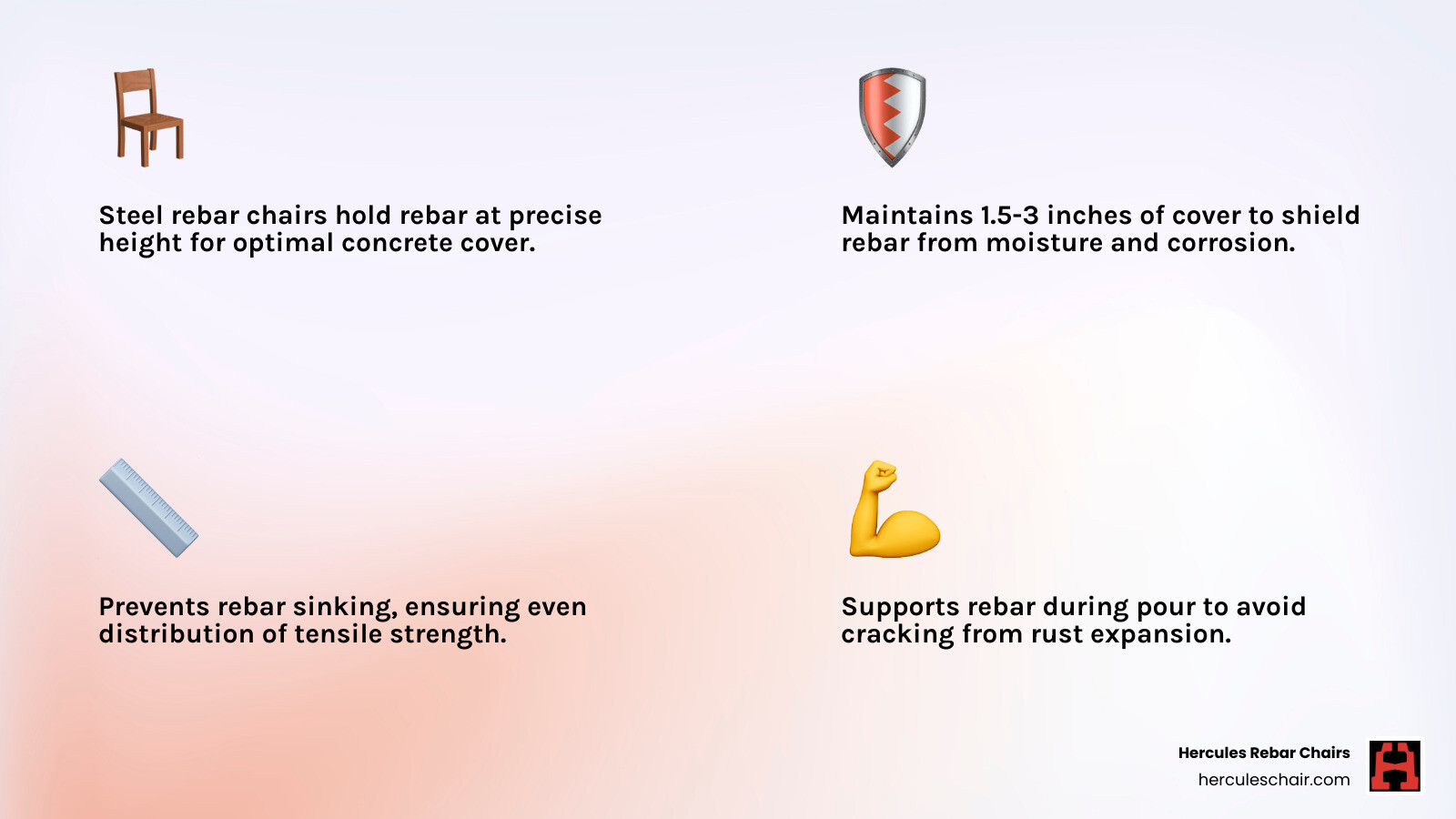
Understanding the Steel Rebar Chair and Its Primary Purpose
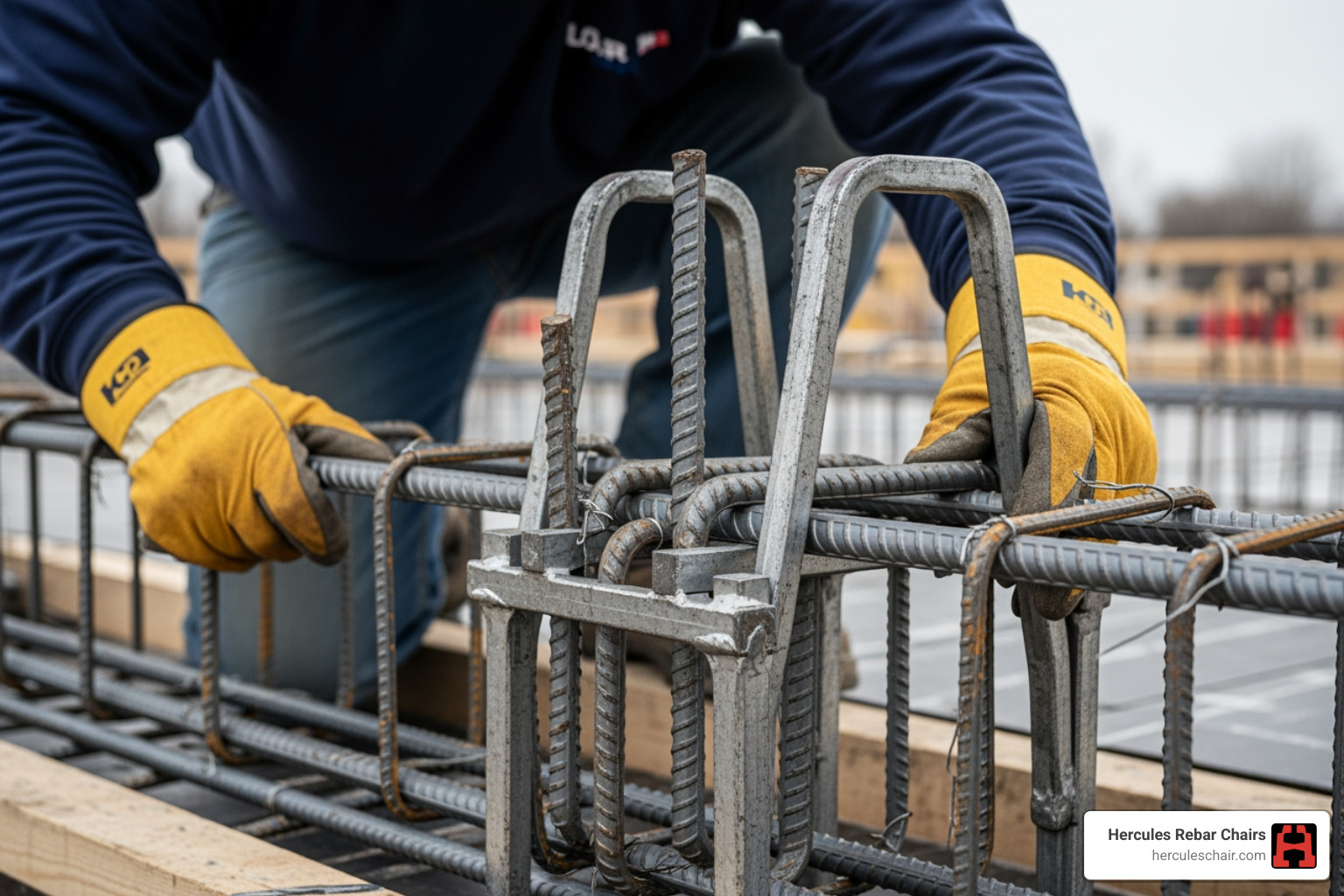
At its core, a steel rebar chair is the “strong silent type” of construction hardware. Its primary job is to ensure that reinforcing steel stays exactly where the structural engineer intended. Concrete is world-class at handling compression (squeezing forces), but it is notoriously weak in tension (stretching forces). Rebar provides that missing tensile strength, but only if it is positioned correctly.
If your rebar is sitting on the ground or has sunk to the bottom of the slab, it isn’t doing its job. This is where “concrete cover” comes in. Concrete cover is the minimum thickness of concrete between the rebar and the outer surface. Without this protective layer, moisture and oxygen reach the steel, leading to oxidation. Since rust occupies more volume than steel, it creates internal pressure that causes “spalling”—where the concrete literally explodes off the face of the structure.
Traditional steel rebar chair designs, often made of bright basic wire, have been the industry standard for years. However, as we move into May 2026, the industry is shifting toward more sophisticated systems. We are seeing a move away from simple wire stands toward high-performance supports that offer better load resistance. For a deeper dive into these variations, you can explore The Ultimate Guide to Rebar Chairs: Types, Uses, and Sizing for Concrete Slabs.
These modern supports are designed to maintain precise reinforcement depth even under the weight of a full crew. We’ve seen scenarios where five men can stand directly on a rebar mat supported by high-quality chairs without the steel moving an inch. That level of stability is the difference between a slab that lasts 50 years and one that cracks in five.
Choosing the Best Support System for Steel Reinforcement
When selecting a steel rebar chair, you aren’t just buying a piece of metal or plastic; you’re buying insurance for your concrete. The choice often comes down to the environment and the weight of the steel.
| Feature | Traditional Metal Chairs | Modern High-Performance Supports |
|---|---|---|
| Rust Risk | High (if not coated) | Zero to Low |
| Installation | Slow (requires wire tying) | Fast (snap-lock design) |
| Stability | Can tip or sink in soft soil | Wide-base prevents sinking |
| Load Capacity | Varies by gauge | Engineered for heavy foot traffic |
Traditional metal chairs come in several finishes: bright basic (plain steel), epoxy-coated, galvanized, or plastic-tipped. While these have served the industry well, they have limitations. Plain steel can leave rust “bleed” marks on the surface of finished concrete. Galvanized and epoxy-coated options offer better protection but can be expensive and may still suffer from coating nicks during installation.
This is why many pros are turning to the “strong silent type” of supports. You can read more about this transition in our guide on Choosing the Best Steel Rebar Chairs for Your Project. The goal is to meet CRSI (Concrete Reinforcing Steel Institute) specifications while keeping labor costs down.
Advantages of Non-Corrosive Reinforcement Supports
One of the biggest headaches in coastal or high-moisture environments is corrosion. Even a “plastic-tipped” steel rebar chair can fail if the metal body of the chair provides a path for moisture to travel. This is why we advocate for heavy-duty polypropylene supports.
These supports are naturally moisture-resistant and provide a superior bond with the concrete. Because they are made of the same non-corrosive material throughout, there is no “coating” to chip or scratch. Plus, they eliminate the need for expensive epoxy-coated rebar in many applications. For more on how these supports interact with your slab, check out Slab Bolster Chairs and Why Your Rebar Deserves a Seat.
Sizing and Height Specifications for Concrete Slabs
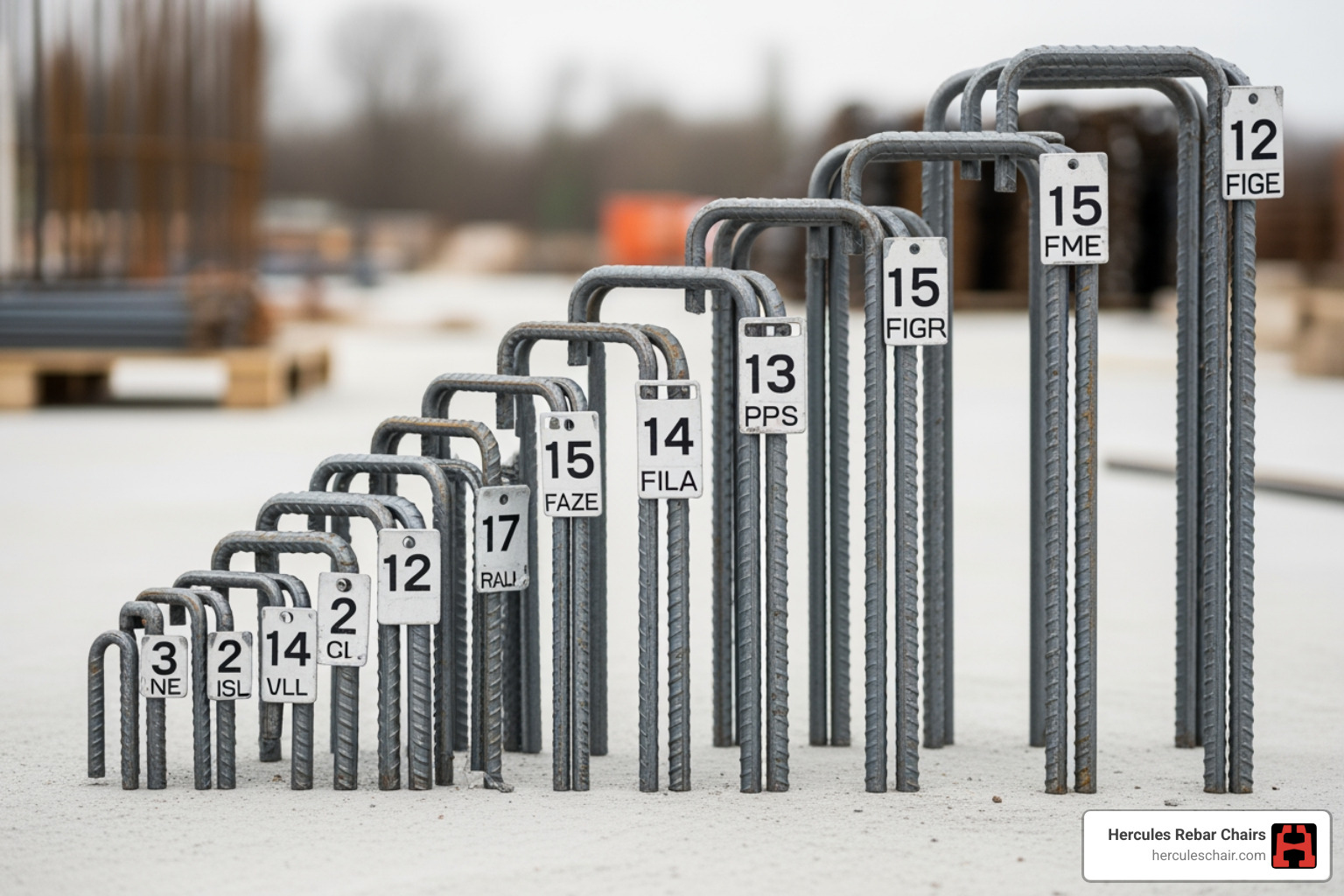
Size matters. If you use a chair that is too short, your rebar lacks proper cover. If it’s too tall, the steel might actually peek out of the top of the wet concrete. Most steel rebar chair systems are available in heights ranging from 1 inch up to 15 inches, often in 1/4-inch increments to allow for precision.
Choosing the right height is a three-step process:
- Identify the total slab thickness (e.g., 6 inches).
- Determine the required concrete cover from your blueprints (e.g., 2 inches).
- Select the chair that places the center of the rebar mat at the specified depth.
For a detailed walkthrough, see our resources on Concrete Bar Chair Sizes for Every Project and How to Determine Bar Chair Sizes in 3 Easy Steps.
Stability Requirements for a Tall Steel Rebar Chair Alternative
When you start getting into “high chairs”—those over 12 inches—stability becomes a major safety concern. In wire supports, chairs over 12 inches often require cross-bracing or “lacing” of the legs to prevent them from buckling under the weight of the wet concrete and the workers.
Our alternative approach involves a wide-base design. A wider footprint distributes the load across more surface area, which is critical when you are pouring on top of vapor barriers or rigid foam insulation. You don’t want your chairs puncturing the moisture barrier or sinking into the foam. For a complete look at managing these heavy-duty loads, our Rebar Slab Support Complete Guide is an essential read.
Key Applications in Modern Construction
The steel rebar chair (and its modern alternatives) is a staple across various construction sectors:
- Flat Slabs: Standard for driveways, sidewalks, and garage floors. Usually requires 1.5″ to 3″ chairs.
- Tilt Wall Panels: These require extreme precision because the “face” of the panel will be the exterior of the building. Any rust spots here are a disaster.
- Elevated Slabs: In multi-story buildings, rebar positioning is critical for structural safety. High chairs are often used here to support upper mats of steel.
- Precast Panels: Used in controlled factory environments where consistency is king.
- Foundation Footings: Often uses specialized “footer stands” that can hold two or three parallel bars simultaneously.
Whether you are working on a residential patio or a massive commercial warehouse, the engineering requirements remain the same: the steel must be suspended. For more insight into why these supports are non-negotiable, see Why Your Slab Needs Rebar Chair Supports.
Frequently Asked Questions about Rebar Supports
How far apart should I space my steel rebar supports?
Generally, we recommend spacing supports every 2 to 3 feet along the length of the rebar. However, if you are using a heavy rebar (like #5 or #6) or if you expect a lot of foot traffic from the crew, you should place a chair at every single rebar crossing. The goal is to prevent any “sag” in the rebar mat. If you see the steel dipping between chairs, you need more chairs. To get a precise count for your next job, use our Hercules Rebar Chair Estimator.
Are Hercules chairs better than traditional steel chairs?
We certainly think so, and so do the contractors who have used 14 million of them! While a traditional steel rebar chair is strong, our “iconic red” chairs offer several advantages. They won’t rust, they feature a snap-lock design that eliminates the need for wire tying (saving you hours of labor), and they are engineered for maximum concrete flow. Unlike metal, they won’t become brittle in the cold or warp in the heat of a July pour. Learn more about these benefits in Spacer Secrets: Unpacking the Role of Plastic Rebar Chairs.
Do I leave the chairs inside the concrete after the pour?
Yes! Rebar chairs are permanent components of the structure. Once the concrete is poured, they are buried forever. This is why it is so important to use a chair that allows concrete to flow around it completely, leaving no air pockets or “honeycombing.” High-quality supports are designed with a minimal footprint to ensure they don’t create a weak point in the slab. For a deeper look at this, check out Elevate Your Concrete: Why Bar Chairs Are Essential for Strong Slabs.
Conclusion
At Hercules Rebar Chairs (T.J. Harris Co.), we take pride in being America’s #1 choice for reinforcement supports. With over 14 million units sold and 25 years of experience, we’ve seen every type of pour imaginable. Our iconic red chairs are 100% made in the USA and are designed to save you time and money while ensuring your project stays code-compliant.
Don’t settle for “good enough” when it comes to your structural integrity. Whether you need a standard 1.5-inch chair for a driveway or a custom solution for a multi-story commercial build, we have the inventory and expertise to help you get the job done right. Ready to upgrade your next pour? You can Buy Rebar Chairs directly or browse our full range of high-performance products. Let’s build something that lasts.