

Why a Rebar Joint Coupler Belongs on Every Structural Engineer’s Radar
A rebar joint coupler is a mechanical sleeve that connects two reinforcing bars end-to-end, transferring the full load between them without relying on concrete bond or overlapping bar length.
Quick answer — what you need to know:
| Question | Answer |
|---|---|
| What does it do? | Joins two rebar ends to create a continuous, load-bearing connection |
| How strong is it? | Can reach 110% of the parent bar’s yield strength |
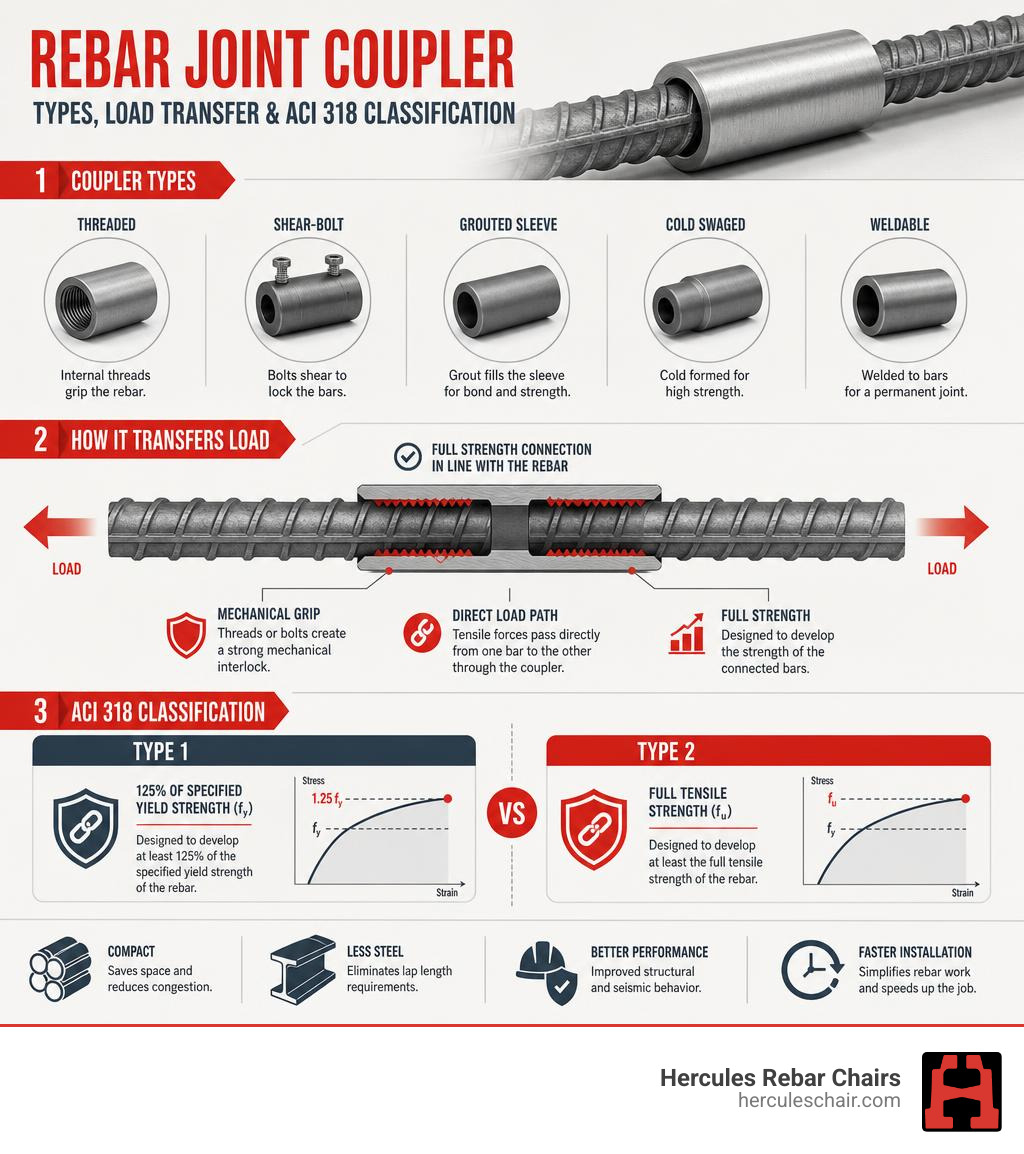
| Main types | Threaded, shear-bolt, grouted sleeve, cold swaged, weldable |
| Key standard | ACI 318 Type 1 (125% yield) and Type 2 (full tensile strength) |
| Biggest advantage over lap splices | Less congestion, less steel, better seismic performance |
If you’ve ever watched a crew try to pour concrete through a dense cage of overlapping bars, you already understand the problem. Lap splices work — but they stack bars side by side, eating up space and adding weight. In tight columns, beam-column joints, or seismic zones, that overlap quickly becomes a liability.
Couplers solve that by joining bars in line, point to point. The connection is compact, predictable, and — when properly installed — stronger than the bar itself.
I’m Jordan Harris, a licensed Professional Engineer with a master’s in structural engineering and five years of hands-on experience designing large-scale concrete structures, including work where rebar joint coupler selection directly affected code compliance and pour quality. That background shapes everything I’ll walk you through in this guide.
What is a Rebar Joint Coupler and How Does It Work?
At its core, a rebar joint coupler is a high-strength mechanical connector designed to join two pieces of reinforcing steel in a continuous line. Unlike traditional lap splices, which rely on the surrounding concrete to transfer loads from one bar to the next through shear and bond stress, a mechanical coupler creates a direct, physical bridge.
This direct load transfer mechanism means the structural integrity of the joint is self-contained. The mechanical splice carries the tension, compression, and dynamic forces directly through the coupler body.
Using mechanical couplers ensures that the load path remains uninterrupted, even if the surrounding concrete suffers localized cracking or degradation. This is a massive step forward for structural safety.
For a complete breakdown of the fundamentals of steel-to-steel connections, check out our Rebar Couplers: Your Ultimate Guide to Connecting Steel Strong.

The Mechanics of a Parallel Threaded Rebar Joint Coupler
The parallel threaded coupler is one of the most widely specified mechanical connectors in modern construction. The mechanics are elegant: the ends of the rebars are prepared with parallel threads, and a matching internally threaded sleeve is screwed onto both ends to lock them together.
There are two primary ways to prepare parallel threads:
- Direct Thread Cutting or Rolling: Threads are cut or rolled directly onto the rebar end. Because this process removes a small portion of the bar’s outer diameter, it can slightly reduce the net cross-sectional area of the bar.
- Upset Forging: To prevent any loss of cross-sectional area, the rebar end is first cold-forged (upset) to enlarge its diameter. The parallel threads are then rolled onto this enlarged end. This ensures that the thread cross-sectional area is equal to or greater than the parent bar, tightening the molecular structure of the steel and delivering a true “Bar Break” performance.
Standard parallel threaded couplers, such as those featured in the Standard Rebar Coupler | Parallel Threaded Coupler | Aleono specifications, are typically machined from high-grade 45# carbon steel. They routinely achieve a tensile strength of over 600 MPa, reaching up to 110% of the yield strength of the parent rebar.
Specialized Rebar Joint Coupler Types for Complex Geometry
Standard couplers work beautifully when at least one rebar is free to rotate. But what happens when you are dealing with bent bars, pre-assembled rebar cages, or heavy column joints where rotating the steel is physically impossible?
That is where specialized mechanical couplers come in:
- Positioning Couplers: Designed for situations where neither bar can be rotated. These couplers use a multi-part design—often featuring a longer thread on one bar and a locknut—allowing the coupler to be fully screwed onto one bar and then backed off onto the adjacent bar to lock the joint.
- Transition Couplers: Used when joining bars of two different diameters (such as connecting a #9 bar to a #8 bar). These eliminate the need for awkward field adaptations and maintain structural continuity across steps in column or wall profiles.
- Bridging Couplers: Ideal for bridging gaps between reinforcement bars that do not quite meet due to fabrication or site tolerances.
To see how these specialized couplers can simplify your next field installation, explore our guide on Splicing Made Simple with These Top-Rated Rebar Couplers.
Mechanical Couplers vs. Traditional Lap Splices
For decades, lapping was the default way to splice rebar. You simply overlap two bars by a calculated length and tie them together with wire. But as structural demands have increased and concrete designs have become more complex, the limitations of lap splices have become glaringly obvious.
Here is how mechanical couplers stack up against traditional lap splices across key engineering and economic metrics:
| Performance Metric | Traditional Lap Splices | Mechanical Rebar Couplers |
|---|---|---|
| Load Transfer Mechanism | Relies entirely on concrete bond and shear transfer. | Direct mechanical connection; independent of concrete quality. |
| Structural Capacity | Limited by concrete bond; vulnerable to bond failure. | Typically delivers 125% to 150% greater capacity than lap splices. |
| Rebar Congestion | Doubles the amount of steel at the splice zone, creating “rebar jungles.” | Maintains a single-bar profile, maximizing space for concrete placement. |
| Material Savings | Consumes significant steel tonnage solely for lap lengths (up to 50% more for epoxy-coated bars). | Eliminates lap waste; connects bars end-to-end. |
| Seismic Performance | Poor performance in plastic hinge zones; prone to unzipping under cyclic loading. | Excellent ductility; Type 2 couplers withstand extreme cyclic loading. |
| Installation Labor | High labor required to calculate, position, and tie long lap zones. | Quick, standardized installation with immediate visual verification. |
Structural and Economic Advantages Explained
1. Material and Cost Savings
While a rebar joint coupler has a higher unit cost than a simple piece of tie wire, it eliminates the need for long overlapping sections of steel. The cost advantage of using a coupler instead of lapping increases dramatically with the size of the rebar.
Research indicates that the cost savings on steel material range from approximately 11% for #5 bars to a massive 140% for #10 bars. On a large project, eliminating tons of redundant lap steel can reduce the total structural cost significantly. In fact, historical project data shows that the additional cost of using mechanical butt splices is typically only about 0.2 percent of the total cost of the structure, which is easily offset by the reduction in raw steel tonnage and labor.
For deep-dive calculations on how lap lengths impact your material budget, read our article on Mastering the Rebar Splice Length Formula.
2. Eliminating Concrete Congestion
When you overlap large-diameter bars, you create a physical barrier that blocks the flow of aggregate. This leads to voids, honeycombing, and weak spots in your pour. Mechanical couplers keep the reinforcement profile slim. This allows concrete to flow freely, ensuring a dense, consolidated structure.
To keep those perfectly aligned bars at the correct height and spacing before the pour, we always recommend pairing your couplers with heavy-duty concrete accessories, such as our iconic red concrete supports.
Exploring the Main Types of Mechanical Splices
Not all mechanical splices are created equal. Depending on your project requirements, access limitations, and equipment availability, different coupler systems offer distinct advantages.

Shear-Bolt and Bolted Couplers
Shear-bolt couplers—such as the Rebar coupler – Soscoup | Regbar Construction—are the ultimate problem solvers for field retrofits, structural expansions, and concrete repairs.
These couplers do not require any thread preparation, upset forging, or specialized hydraulic machinery on site. Instead, the two plain-end rebars are inserted into a heavy-wall steel sleeve equipped with special lock bolts.
Using a standard impact wrench or manual socket wrench, the installer tightens the bolts. The bolts pinch the rebar, and as the specified torque is reached, the bolt heads shear off. This provides an immediate, foolproof visual verification that the connection has achieved its design capacity.
These systems are compatible with epoxy-coated or galvanized rebars without requiring the removal of the protective coating.
Grouted Sleeve and Weldable Couplers
In precast concrete construction and hybrid steel-to-concrete structures, standard threaded connections are not always practical.
- Grouted Sleeve Couplers: Widely used to connect precast columns and shear walls. One end of the rebar is cast into the precast element inside a hollow sleeve. During field assembly, the continuation bar from the lower level is inserted into the sleeve, and a high-strength, non-shrink structural grout is pumped in. The grout cures to form a rigid, high-capacity joint.
- Weldable Couplers: When your design requires a transition from structural steel to reinforced concrete, weldable couplers like the Rebar coupler – Weldcoup | Regbar Construction are essential. These feature a weldable carbon steel base on one side—allowing them to be welded directly to structural steel beams, piles, or composite columns—and a threaded socket on the other side to receive the rebar.
Code Compliance and Performance Standards
In the United States, structural concrete design is governed by the American Concrete Institute (ACI) and local building codes. Under ACI 318, mechanical splices are strictly classified into two categories based on their performance under tension and compression:
- Type 1 Mechanical Splice: Must be capable of developing at least 125% of the specified yield strength ($f_y$) of the bar. This ensures that the splice remains intact under typical design loads.
- Type 2 Mechanical Splice: Must meet the Type 1 requirement (125% of $f_y$) and develop the specified tensile strength of the reinforcing bar. Type 2 couplers are engineered for high-seismic zones and plastic hinge regions where the rebar must be allowed to undergo significant inelastic deformation without failing at the joint.
For international projects or those complying with European specifications, couplers must meet standards like Eurocode 2 and ISO 15835. These standards mandate rigorous testing, including dynamic fatigue testing. High-quality couplers are subjected to over 2 million cycles of fatigue testing to ensure long-term durability in infrastructure projects like high-speed rail tunnels, bridges, and metro lines.
To ensure your splicing choices align perfectly with local building codes, consult our detailed handbook, Splice It Right: Your Handbook to Mechanical Lap and Dowel Bar Splicers.
Key Construction Scenarios Where Couplers Are Essential
While mechanical couplers are beneficial on almost any job, there are several scenarios where they are practically mandatory:
- High-Congestion Reinforcement Areas: In heavily reinforced beam-column joints, raft foundations, and core walls, there is simply no physical room for lap splices. Couplers keep the steel footprint minimal, preventing aggregate blockages.
- Large-Diameter Bars: For heavy structural bars (such as #11, #14, and #18 bars), lap splicing is often prohibited by code or becomes structurally impractical due to the extreme lap lengths required. Couplers provide a safe, code-compliant, and highly efficient butt joint.
- Seismic and Dynamic Loading Zones: In earthquake-prone regions, structural ductility is everything. Type 2 couplers ensure that reinforcement bars can yield and absorb seismic energy without brittle joint failures.
- Precast Concrete Elements: Connecting precast columns, beams, and hollow-core slabs requires precise, high-strength connections. High-quality modular rebar couplers offer the flexibility needed to assemble precast components quickly on site.
If you are planning your next heavy-duty reinforcement layout, you can view our specialized splicing accessories directly on Our Products: Splicer.
Frequently Asked Questions about Rebar Splicing
Can you mix different types of couplers in a single project?
Generally, mixing different brands or types of couplers on the same bar connection is highly discouraged. Each manufacturer has proprietary thread pitches, tolerances, and steel formulations. Mixing components can lead to thread stripping, poor fitment, and catastrophic structural failure. Always stick to a single, approved mechanical splicing system for each connection type and obtain explicit engineering approval before making any field substitutions.
Do mechanical couplers require specialized tools for installation?
It depends entirely on the coupler type:
- Threaded Couplers: Require a calibrated torque wrench to ensure the threads are engaged to the manufacturer’s specified torque.
- Shear-Bolt Couplers: Only require a standard impact wrench or socket wrench; no specialized hydraulic equipment is needed.
- Cold Swaged Couplers: Require a portable hydraulic press on-site to crimp the steel sleeve onto the rebar ends.
- Grouted Sleeves: Require grout mixing and injection pumps.
How do you inspect a mechanical coupler connection?
Inspection protocols vary by system:
- For Threaded Systems: Inspectors perform visual checks to ensure no more than a specified number of threads are exposed outside the coupler sleeve (typically no more than 2 pitches). Torque verification testing is also conducted on a representative sample of joints.
- For Shear-Bolt Systems: Inspection is incredibly straightforward—if the bolt heads have sheared off cleanly, the connection is properly tightened and verified.
- For Grouted Sleeves: Inspectors verify that grout has completely filled the sleeve by checking for outflow at the grout vent ports.
Conclusion
The transition from traditional lap splices to mechanical rebar couplers represents a major leap forward in concrete construction. By delivering superior structural performance, reducing material waste, and solving the headache of rebar congestion, the rebar joint coupler has earned its place as an essential tool for modern structural engineers.
At Hercules Rebar Chairs, we are committed to helping you build stronger, safer, and more efficient concrete structures. As America’s #1 manufacturer of heavy-duty concrete supports—with over 14 million units sold—our bright red rebar chairs are designed to save you time and money on site while ensuring perfect code compliance.
Whether you are detailing a complex high-rise column or pouring a heavy foundation slab, pairing high-performance mechanical couplers with our ultra-strong concrete supports ensures your steel stays exactly where it belongs.
Ready to take your concrete reinforcement to the next level? Explore Rebar Couplers: Your Ultimate Guide to Connecting Steel Strong to find the perfect solutions for your next project.