

Why the Right Rebar Chair Plastic Support Makes or Breaks Your Concrete Slab
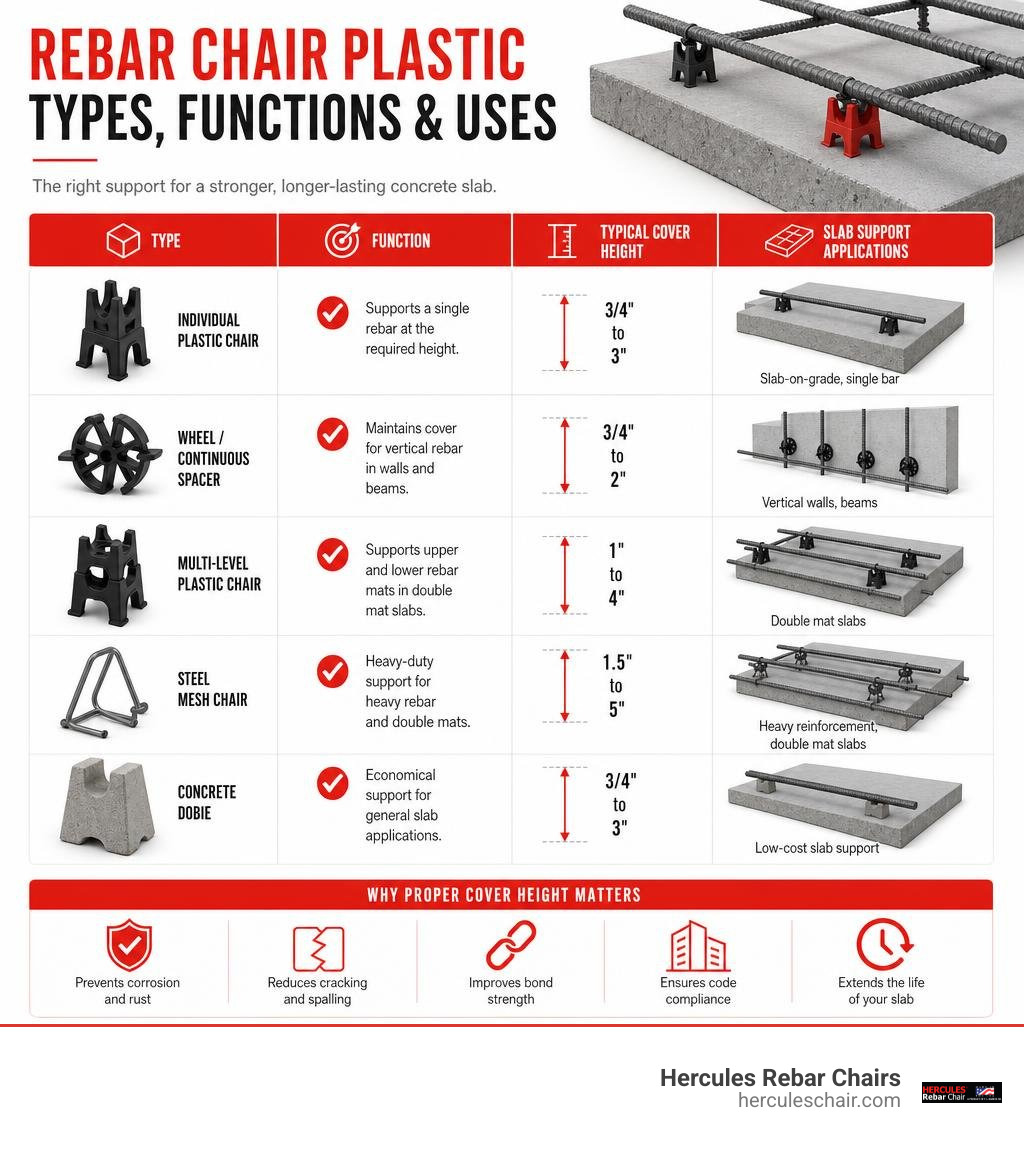
If you need a quick answer on rebar chair plastic supports, here are the top options contractors rely on:
| Product Type | Best For | Typical Cover Height |
|---|---|---|
| Individual plastic chair | Slab-on-grade, single bar | 3/4″ to 3″ |
| Wheel/continuous spacer | Vertical walls, beams | 3/4″ to 2″ |
| Multi-level plastic chair | Double mat slabs | 1″ to 4″ |
| Steel mesh chair | Heavy reinforcement, double mat | 1.5″ to 5″ |
| Concrete dobie | Low-cost slab support | 3/4″ to 3″ |
Getting rebar positioned at the exact right height before a pour is one of the most critical — and most overlooked — steps in concrete construction. Set it too low, and you risk corrosion, cracking, and structural failure years down the line. Set it too high, and the rebar may not bond properly with the concrete above. Plastic rebar chairs are the simple, low-cost tool that solves this problem. They hold your rebar at a precise, code-compliant height so the concrete can do its job the way it was designed to.
I’m Jordan Harris, a licensed Professional Engineer and structural engineer with hands-on experience designing large-scale concrete projects — and today I help lead T.J. Harris Company, where our rebar chair plastic supports have been installed on job sites across the country. In this guide, I’ll walk you through the best options available so you can choose the right support for your next pour with confidence.
Simple guide to rebar chair plastic terms:
Understanding the Rebar Chair Plastic Support for Concrete Slabs
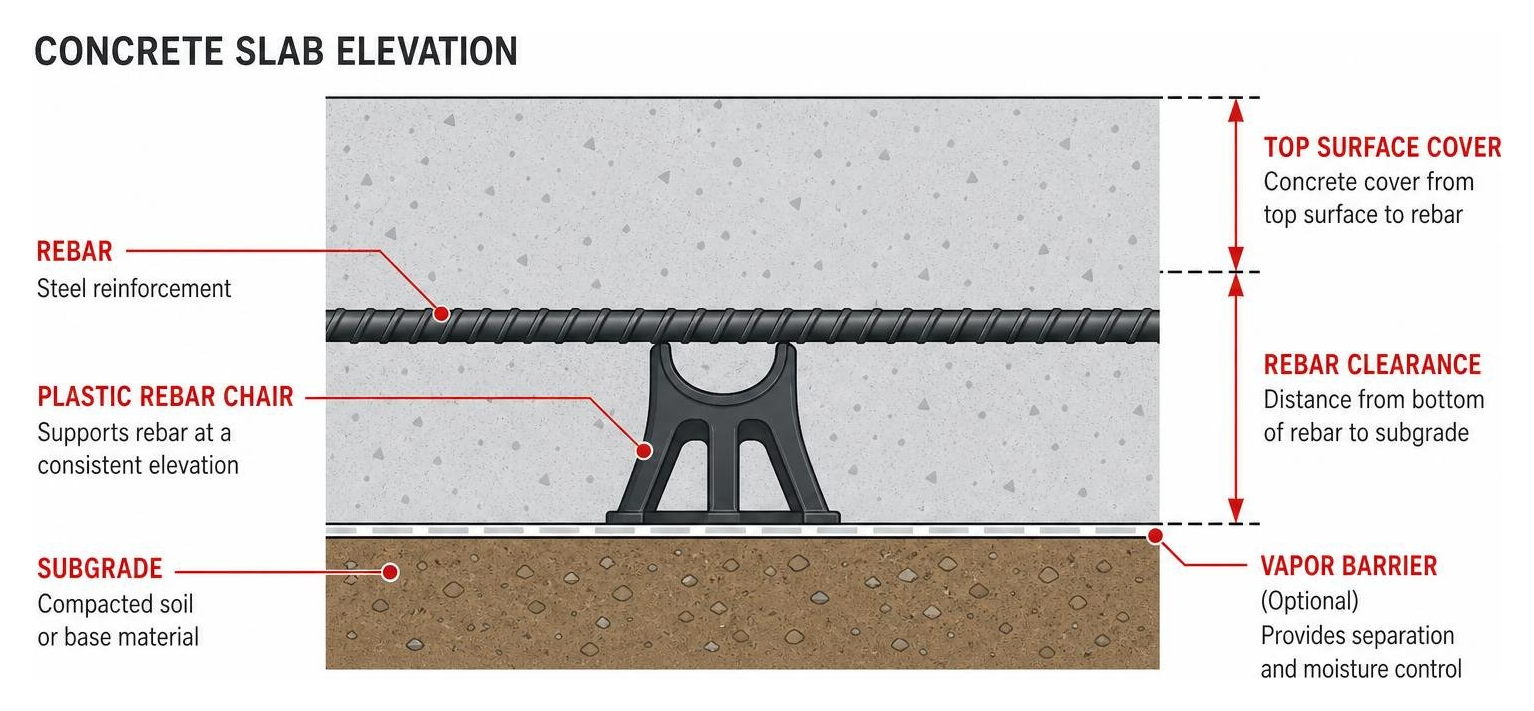
When pouring a concrete slab, steel reinforcement provides the tensile strength that plain concrete lacks. However, steel only works when it is embedded securely inside the concrete matrix rather than resting flat on the ground. A rebar chair plastic component acts as a precision spacer, elevating steel mesh or rebar grids above the subgrade to ensure full concrete encasement.
To understand why this matters, we have to look at concrete cover—the depth of concrete measured from the outer surface to the embedded steel reinforcement. Concrete cover serves three essential functions:
- Corrosion Protection: Concrete is inherently alkaline, creating a protective passivating layer around steel. If water, moisture, or de-icing chemicals penetrate through inadequate cover, the steel oxidizes, expands, and causes internal spalling.
- Structural Bond Strength: The surrounding concrete must physically wrap around the deformed ribs of the rebar to transfer tension forces seamlessly across the slab depth.
- Fire Resistance: Concrete acts as a thermal shield. Proper depth insulates steel reinforcement from extreme heat during fire events, preventing sudden yield strength loss.
When workers walk across a rebar grid during a pour without reliable support, the steel bends down and touches the vapor barrier or dirt subgrade. Unsupported steel leads directly to long-term cracking and premature structural degradation. By deploying lightweight, high-strength rebar chair plastic supports, we keep the steel elevated, maintaining exact grid stability across the entire project footprint. For a deeper breakdown of spacer functions, check out our insights on Spacer Secrets: Unpacking the Role of Plastic Rebar Chairs.
Top Types of Rebar Support Chairs for Slab Construction
Different slab designs, wall sections, and load requirements demand specific support structures. While traditional concrete dobies and steel wire chairs have their place, modern high-density polypropylene plastic chairs have emerged as the industry standard due to their non-corrosive properties, lightweight convenience, and precise elevation notches.

Heavy-Duty Individual Rebar Chair Plastic Models
Individual plastic rebar chairs are designed primarily for slab-on-grade applications, footings, and elevated decking. These chairs feature a wide base footprint that prevents them from sinking into soft subgrade soils or punching through delicate vapor barriers.
Key characteristics include:
- Snap-Lock Mechanisms: Integrated top cradles clamp directly onto the rebar (#3 through #6 sizes), eliminating the need for manual tie wire in many applications.
- Dual and Multi-Height Options: Many individual models offer flip capabilities, providing two different elevation heights (e.g., 2-inch or 2.5-inch cover) in a single unit.
- Point Load Spread: Wide, rounded base feet distribute worker foot-traffic loads evenly without puncturing underlying moisture barriers.
Wheel Spacers and Multi-Level Rebar Chair Plastic Components
When pouring vertical elements such as foundation walls, square columns, retaining walls, or deep concrete beams, standard floor chairs won’t cut it. That’s where wheel-style plastic spacers excel.
- Wheel Spacers: Designed to snap onto vertical rebar grids. As formwork is assembled around the reinforcement, the outer edge of the wheel rolls smoothly against the plywood or steel form, ensuring precise lateral clearance.
- Multi-Level Chairs: Built for thick mat applications where multi-tiered reinforcing bars must be maintained at tiered intervals.
Whether you’re pouring tilt-up panels or heavy grade beams, using vertical and multi-level units ensures continuous spacing throughout the formwork. Take a look at our full lineup to Elevate Your Concrete Game with the Best Plastic Rebar Chairs for Sale.
Heavy-Duty Steel Mesh Chairs for Double Mat Systems
While plastic chairs dominate single-layer slabs, heavy structural decks and industrial bridge approach slabs often require double mat reinforcement. When managing extremely heavy steel bundles, wire mesh, and double mats, continuous steel wire mesh chairs or heavy-duty combo supports provide high-capacity stability.
- Steel Wire Mesh Chairs: Formed from cold-drawn steel wire, these chairs handle massive point loads without deflecting under heavy reinforcement mats.
- Double Mat Integration: They allow workers to position top and bottom steel layers rapidly with minimal lateral movement.
For a complete breakdown of heavy-duty mat supports and dobie alternatives, explore our guide From Dobies to Double Mats: A Comprehensive Look at Rebar Chair Types.
Key Benefits, Load Capacity, and Durability
Why have contractors shifted so rapidly from old-school concrete blocks (dobies) to plastic chairs? The answer comes down to durability, jobsite efficiency, and chemistry.
Modern plastic chairs are manufactured from high-impact polypropylene polymers. Unlike steel wire chairs, rebar chair plastic units will never rust or bleed through the finished bottom face of exposed concrete soffits. Unlike concrete dobies, plastic chairs won’t crumble or absorb moisture during freeze-thaw cycles.

When assessing performance under tough jobsite conditions, plastic chairs undergo compression load testing to ensure they won’t crush when crews walk on top of the rebar grid:
| Feature / Metric | Plastic Rebar Chairs | Steel Wire Chairs | Concrete Dobies |
|---|---|---|---|
| Material Composition | High-Impact Polypropylene | Cold-Drawn Steel Wire | Cementitious Mortar |
| Corrosion Resistance | 100% Rust-Proof | Requires Plastic Caps/Coating | Non-Corrosive (Permeable) |
| Vapor Barrier Safe | Yes (Wide Base Feet) | Risk of Puncture | Moderate Risk (Heavy Edge) |
| Weight per 100 Units | Extremely Lightweight (~3–5 lbs) | Moderate (~12–20 lbs) | Heavy (~40–80 lbs) |
| Snap-Lock Integration | Built-in (No Tie Wire Needed) | Requires Manual Tie Wire | Requires Integrated Tie Wire |
| Compressive Load Rating | Up to 500+ lbs per chair | High Load Capacity | High (Fragile on Impact) |
With compressive strength ratings exceeding point-load demands, high-quality plastic chairs support severe worker foot traffic while preserving total structural safety.
Sizing, Spacing, and Installation Best Practices
Choosing the correct rebar chair plastic support depends on three main variables: required concrete cover depth, rebar bar diameter, and total slab thickness.
Follow these standard guidelines according to American Concrete Institute (ACI 318) recommendations:
Determine Concrete Cover Requirements:
- Concrete cast against and permanently exposed to earth (e.g., footings): 3 inches minimum cover.
- Concrete exposed to earth or weather (e.g., exterior slabs, driveways): 1.5 inches to 2 inches cover.
- Slab-on-grade not exposed to weather: 3/4 inch to 1.5 inches cover depending on bar size.
Calculate Chair Spacing:
- For light welded wire mesh (#10 to #4 rebar grids), space chairs 2 to 3 feet apart in both directions to prevent sag between supports.
- For heavy structural rebar (#5, #6, and larger), chairs can typically be spaced 3 to 4 feet apart on center.
Avoid Installation Pitfalls:
- Pitfall 1: Spacing Too Far Apart. Over-spacing causes the rebar grid to bow downward when workers walk over it during concrete placement.
- Pitfall 2: Using Small-Footprint Chairs on Soft Soil. Narrow legs sink straight into uncompacted gravel or sand, lowering the concrete cover.
- Pitfall 3: Tipping Over During Pour. Ensure snap-lock heads bite securely onto the bar so chairs don’t displace under pumped concrete flow.
For step-by-step sizing charts and cover formulas, read The Ultimate Guide to Rebar Chairs: Types, Uses, and Sizing for Concrete Slabs.
Frequently Asked Questions About Concrete Supports
What is the recommended spacing for plastic rebar chairs in a slab?
For standard residential slab-on-grade applications using #3 or #4 rebar, place chairs approximately 2.5 to 3 feet apart along each bar length. If you are supporting thin welded wire mesh, keep spacing closer to 2 feet to prevent excessive deflection when workers stand on the grid.
Are plastic rebar chairs recyclable and eco-friendly?
Yes! Most modern rebar chair plastic components are manufactured from recycled polypropylene (PP) polymers. By redirecting post-industrial plastic waste into long-lasting structural materials, contractors can support sustainable LEED building practices while ensuring non-corrosive concrete performance.
Why is proper concrete cover critical for rebar reinforcement?
Inadequate cover allows moisture, oxygen, and carbon dioxide to reach embedded rebar, accelerating rust formation. Rust expands up to six times the original volume of steel, generating internal stresses that pop off the outer layer of concrete (spalling). Proper cover also provides vital fire endurance ratings.
Conclusion
At Hercules Rebar Chairs (T.J. Harris Co.), we take pride in being recognized as America’s #1 concrete support manufacturer, with over 14 million units sold across all 50 states. Easily identifiable by our signature red color, our heavy-duty plastic and steel chairs save contractors valuable time and money on the job site while guaranteeing strict code compliance.
Whether you are placing a small driveway slab or a commercial double-mat foundation deck, choosing high-performance supports ensures your structure stands the test of time. Reach out today to explore our full selection, including our industry-leading 2-inch steel mesh chair, and keep your next concrete pour on solid ground!