

Why Concrete Chairs for Rebar Make or Break Your Slab
Concrete chairs for rebar are small plastic or metal supports that hold reinforcing steel at the correct height inside a concrete slab before and during the pour.
Quick answer — what you need to know:
| Question | Answer |
|---|---|
| What do they do? | Hold rebar at the right height so concrete fully surrounds the steel |
| Why do they matter? | Rebar placed too low corrodes; too high loses load capacity |
| Common heights | 3/4″ to 5″ depending on slab thickness and code requirements |
| Main types | Plastic snap-lock chairs, metal high chairs, stackable caged chairs, continuous bolsters |
| Where to use them | Slabs, walls, bridge decks, tilt-up panels, precast applications |
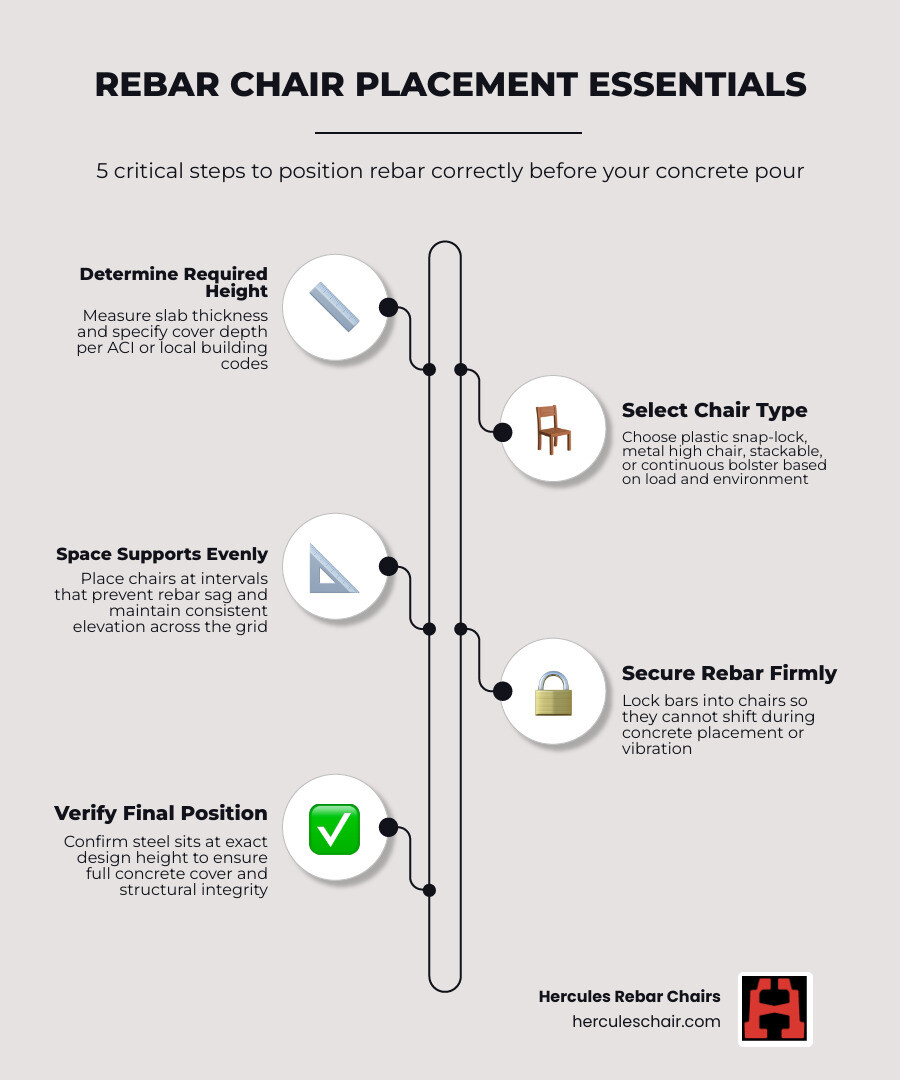
Every concrete slab depends on rebar being in exactly the right position. If the steel sits too close to the bottom of the slab, moisture reaches it and corrosion begins — silently weakening the structure over years. If it sits too high, the slab loses the tensile strength it was designed to carry. Rebar chairs solve both problems by locking the steel at a precise, consistent height before a single yard of concrete is poured.
Getting this right isn’t just good practice — it’s required by building codes and DOT specifications on most commercial and public-works projects.
I’m Jordan Harris, a licensed Professional Engineer and structural engineer with hands-on experience designing large-scale concrete projects for major power generation facilities. As part of the team behind the Hercules Chair — a concrete chair for rebar system with over 14 million units sold — I’ve seen what happens when supports are chosen well, and when they aren’t. In this guide, I’ll walk you through everything you need to pick the right chair for your next pour.
What Are Concrete Chairs for Rebar and Why Are They Essential?
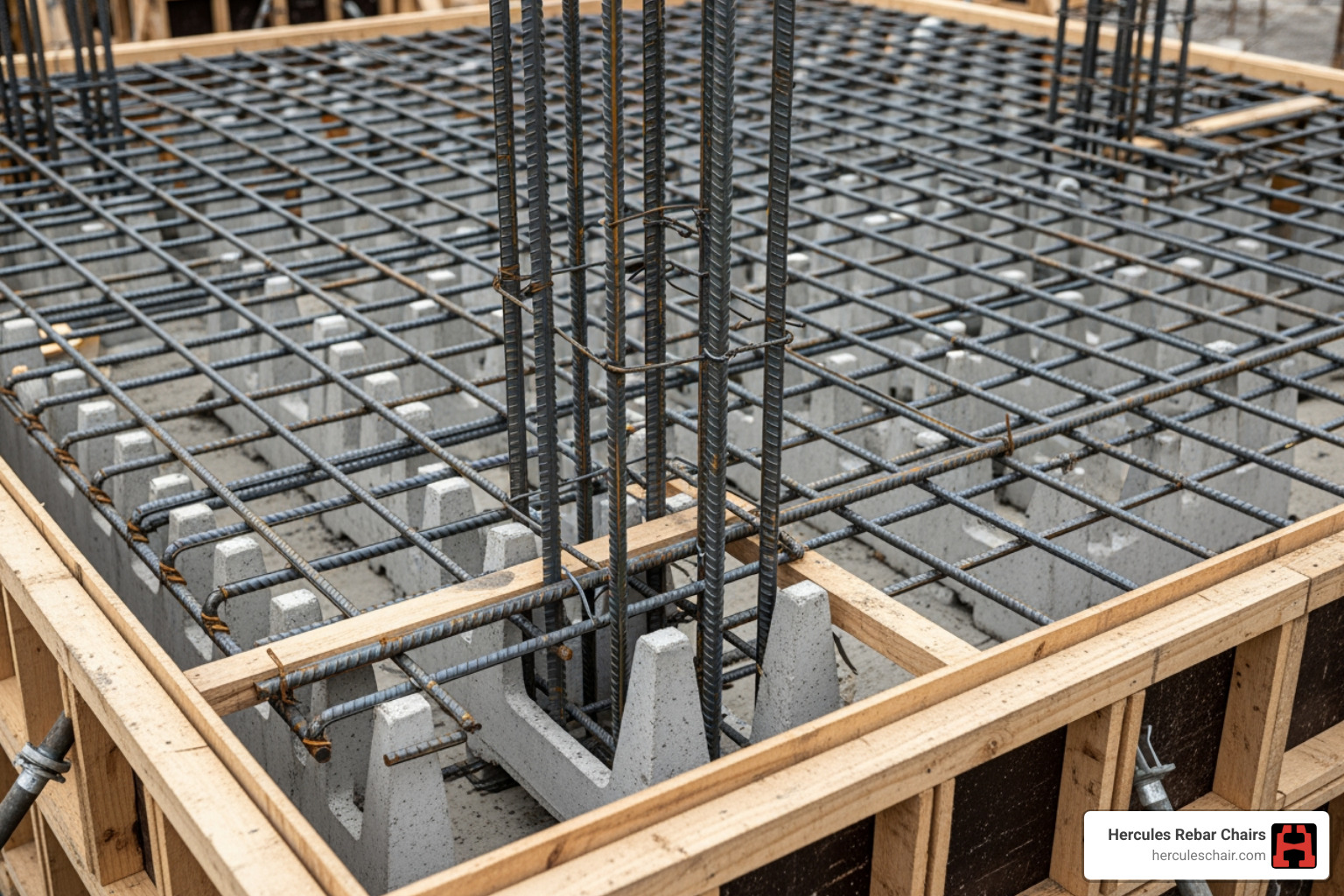
To understand why we use a concrete chair for rebar, we have to look at how reinforced concrete actually works. Concrete is a champion when it comes to compression—it can handle massive downward crushing forces without breaking a sweat. However, it is notoriously weak under tension (pulling forces).
That is where steel rebar comes in. When you combine concrete and steel, you get a composite material that resists both crushing and pulling. But this partnership only works if the rebar is suspended in the correct zone of the slab. If the steel is sitting on the ground, it is essentially useless.
Ensuring proper “concrete cover”—the depth of the concrete surrounding the steel—is the primary job of a rebar chair. If the steel is not elevated, the concrete cannot flow underneath it, leaving the reinforcement exposed to the elements and failing to bond with the slab. Using high-quality support systems prevents catastrophic structural failures. For a deeper look into why this is so critical, explore Why Your Slab Needs Rebar Chair Supports.
The Role of Concrete Chairs for Rebar in Preventing Corrosion
When rebar is left resting on the dirt or subgrade, it acts like a straw, drawing up moisture from the earth. Over time, this moisture causes the steel to rust. As steel rusts, it expands up to several times its original volume. This expansion exerts incredible internal pressure on the surrounding concrete, leading to cracking, spalling, and eventually total degradation of the slab.
By utilizing a concrete chair for rebar, we lift the steel grid off the ground and encapsulate it completely within the alkaline environment of the concrete, which naturally protects the steel from rusting. Elevating your steel creates a permanent moisture barrier of solid concrete beneath the reinforcement. Learn more about protecting your project’s lifespan in our article, Elevate Your Concrete Why Bar Chairs Are Essential for Strong Slabs.
How Concrete Chairs for Rebar Ensure Code Compliance
Building codes are not just friendly suggestions—they are legal requirements designed to keep people safe. The American Concrete Institute (ACI) specifies exact concrete cover requirements for different structural elements. For example, ACI 318 dictates that concrete cast against and permanently exposed to earth must have a minimum of 3 inches of concrete cover.
If a building inspector walks onto your job site and sees rebar resting on the ground, or supported by temporary wooden blocks or soda cans (yes, we have seen it all), they will shut your project down immediately. Furthermore, Department of Transportation (DOT) projects have incredibly strict guidelines regarding the stability, spacing, and material composition of rebar supports. Using certified, high-strength chairs ensures you pass inspections the first time. For guidance on avoiding costly compliance mistakes, check out Don’t Let Your Rebar Sink A Guide to Concrete Chairs.
Main Types of Rebar Support Chairs
Choosing the right style of support depends heavily on your subgrade, the weight of your rebar mat, and the specific application. Let’s break down the primary types of supports used across the industry today.
| Support Type | Material | Best For | Pros | Cons |
|---|---|---|---|---|
| Plastic Chairs | Polypropylene | Slabs, decks, corrosive environments | Non-corrosive, lightweight, snap-lock designs | Lower load capacity than heavy-duty metal |
| Metal Chairs | Steel (Galvanized/Epoxy) | Heavy rebar mats, multi-layer steel | Extremely strong, high load capacity | Can rust if not coated; pricier |
| Concrete Dobies | Precast Concrete | Heavy-duty civil projects, footings | Matches concrete expansion; high strength | Heavy, hard to transport; no snap-lock |
For an in-depth comparison of these different support systems, read our article From Dobies to Double Mats: A Comprehensive Look at Rebar Chair Types.
Plastic vs. Metal Rebar Chairs
In the construction world, the debate between plastic and metal supports is ongoing.
Plastic rebar chairs made of premium polypropylene are rapidly becoming the industry standard. They are entirely non-corrosive, meaning they will never rust or cause cosmetic blemishes on the surface of your finished concrete. They are also highly cost-effective and lightweight, making them easy to transport in bulk. Many feature advanced snap-lock designs that hold the rebar firmly in place without the need for manual wire tying. For instance, options like the Hercules 1-1/2 in. Rebar Chair (50-Pack) 911 – The Home Depot offer an incredibly durable, fast-installing option for residential and light commercial slabs.
Metal rebar chairs are the traditional choice for heavy-duty applications. They can handle massive loads without crushing, making them ideal for thick industrial slabs. However, they are prone to corrosion if the protective plastic or epoxy coating is damaged during the pour.
Continuous High Chairs and Slab Bolsters
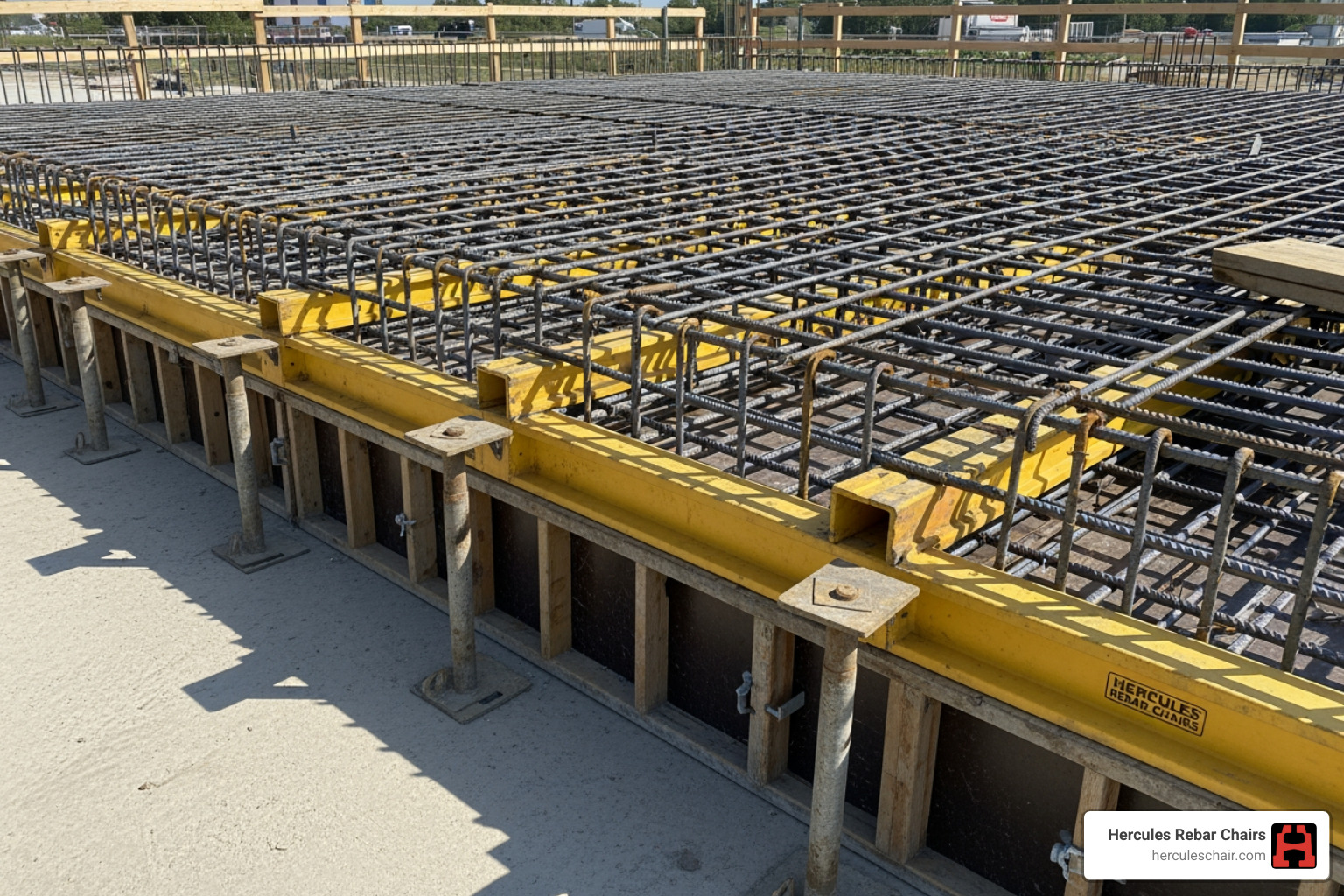
When you are dealing with large, multi-layered rebar grids or upper slab steel, placing hundreds of individual chairs can be incredibly labor-intensive. That is where continuous high chairs and slab bolsters come in.
Instead of supporting the rebar at isolated points, continuous bolsters run along the entire length of the grid. This design eliminates the need for carrier bars and distributes the weight of the steel evenly across the formwork. These supports are typically fabricated in 5-foot lengths with legs spaced at regular intervals (such as 7-1/2 inch centers), providing unmatched structural stability during heavy concrete pours.
Stackable Caged Chairs
For complex precast concrete elements or multi-layer spacing, stackable caged chairs are a game-changer. These polypropylene supports feature a unique cage-like structure that allows you to stack them to achieve custom heights or support multiple layers of steel within a single form.
Because they are molded with wide, open cavities, concrete flows freely through them, eliminating any risk of voids or air pockets in the finished structure. If you are working on advanced precast or tilt-up projects, check out our specialized line of Hercules Stackable Chairs to streamline your workflow.
How to Choose the Right Height and Capacity
Selecting the wrong size chair is one of the most common mistakes on the job site. If the chair is too short, your rebar sits too close to the bottom of the slab; if it is too tall, the steel will poke out of the top of the concrete.
To find the perfect fit, you must calculate your slab thickness and subtract the required concrete cover. For example, in a standard 4-inch residential slab, you typically want your rebar positioned dead-center (2 inches of concrete cover below the steel). Therefore, you would select a 2-inch chair. For a comprehensive sizing walkthrough, consult The Ultimate Guide to Rebar Chairs Types, Uses, and Sizing for Concrete Slabs and The Goldilocks Guide to Concrete Bar Chair Sizes Not Too Big Not Too Small.
Sizing for Standard Slabs
Standard construction projects typically use rebar sizes ranging from #3 (3/8″ diameter) to #5 (5/8″ diameter). Your chairs must be compatible with these specific bar sizes to ensure a secure fit.
For projects requiring larger heights, such as deep commercial footings or thick foundation slabs, heavy-duty supports like the Hercules 5-Inch Rebar Chairs provide the robust elevation needed to keep thick steel grids stable under the weight of active construction crews. For more details on matching bar sizes to support heights, check out Concrete Bar Chair Sizes for Every Project.
Specialized Applications: Tilt-Up, Fiber Rebar, and Corrosive Environments
Not all concrete projects are created equal. Some require specialized engineering solutions:
- Tilt-Up Walls: These panels are cast horizontally on-site and then lifted into place. The chairs used must not leave any visible marks or “shadows” on the exterior face of the panel.
- Fiber Rebar: Modern composite rebars (like fiberglass or basalt) are incredibly lightweight but flexible. They require highly stable, closely spaced chairs to prevent the bars from bowing or floating during the pour.
- Corrosive Environments: Projects like bridge decks, coastal waterways, and chemical processing plants require non-conductive, non-corrosive plastic supports to prevent electrical currents and chemical agents from degrading the reinforcement.
Key Features of High-Quality Rebar Chairs
When you are purchasing supports in bulk, it is tempting to simply look for the cheapest option. However, cheap, poorly designed chairs will crush under the weight of concrete or tip over when workers walk on the rebar grid. Here are the non-negotiable features to look for:
- Snap-Lock Design: Premium chairs feature a top saddle that snaps tightly around the rebar. This eliminates the need for tedious wire tying, saving contractors thousands of dollars in labor costs.
- Concrete Flow-Through: The chair must have large, open cavities so that the aggregate in the concrete mix can flow completely through and around the support. This ensures a monolithic pour without voids.
- Stability on Sand and Soft Subgrades: If you are pouring on sand, gravel, or vapor barriers, look for chairs with wide, flat bases (often called sand plates). These prevent the chair from sinking into the ground under load.
- High Load Capacity: A quality chair should easily support several hundred pounds of downward force without collapsing or warping.
Fun Fact: Did you know that construction materials can even inspire high art? Designers have occasionally reimagined these structural elements for everyday life, such as the famous 1986 German Concrete and Rebar Chair by Heinz Landes, or the avant-garde EKSTREM™ REBUS — VARIER x INGRID BREDHOLT . While those artistic masterpieces look great in a gallery, we prefer our chairs hidden inside a rock-solid concrete slab!
Frequently Asked Questions about Rebar Supports
How far apart should rebar chairs be spaced?
As a general rule of thumb, rebar chairs should be spaced approximately 2 to 3 feet apart along the length of the rebar. If your spacing is too wide, the steel will sag or deflect between the chairs when workers step on it during the pour. Keeping the grid rigid is critical for maintaining an even concrete cover. For a complete spacing guide, check out Sitting Pretty Everything You Need to Know About Rebar Supports.
Can you use plastic rebar chairs on sand or gravel bases?
Yes, but you must use chairs specifically designed with a flat base or integrated sand plate. Standard pointed-leg chairs will sink directly into sand or puncture vapor barriers, rendering them useless. Flat-bottomed supports, such as a 5″ CONCRETE REBAR SUPPORT CHAIR WITH BASE- BAR SIZE 4 , distribute the weight across a larger surface area to prevent sinking. For more tips on managing soft subgrades, read Keep Your Rebar Up A Guide to Concrete Support Blocks.
What is the difference between a dobie and a plastic chair?
A “dobie” is a block of precast concrete, often with tie wires embedded in the top. They are incredibly strong and have the advantage of being made of the exact same material as the surrounding pour, meaning they expand and contract at the same rate. However, they are heavy, expensive to ship, and lack the quick snap-lock installation features of modern plastic chairs. Plastic chairs are far lighter, faster to install, and more cost-effective for the vast majority of standard slabs. Dive deeper into this comparison with Chair-ish Your Concrete Everything You Need to Know About Reinforcement Supports.
Conclusion
At the end of the day, a concrete slab is only as strong as its reinforcement—and that reinforcement is only as good as the chairs supporting it. Cutting corners on your rebar supports is a shortcut to structural cracks, code violations, and expensive future repairs.
At Hercules Rebar Chairs, we are proud to be America’s #1 choice for concrete supports, with over 14 million units sold nationwide. Our iconic red, high-strength plastic chairs are engineered to save you time and money on the job site while ensuring absolute code compliance. Whether you are pouring a residential driveway in Texas or a massive commercial bridge deck in Ohio, we have you covered.
Ready to secure your next project with the strongest supports on the market?
- Explore our full inventory of Hercules Rebar Support Chairs.
- Get high-quality USA-made concrete supports shipped directly to your job site today!