

Why the Right Rebar Chairs for Chemical Plants Can Make or Break Your Pour
Rebar chairs for chemical plants need to do more than just hold rebar at the right height — they need to survive one of the harshest environments in industrial construction.
Here is a quick summary of what you need to know:
| Feature | What to Look For |
|---|---|
| Material | Heavy-duty plastic (HDPE or polypropylene) |
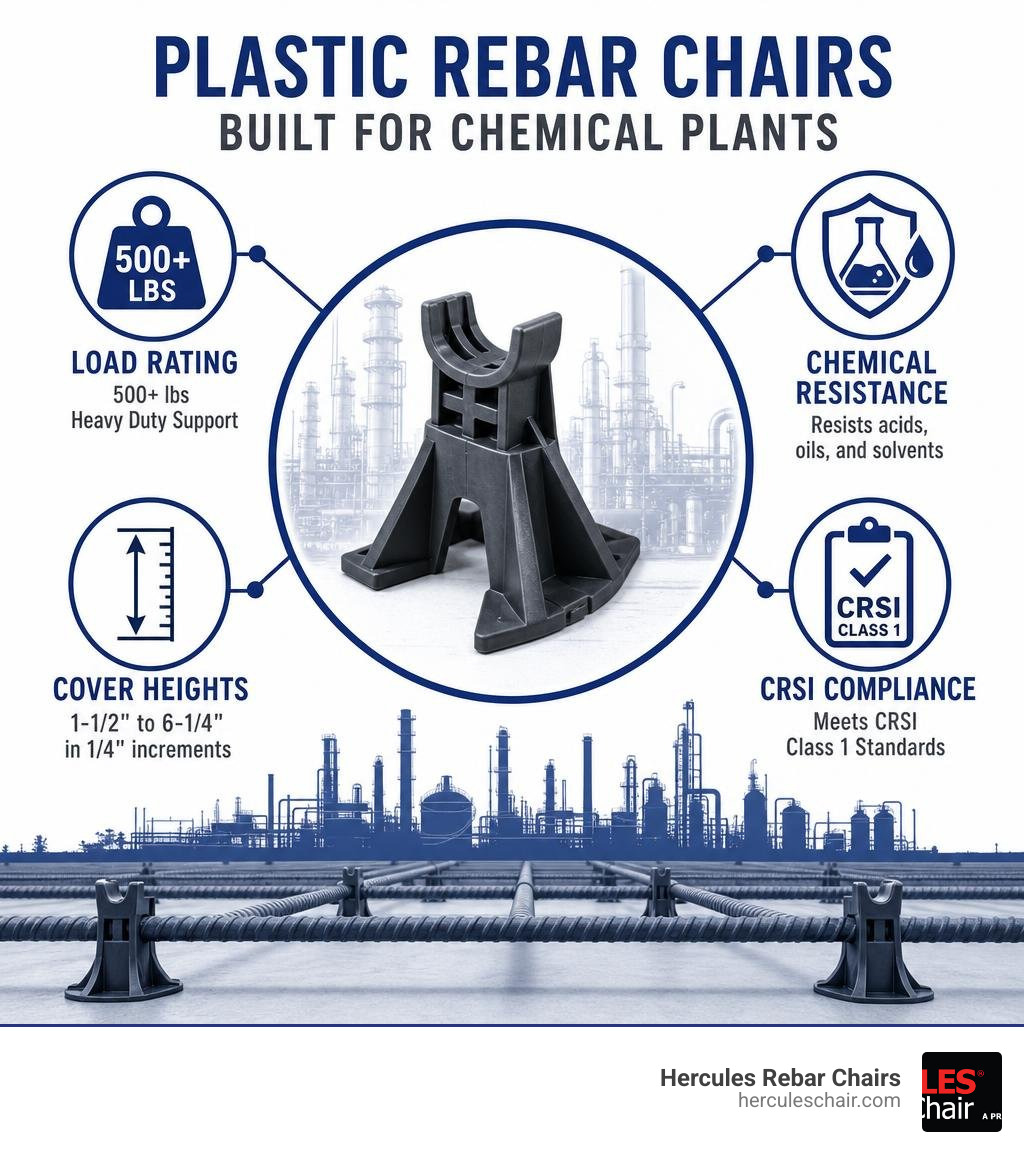
| Load capacity | 500+ lbs, CRSI Class 1 rated |
| Chemical resistance | Resists acids, oils, and solvents |
| Cover height range | 1-1/2″ to 6-1/4″ in 1/4″ increments |
| Rebar compatibility | Fits #3 through #8 rebar |
| Base type | Round (up to 4-1/4″) or square (4-1/2″ and up) |
| Corrosion risk | None — no exposed metal |
Chemical plants expose concrete structures to acids, solvents, moisture, and corrosive fumes on a daily basis. Metal rebar supports rust. Rusted supports stain and weaken concrete from the inside out — often without any visible warning signs until serious structural damage has already occurred. Plastic rebar chairs eliminate that risk entirely.
I’m Jordan Harris, a licensed Professional Engineer with a background in large-scale concrete and structural projects, and today I lead product development at T.J. Harris Company — the team behind the Hercules Chair, which has supported over 14 million concrete pours across the country, including rebar chairs for chemical plants and other demanding industrial applications. Whether you’re pouring a chemical plant floor slab or a heavy-duty foundation, choosing the right chair from the start is the decision that protects everything that comes after.
The Critical Role of Rebar Chairs for Chemical Plants
In heavy industrial construction, concrete is only as strong as its internal reinforcement. When we design foundations, secondary containment units, and floor slabs for chemical processing facilities, we are building structures that must withstand millions of pounds of equipment load while resisting constant chemical attacks.
To achieve this, the reinforcing steel (rebar) must be suspended at a precise depth within the concrete slab. If the rebar sits too low, it fails to provide the necessary tensile strength, leaving the slab vulnerable to cracking. If it sits too high, it lacks sufficient concrete coverage, which accelerates exposure to aggressive chemical agents. This is where rebar chairs for chemical plants become absolutely critical.
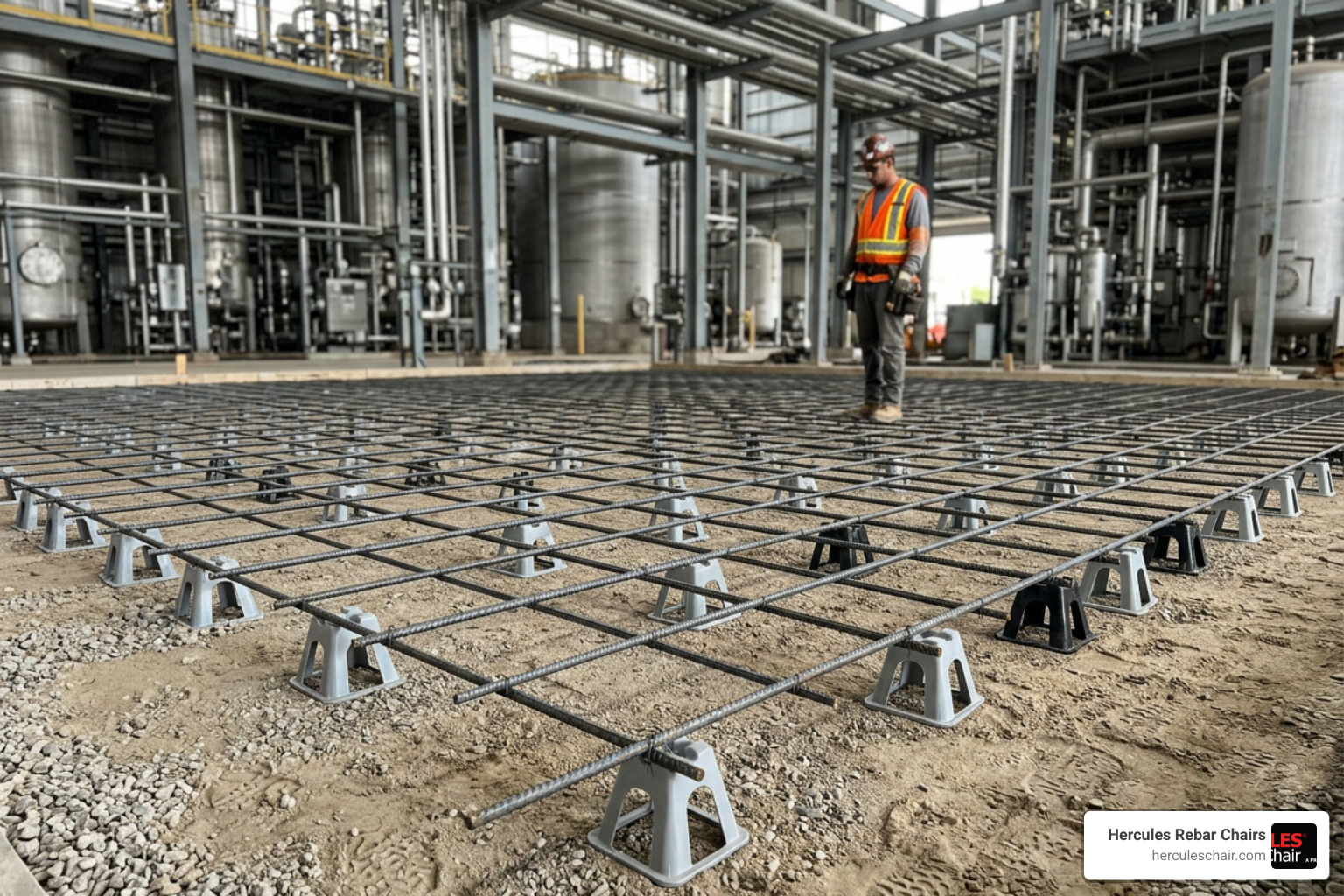
Without reliable supports, the heavy weight of the steel grid—and the footsteps of workers walking over it during the pour—will push the rebar down to the subgrade. When rebar rests directly on the vapor barrier or the ground, it loses its structural purpose. To understand why this positioning is non-negotiable for industrial slabs, you can read our detailed breakdown on Why Your Slab Needs Rebar Chair Supports.
In chemical plants, the stakes are even higher. Concrete is inherently porous. Microscopic pathways allow moisture, salt air, and airborne chemical compounds to slowly migrate inward. If the concrete cover over the steel is compromised due to poor spacing, these corrosive agents reach the rebar much faster. Once the steel begins to rust, it expands up to several times its original volume, causing the surrounding concrete to crack, spall, and ultimately fail. Using high-quality, corrosion-proof chairs ensures that the rebar remains locked in its designated sweet spot, preserving the structural design life of the facility.
Why Heavy-Duty Plastic Chairs Outperform Alternative Supports in Corrosive Environments
For decades, the construction industry relied on metal wire supports or concrete blocks (dobies) to hold rebar in place. While these materials might suffice for a standard residential driveway, they present severe liabilities in a chemical or power plant environment.
Metal wire chairs, even when coated with epoxy or dipped in plastic, carry an inherent risk of corrosion. During the rough process of placing rebar and pouring concrete, these thin protective coatings can easily scrape off, exposing raw steel. Once moisture or chemicals penetrate the concrete, they find these exposed metal points and begin a destructive oxidation chain reaction. While some projects attempt to use specialized steel supports, we dive deep into the trade-offs of metallic options in The Strong Silent Type Choosing the Best Steel Rebar Chairs for Your Project.
Concrete dobies present a different set of challenges. They are heavy, fragile, prone to breaking during transit, and can create weak bonding planes within the poured concrete. If a chemical spill penetrates the slab, the interface between the precast dobie and the newly poured concrete can act as a direct pathway for corrosive fluids to reach the rebar.
Heavy-duty plastic rebar chairs solve all of these issues. They are completely rust-proof, lightweight, chemically inert, and designed to bond seamlessly with the surrounding concrete matrix.
| Support Material | Corrosion Resistance | Chemical Resistance | Installation Speed | Bond Integrity |
|---|---|---|---|---|
| Heavy-Duty Plastic | Excellent (100% Rust-Proof) | Outstanding (Resists acids, oils, solvents) | Fast (Snap-lock, no tie wire) | High (Seamless consolidation) |
| Metal Wire (Plain/Coated) | Poor to Moderate (Coatings scratch) | Poor (Vulnerable to acids) | Slow (Requires manual tying) | Moderate |
| Concrete Dobies | High | Moderate (Porous) | Slow (Heavy, breaks easily) | Low (Creates cold joint lines) |
Chemical Resistance Properties of Plastic Rebar Chairs for Chemical Plants
The primary reason plastic rebar chairs are preferred in industrial facilities is their exceptional material formulation. High-density polyethylene (HDPE) and polypropylene are highly stable polymers that do not react with the aggressive substances commonly found on industrial construction sites.
These plastics are naturally resistant to:
- Strong Acids & Alkalis: Whether it is sulfuric acid, hydrochloric acid, or caustic soda, industrial-grade plastics maintain their structural integrity without softening or dissolving.
- Solvents and Oils: Hydrocarbon exposure, fuel spills, and industrial solvents will not degrade high-quality plastic chairs.
- Moisture and Salt Air: For chemical plants located in coastal regions, salt-laden air can destroy metal supports in a matter of weeks. Plastic is entirely unaffected by humidity and saline environments.
This shift toward non-corrosive, high-performance polymers mirrors other areas of industrial plant design. For instance, many chemical facilities now replace traditional steel structures with composite materials to eliminate maintenance costs, as highlighted in this case study on Platforms and Safety Ladders at Chemical Plant | Fibergrate UK . By applying this same logic to the internal reinforcement supports of your concrete foundations, you construct a facility designed for maximum longevity.
High-Load Performance of Heavy-Duty Rebar Chairs for Chemical Plants
A common misconception is that plastic supports lack the strength to handle heavy industrial loads. In reality, modern industrial plastic rebar chairs are engineered to support massive weights.
High-quality plastic chairs are rated to support loads exceeding 500 lbs per individual unit. This heavy-duty capacity ensures that the chairs will not crush, bend, or collapse under the weight of thick industrial rebar mats (such as #6 or #8 bars) or under the dynamic impact of construction crews walking on the grid.
Furthermore, these chairs meet the strict guidelines of the Concrete Reinforcing Steel Institute (CRSI) Class 1 Bar Support requirements. This classification is reserved for supports designed for maximum corrosion protection in environments where the concrete surface may be exposed to highly corrosive elements. For a comprehensive look at how these ratings impact project approvals and structural safety, read our guide on Compliant Rebar Elevation Chairs for Professional Results.
Key Specifications, Sizing, and Installation Advantages
When selecting rebar chairs for chemical plants, a one-size-fits-all approach does not work. Industrial foundations vary wildly in thickness, requiring precise elevation adjustments to meet engineering specifications.

To accommodate these varying demands, heavy-duty plastic chairs are manufactured in a wide array of heights and configurations. High-performance lines are engineered to provide maximum stability across a broad spectrum of industrial applications. To learn more about selecting the right configuration for your project, check out our resource on From Dobies to Double Mats A Comprehensive Look at Rebar Chair Types.
Sizing and Rebar Compatibility
Industrial plastic rebar chairs are typically available in 1/4-inch increments ranging from 1-1/2 inches to 6-1/4 inches in cover height. This precise range allows engineers and contractors to match the exact concrete cover specified in the structural drawings.
To ensure stability across these different heights, the base design of the chair adapts to the height of the support:
- Round Bases (1-1/2″ to 4-1/4″ heights): Ideal for mid-range elevations, offering a stable footprint that prevents tipping on vapor barriers or soft subgrades.
- Square Bases (4-1/2″ to 6-1/4″ heights): Designed for taller elevations where a wider, more rigid footprint is required to support heavy, multi-layered rebar grids.
These chairs are highly versatile and compatible with standard rebar sizes from #3 through #8, with many models designed to securely hold up to two intersecting bars per chair. They are typically sold in bulk packaging ranging from 100 to 480 pieces per package (and packed up to 500 pieces per box) depending on the size, making it easy to scale orders for massive industrial footprints.
Installation Efficiency and Labor Savings
In industrial construction, time is money. Traditional metal or concrete supports require workers to manually tie each intersection with wire to keep the rebar from shifting during the concrete pour. This is a slow, labor-intensive process that can add days to a project schedule.
Modern plastic rebar chairs feature an innovative snap-lock design.
This simple mechanism allows installers to secure the rebar in seconds without using any tie wire. The elimination of wire tying dramatically reduces labor costs, speeds up the prep phase of the pour, and minimizes physical strain on the installation crew. Additionally, the wide, stable bases prevent the chairs from tipping over when the concrete is discharged from the pump hose, ensuring that the reinforcement remains perfectly positioned throughout the entire pour. To discover how these small components can drive massive project savings, read Elevate Your Concrete Why Bar Chairs Are Essential for Strong Slabs.
Frequently Asked Questions about Industrial Rebar Supports
What are the load capacity requirements for industrial rebar chairs?
For heavy industrial applications, including chemical and power plants, rebar chairs must have a minimum load capacity of 500 lbs. This rating ensures that the supports can handle the heavy dead load of thick steel reinforcement mats, as well as the live loads of construction personnel and concrete placement equipment moving over the grid before the concrete cures.
How do plastic rebar chairs ensure code compliance in chemical plants?
Plastic rebar chairs ensure compliance by meeting CRSI Class 1 (Maximum Protection) standards. They guarantee that no metal is exposed near the surface of the concrete, which is a common cause of code violations in corrosive environments. By maintaining precise concrete cover depth, they satisfy the strict requirements of ACI (American Concrete Institute) building codes. For a deeper look at navigating these regulatory requirements, consult our guide on Rebar Chair Code Ensuring Stability and Compliance.
Can plastic rebar chairs be used with double mat rebar configurations?
Yes. Heavy-duty plastic chairs, particularly those designed with tall square bases or high-chair profiles, are perfect for bottom-layer support in double mat configurations. Their open-frame designs allow for maximum concrete flow and consolidation, ensuring that no voids or honeycombs form around the reinforcement during the pour.
Conclusion

When building critical infrastructure like chemical processing plants, there is no room for compromise. The materials you choose to support your reinforcing steel today will dictate the structural integrity, safety, and maintenance costs of your facility for decades to come.
At Hercules Rebar Chairs (T.J. Harris Co.), we have dedicated ourselves to manufacturing the strongest, most reliable concrete supports on the market. As America’s #1 choice with over 14 million units sold, our iconic red rebar chairs are engineered to save you time and money on the job site while ensuring absolute code compliance. Proudly manufactured and distributed across the United States, our heavy-duty plastic chairs provide the ultimate defense against chemical corrosion and structural failure.
Ready to secure your next industrial pour with the ultimate in strength and durability? Explore our complete range of heavy-duty supports by reading The Ultimate Guide to Rebar Chairs Types Uses and Sizing for Concrete Slabs or contact our team today to find the perfect solution for your project.