

Why Every Contractor Needs to Understand Rebar Couplers
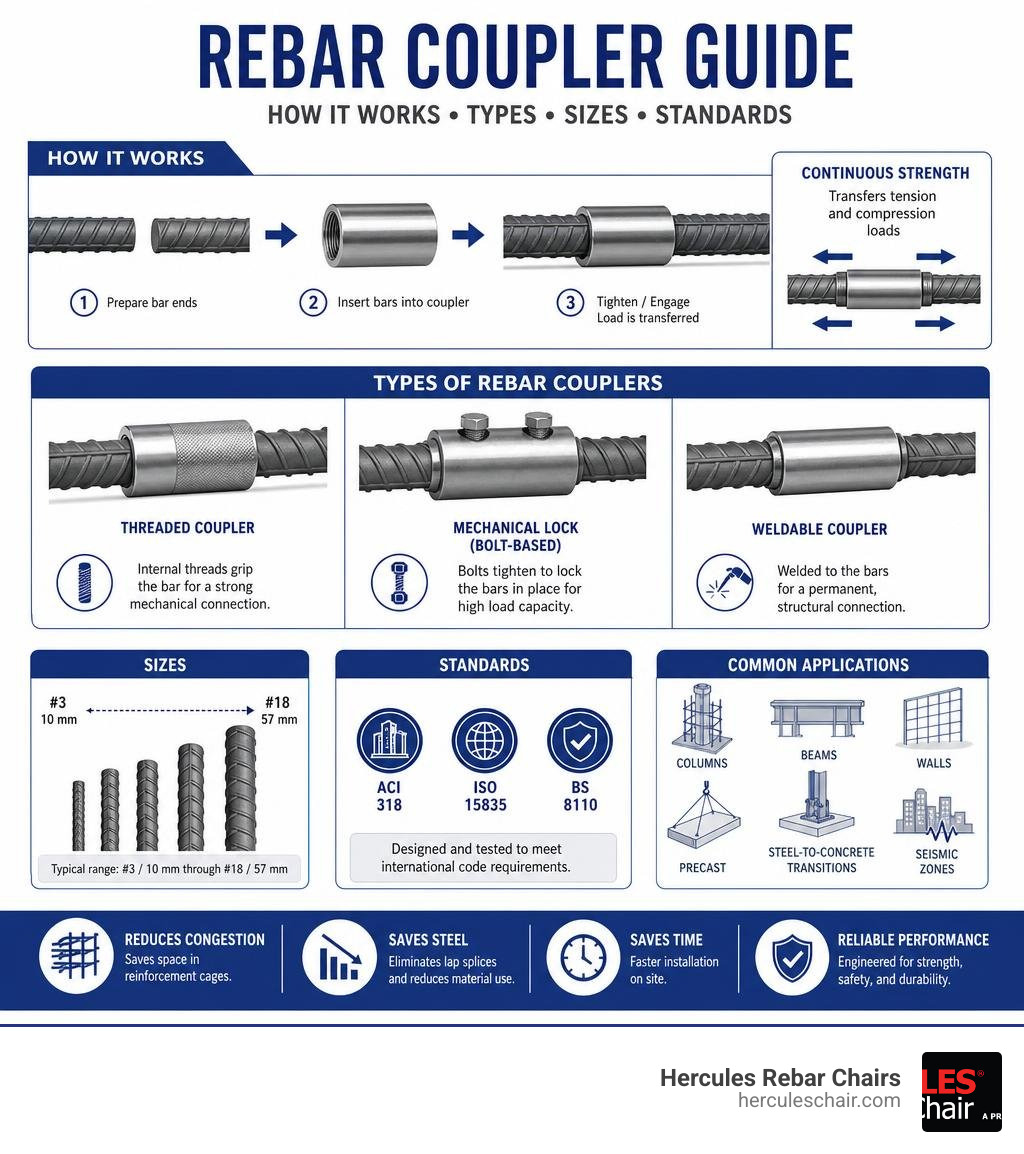
A rebar coupler is a mechanical sleeve device used to connect two reinforcing bars end-to-end, creating a continuous structural splice without lap splicing or welding. Here’s a quick overview:
| Feature | Details |
|---|---|
| What it does | Joins two rebar ends to transfer tension and compression loads |
| Common types | Threaded, mechanical lock (bolt-based), weldable |
| Bar sizes | Typically #3 / 10 mm through #18 / 57 mm |
| Key standards | ACI 318, ISO 15835, BS8110 |
| Main benefit | Eliminates lap splice congestion and reduces steel use |
| Typical applications | Columns, beams, walls, precast, and steel-to-concrete transitions |
If you’re pouring concrete on a complex project, rebar connections can make or break your schedule — and your budget.
Traditional lap splicing works, but it adds significant rebar congestion, wastes steel, and eats up space in tight form work. That’s exactly the problem rebar couplers solve.
They’re used everywhere from standard column splices to seismic zones, precast connections, and hybrid steel-concrete structures. And with sizes running from small #4 bars all the way up to heavy #18 bars, there’s a coupler solution for almost every application on site.
This guide breaks down the main coupler types, how to install them, which standards apply, and how to pick the right one for your project.
I’m Jordan Harris — a licensed structural engineer and part of the team at Hercules Rebar Chairs, where I bring hands-on experience from large-scale concrete and steel construction into every product and resource we publish. My background in structural engineering, including work on major concrete projects, means I’ve evaluated rebar coupler performance from both the design table and the job site. Let’s dig into what you need to know.
What is a Rebar Coupler and How Does It Work?
At its core, a rebar coupler is a high-strength mechanical splice designed to join two pieces of reinforcing steel end-to-end. Instead of relying on the surrounding concrete to transfer forces from one bar to another—as is the case with traditional lap splicing—the coupler establishes a direct, continuous physical link between the bars. This ensures a seamless path for both tension transfer and compression transfer throughout the structural member.
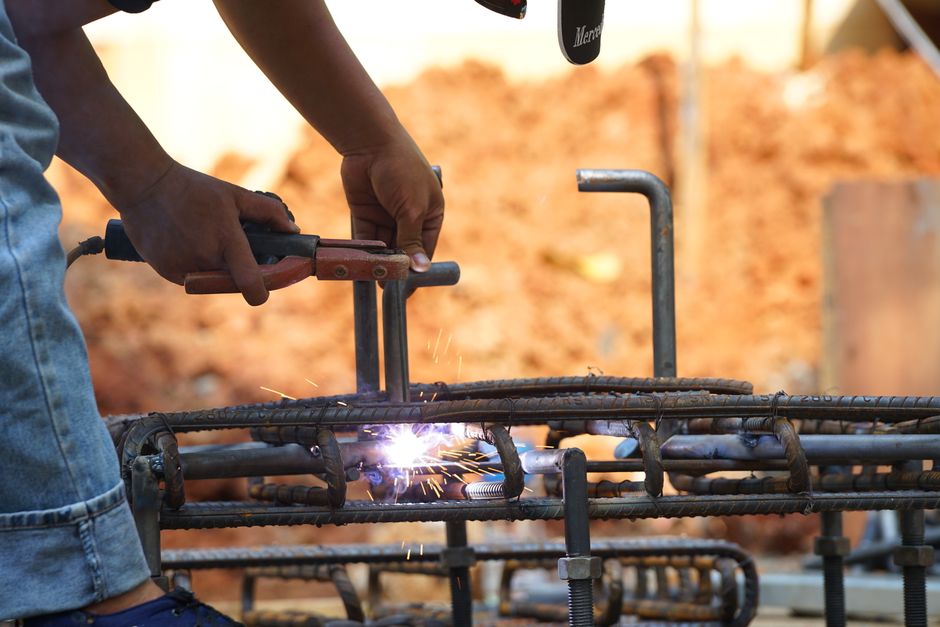
When we install a mechanical splice, we are essentially turning two independent pieces of steel into a single, continuous reinforcement bar. This is vital for maintaining the structural integrity of heavy-load elements like columns, shear walls, and bridge piers. In many situations, particularly with larger bar diameters like #11, #14, and #18, lap splicing becomes physically impractical or prohibited by code due to the extreme lap lengths required.
By using mechanical couplers, we bypass these limitations entirely. To dive deeper into how mechanical connections compare to other splicing options, you can read our guide on how to Splice It Right: Your Handbook to Mechanical Lap and Dowel Bar Splicers.
Key Types of Mechanical Splicing Systems
Choosing the right splicing system depends on your project’s specific engineering demands, access constraints, and whether the rebar can be rotated during assembly.
| Splicing System Type | Key Mechanism | Best For | Bar Rotation Required? |
|---|---|---|---|
| Threaded Couplers | Internal threads matching threaded bar ends (taper or straight) | New construction, high-repetition column/beam joints | Yes (unless using a position coupler) |
| Mechanical Lock (Bolt-Based) | Lock-shear bolts and serrated grip rails | Rehabilitation, retrofitting, and where bar ends cannot be threaded | No |
| Weldable Couplers | One-sided weld prep, one-sided thread | Structural steel-to-concrete transitions, pile caps | No (for the welded side) |
Threaded Rebar Coupler Systems
Threaded rebar couplers are among the most common mechanical splices in modern concrete construction. They fall into three primary categories based on how the threads are formed: parallel thread, taper thread, and upset straight thread.
- Taper Thread Systems: These systems use a tapered thread on the bar ends and inside the coupler. The tapered design is incredibly popular because it prevents cross-threading during installation and allows for rapid assembly. For example, standard taper-lock couplers are engineered to connect rebar sizes from #4 (13mm) up to #18 (57mm). They use a positive locking tapered thread to ensure structural continuity with minimal rotation. Similarly, tapered systems are designed for rebar sizes 12 mm to 40 mm, offering a slim profile that easily satisfies concrete cover requirements.
- Parallel Thread Systems: These couplers feature straight, parallel threads. Parallel-threaded systems are designed for connecting ribbed reinforcement bars from 10 mm to 40 mm in diameter. Some of these systems include a unique visual inspection feature, such as a color-coded indicator ring that becomes fully covered when the connection is properly tightened, giving inspectors immediate proof of a secure joint.
- Upset Straight Thread Systems: In these systems, the end of the rebar is hydraulically “upset” (enlarged) before threads are cut or rolled onto it. This ensures that the net thread area is equal to or greater than the nominal bar area, preventing any reduction in the bar’s tensile capacity. Double-sided straight thread systems are frequently utilized in heavy infrastructure projects where maximum load capacity is non-negotiable.
Mechanical Lock and Bolt-Based Rebar Coupler Systems
When you cannot rotate the rebar, or when you are working on a rehab project where threading the existing steel is impossible, mechanical lock and bolt-based systems are the ultimate problem solvers.
These couplers do not require any bar-end preparation. Instead, they utilize a friction-grip sleeve equipped with lock-shear bolts and serrated grip rails.
Standard bolt-based couplers are a leading example of this technology. To install these couplers, you simply slide the sleeve over the two bar ends and tighten the heavy-duty bolts. As you tighten them, the serrated grip rails bite into the rebar. Once the proper torque is reached, the bolt heads shear off automatically. This “torque-off” design serves as a built-in visual quality control check, proving that the coupler has been fully tightened without needing a calibrated torque wrench on hand.
These bolt-based couplers are available in standard, transition, and weldable versions in sizes #4 through #18. They cover bar diameters from 10 mm to 40 mm, using specialized shear bolts that bend or break at the target torque to guarantee a full mechanical junction in both tension and compression.
Weldable Couplers for Steel-to-Concrete Transitions
Modern architecture loves hybrid structures that combine structural steel frames with reinforced concrete cores. To bridge these two different building materials, engineers rely on weldable couplers.
A weldable coupler features a forged steel body with a smooth, beveled exterior on one half and an internal thread on the other. The beveled end is welded directly to structural steel columns, plates, or piling caps in accordance with the AWS D1.1 Structural Welding Code. Once the weld is complete and inspected, the reinforcing bar is threaded into the open end. This creates a high-strength, direct load path between the structural steel and the cast-in-place concrete elements without requiring complex dowel drilling or anchor plates.
Advantages of Couplers Over Traditional Lap Splicing
For decades, overlapping two parallel bars and tying them with wire was the default way to splice rebar. While simple, lap splicing has massive limitations that a mechanical rebar coupler easily overcomes.
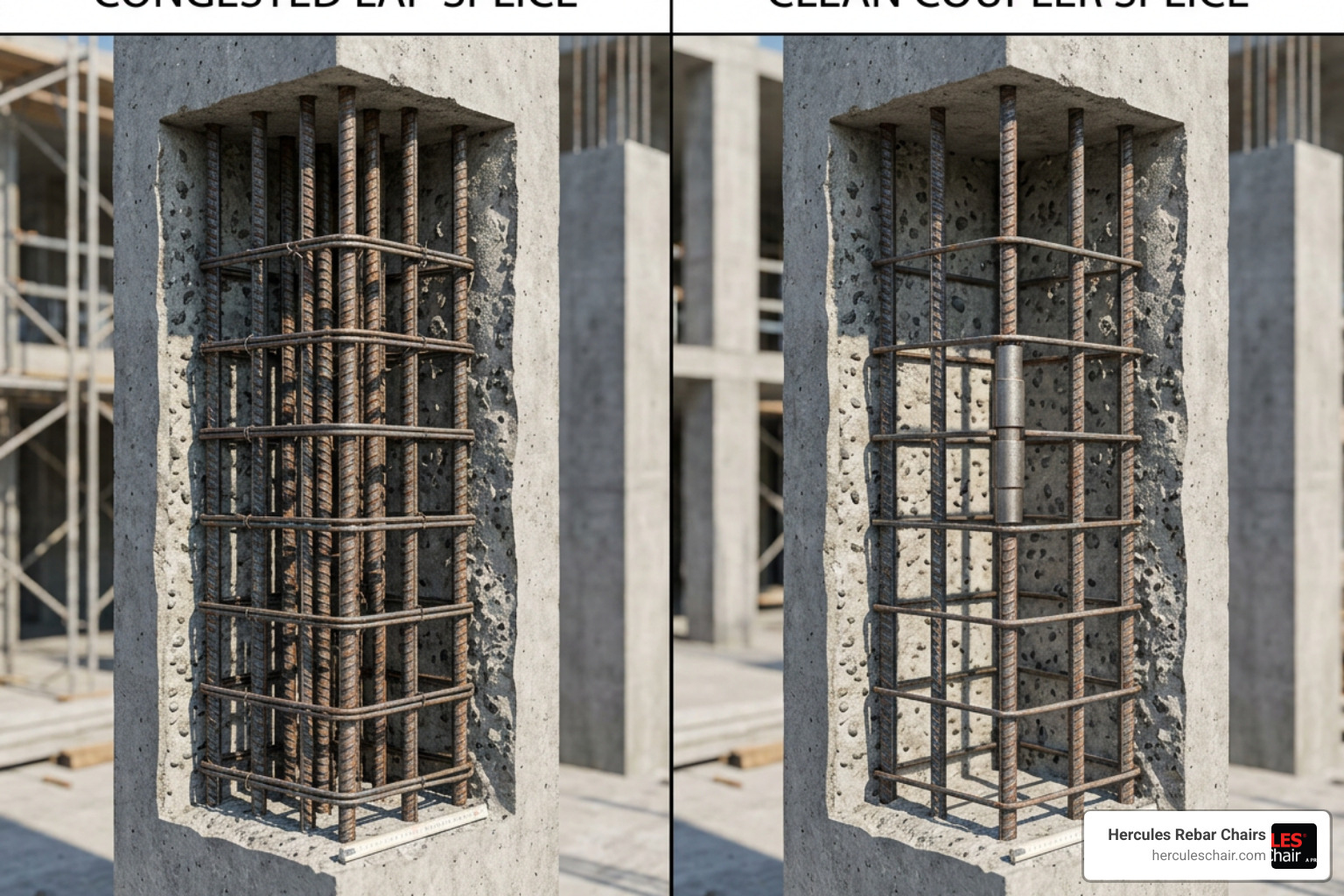
- Congestion Reduction: Lap splicing requires overlapping two bars side-by-side. In heavily reinforced columns or beams, this doubles the amount of steel at the splice zone, leaving very little room for aggregate to pass through. This can lead to honeycombing and structural voids. Couplers align bars end-to-end, maintaining a slim profile and allowing concrete to flow smoothly.
- Significant Steel Savings: Lap lengths are calculated based on bar diameter and concrete strength. For a #11 bar, a lap splice might need to be six feet long or more! Multiply that by hundreds of columns, and you are burying tons of expensive, non-structural steel in your concrete. Mechanical couplers eliminate this waste entirely, paying for themselves in material savings alone. To understand how lap lengths are calculated and why they get so long, check out our article on How to Master the Rebar Splice Length Formula.
- Superior Structural Integrity: Lap splices rely entirely on the surrounding concrete to transfer load via bond stress. If the concrete cracks or degrades, the splice fails. A mechanical coupler provides a continuous steel-to-steel connection that functions independently of the concrete’s condition.
- Enhanced Seismic Performance: Under cyclic seismic loading, concrete can spall and lose its grip on lapped bars. Mechanical couplers are designed to withstand plastic deformation and cyclic tension-compression loads, making them essential for high-rise buildings and infrastructure in earthquake-prone zones.
Technical Specifications, Series, and Installation
To ensure structural safety, every mechanical splicing system must comply with rigorous building codes. In the United States, the primary governing standard is ACI 318 (Building Code Requirements for Structural Concrete). Internationally, standards like ISO 15835 and BS8110 govern mechanical splices.
Under ACI 318, mechanical splices are classified into two categories:
- Type 1 Mechanical Splice: Must be capable of developing at least 125% of the specified yield strength ($f_y$) of the bar. These are typically used in non-seismic areas or locations where high ductility is not required.
- Type 2 Mechanical Splice: Must develop the full specified tensile strength of the reinforcing bar (which is typically 135% to 160% of the yield strength, depending on the steel grade). Type 2 splices are mandatory in seismic design zones and plastic hinge regions where the steel must be allowed to yield without breaking.
For a comprehensive review of top-performing options on the market, take a look at our guide on Splicing Made Simple with These Top-Rated Rebar Couplers.
Understanding Coupler Series (S/CA, L, and XL)
When browsing manufacturer catalogs, you will see couplers categorized into different series like S/CA, L, and XL. These designations refer to the performance levels and physical configurations of the couplers:
- S/CA Series (Standard/Caltrans): These are standard-grade couplers designed to meet Type 1 splice requirements and Caltrans (California Department of Transportation) service splice standards. They are ideal for standard tension and compression applications where the rebar is free to rotate during installation.
- L Series (Position/Type 2): Engineered to meet Type 2 requirements, these couplers are designed for positional splicing where neither bar can be rotated. They feature a multi-part sleeve and locking nut system that allows you to join two fixed, pre-bent, or curved bars on site.
- XL Series (Extra-Strength/Type 2): These heavy-duty couplers are designed for ultra-high-strength applications, seismic zones, and heavy infrastructure projects. They are built to exceed 160% of the specified yield strength, ensuring that the bar itself will fail before the mechanical splice does.
Installation Procedures and Selection Criteria
Proper installation is critical to achieving the rated capacity of a mechanical splice.
For threaded couplers, thread preparation is key. The rebar ends must be cut squarely and threaded using the manufacturer’s approved bar-threading machines to ensure a perfect fit. During assembly, a calibrated torque wrench must be used to tighten the connection to the specified torque value.
For bolt-based couplers, the process is simpler but still requires care. Workers must clean any mud or heavy rust off the rebar ends, insert the bars into the coupler until they hit the central stop pin, and tighten the bolts in a specific pattern (usually from the center outward) until the bolt heads shear off.
When selecting a coupler, always consider the environmental exposure of your project. If you are using epoxy-coated or galvanized rebar to prevent corrosion in marine or bridge deck environments, you must use matching epoxy-coated or galvanized couplers to preserve the protective barrier. For more information on selecting the right tools for the job, read A Comprehensive Guide to Comparing Rebar Connection Tools.
Frequently Asked Questions about Rebar Splicing
Can rebar couplers be used on epoxy-coated or galvanized bars?
Yes. Manufacturers offer specialized epoxy-coated and galvanized versions of their couplers to match the corrosion protection of the reinforcing steel. For bolt-based systems, you can often install them directly over coated bars without stripping the epoxy or galvanization, as the serrated rails bite through the coating to establish a secure mechanical connection.
What is the difference between Type 1 and Type 2 mechanical splices?
A Type 1 splice must reach at least 125% of the rebar’s specified yield strength ($fy$). A Type 2 splice is a “full-strength” connection that must develop the specified tensile strength of the bar (typically 135% to 160% of $fy$). Type 2 splices are required in high-seismic regions (Seismic Design Categories D, E, and F) because they guarantee that the rebar can undergo plastic deformation without the connection failing.
Do mechanical couplers require specialized installation equipment?
It depends on the system. Threaded couplers require bar-threading machines to prep the rebar ends, along with torque wrenches for final tightening. Mechanical lock (bolt-based) couplers do not require any bar end preparation; they can be installed using standard impact wrenches or manual socket wrenches, making them highly convenient for job sites.
Conclusion
Whether you are building high-rise columns in California, expanding a highway bridge in Texas, or pouring a precast foundation in New York, understanding how to select and install a rebar coupler is essential for modern concrete construction. These mechanical splices save time, eliminate rebar congestion, and guarantee code-compliant structural integrity.
At Hercules Rebar Chairs, we are dedicated to helping contractors build stronger, safer, and more efficient concrete structures. As America’s #1 concrete support manufacturer with over 14 million units sold, we know what it takes to keep steel perfectly positioned and code-compliant. Our signature red concrete supports and rebar chairs are designed to save you time and money on every pour.
For more expert advice on reinforcing your concrete projects, dive into our Rebar Couplers: Your Ultimate Guide to Connecting Steel Strong.