

Why the Threaded Rebar Coupler Has Become the Industry Standard
A threaded rebar coupler is a mechanical sleeve that connects two reinforcing bars end-to-end using precision threads — no lapping, no welding, no concrete dependency required.
Quick answer: Here’s what you need to know at a glance:
| Question | Answer |
|---|---|
| What does it do? | Connects two rebar ends with a threaded sleeve to transfer full tensile load |
| What sizes does it cover? | #4 to #11 (12 mm to 40 mm diameter) |
| How strong is it? | Exceeds 125% of specified yield strength for Grade 60 rebar |
| How fast is installation? | Two bars can be connected in as little as 35 seconds |
| What standards apply? | ACI 318, ISO 15835, Eurocode 2 |
| Where is it used? | Columns, walls, slabs, bridges, tunnels, seismic zones |
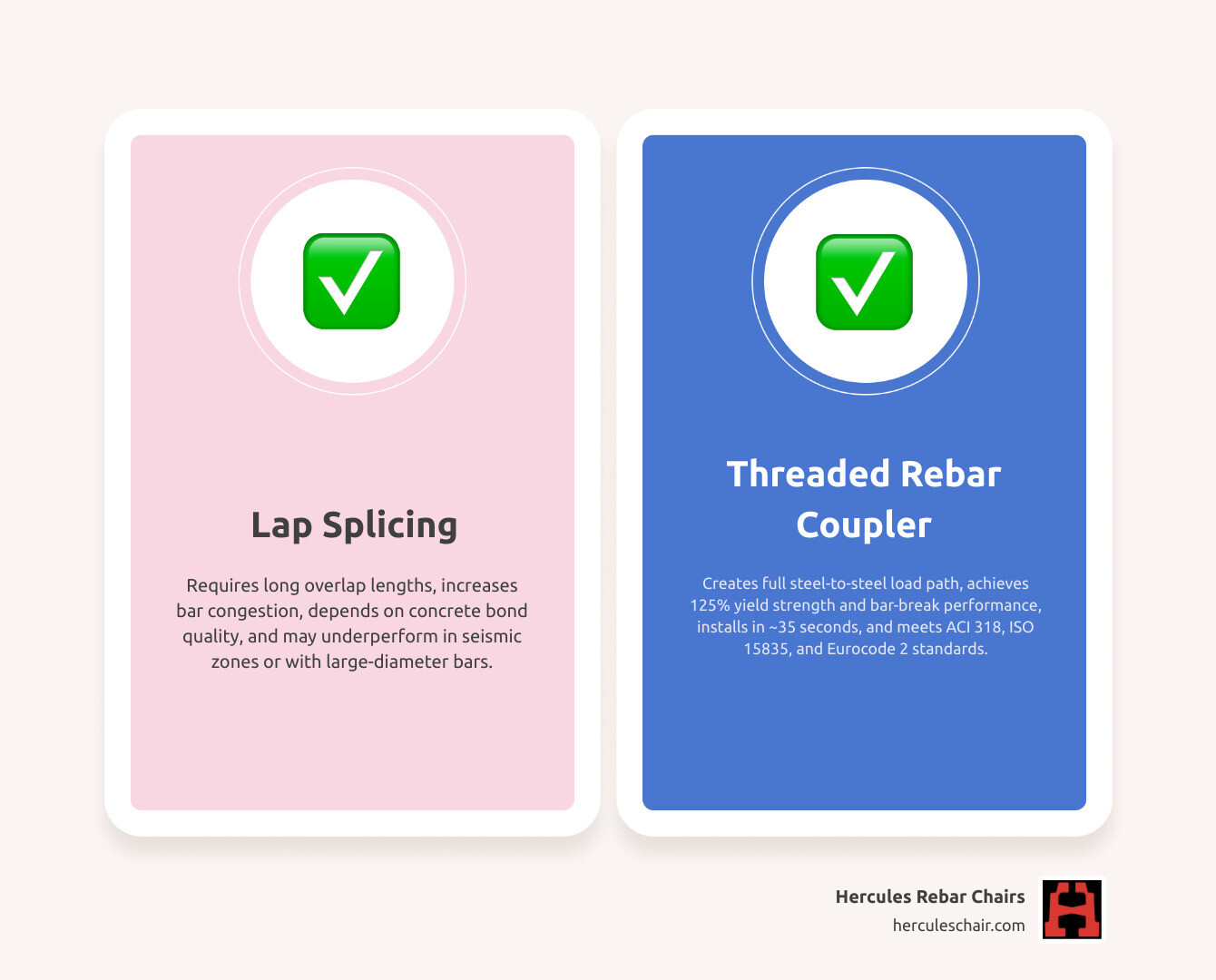
For decades, contractors defaulted to lap splicing — overlapping two bars and letting the concrete bond carry the load. It works, but it costs more steel, creates congestion, and struggles in seismic zones and large-diameter applications. Mechanical threading changed that.
Today, threaded couplers are engineered to achieve full bar-break performance — meaning the rebar itself fails before the connection does. That’s not a marketing claim. It’s a testable, code-defined result that structural engineers now specify by default on high-stakes projects.
Whether you’re tying columns for a high-rise or prepping rebar cages for a bridge deck, understanding how these systems work — and how to install them correctly — can save you real time and money on the job site.
I’m Jordan Harris, a licensed Professional Engineer and structural engineering specialist with hands-on experience designing large-scale concrete systems. That background directly informs how I evaluate threaded rebar coupler technology — from thread engagement mechanics to code compliance. Let’s walk through everything you need to know to use these systems with confidence.
Understanding the Threaded Rebar Coupler and Mechanical Splicing
At its core, a threaded rebar coupler is designed to provide a continuous load path. Unlike lap splicing, which relies on the surrounding concrete to transfer stress from one bar to another, a mechanical splice creates a direct steel-to-steel connection. This is vital because it makes the structural integrity of the joint independent of the concrete’s condition or bond quality.
The most common manufacturing process for high-performance couplers involves parallel thread processing. To ensure the connection doesn’t become the “weak link,” many systems utilize cold forging (also known as upset forging). In this process, the end of the rebar is hydraulically enlarged before the threads are cut or rolled. This ensures that the cross-sectional area at the root of the thread is equal to or greater than the original bar diameter.
The result is a “male-female” connection where the threaded bar end (male) screws into the internally threaded sleeve (female). By using techniques like rib-peeling and rolled threading, manufacturers can achieve a high-precision fit that eliminates the “play” or slip often associated with older mechanical systems.
For a deeper dive into how these connections fit into the broader world of steel reinforcement, check out our Rebar Couplers: Your Ultimate Guide to Connecting Steel Strong.
Selecting the Right Threaded Rebar Coupler for Your Project
Choosing the right coupler starts with the rebar itself. In the United States, we typically work with ASTM A615 Grade 60 rebar. These bars are the backbone of our infrastructure, and the couplers must be rated to match or exceed their performance.
Standard threaded rebar coupler systems are designed to accommodate a wide range of bar diameters:
- Small Diameters: #4 (12mm) and #5 (16mm) are common in residential and light commercial slabs.
- Medium Diameters: #6 (20mm) to #8 (25mm) are the workhorses of column and beam construction.
- Large Diameters: #9 (28mm), #10 (32mm), and #11 (36mm or 40mm) are used in heavy civil engineering, bridge piers, and high-rise foundations.
When selecting your system, you must ensure the coupler is specifically designed for the grade of steel you are using. For example, a coupler designed for Grade 60 may not meet the 125% yield strength requirement if used on higher-strength Grade 75 or Grade 80 rebar. You can find more details on matching products in our guide to Splicing Made Simple with These Top-Rated Rebar Couplers.
Essential Types of Threaded Couplers for Modern Construction
Not every rebar connection is a simple “point A to point B” scenario. Construction sites are messy, and sometimes the bars can’t move or rotate. That’s why the industry has developed several specialized coupler types.
| Coupler Type | Primary Application | Key Feature |
|---|---|---|
| Standard Coupler | General splicing where at least one bar can rotate. | Simple, cost-effective, parallel threads. |
| Positional Coupler | Connecting rebar cages or fixed bars that cannot be rotated. | Multi-part system, often includes a lock nut. |
| Transition/Reducing | Connecting two bars of different diameters (e.g., #9 to #8). | Internally stepped threads to match both sizes. |
| Weldable Socket | Connecting rebar to structural steel plates or beams. | Made from weldable carbon steel; one end is threaded. |
| End Anchor | Replacing long “hook” bars in congested zones. | Large “head” that provides anchorage via bearing area. |
Standard couplers are the most frequent sight on-site. They are used when the “continuation bar” can be freely spun into the sleeve already attached to the “fixed bar.” However, in bridge construction or heavy cage assembly, we often encounter situations where neither bar can be rotated. This is where the positional threaded rebar coupler becomes the hero of the day.
The Role of the Positional Threaded Rebar Coupler
Imagine you are lowering a 20-foot column cage onto starter bars protruding from a foundation. You can’t exactly spin the entire cage to engage the threads!
The positional coupler solves this by using an “adding length” thread or a multi-part sleeve. In these systems, the coupler is screwed entirely onto one bar (the one with the extra-long thread). Once the bars are butted against each other, the coupler is screwed back onto the second bar. A lock nut is then tightened against the coupler to ensure a rigid, slip-free connection.
These adjustable connections are vital for maintaining the pace of construction in complex projects like subways or comprehensive pipe galleries. For a handbook on how to manage these specific dowel bar challenges, see Splice It Right: Your Handbook to Mechanical Lap and Dowel Bar Splicers.
Why Mechanical Couplers Outperform Traditional Lap Splicing
If you’ve ever looked at a column blueprint and seen more steel than concrete, you’ve seen bar congestion. Lap splicing requires overlapping bars by a specific length (the “lap length”), which can be 40 to 60 times the bar diameter. In a dense column, this effectively doubles the amount of steel in the splice zone.
Using a threaded rebar coupler offers several massive advantages:
- Reduced Congestion: Because the bars are connected end-to-end, the cross-sectional area of steel remains constant. This allows concrete to flow easily, preventing “honeycombing” and ensuring a better bond.
- Structural Integrity: Mechanical splices are “Type 2” splices, meaning they are designed to exceed 125% of the specified yield strength (fy). In many tests, they achieve 100% bar break, meaning the connection is actually stronger than the rebar.
- Material Savings: While a coupler costs more than a few inches of wire, you save the cost of the entire lap length of steel. On a #11 bar, a lap can be 5 feet long—that’s a lot of expensive steel saved per joint.
- Speed: A skilled worker can complete a connection in roughly 35 seconds.
- Seismic Resistance: Mechanical couplers provide superior performance in earthquake zones by maintaining ductility and load path continuity, even if the concrete cover spalls off during a seismic event.
For those still calculating lap lengths by hand, our guide on How to Master the Rebar Splice Length Formula explains why the mechanical route is often the simpler path.

Step-by-Step Guide to Installing a Threaded Rebar Coupler
Installation is straightforward, but precision is non-negotiable. A poorly installed coupler is a safety hazard. Here is the standard procedure for a parallel threaded system:
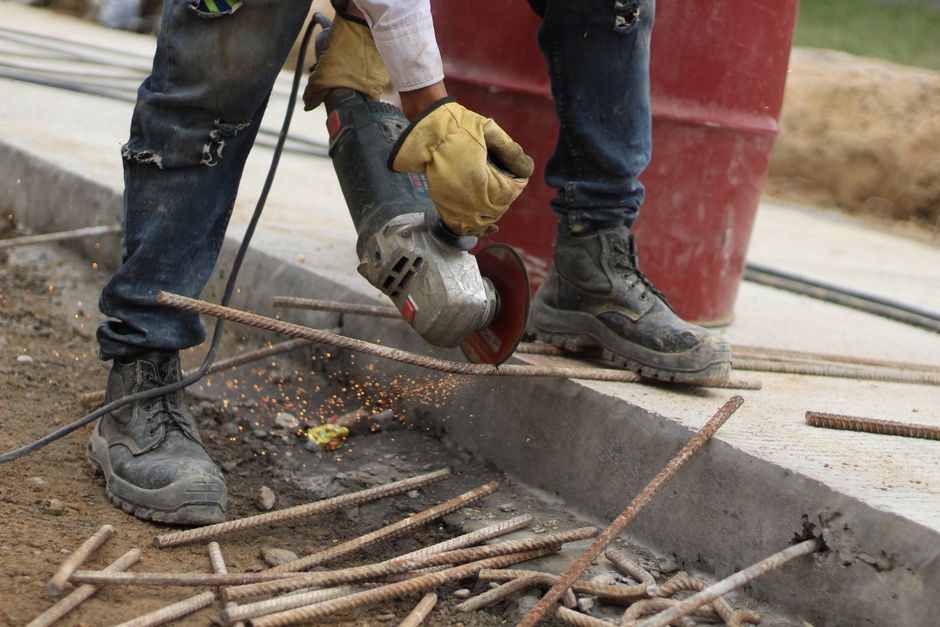
- Preparation: Ensure the rebar ends are sawn square. Any “hoof-shaped” deformation from shears must be removed via end-face grinding.
- Threading: Use a rib-peeling and rolling machine to create the threads. The threads should be clean and protected by plastic caps until the moment of connection.
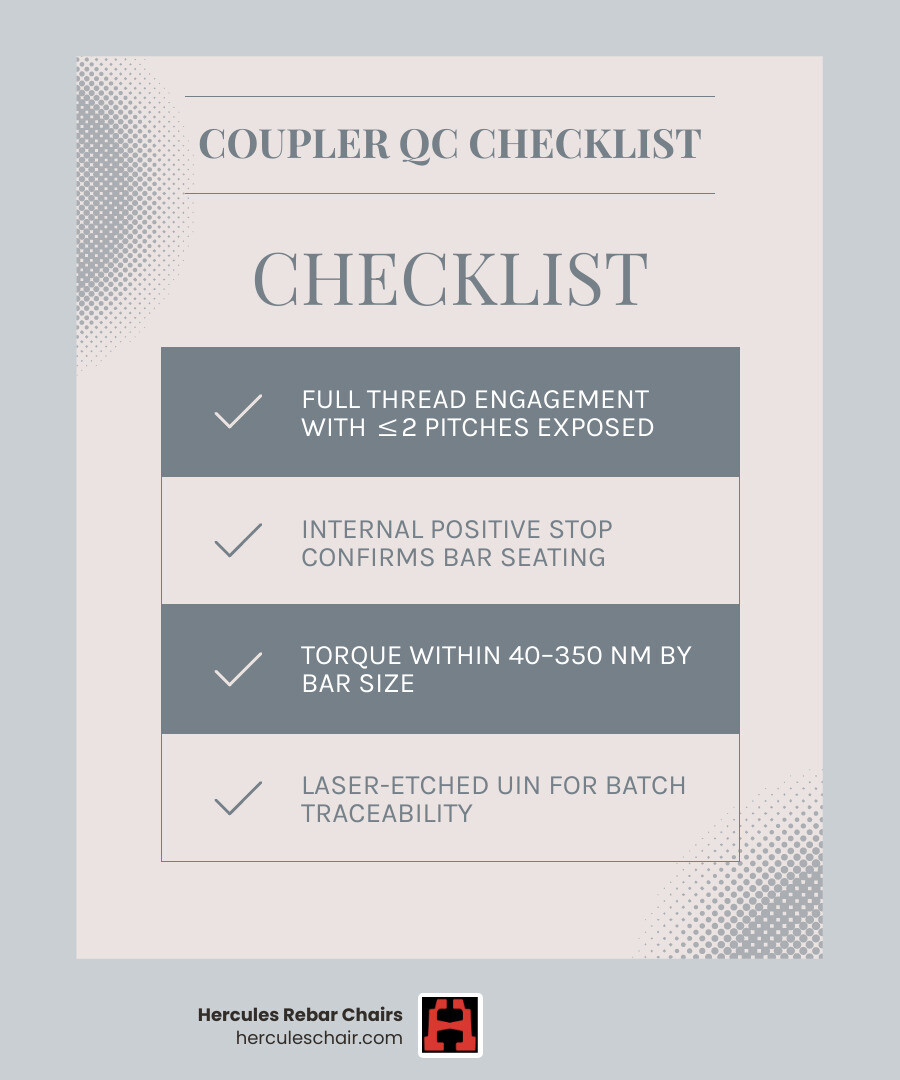
- Initial Engagement: Remove the protective caps. Screw the threaded rebar coupler onto the fixed bar. Many high-quality couplers feature an internal positive stop, which tells the installer exactly when the bar is fully seated.
- Connecting: Bring the second bar into position and screw it into the coupler.
- Torquing: Use a calibrated torque wrench to tighten the connection. While the threads provide the strength, the torque ensures that “slip” is minimized to meet serviceability requirements.
Torque Requirements by Bar Size (Approximate):
- #4 (12mm): ~40 Nm
- #8 (25mm): ~180-200 Nm
- #11 (40mm): ~300-350 Nm
For a comparison of the tools you’ll need for this process, refer to A Comprehensive Guide to Comparing Rebar Connection Tools.
Ensuring a Secure Threaded Rebar Coupler Connection
How do you know it’s right? A visual inspection is your first line of defense. Generally, there should be no more than two full thread pitches exposed outside the coupler after tightening. If you see more, the bar isn’t deep enough.
In May 2026, quality control has gone digital. Many manufacturers now use UIN (Unique Identification Number) systems. Each coupler is laser-etched with a code that allows us to track its manufacturing batch, material certifications, and even the technician who processed the threads. This level of traceability is becoming a standard requirement for infrastructure projects in states like New York, California, and Texas.
Performance Standards and Seismic Compliance in 2026
In the current construction landscape of 2026, “close enough” doesn’t cut it. To be used in modern structures, a threaded rebar coupler must meet rigorous international and domestic standards:
- ACI 318: The American Concrete Institute’s building code requires mechanical splices to develop at least 1.25 times the specified yield strength of the bar.
- ISO 15835: This is the gold standard for high-cycle fatigue. Couplers must withstand two million cycles of fatigue loading without failure.
- Seismic Performance: In earthquake-prone areas (like Alaska or the Pacific Northwest), couplers must pass “low-cycle fatigue” tests. This simulates the violent, repetitive swaying of a building, ensuring the coupler maintains its ductility and doesn’t snap.
- Bar Break Performance: The ultimate goal is a connection that forces the failure into the rebar itself, away from the joint. This ensures that the structural design’s safety factors remain valid.
Frequently Asked Questions about Threaded Rebar Couplers
Can threaded couplers be used for seismic zones?
Yes. In fact, they are often preferred. Because they don’t rely on concrete confinement like lap splices, they maintain structural integrity even if the concrete is damaged. Ensure you select a “Type 2” splice rated for seismic applications per ACI 318.
What is the difference between parallel and tapered threads?
Parallel threads (the type we’ve focused on here) maintain a constant diameter and usually require the rebar end to be upset (enlarged) to maintain strength. Tapered threads are cone-shaped. Tapered systems can be faster to “start,” but parallel threads are widely considered to offer superior consistency and are easier to inspect for full engagement.
How do threaded couplers reduce construction costs?
While the individual unit cost of a coupler is higher than wire ties, the total project cost drops. You save on the “wasted” steel used in laps, reduce the crane time needed to handle heavy, congested cages, and significantly speed up the construction cycle of columns and walls.
Conclusion
The threaded rebar coupler has earned its place as the industry standard by solving the most persistent problems in concrete construction: congestion, material waste, and structural uncertainty. By providing a connection that is often stronger than the steel it joins, these systems allow us to build taller, safer, and more efficient structures across the United States.
At Hercules Rebar Chairs, we understand that a strong structure is built on the details. While we are famous for our “America’s #1” red rebar chairs that ensure your steel stays exactly where it belongs during a pour, we also know that the way you connect that steel is just as vital for code compliance and safety.
Whether you are working in Florida, Ohio, or anywhere across our 50-state service area, using high-quality mechanical solutions is the best way to ensure your project stands the test of time.
Ready to upgrade your next pour with the best supports and splicing technology? Order high-quality rebar supports and splicers today and see why 14 million units of Hercules strength have become the benchmark for the American construction industry.