

Why the Right Chair for Rebar Makes or Breaks Your Concrete Slab
A chair for rebar is a small support device placed under reinforcing steel bars to hold them at the correct height inside a concrete form before and during a pour.
Quick answer: What does a rebar chair do?
| Question | Answer |
|---|---|
| What is it? | A support that holds rebar at the correct height inside concrete forms |
| Why use one? | Ensures proper concrete cover, prevents corrosion, and maintains structural strength |
| When to use? | Before every concrete pour — slabs, footings, walls, and more |
| Common heights | 1.5 in. to 15 in., depending on slab thickness and design specs |
| Stay in concrete? | Yes — chairs are permanently buried in the finished concrete |
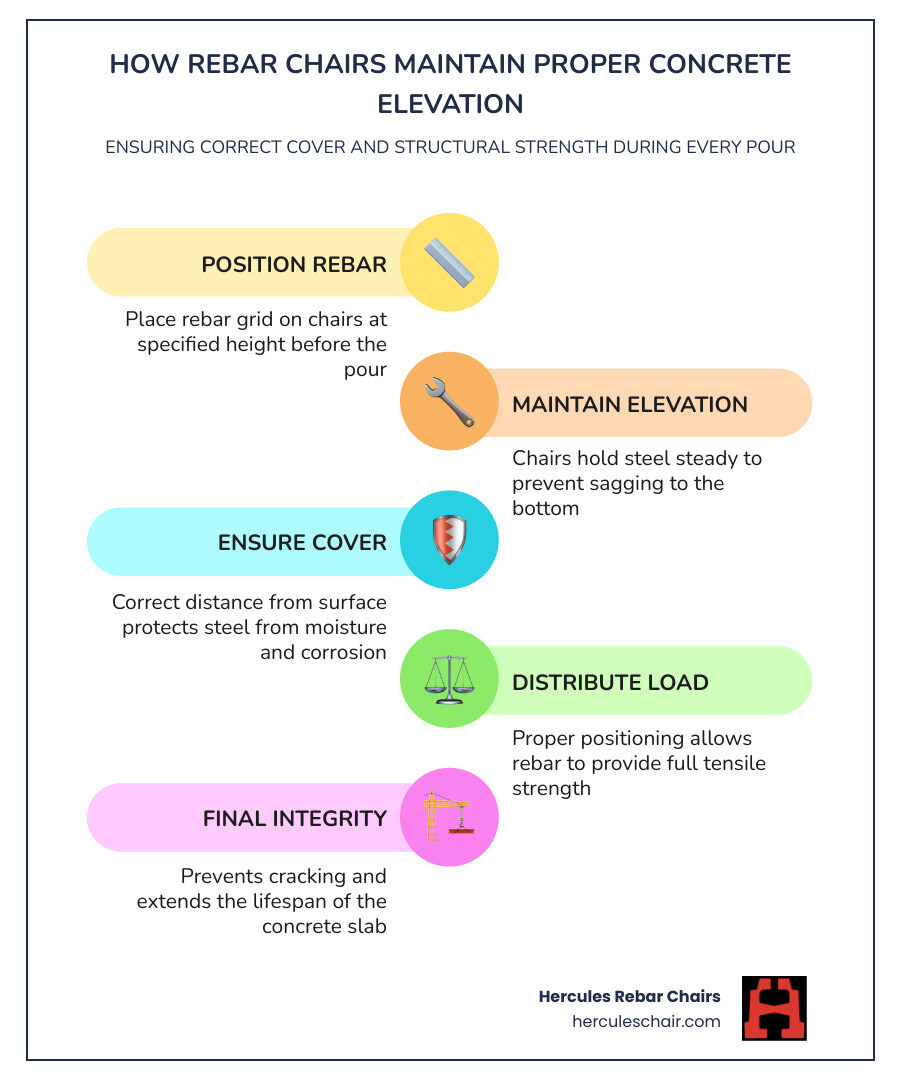
Without proper support, rebar sags to the bottom of the form. That leaves it with too little concrete cover — which leads to cracking, corrosion, and long-term structural failure.
It’s a small part. But it carries a big responsibility.
Whether you’re pouring a driveway, a foundation slab, or an elevated deck, getting rebar placement right is non-negotiable. Chairs are the simplest, most reliable way to do it — and they save significant time compared to traditional wire-tying methods.
I’m Jordan Harris, a licensed Professional Engineer with a master’s degree in structural engineering and five years of hands-on experience designing large-scale concrete structures. As part of the team behind Hercules Rebar Chairs, I’ve spent years engineering and refining the chair for rebar solutions that contractors across the country rely on every day.
What is a Chair for Rebar and Why is it Essential?
At its simplest, a chair for rebar is a standoff. In concrete construction, we often say that “concrete is only as good as its reinforcement,” but that reinforcement is only as good as its position. If your rebar isn’t exactly where the engineer specified, the structural integrity of the entire slab is compromised.
The primary purpose of these supports is to ensure “concrete cover.” This is the distance between the surface of the concrete and the outer edge of the steel. If rebar sits too low (touching the ground or the vapor barrier), it is exposed to moisture and oxygen from the earth, leading to rapid corrosion. If it sits too high, it doesn’t provide the tensile strength needed to keep the slab from cracking under heavy loads.
Beyond just holding things up, a quality chair for rebar contributes to:
- Corrosion Prevention: By keeping steel centered, you prevent “concrete cancer,” where rusting steel expands and blows the concrete apart from the inside.
- Load Distribution: Properly positioned rebar allows the concrete to distribute weight evenly, as designed by the structural engineer.
- Efficiency: Modern chairs allow you to snap rebar into place in seconds, rather than spending hours with tie wire and pliers.
For a deeper dive into why these small tools are the unsung heroes of the job site, check out Why Your Slab Needs Rebar Chair Supports and our comprehensive overview Sitting Pretty: Everything You Need to Know About Rebar Supports.
The Advantages of High-Density Plastic Rebar Supports
In the “old days,” contractors used whatever was lying around—bricks, rocks, or scraps of wood—to prop up rebar. Eventually, metal chairs became the standard. Today, however, high-density plastic (specifically polypropylene) has taken the lead for several technical reasons.
We’ve seen a massive shift toward plastic because it solves the biggest headache in concrete: rust. Even metal chairs with “plastic-dipped feet” can eventually allow moisture to travel up the leg to the rebar. A 100% high-density plastic chair is completely non-corrosive.
| Feature | Hercules Plastic Chairs | Traditional Metal Supports |
|---|---|---|
| Corrosion Resistance | 100% Rust-proof | Prone to rusting over time |
| Vapor Barrier Safety | Wide base; won’t puncture | Pointed feet can pierce liners |
| Installation Speed | Snap-lock (no tying needed) | Requires manual wire tying |
| Concrete Bonding | High; allows maximum flow | Can create “shadowing” or voids |
| Weight | Lightweight and easy to carry | Heavy and bulky in large quantities |
Our chairs are engineered for superior bonding. The design allows concrete to flow freely around and through the chair, ensuring there are no air pockets or weak spots in the finished pour. Furthermore, our wide-base design is a lifesaver when working on top of vapor barriers or rigid foam insulation; they won’t puncture the delicate liners that keep your slab dry.
For more on choosing the right material for your specific environment, see The Ultimate Guide to Rebar Chairs: Types, Uses, and Sizing for Concrete Slabs or compare your options in The Strong Silent Type: Choosing the Best Steel Rebar Chairs for Your Project.
Selecting the Right Chair for Rebar Size
Choosing the right chair for rebar isn’t just about how high you want the steel to sit; it’s also about the diameter of the bar itself. Most residential and light commercial projects use #3 (3/8″), #4 (1/2″), or #5 (5/8″) rebar.
- Bar Diameter: You need a chair that “grips” the bar. Our Hercules 1.5-inch and 3-inch chairs are specifically designed to fit #3 to #5 rebar sizes.
- Clearance Height: This is the distance from the ground to the bottom of the rebar. For a standard 4-inch sidewalk, a 1.5-inch chair is often the “Goldilocks” choice—it puts the steel right where it needs to be.
- Total Height: The overall height of the chair (including the clip) will be higher than the clearance height. For example, our 1.5-inch chair has an overall height of about 2-5/8 inches.
To make sure you don’t end up with chairs that are too tall for your forms, read The Goldilocks Guide to Concrete Bar Chair Sizes: Not Too Big, Not Too Small and Concrete Bar Chair Sizes for Every Project.
How to Use a Chair for Rebar in Multi-Layer Slabs
In heavy-duty applications like bridge decks, high-rise floors, or thick industrial slabs, you’ll often find two layers of steel—a bottom mat and a top mat. This is where “high chairs” and “slab bolsters” come into play.
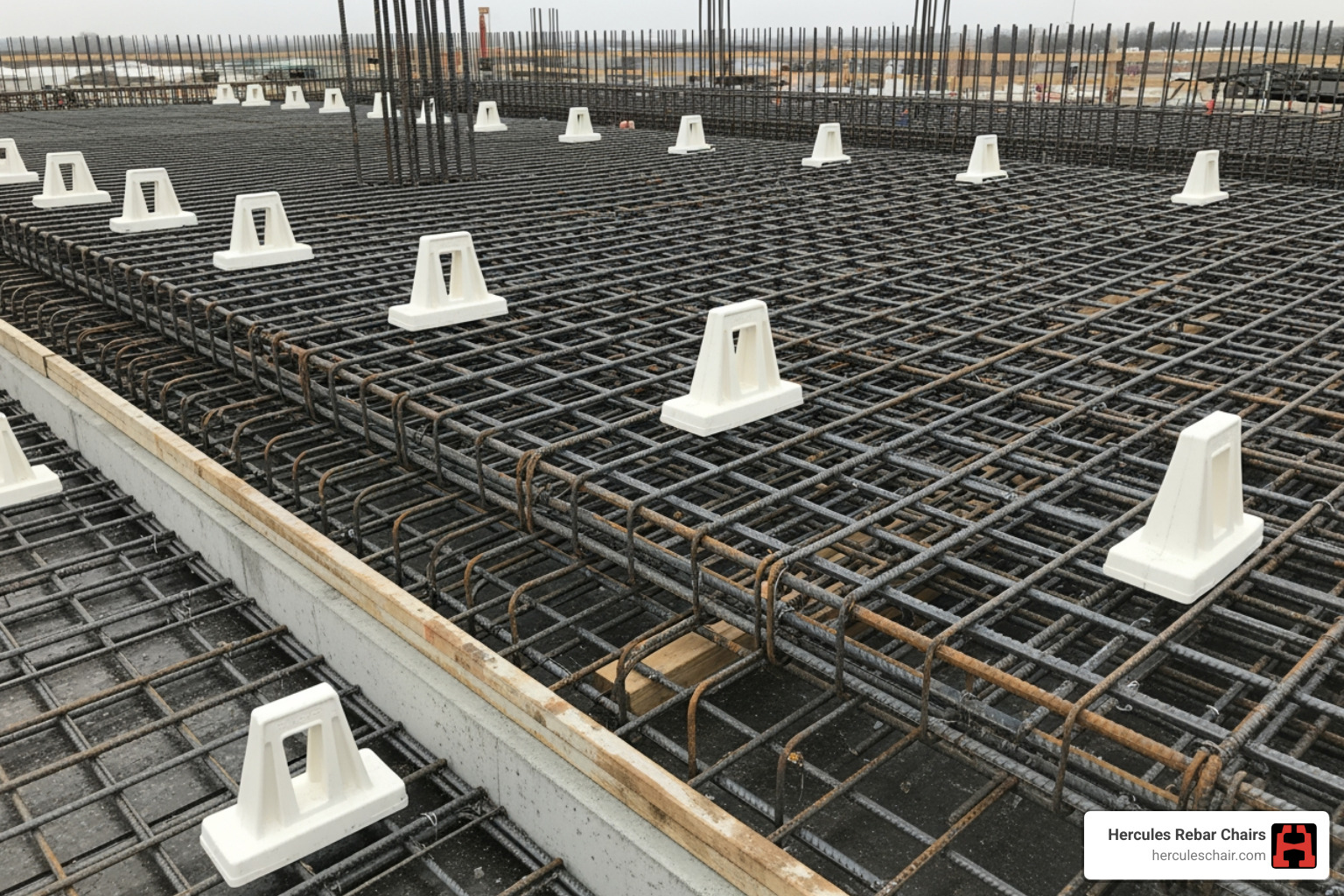
When working with multi-layer steel:
- Support the Bottom Mat: Use standard chairs or bolsters to get the first grid off the ground.
- The “High Chair” Advantage: Use individual high chairs (which can range from 2 to 15 inches) to support the upper layer. These chairs often feature a wide leg span that allows them to “straddle” the lower bars without interference.
- Continuous Supports: If you have long spans of rebar, continuous slab bolsters provide a “running” support that eliminates the need for carrier bars, significantly speeding up the setup.
For complex layouts, understanding the difference between individual supports and continuous runs is key. Learn more at The Long Span Solution: Understanding Continuous Rebar Supports and From Dobies to Double Mats: A Comprehensive Look at Rebar Chair Types.
Installation Best Practices and Spacing Guidelines
Even the best chair for rebar won’t help if they are spaced too far apart. If the rebar “bounces” when you walk on it, or sags between chairs, you need more support.
The Golden Rules of Installation:
- Spacing: Generally, place a chair for rebar every 2 to 3 feet along the length of the bar. For mesh, you may need them more frequently to prevent sagging.
- The Crossing Rule: We highly recommend placing a chair at every rebar crossing (where the longitudinal and transverse bars meet). This provides maximum stability.
- Snap-Lock Method: With Hercules chairs, you don’t need tie wire. Simply snap the bottom rebar into the lower clip and the top rebar into the top clip. It’s faster, more secure, and allows for easy repositioning if your layout changes.
- Stability Check: Before the concrete truck arrives, walk the grid. If the chairs shift or the rebar feels unstable, add more supports. Once the concrete is poured, you can’t go back and fix it!
For a step-by-step walkthrough on professional placement, see Pulling Up a Chair with Professional Rebar Standoffs.
Structural Integrity and Industry Standards
In the US, concrete construction is governed by strict codes, primarily from the American Concrete Institute (ACI). Many state Departments of Transportation (DOT) also have their own approved lists for products used in highway and bridge work.
Using a certified chair for rebar ensures that your project meets these safety standards. For instance, our chairs are designed to be “code compliant,” meaning they provide the necessary structural support and concrete cover required by building inspectors across the country.
Key standards often referenced include:
- ACI 318: Building Code Requirements for Structural Concrete.
- AS/NZS 2425:2015: While an Australian/New Zealand standard, it is often cited in international technical data for its rigorous testing of reinforcement supports.
- DOT Approvals: Essential for any government-funded infrastructure project.
Using compliant supports isn’t just about passing inspection; it’s about the long-term liability and safety of the structure. For more on the legal and technical side of supports, read Compliant Rebar Elevation Chairs for Professional Results and Elevate Your Concrete: Why Bar Chairs Are Essential for Strong Slabs.
Frequently Asked Questions about Rebar Supports
How many rebar chairs do I need per square foot?
While it varies by the weight of the rebar and the thickness of the slab, a good rule of thumb is one chair for every 2 to 3 linear feet of rebar. In a standard grid, this usually averages out to about 1 chair per 4 to 6 square feet. Always err on the side of more support; the cost of an extra box of chairs is pennies compared to the cost of a structural crack.
Do rebar chairs stay in the concrete after the pour?
Yes! Rebar chairs are designed to be “sacrificial” components. They are buried permanently within the concrete. This is why using non-corrosive plastic is so beneficial—it becomes a seamless part of the slab without creating a path for rust to enter.
Why is the snap-lock design better than tying wire?
Time is money. Traditional wire tying requires a worker to bend over, wrap wire, and twist it with pliers at every intersection. With a snap-lock chair for rebar, you simply push the bar into the clip until it clicks. It’s significantly faster, easier on the back, and doesn’t require specialized tools. Plus, if you make a mistake, you can just “unsnap” and move it—no wire cutters needed.
Conclusion
At Hercules Rebar Chairs, we take pride in being “America’s #1” choice for concrete supports. With over 14 million units sold and more than 25 years in production, our signature red chairs have become a staple on job sites from Alaska to Florida.
We understand that in the world of construction, you need products that save you time, reduce labor costs, and guarantee that the job is done right the first time. Our high-density, snap-lock chairs are engineered to do exactly that—ensuring your rebar stays exactly where it belongs while you focus on the pour.
Ready to upgrade your next project with the strongest chairs on the market? Buy Rebar Chairs More info about our products