

The Best Mesh Chairs Without Wheels in 2026
A mesh chair without wheels is one of the smartest seating upgrades you can make — whether you’re outfitting a home office, dorm room, or compact workspace.
Quick Answer: Top Mesh Chairs Without Wheels
| Chair Type | Best For | Key Feature |
|---|---|---|
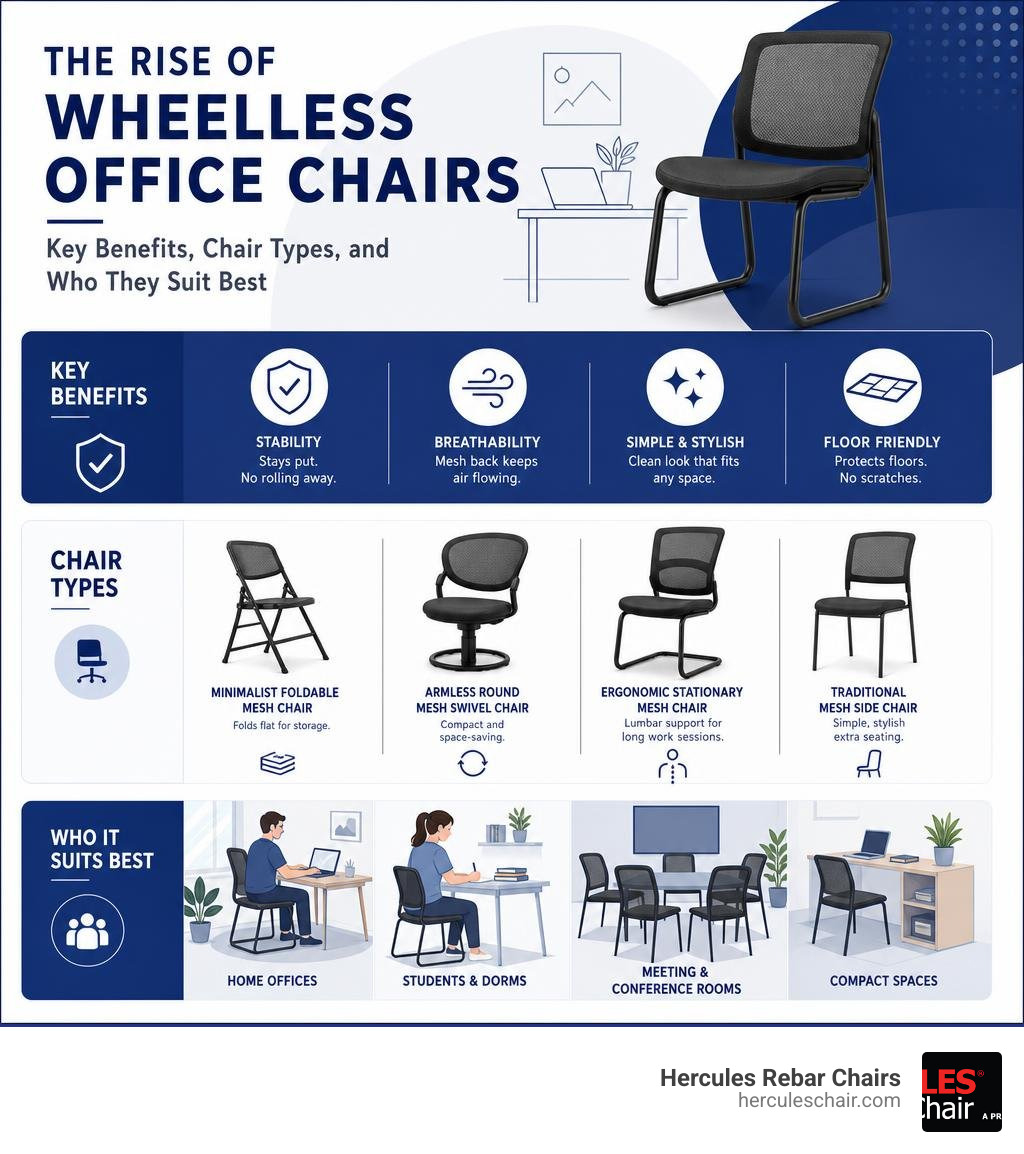
| Minimalist foldable mesh chair | Small spaces, home offices | Folds flat for storage |
| Armless round mesh swivel chair | Student desks, dorms | Compact, space-saving |
| Ergonomic stationary mesh chair | Long work sessions | Lumbar support, breathable back |
| Traditional mesh side chair | Conference rooms, extra seating | Simple, stylish design |
Most people assume every office chair needs wheels. But with over 8,000 results on Amazon alone for “office chair no wheels,” it’s clear that a huge number of people are looking for something different.
Stationary mesh chairs offer something wheeled chairs often can’t: stability, style, and breathability — all in one package. They don’t slide on uneven floors. They don’t roll away when you stand up. And the open mesh back keeps air moving so you stay cool during long sitting sessions.
They’re also a natural fit for spaces where a rolling base would be more of a hazard than a help.
So why don’t more people know about them? Because most office chair marketing pushes the same five-wheeled, gas-lift formula. This guide cuts through that noise.
I’m Jordan Harris — a licensed Professional Engineer and product developer at T.J. Harris Company, where I work with structural materials and support systems every day. My background in concrete and structural engineering has given me a deep appreciation for how material design and load support intersect — the same principles that make a mesh chair without wheels either a durable daily driver or a short-lived disappointment. In this guide, I’ll walk you through exactly what to look for.
Simple mesh chair without wheels word guide:
Why Choose a Mesh Chair Without Wheels?
When we think about office seating, we often picture the classic executive chair rolling across a plastic floor mat. But in 2026, many of us are redefining what a productive workspace looks like. The shift toward a mesh chair without wheels isn’t just a design trend; it’s a practical response to how we actually work, live, and move.
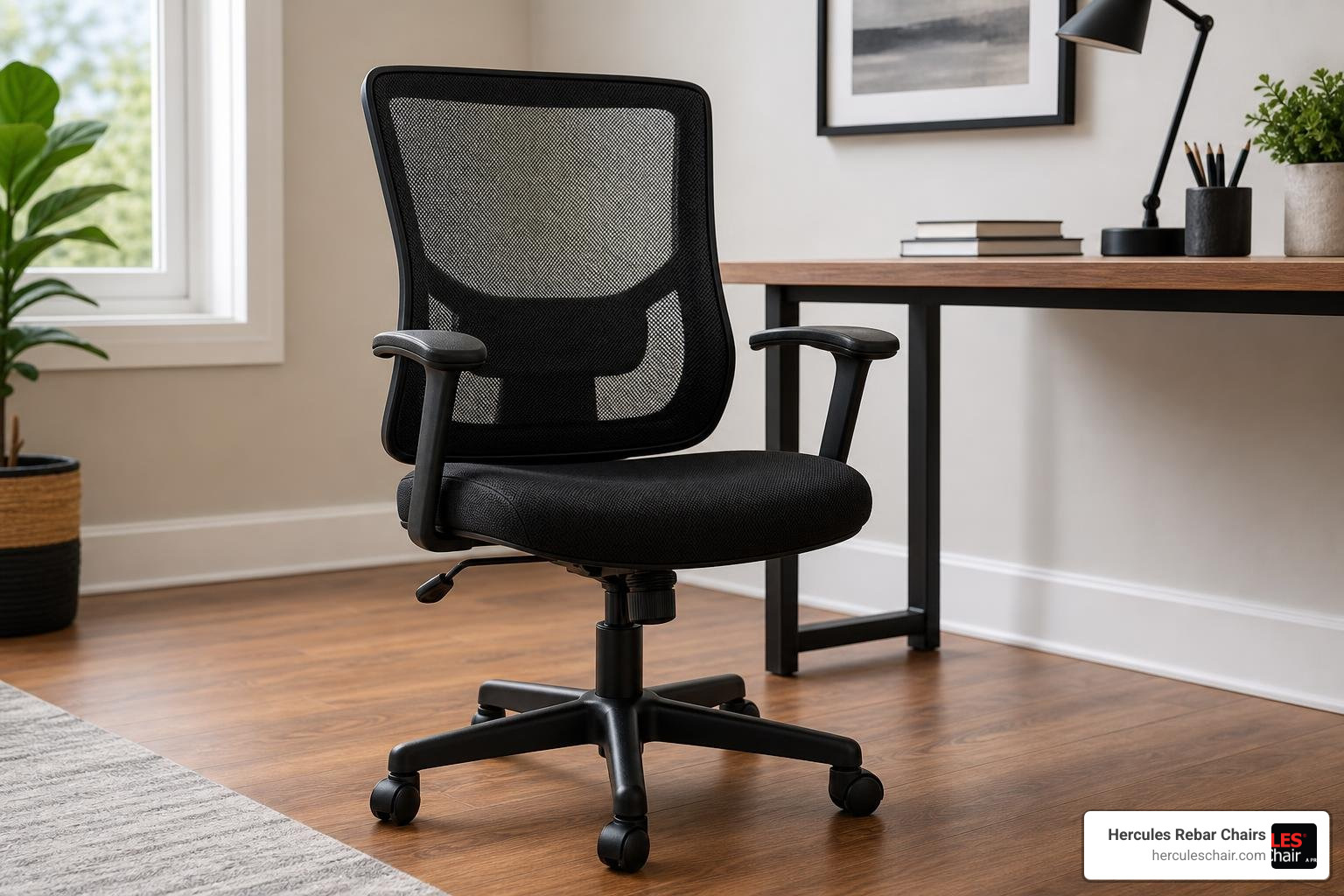
One of the biggest reasons to ditch the wheels is floor protection. Standard plastic casters are notorious for chewing up beautiful hardwood floors, scratching delicate tiles, and snagging high-pile carpets. Over time, those rolling wheels grind tiny dirt particles directly into your floor’s finish. A stationary chair, on the other hand, sits firmly in place. By utilizing flat, protective felt pads or rubberized glides, it keeps your flooring pristine.
Beyond floor preservation, stability is a major factor. If you work on an uneven floor, a platform, or a slightly sloped surface, a wheeled chair can slowly drift or roll away every time you shift your weight. This constant micro-movement forces your lower body to tense up just to keep the chair in place. A stationary base eliminates this issue entirely, giving you a rock-solid foundation.
In many ways, selecting the right base for your seating is similar to choosing structural supports in construction. Just as we analyze load distribution when selecting concrete accessories—which you can read about in The Ultimate Guide to Mesh Chairs—you must also consider how your seating distributes your weight to the ground. A four-legged or sled-base mesh chair provides a stable, predictable load path that keeps you grounded and focused.
Ergonomics of a Mesh Chair Without Wheels
Can a chair without wheels actually be ergonomic? Absolutely. In fact, removing the wheels can actually improve your posture and spinal health.
When you sit in a rolling chair, your legs and core are constantly making tiny, unconscious micro-adjustments to stabilize your position. Over an eight-hour workday, this continuous muscle tension can lead to fatigue, lower back strain, and poor posture. A stationary mesh chair without wheels encourages you to plant both feet firmly on the floor. This “two feet flat” position is the absolute foundation of healthy ergonomic posture. It naturally aligns your pelvis, reduces pressure on your lower lumbar region, and keeps your spine in its neutral “S” curve.
Furthermore, high-end stationary models are engineered to support active sitting. For instance, the advanced designs seen in the ID Mesh | Official Vitra® Online Shop GB utilize responsive spacer fabrics and synchronizing mechanisms. These systems allow for a gentle, weight-dependent forward tilt. Biomechanical studies have shown that a subtle forward tilt triggers muscle activation in the core and lower spine, preventing the stiff, locked-in feeling that often leads to back pain.
Stationary vs. Wheeled Chairs
To help you decide which setup fits your daily routine, we’ve broken down the key differences between these two styles:
| Feature | Stationary (No Wheels) | Wheeled (Rolling Casters) |
|---|---|---|
| Floor Wear & Tear | Minimal; uses soft glides or protective feet | High; can scratch wood and wear down carpet |
| Workspace Focus | Excellent; zero drifting or unwanted shifting | Moderate; prone to rolling on uneven surfaces |
| Footprint & Space | Compact; easily slides under desks and fits tight corners | Bulky; requires wider clearance for the star base |
| Postural Alignment | Encourages feet-on-floor stability and core alignment | Can lead to slouching or core strain from micro-movements |
| Aesthetics | Clean, minimalist, and blends with home decor | Industrial, highly utilitarian look |
If your job requires you to roll back and forth between multiple filing cabinets or adjacent desks, a wheeled model might still be your best bet. You can browse various options like the Office Chair No Wheels – Amazon.com to see how different bases align with your specific workflow. But if you spend your day focused at a single desk or screen, a stationary chair offers a level of calm, undistracted stability that rolling chairs simply cannot match.
Key Design Features of Stationary Mesh Seating
When shopping for a mesh chair without wheels, you shouldn’t have to sacrifice performance for style. The best models combine durable structural frames with advanced mesh textiles that keep you comfortable all day long.
The most obvious benefit of mesh is breathability. Traditional leather or thick foam cushions act like thermal insulators, trapping your body heat and moisture. After an hour or two of deep work, this can lead to that sticky, uncomfortable “hot seat” feeling. High-quality elastomeric mesh solves this by allowing air to circulate freely. It wicks away moisture and keeps your back cool, even during back-to-back video calls in a warm room.
However, not all mesh is created equal. Cheap mesh can stretch out, sag, and lose its tension over time, leaving you with zero lumbar support. Look for woven mesh that features a blend of high-strength polyester and elastomeric fibers. These materials are designed to stretch to cradle your body’s contours and then snap back to their original shape when you stand up.
The frame construction is just as critical. A stationary chair relies on a solid frame to distribute your weight evenly. Much like planning the structural spacing for reinforcing mesh in a concrete slab—a topic we discuss in detail in How to Space Your Wire Mesh Chairs Like a Pro—the frame of your office chair must be engineered to handle continuous load without warping or flexing. Look for heavy-duty steel, reinforced nylon, or cast aluminum frames that offer robust weight capacities (ideally 250 lbs or more).
How to Choose the Right Mesh Chair Without Wheels
To find the perfect chair for your physical build and workspace, keep these key ergonomic features in mind:
- Seat Depth and Width: Ensure there is a small gap (about two to three fingers wide) between the front edge of the seat cushion and the back of your knees. This prevents the seat from cutting off circulation to your lower legs.
- Height Adjustability: While many stationary chairs have fixed heights, some premium models feature a compact gas lift built into a stationary pedestal. This allows you to perfectly align your elbows with your desk surface.
- Armrest Options: Armrests can reduce shoulder strain, but only if they allow your shoulders to remain relaxed. If you prefer to slide your chair completely under your desk when not in use, an armless design or a model with flip-up arms is highly recommended.
For those who appreciate high-end design, models like the ACX Mesh | Official Vitra® Website LP showcase how modern engineering can automatically adjust to the user’s weight. These self-regulating designs eliminate the need for complicated knobs and levers, providing instant ergonomic comfort the moment you sit down.
Comparing Mesh to Criss-Cross and Cross-Legged Chairs
In recent years, “criss-cross” or cross-legged office chairs have taken social media by storm. These chairs feature extra-wide seats designed for people who like to tuck their legs up, sit cross-legged, or change positions frequently throughout the day.
While criss-cross chairs offer incredible freedom of movement, they are usually heavily padded with thick foam and wrapped in velvet or boucle fabrics. This makes them incredibly warm and prone to trapping heat. Additionally, their wide bases can take up a massive amount of floor space, making them impractical for smaller rooms.
A mesh chair without wheels offers a much more streamlined, space-saving alternative. It provides targeted lumbar support and unmatched breathability while maintaining a clean, compact footprint. If you want the best of both worlds—the stability of a stationary base with the supportive comfort of an ergonomic backrest—options like the KLASIKA Desk Chair No Wheels with Adjustable Mesh Backrest … offer a perfect middle ground, giving you structured, breathable support without the bulky footprint of a giant lounge chair.
Top Stationary Mesh Chairs on the Market
Ready to upgrade your seating? We’ve rounded up some of the most versatile stationary mesh chairs available, ranging from ultra-portable folding designs to sleek, compact study chairs.

Whether you are setting up a temporary workspace, outfitting a dorm room, or looking for a permanent addition to your home office, these chairs prove that you don’t need wheels to work comfortably. For a deeper look at how mesh materials can be utilized in creative and structural ways, check out our guide on how to Elevate Your Slab with Concrete Mesh Chairs.
Minimalist and Foldable Options
If you work in a multi-purpose room, a guest bedroom, or a tight apartment, space is at a premium. You don’t want a massive, industrial office chair dominating the room when the workday is done.
That is where a high-quality folding mesh chair shines. The Minimalist Mesh Metal Foldable Desk Chair | Lighom is an exceptional example of space-saving engineering. It features a breathable mesh backrest and seat paired with a sturdy metal frame that folds completely flat. You can easily slide it under a bed, tuck it behind a door, or store it in a closet when your workday ends. It is the ultimate blend of temporary convenience and genuine ergonomic comfort.
Compact Swivel Study Chairs
For students, teenagers, or anyone working at a smaller writing desk, a massive high-back chair can feel overwhelming. A compact, armless design is often the perfect solution.
The Armless Round Mesh Swivel Study Chair offers a playful, space-saving aesthetic without sacrificing functionality. Its armless profile means it can slide completely under desks of any height, saving valuable floor space in tight bedrooms or dorms. The swivel base allows you to rotate freely to reach items behind you, while the stationary feet keep you securely anchored when it’s time to focus on your studies.
Frequently Asked Questions About Stationary Office Chairs
Do mesh chairs without wheels protect hardwood floors?
Yes! Unlike rolling chairs that can grind dirt and grit into your wood floors, stationary mesh chairs are much gentler on hard surfaces. Most models come equipped with protective nylon glides, rubber feet, or felt pads. These accessories distribute your weight evenly and allow you to slide the chair back and forth without scratching, scuffing, or denting your hardwood, laminate, or tile floors.
Can you adjust the height of a stationary mesh chair?
It depends on the model. While many four-legged or sled-base stationary chairs have a fixed seat height (typically around 17 to 19 inches), several modern stationary chairs feature a pedestal base with a built-in pneumatic gas lift. This allows you to adjust the height just like a standard rolling chair, ensuring perfect alignment with your desk.
Are armless mesh chairs better for small spaces?
Absolutely. Armless chairs are incredibly space-efficient because they don’t require the wide clearance that armrests do. They can slide completely under your desk when you’re not using them, freeing up valuable walkway space in small apartments, dorm rooms, or bedroom corners. They also give you the freedom to sit in various postures without feeling restricted by side barriers.
Conclusion
Upgrading to a mesh chair without wheels is a fantastic way to bring stability, breathability, and clean design to your workspace. By keeping your feet planted and your seat anchored, you can say goodbye to unwanted drifting, floor damage, and distracting micro-movements.
At T.J. Harris Company, we understand the vital role that proper support plays in any project. Whether we are helping you build a rock-solid foundation with our industry-leading Hercules Rebar Chairs—proudly recognized as America’s #1 with over 14 million units sold—or helping you design a more comfortable, productive home office, we believe that quality materials and smart engineering are the keys to long-term success.
Ready to explore our heavy-duty structural support solutions? Check out our full range of products at Hercules Chair Products today!