

Why Bridge Deck Rebar Is the Hidden Force Keeping Bridges Safe
Bridge deck rebar is the steel (or composite) reinforcement embedded in a concrete bridge deck that carries tension forces the concrete cannot handle on its own. Here’s a quick summary of what you need to know:
- What it does: Rebar gives the bridge deck tensile strength, preventing cracking, sagging, and structural failure under traffic loads
- Main types: Carbon steel, epoxy-coated steel, stainless steel, Glass Fiber Reinforced Polymer (GFRP), and high-strength Grade 830 steel
- Biggest threat: Corrosion from deicing salts and moisture — the leading cause of bridge deck deterioration in northern climates
- Service life range: 35–50 years for epoxy-coated rebar; 100+ years for stainless steel or GFRP
- Key standards: ASTM A615, ASTM A706, AASHTO LRFD, and CHBDC govern rebar design and placement
Every day, roughly 200 million trips are made across bridges in the United States that are considered structurally insufficient. Corrosion of embedded rebar is one of the primary reasons bridge decks fail — and the cost is staggering. In a single year, the Canadian government alone spent an estimated $46 billion on costs related to rebar corrosion. The U.S. market is estimated to be ten times larger.
The good news? Advances in rebar materials and design are extending bridge life dramatically — and proper installation practices make all the difference.
I’m Jordan Harris, a licensed Professional Engineer with a master’s degree in structural engineering and hands-on experience designing large-scale concrete structures. My work at T.J. Harris Company keeps me deeply connected to bridge deck rebar — from the engineering principles behind reinforcement to the support systems that ensure it’s placed correctly in the field. Let’s break down everything you need to know.
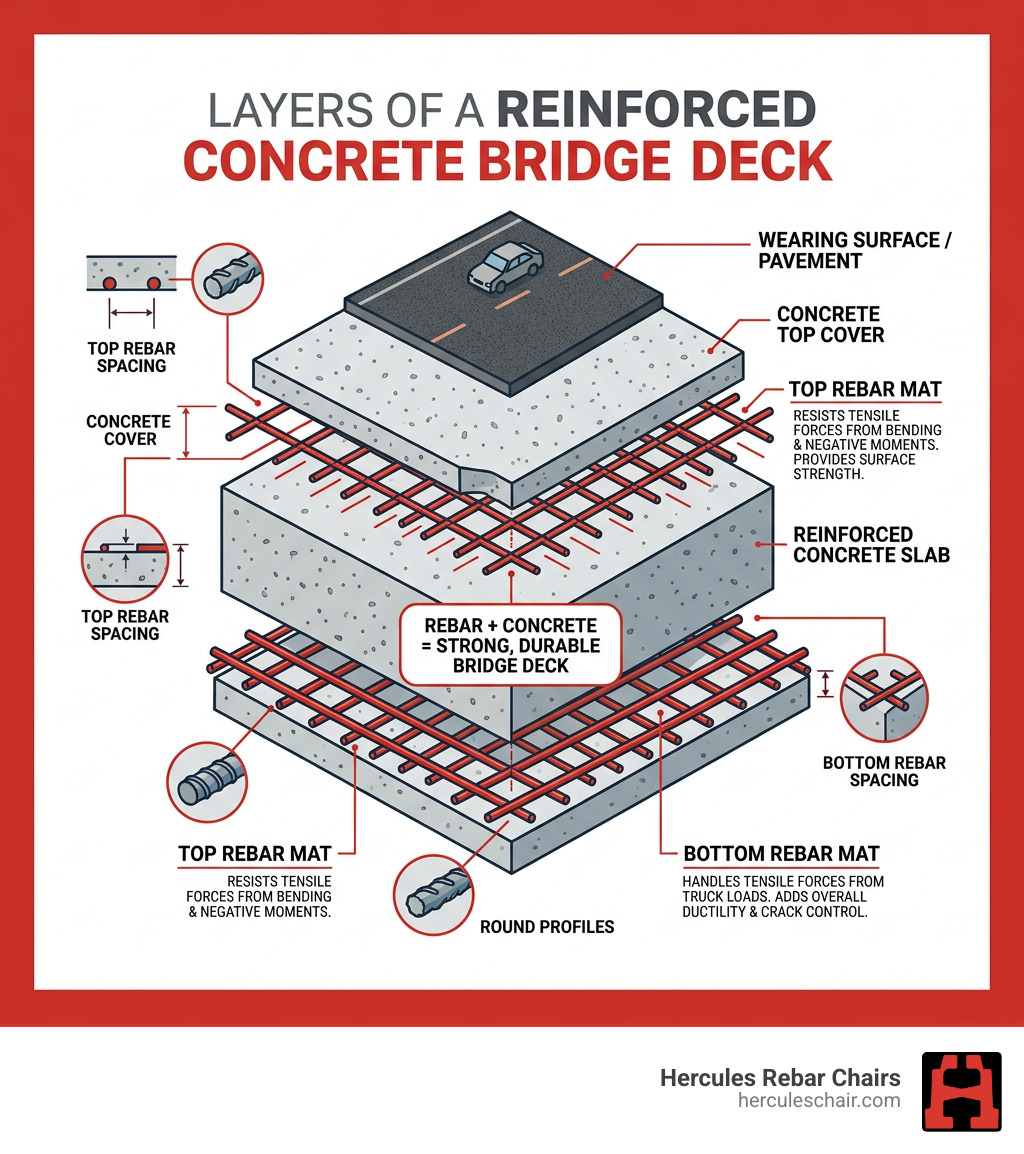
The Evolution of Bridge Deck Rebar Materials
The history of bridge construction is essentially a long-running battle against rust. For decades, traditional carbon steel was the gold standard. While carbon steel provides incredible tensile strength, it has a “Kryptonite”: chloride ions from de-icing salts and coastal spray. When these ions penetrate the concrete, the steel oxidizes, expands, and causes the concrete to spall or “pop” off.
To fight this, the industry moved toward Epoxy-Coated Rebar (ECR). Governed by standards like ASTM A615, ECR uses a protective polymer coating to block corrosive agents. In northern states like Minnesota or Ohio, where salt is spread liberally every winter, ECR bridge decks typically last between 35 and 50 years. While this was a massive improvement over bare steel, we’ve realized that even a tiny pinhole in that epoxy coating can lead to localized corrosion.
This is why understanding the relationship between the steel and its surroundings is so vital. We often talk about Rebars’ Armor: Understanding Concrete Cover and Its Critical Role because the distance between the rebar and the surface of the bridge is the first line of defense. If the rebar isn’t held at the exact right height during the pour, that “armor” fails before the bridge even opens.
Material Selection for Bridge Deck Rebar
Choosing the right material isn’t just about strength; it’s about the “Life-Cycle Cost.” While some materials are more expensive upfront, they save millions in avoided repairs down the road.
| Rebar Type | Corrosion Resistance | Estimated Service Life | Initial Cost Impact |
|---|---|---|---|
| Carbon Steel | Low | 20-30 Years | Baseline |
| Epoxy-Coated (ECR) | Moderate | 35-50 Years | +10-20% |
| GFRP (Fiberglass) | Excellent (Non-corrosive) | 100+ Years | Competitive |
| Stainless Steel | Superior | 100+ Years | +2.5x – 4x |
| Grade 830 Steel | High | 100+ Years | Lower (less steel needed) |
High-Performance Steel and ASTM A706
In regions prone to earthquakes, such as California or Washington, we can’t just focus on rust; we have to focus on “ductility”—the ability of the steel to bend without snapping. This is where ASTM A706 comes in. This specification is stricter than the standard A615. It ensures the steel has a controlled chemistry that makes it easier to weld and provides the predictable “give” needed during seismic events.
Comparing GFRP, Stainless Steel, and High-Strength Alloys
We are currently witnessing a revolution in bridge deck rebar materials. One of the most exciting players is Glass Fiber Reinforced Polymer (GFRP). Unlike steel, GFRP is completely rust-proof. It doesn’t care about road salt or seawater.
The weight savings are also mind-blowing. GFRP is so light that you can fit 4x more rebar on a single truck compared to steel. This means fewer deliveries to the job site and less strain on the crew. In fact, research from the Minnesota Department of Transportation (MnDOT) showed that while GFRP behaves slightly differently under load, its long-term performance in harsh winter climates is exceptional. Because it doesn’t rust, even if the concrete develops small cracks, the structural integrity remains intact.
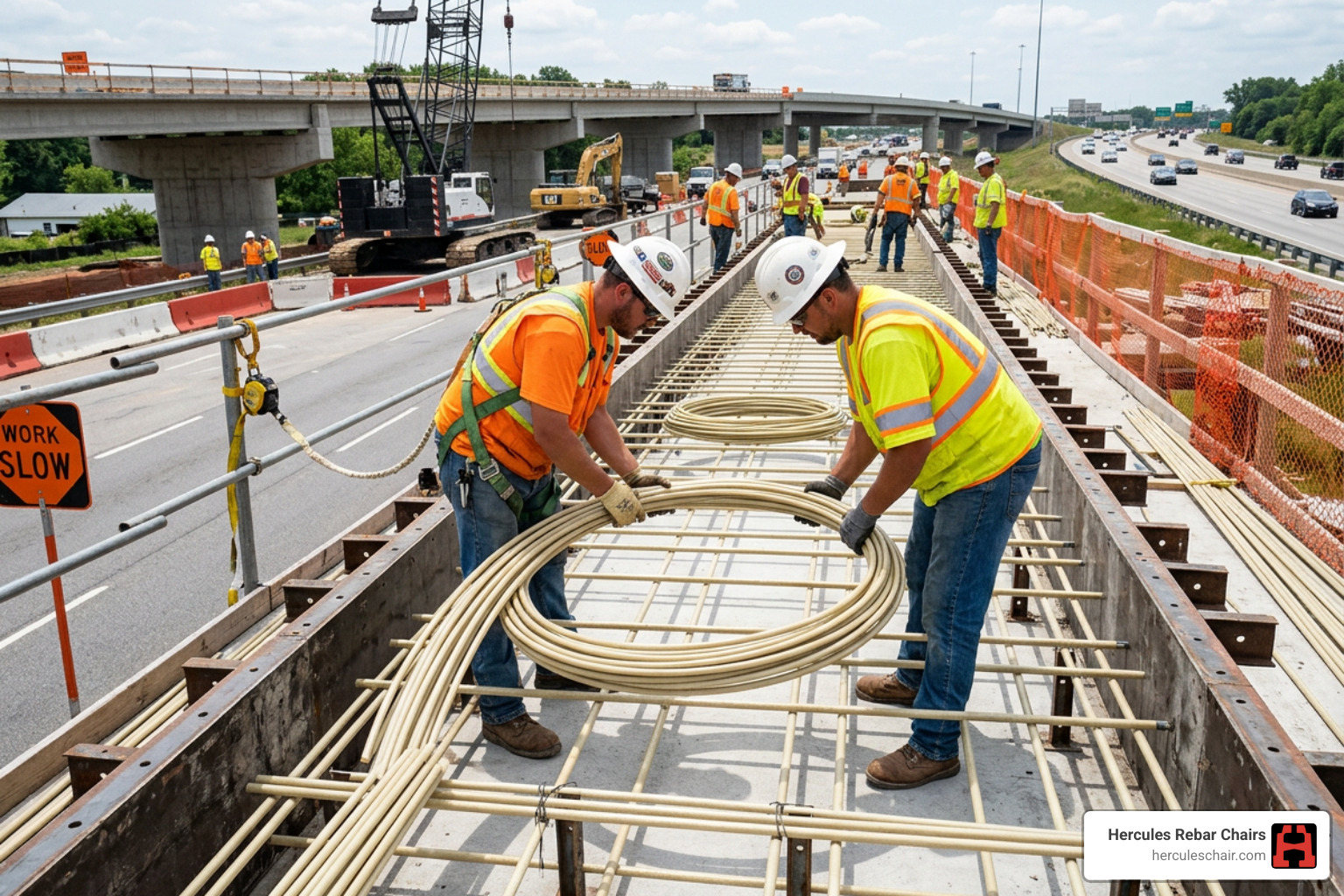
Then there is Solid Stainless Steel. While it can increase the cost of a bridge deck by about 12%, that usually represents less than 1.5% of the total structure’s cost. For that small investment, you get a 100-year service life. The famous Progreso Pier in Mexico, built with stainless reinforcement in the 1930s, is still standing strong today, while a neighboring carbon steel structure built decades later has already crumbled.
Structural Performance of High-Strength Bridge Deck Rebar
If you want to stick with steel but want more “bang for your buck,” Grade 830 (High-Strength) steel is the answer. Traditional rebar is usually Grade 420 (60 ksi). Grade 830 is nearly twice as strong.
According to a study on the Structural performance of Grade-830 steel bars, using this material can lead to a 40% savings in reinforcement costs. Because the bars are so strong, you need fewer of them. This reduces “rebar congestion,” making it easier to pour concrete into the forms. These decks also showed 37-38% greater moment capacity (the ability to resist bending) and significantly smaller crack widths compared to standard steel.
Engineering and Economic Advantages of Modern Reinforcement
We have to look at the big picture. The Federal Highway Administration (FHWA) predicts we need to invest $20.5 billion annually to eliminate bridge deficiencies by 2028. Currently, we’re only spending about $12.8 billion.
One way to bridge that gap is by using stay-in-place form systems like Bridge-Dek®. These systems allow for faster construction and, when paired with the right rebar, create a incredibly durable composite floor.
However, even the most expensive stainless steel or GFRP won’t work if it sinks to the bottom of the form during the pour. This is why we advocate for high-quality support systems. In our guide, Elevate Your Concrete: Why Bar Chairs Are Essential for Strong Slabs, we explain that the cost of a chair is pennies, but the cost of a misplaced bar is millions in future repairs.
Quality Control and Inspection Standards for Bridge Deck Rebar
Before a single drop of concrete is poured, an inspector must sign off on the rebar placement. The FHWA Bridge Deck Rebar Checklist is the “bible” for this process.
Inspectors look for:
- Bundle Tags: Verifying the steel grade and origin.
- Coating Integrity: For epoxy-coated bars, any nick or scratch larger than a tiny percentage (usually 2%) must be patched with a two-part epoxy repair kit.
- Cleanliness: No oil, dirt, or excessive rust that could prevent the concrete from bonding to the steel.
We’ve put together a Rebar Placement Guide to help teams navigate these requirements. One of the most common “fails” in an inspection isn’t the steel itself—it’s the supports.
Procedures Before and During Concrete Placement
During the pour, things get chaotic. Workers are walking on the mats, and heavy vibrators are used to settle the concrete. If you use flimsy supports, the bridge deck rebar will shift.
We always emphasize using the right “dobies” or plastic chairs. For example, in bridge decks, you need to Chair-ish Your Concrete: A Deep Dive into Rebar Support Systems to ensure the top mat doesn’t get pushed down. If that top mat drops just half an inch, the bridge loses a significant portion of its design strength.
Splicing and Clearance Requirements
Since rebar doesn’t come in 300-foot lengths, we have to join pieces together.
- Lap Splices: This is the most common method, where two bars overlap. For bridge decks, the overlap is usually 45 to 60 times the diameter of the bar.
- Mechanical Splices: In tight spots or for larger bars (#9 to #11), we use mechanical couplers. These must be incredibly strong—usually required to reach 125% of the yield strength of the bar itself.
Clearance is also non-negotiable. Most state DOTs (like ADOT in Arizona) require at least 2.5 inches of concrete cover on the top mat to protect against salt, and 1 inch on the bottom.
Design Innovations: Thinner Decks and Reduced Cover
When we use non-corroding materials like GFRP or stainless steel, we can actually change how we design the entire bridge. Because we don’t have to worry about rust “creeping” in, we can sometimes reduce the concrete cover.
Reducing the cover by just one inch can lead to a 10% reduction in concrete volume. This makes the bridge lighter (reducing the “dead load”), which in turn allows for smaller, cheaper foundations. It’s a domino effect of savings. The Ministry of Transportation in Ontario (MTO) has already embraced this, having constructed over 400 bridges using GFRP reinforcement.
Frequently Asked Questions about Bridge Deck Rebar
How long does epoxy-coated rebar last in northern climates?
In states where de-icing salts are used heavily, epoxy-coated rebar typically provides a service life of 35 to 50 years. While much better than bare steel, it is increasingly being passed over for 100-year solutions like GFRP or stainless steel in critical infrastructure.
What are the main advantages of using GFRP over traditional steel?
The “Big Three” advantages are zero corrosion, massive weight savings (it’s 1/4 the weight of steel), and non-conductivity. It’s also “greener” to transport because you can fit so much more on a single truck, reducing the carbon footprint of the project.
Can high-strength Grade 830 steel reduce total construction costs?
Yes! Because Grade 830 is so much stronger than standard Grade 420, you can use significantly less steel to achieve the same structural strength. Research shows this can lead to a 40% savings in reinforcement material costs and faster installation times due to less rebar congestion.
Conclusion
The future of our infrastructure depends on the “bones” we put inside the concrete today. Whether it’s the rust-proof promise of GFRP, the brute strength of Grade 830 steel, or the century-long reliability of stainless steel, choosing the right bridge deck rebar is the most important decision a designer can make.
At Hercules Rebar Chairs, we take pride in being a small but vital part of that process. Our American-made, bright red chairs are designed to ensure that no matter what high-tech material you choose, it stays exactly where the engineers intended. With 14 million units sold across the USA—from the heat of Arizona to the freezes of Alaska—we help contractors stay code-compliant and on schedule.
Ready to build a bridge that lasts a century? Ensure your reinforcement is supported by the best in the business. Buy Hercules Rebar Chairs today and experience the strength of America’s #1 concrete supports.