

Why Concrete Rebar Standards Matter on Every Pour
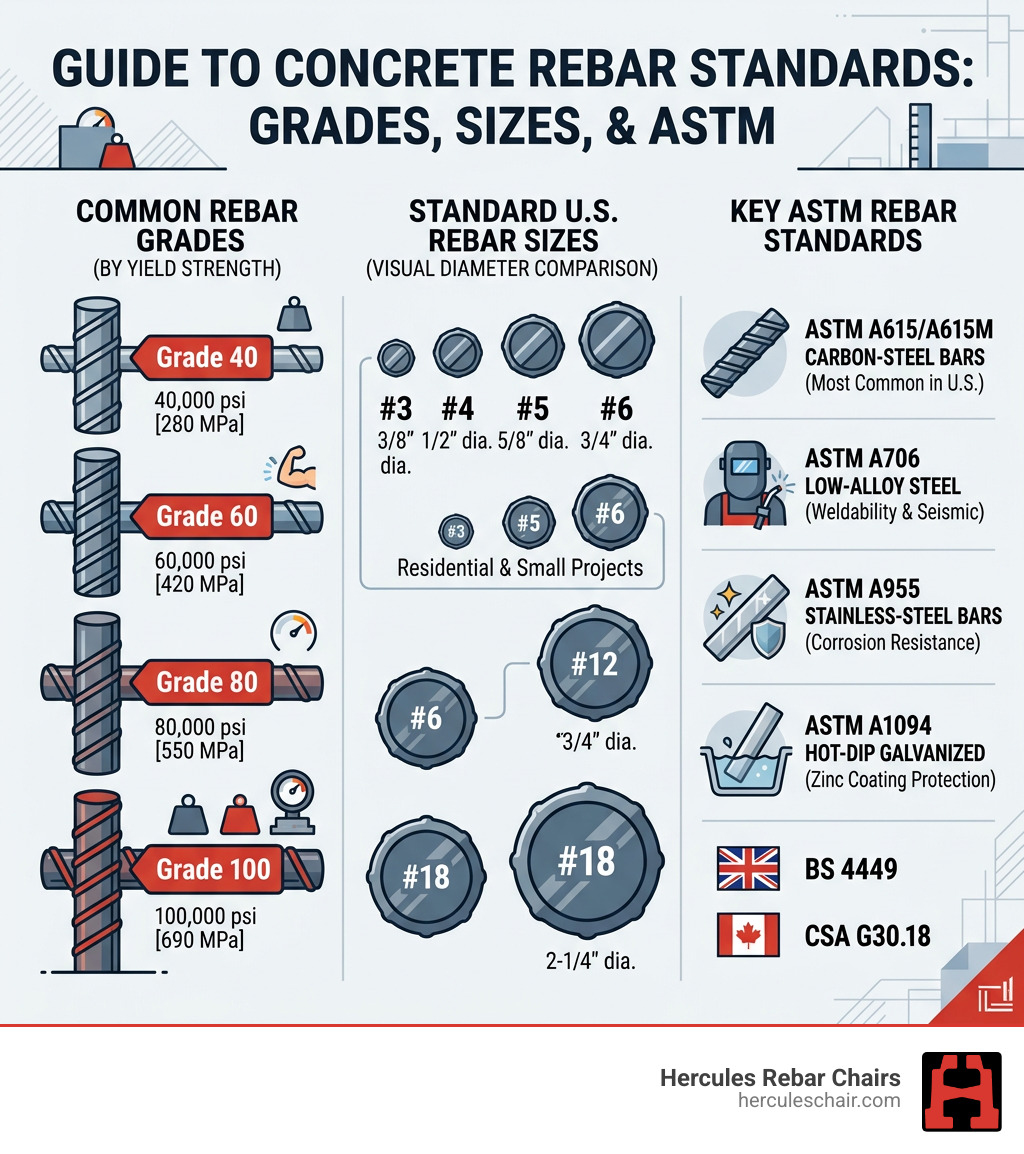
Concrete rebar standards define the sizes, grades, materials, and testing requirements that reinforcing steel must meet to keep concrete structures safe and code-compliant. Here’s a quick overview of what you need to know:
| Standard | What It Covers |
|---|---|
| ASTM A615/A615M | Carbon-steel deformed and plain bars (most common in the U.S.) |
| ASTM A706 | Low-alloy steel bars for improved weldability |
| ASTM A955 | Stainless-steel reinforcing bars |
| ASTM A1094 | Hot-dip galvanized steel bars |
| BS 4449 | UK rebar standard |
| CSA G30.18 | Canadian rebar standard |
Common rebar grades by yield strength:
- Grade 40 — 40,000 psi [280 MPa]
- Grade 60 — 60,000 psi [420 MPa]
- Grade 80 — 80,000 psi [550 MPa]
- Grade 100 — 100,000 psi [690 MPa]
Standard U.S. rebar sizes run from #3 (3/8″ diameter) to #18 (2-1/4″ diameter), with #3 through #6 covering most residential work.
Concrete is one of the most widely used building materials on the planet — but it has a serious weakness. Its tensile strength is only about 10–15% of its compressive strength. That means it can handle enormous crushing forces, but it cracks quickly when pulled or bent. Rebar exists to fix that problem.
By embedding steel bars inside a concrete pour, engineers create a composite material that handles both compression and tension. But not just any steel will do. The bar has to meet strict specifications for size, strength, surface deformation, and chemical makeup — all defined by concrete rebar standards.
Whether you’re pouring a residential driveway or a commercial foundation, the wrong rebar choice can quietly undermine the entire structure.
I’m Jordan Harris, a licensed Professional Engineer with a master’s degree in structural engineering and five years of hands-on experience designing large-scale concrete and steel projects. At Hercules Rebar Chairs, I apply that background every day to help contractors make smarter decisions around concrete rebar standards — from material selection to proper placement. Let’s break it all down.
Understanding Concrete Rebar Standards: ASTM, BS, and CSA
When we talk about concrete rebar standards, we are usually referring to the rigorous specifications set by ASTM International (formerly the American Society for Testing and Materials). These standards ensure that every piece of steel arriving at your job site behaves exactly as the engineer intended.
In the United States, the “gold standard” is the Standard Specification for Carbon-Steel Bars, known as ASTM A615/A615M. This covers the everyday “black bar” used in the vast majority of construction. However, if your project requires welding or seismic resistance, you’ll likely see ASTM A706 (Low-Alloy Steel) specified because it has a more controlled chemical composition that handles heat better.
For coastal projects or environments where salt is a factor, we look toward the ASTM A955/A955M Standard Specification for Stainless-Steel Bars. While more expensive, stainless steel is roughly 1,500 times more resistant to corrosion than standard carbon steel.
While we focus on U.S. standards across all 50 states, it is helpful to know that our neighbors use different systems. The United Kingdom follows British Standards (BS 4449), and Canada utilizes CSA G30.18. These international standards have their own unique grading systems, but they all share the same goal: ensuring material testing, quality control, and strict chemical composition limits (such as limiting phosphorus to 0.06% in ASTM A615) to prevent brittle failure.
Rebar Sizes and Dimensions: From #3 to #18
In the U.S., we use an imperial sizing system that is actually quite simple once you know the “1/8-inch rule.” The bar number represents how many eighths of an inch make up the nominal diameter. For example, a #4 bar is 4/8″, or 0.500 inches in diameter.
| Rebar Size | Nominal Diameter (in) | Weight (lb/ft) | Common Applications |
|---|---|---|---|
| #3 | 0.375 | 0.376 | Driveways, patios, pool walls |
| #4 | 0.500 | 0.668 | Residential footings, stem walls |
| #5 | 0.625 | 1.043 | Foundations for larger homes, retaining walls |
| #6 | 0.750 | 1.502 | Commercial slabs, heavy retaining walls |
| #8 | 1.000 | 2.670 | Sea walls, columns, heavy beams |
| #11 | 1.410 | 5.313 | Bridges, high-rise buildings |
| #14 | 1.693 | 7.650 | Docks, parking structures, tall buildings |
| #18 | 2.257 | 13.60 | Massive infrastructure, dams |
Different sizes are necessary because rebar sizing and tensile strength requirements scale with the load. A massive bridge pier needs the heavy-duty #14 or #18 bars, while a standard 4-inch backyard patio is perfectly fine with #3 or #4. Using a bar that is too large is a waste of money, but using one that is too small can lead to structural failure.
Decoding Rebar Grades and Strength Requirements
If the “size” tells you how big the bar is, the “grade” tells you how strong it is. The grade number refers to the yield strength of the steel in kilopounds per square inch (ksi).
- Grade 40: Minimum yield strength of 40,000 psi. Common in light residential work like driveways.
- Grade 60: Minimum yield strength of 60,000 psi. This is the industry workhorse for both residential and commercial projects.
- Grade 80 & 100: High-strength bars used in heavy infrastructure.
It is important to understand the yield and tensile strength differences. Yield strength is the point where the steel permanently deforms (it won’t “snap back” like a rubber band). Tensile strength is the point where the bar actually breaks.
One safety note: As we move to higher grades like Grade 100, the “safety margin” changes. Grade 100 bars have a tensile-to-yield ratio of about 1.15, whereas lower grades have a ratio of 1.25 to 1.50. This means lower-grade steel gives you more “warning” (visible stretching and cracking) before a total collapse occurs. For a deeper dive into how this affects your pour, check out our guide on Slab Strong: Mastering Rebar Placement for Durable Concrete.
Types of Reinforcing Bars and Material Standards
Not all rebar is made of the same “black” carbon steel. Depending on where you are building — like a salty coastal town in Florida or a freeze-thaw environment in Ohio — you might need a different material to combat corrosion.
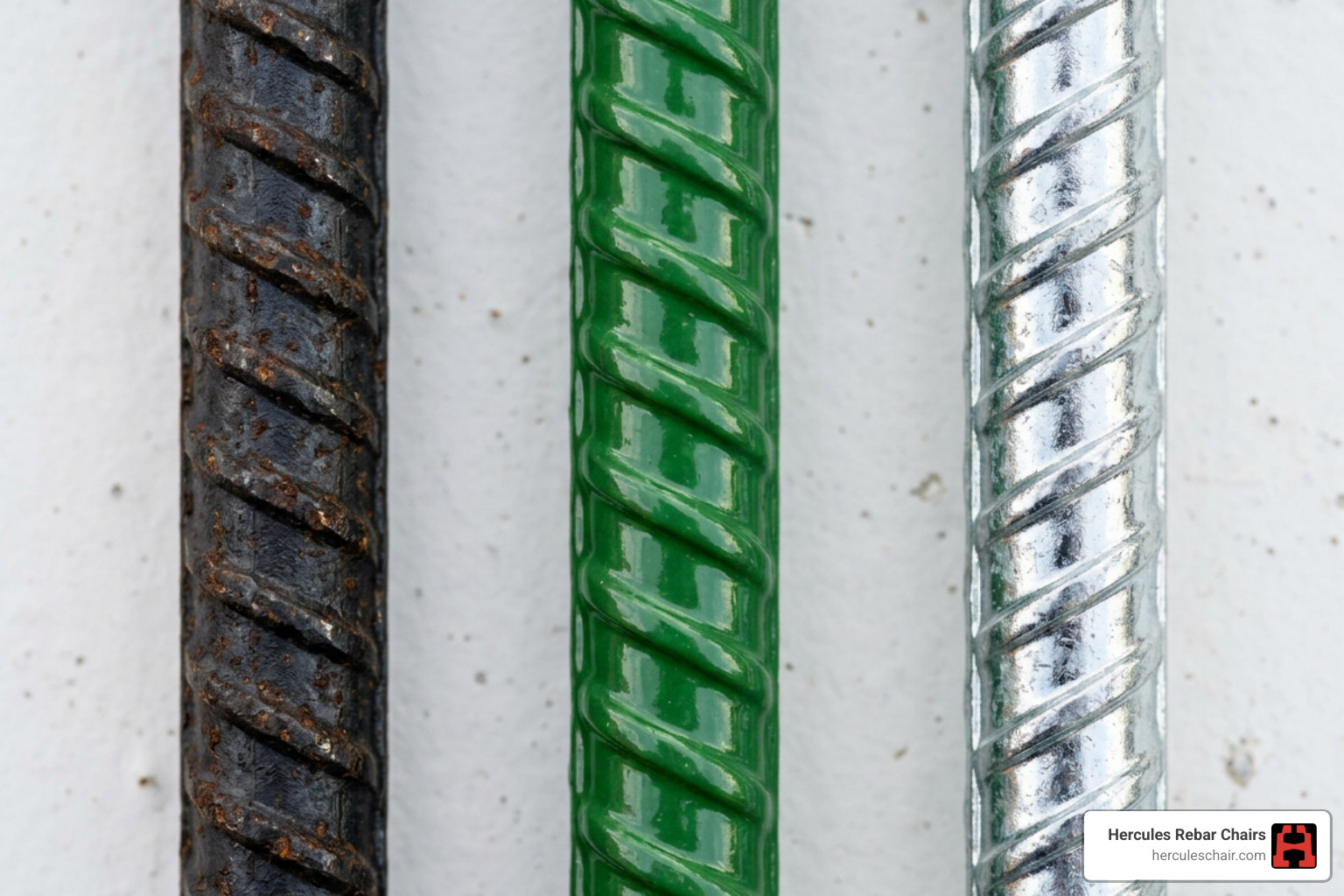
- Carbon Steel (Black Bar): The most common and affordable type. It’s versatile but susceptible to rust if moisture reaches it.
- Epoxy-Coated Rebar: Carbon steel with a thin epoxy layer. It is up to 1,700 times more corrosion-resistant than black bar, making it a favorite for bridges and saltwater environments. However, if the coating is nicked during shipping, corrosion can concentrate at that spot.
- Galvanized Rebar: Coated in zinc, this bar is 40 times more resistant to corrosion than black bar. It is often preferred over epoxy because the coating is much tougher and harder to damage on the job site.
- Stainless Steel: The “forever” bar. It is 1,500 times more corrosion-resistant than black bar. While it costs significantly more, it is often used in high-value structures where repairs are impossible.
- GFRP (Fiberglass): Glass-Fiber-Reinforced-Polymer is 75% lighter than steel and 100% rust-proof. It is non-conductive and non-magnetic, though it can’t be bent in the field like steel.
Understanding why concrete needs reinforcement helps you choose the right type. If the steel inside rusts, it expands, which causes the concrete to “spall” or flake off, destroying the bond. Proper selection and following a Rebar Placement Guide are the best ways to prevent this.
Best Practices for Concrete Rebar Standards in Construction
Sizing and Spacing for Residential Concrete Rebar Standards
In residential work, the most common mistake we see isn’t the size of the rebar — it’s the spacing. If a plan calls for 4-inch spacing and the installer places them at 5 inches, the structural strength is reduced by 20%.
For a standard concrete driveway, we typically recommend #3 rebar placed in a grid at 18 to 24 inches on center. For foundations and footings, #4 rebar is the standard, usually spaced at 12 inches on center. If you are building on problematic soil (like expansive clay in Texas or Arizona), an engineer might bump you up to #5 bars to handle the extra ground movement.
To ensure your foundation stands the test of time, follow the steps in how to install rebar in footings the right way and our comprehensive guide on Foundation Strong: Mastering Rebar Placement for Lasting Concrete.
Structural Integrity and Industrial Concrete Rebar Standards
In industrial settings, the “deformations” (those little ridges on the bar) are critical. They aren’t just for decoration; they ensure the steel “grabs” the concrete. According to concrete rebar standards, the average spacing of these ridges shouldn’t exceed 70% of the bar’s diameter.
Another critical factor is concrete cover. This is the amount of concrete between the rebar and the edge of the slab. If the rebar is too close to the surface, moisture will get in and cause rust. Generally, you want at least 2 to 3 inches of cover for rebar exposed to earth. Learn more about this in Rebars Armor: Understanding Concrete Cover and Its Critical Role.
For light-duty residential slabs where rebar might feel like overkill, some contractors use welded wire fabric. It’s thinner and cheaper, but it doesn’t provide the same structural load distribution as a proper rebar grid held up by high-quality chairs.
Frequently Asked Questions about Rebar Standards
What is the difference between Grade 40 and Grade 60 rebar?
The primary difference is the yield strength. Grade 40 can withstand 40,000 pounds of pressure per square inch before it deforms permanently, while Grade 60 can handle 60,000 psi. Grade 60 is the most common standard for modern construction because it provides 50% more strength for a very small increase in cost.
How do I calculate the amount of rebar needed for a slab?
Calculating rebar involves determining the perimeter and the internal grid based on your spacing requirements (e.g., 12″ or 18″ on center). Don’t forget to account for “lap splices,” where bars overlap to maintain continuity. We’ve simplified this process in our guide on How to Calculate Rebar for Slab the Right Way.
When is rebar necessary for a 4-inch concrete slab?
For a 4-inch slab, rebar is necessary if the slab will support heavy loads (like a vehicle in a garage), if the soil is prone to shifting, or if you want to minimize visible cracking. While not always required by code for a simple walkway, it’s almost always a good idea for longevity. See our detailed breakdown: Why Your 4 Inch Slab Might Not Need Rebar (and When It Does).
Conclusion
At Hercules Rebar Chairs, we believe that a great concrete project starts with the right standards and ends with the right support. Choosing the correct size and grade of rebar is only half the battle — you also have to ensure that steel stays exactly where it belongs during the pour.
Our “America’s #1” red rebar chairs are designed to do exactly that. With over 14 million units sold across the USA, our supports help you maintain perfect concrete cover and ensure full code compliance while saving you time and labor costs. Whether you are working on a small residential patio or a massive industrial foundation, we have the chairs to keep your steel steady.
For more information on choosing the right supports for your next project, check out The Ultimate Guide to Rebar Chairs: Types, Uses, and Sizing or visit our shop to Buy Rebar Chairs today. Let’s build something that lasts!