

Why Rebar Slab Support Is the Foundation of Every Strong Concrete Pour
Rebar slab support is any device — chair, bolster, or spacer — that holds reinforcing steel at the correct height inside a concrete form before and during the pour.
Here are the most common types at a glance:
| Support Type | Best For | Typical Height Range |
|---|---|---|
| Slab Bolster (SB) | Flatwork, slab-on-grade | 3/4″ to 3″ |
| Slab Bolster Upper (SBU) | Double-mat elevated slabs | 3/4″ to 5″ |
| Bar Chair | Individual rebar support points | 3/4″ to 2″ |
| Continuous High Chair | Heavy-duty, thick pours | Up to 30″ |
| Castle Chair | Soft sub-base conditions | 1-1/2″ to 6-1/4″ |
| Plastic Slab Bolster | Corrosion-sensitive environments | 3/4″ and up |
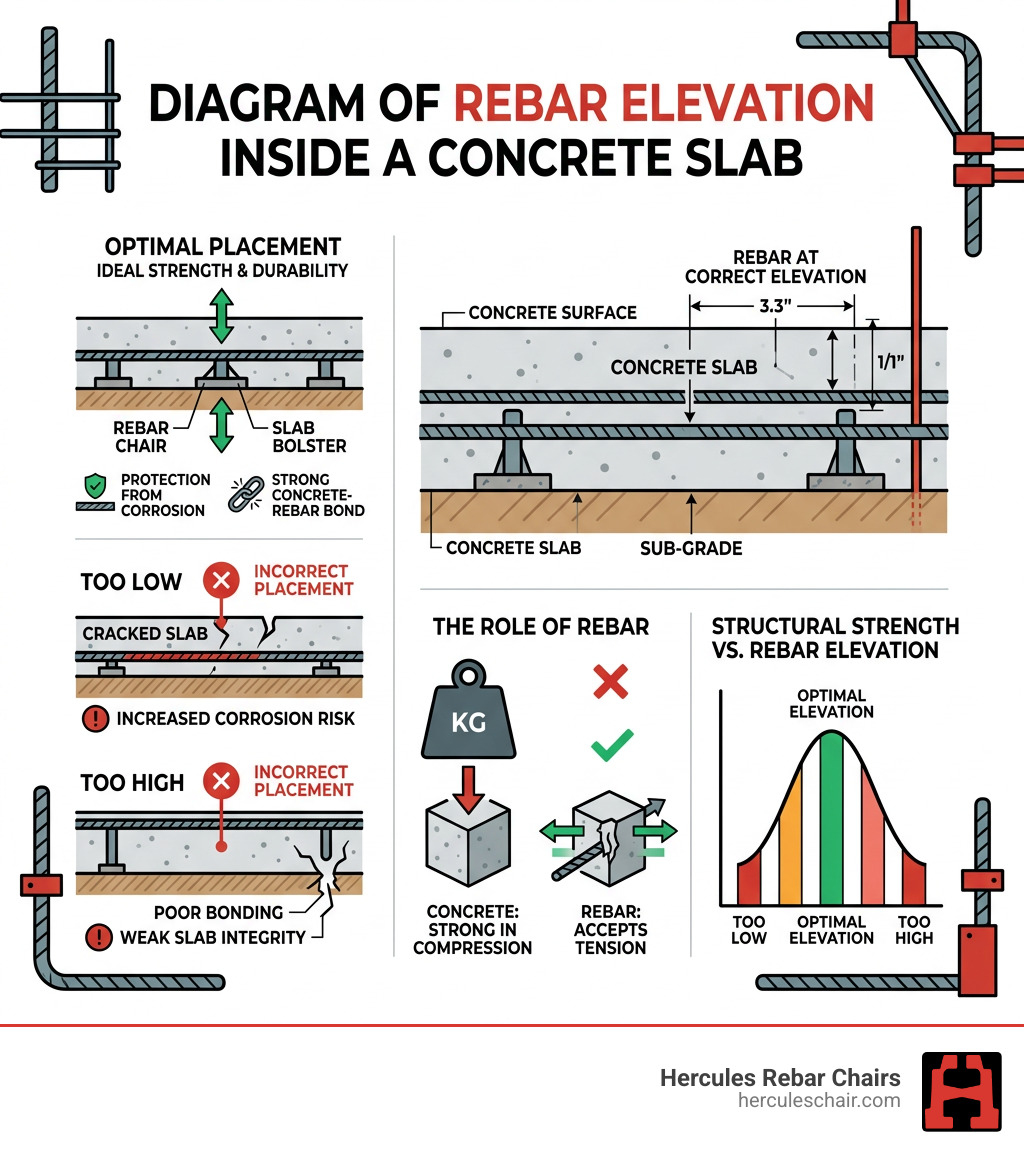
Concrete is incredibly strong under compression — but it cracks easily under tension. Rebar handles that tension. But only if it’s in the right place.
If the rebar sits too low, there isn’t enough concrete above it to protect it from corrosion. Too high, and there isn’t enough below it to bond properly. Either way, the slab is weaker than it needs to be.
That’s exactly why rebar supports exist. They take the guesswork out of rebar placement and keep steel locked in position while concrete is poured and cured.
I’m Jordan Harris, a licensed structural engineer and co-owner of T.J. Harris Company, where I’ve spent years designing and manufacturing rebar support systems — including products used in critical rebar slab support applications across the country. Whether you’re pouring a residential driveway or a bridge deck, this guide will walk you through everything you need to make the right call on supports.
Essential Types of Rebar Slab Support
When we talk about rebar slab support, we aren’t just talking about one-size-fits-all blocks. The industry has developed a specialized vocabulary of supports designed for specific loads, surfaces, and slab thicknesses. Choosing the wrong one can lead to the rebar “sinking” into the dirt or the supports snapping under the weight of the wet concrete and the crew walking on the grid.
One of the most common questions we get is: “Do I need a continuous support or an individual chair?” To answer that, you have to look at your Rebar grid for Slab Foundation. If you are dealing with a heavy mat or a large area, continuous supports like bolsters offer more stability. If you are doing light residential work, individual chairs might be more cost-effective.
Understanding Slab Bolsters and SBU Rebar Slab Support
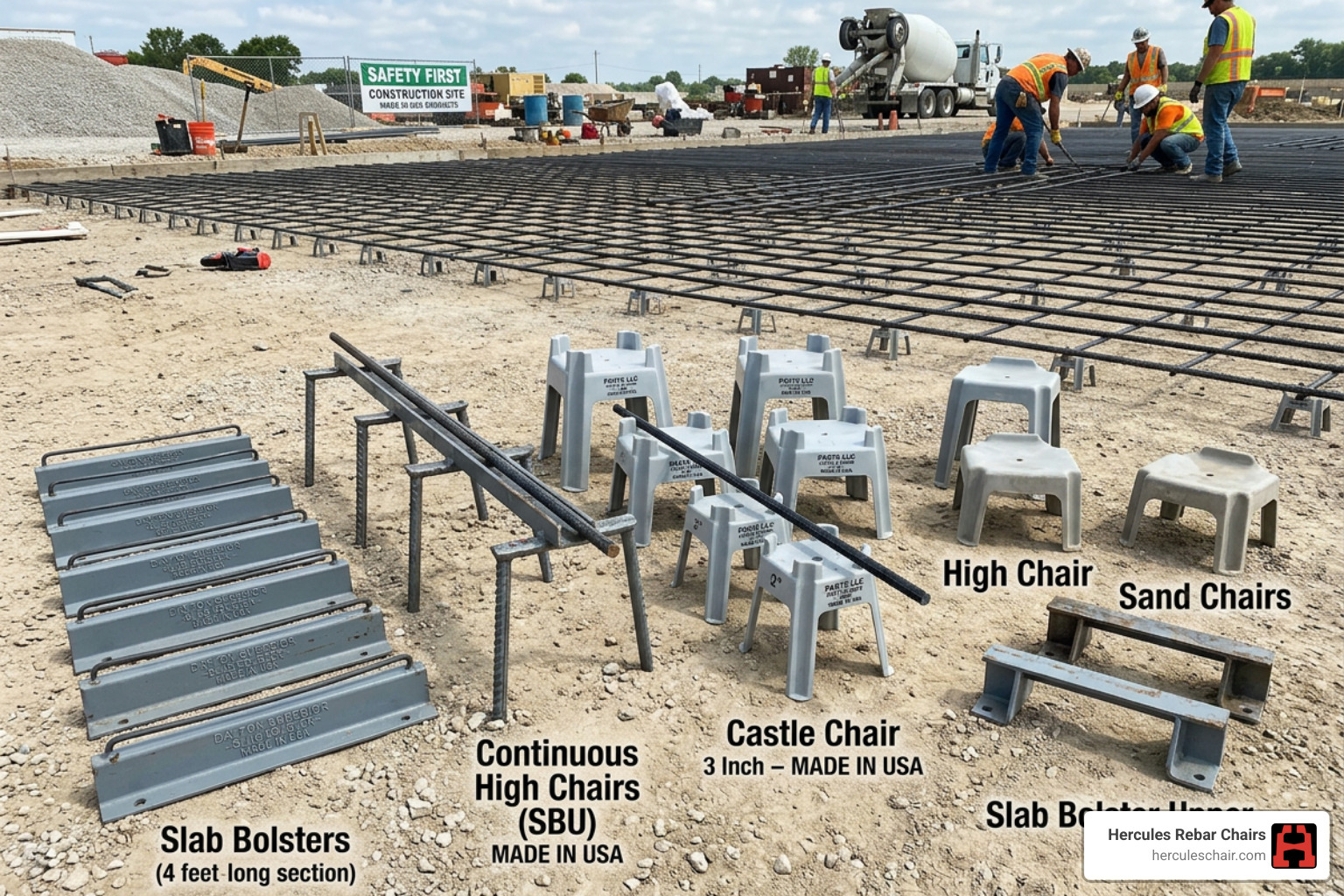
Slab Bolsters (SB) are the workhorses of the flatwork world. These are long, continuous supports—usually 5 feet in length—consisting of a top support wire held up by corrugated legs spaced every 5 inches. They are designed to support the bottom layer of steel in a slab.
What Are Concrete Bolster Chairs and Why Do You Need Them? The answer lies in load distribution. Because a bolster is continuous, it prevents the rebar from sagging between support points.
Then there is the Slab Bolster Upper (SBU). These are specifically designed for multi-layered steel. An SBU features “runner wires” on the bottom. When you have a bottom mat of rebar already in place, you place the SBU perpendicularly across that lower layer. The runner wires allow the bolster to sit securely on the existing steel, providing a stable platform for the top mat. According to ACI 315-99 specifications, these are essential for maintaining the correct “clear cover” in thick, double-mat slabs. They typically come in heights from 3/4″ up to 5″ in 1/4″ increments.
Specialized Chairs for Heavy-Duty Rebar Slab Support
Not every project is a flat driveway. When you move into From Dobies to Double Mats: A Comprehensive Look at Rebar Chair Types, you’ll encounter high-clearance needs.
- Continuous High Chairs (CHC): These look like slab bolsters but are much taller—sometimes up to 30 inches. They are used to support the upper mat of rebar in thick foundations or bridge decks.
- Castle Chairs: These are a favorite for slab-on-grade projects where the ground might be a bit soft. They have a wide, stable base that prevents them from sinking into the sub-grade. They cover heights from 1-1/2” to 6-1/4”.
- Mesh Supports: If you are working with wire mesh instead of heavy rebar, you need something that “snaps” on. Elevate Your Slab with Concrete Mesh Chairs to ensure that the thin wire doesn’t get pushed to the bottom of the pour.
Material Options and Corrosion Protection
The material of your rebar slab support is just as important as its shape. If you use a plain steel chair in a coastal environment or a bridge deck, that chair will eventually rust. That rust can travel up into the rebar, causing “concrete cancer” (spalling), where the expanding rust cracks the concrete from the inside out.
Steel vs. Plastic: The Great Debate
In Spacer Secrets: Unpacking the Role of Plastic Rebar Chairs, we see a massive shift toward non-corrosive materials. Plastic chairs, often made from 100% virgin polypropylene, are completely rust-proof. They are also lightweight and often feature “snap-and-lock” designs that make installation a breeze.
However, for heavy-duty industrial slabs, steel is still king. The Strong Silent Type: Choosing the Best Steel Rebar Chairs for Your Project usually involves looking at the coating:
- Plain Steel: Best for interior slabs where moisture isn’t an issue.
- Plastic Tipped/Dipped: The legs are coated in plastic so no metal touches the formwork. This prevents rust spots on the finished concrete surface.
- Epoxy Coated: Required for projects using epoxy-coated rebar, common in bridge decks and high-corrosion areas.
- Stainless Steel: The gold standard for longevity, though the most expensive.
- Galvanized: Offers a middle ground of protection against the elements.
CRSI (Concrete Reinforcing Steel Institute) Class 1 protection is the standard we often aim for, which ensures the support won’t leave unsightly blemishes on the face of the concrete.
Selection Criteria and Installation Best Practices
Choosing the right rebar slab support requires looking at three main factors: slab thickness, the sub-surface, and the load.
1. Slab Thickness and Cover
The “Golden Rule” of concrete is maintaining proper cover. For slabs on grade, you generally want 2 inches of concrete between the rebar and the ground. For other slabs, 1.5 inches is standard. How to Determine Bar Chair Sizes in 3 Easy Steps starts with knowing your total slab depth. If you have a 4-inch slab and need 2 inches of cover, you need a 2-inch chair. It sounds simple, but you’d be surprised how often people guess!
2. Surface Conditions
Are you pouring on a hard vapor barrier or soft sand? If it’s sand, a thin-wire chair will sink like a stone. You need a “sand plate” or a wide-based chair like a Castle Chair. Slab Strong: Mastering Rebar Placement for Durable Concrete requires a stable base so the rebar doesn’t shift when the pump hose starts dragging across it.
3. Installation Techniques
- Spacing: Generally, supports should be spaced about 2 to 4 feet apart. If the rebar “bounces” when you walk on it, you need more supports.
- Tying: Don’t just set the rebar on the chair; tie it with tie wire. This prevents the rebar from falling off the chair during the pour.
- Safety: Always use impalement safety caps on any vertical rebar. While we focus on horizontal rebar slab support, safety is a site-wide requirement.
Calculating Quantities and Spacing for Slabs
Nothing stops a project faster than running out of chairs halfway through the grid. We recommend using a Hercules Rebar Chair Estimator to get an exact count, but you can do a rough calculation yourself.
For a standard grid, you can expect to use one support for every 8 to 10 square feet of slab. However, this varies based on the rebar size. Heavier bars (#5 and up) can span further than thinner bars (#3), which sag more easily.
- Determine the Grid: If your rebar is on 12-inch centers, you have a lot of intersections.
- Standard Spacing: Place a bolster or chair every 4 feet along the length of the bar.
- Calculate Area: For a 1,000 sq. ft. slab, you might need anywhere from 100 to 150 chairs depending on the layout.
- Waste Factor: Always add 5-10% extra for breakages or unexpected soft spots in the sub-grade.
How to Calculate Rebar for Slab the Right Way involves more than just the steel; it’s about the system that holds it up. Once you have your numbers, you can Buy Rebar Chairs in bulk to save on shipping and ensure consistency across the job site. Check our Rebar Placement Guide for specific spacing tables based on bar diameter.
Frequently Asked Questions about Rebar Supports
How do I choose the right height for a rebar chair?
The height is determined by the required “concrete cover.” Consult your structural drawings or local building codes. Generally, for a slab-on-grade, you want the rebar in the top third or the middle of the slab. Chair-ish Your Concrete: Everything You Need to Know About Reinforcement Supports provides a deep dive into these measurements. If you’re pouring a 6-inch slab, a 3-inch or 4-inch chair is usually the sweet spot.
What is the difference between a slab bolster and a bar chair?
Think of a bar chair as a “point” support and a bolster as a “line” support. A bar chair supports the rebar at one specific spot. A slab bolster provides continuous support over 5 feet. Bolsters are better for heavy mats and preventing sag, while chairs are great for irregular shapes or lighter mesh. Chair-ish Your Concrete: A Deep Dive into Rebar Support Systems explains that bolsters significantly reduce the labor time spent placing individual chairs.
Why is concrete cover important for rebar?
Concrete cover is the “armor” for your steel. It provides:
- Corrosion Protection: It keeps water and salt away from the metal.
- Fire Resistance: Concrete acts as an insulator, protecting the steel from losing strength in a fire.
- Structural Bond: The concrete needs enough surface area to “grip” the rebar. Without proper cover, you might as well not use rebar at all. Keep Your Rebar Up: A Guide to Concrete Support Blocks shows how supports ensure this cover is uniform across the entire slab.
Conclusion
At Hercules Rebar Chairs (T.J. Harris Co.), we don’t just make pieces of plastic and steel; we make the components that ensure your hard work stands the test of time. We are proud to be America’s #1 choice for rebar slab support, with over 14 million units sold to contractors who value speed, economy, and code compliance.
Our signature red chairs are more than just a brand color—they are a mark of quality that inspectors recognize. By using our products, you’re not just saving time and money on the job site; you’re guaranteeing that your concrete slab is built to the highest industry standards.
Ready to elevate your next project? Explore Our Products and see why we are the trusted partner for concrete professionals across the United States. Whether you need a simple bar chair or a heavy-duty slab bolster, we have the support you need to get the job done right.