

Why Rebar Chair Supports Are Critical for Every Concrete Slab
Rebar chair supports are small but essential devices that hold steel reinforcing bars at the correct height inside a concrete form — ensuring the rebar ends up fully embedded in concrete at the exact depth required for structural strength.
Quick answer — what you need to know:
| Question | Answer |
|---|---|
| What do they do? | Hold rebar at the correct height (concrete cover) during a pour |
| Who needs them? | Anyone pouring reinforced concrete slabs, footings, walls, or decks |
| Common types | Castle chairs, slab bolsters, spacer wheels, multi-level chairs |
| Materials | Plastic, steel, or steel with plastic-dipped legs |
| Typical spacing | Every 2 to 3 feet along rebar length |
| Do they stay in? | Yes — permanently embedded in the finished concrete |
| Typical cost | $0.33 to $0.80 per chair depending on type and quantity |
Here’s the problem most contractors already know: if rebar sinks to the bottom of a slab — or floats too close to the surface — the concrete loses a significant portion of its designed strength. Rebar that isn’t sitting at the right depth simply can’t do its job. Even a small error in rebar position can mean the difference between a slab that lasts decades and one that cracks prematurely.
That’s exactly the problem rebar chair supports solve. They lift the rebar off the subbase, lock it in position, and hold it there while concrete is placed around it — no wire tying required on many modern designs.
I’m Jordan Harris, a licensed Professional Engineer and structural engineer with hands-on experience designing large-scale concrete projects. As part of the team behind Hercules Rebar Chairs, I’ve spent years working directly with rebar chair supports in both design and manufacturing — and I’ll walk you through everything you need to select and use them correctly.
Understanding the Role of rebar chair supports in Concrete Integrity
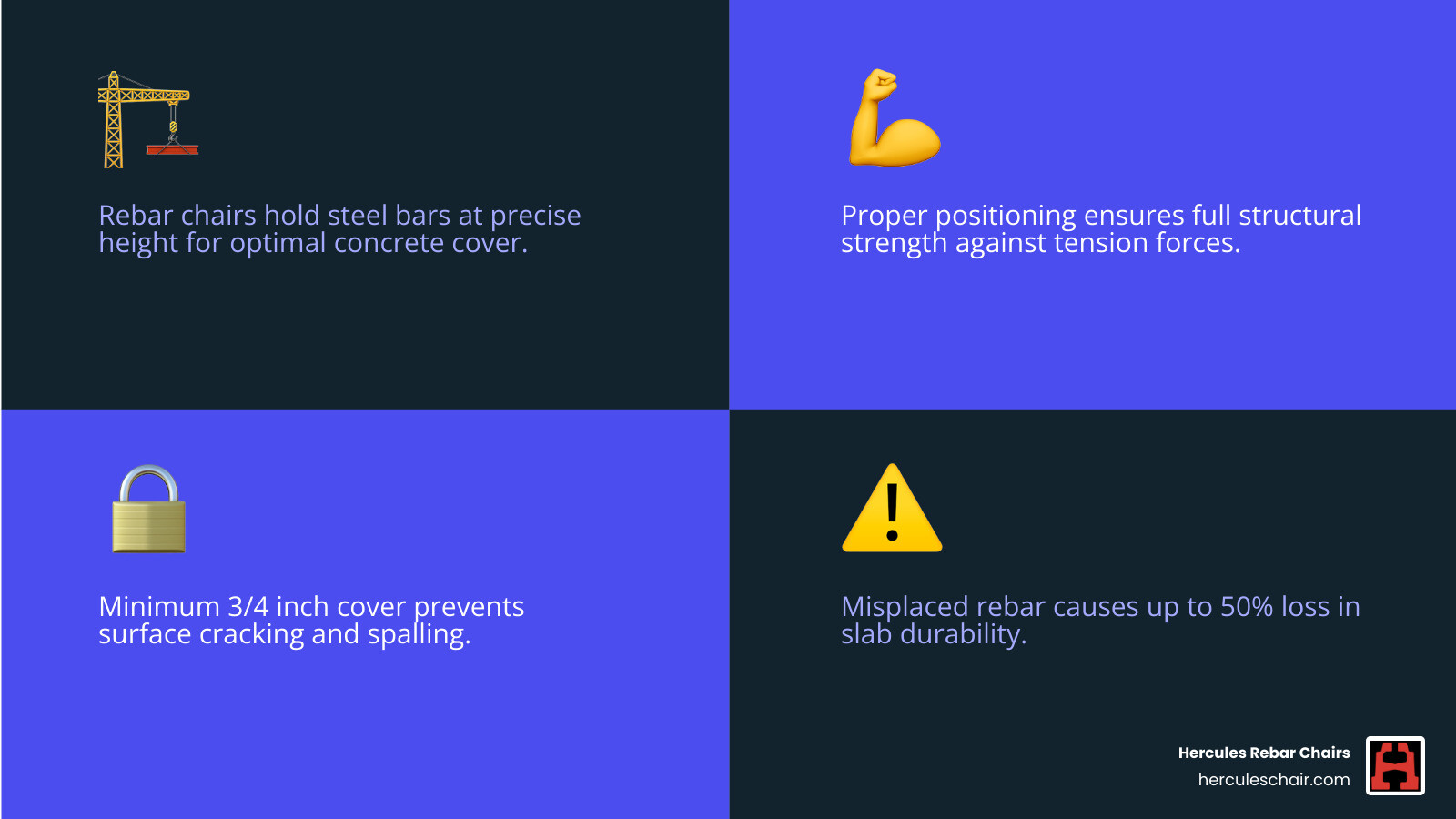
When we talk about “concrete integrity,” we are really talking about how well the steel and concrete work together. Concrete is fantastic under compression (pushing forces), but it’s quite weak under tension (pulling forces). That is where rebar comes in. However, for that partnership to work, the rebar must be positioned exactly where the engineers intended.
According to How to Properly Support Rebar When Pouring Concrete, the “concrete cover”—the distance between the rebar and the outer surface of the concrete—is the most critical factor for structural strength. If the rebar is too close to the bottom, it won’t engage with the concrete’s tension zone properly. If it’s too close to the top, it can lead to surface cracking or “spalling” as the steel eventually rusts and expands.
At Hercules, we emphasize that Elevate Your Concrete Why Bar Chairs Are Essential For Strong Slabs isn’t just a catchy phrase—it’s a requirement for meeting ACI (American Concrete Institute) specifications. Proper rebar chair supports ensure uniform load distribution across the slab, preventing localized weak points that lead to failure under heavy equipment or structural loads.

Primary Types of Rebar Supports
Not every project is a simple 4-inch sidewalk. Depending on your application, you might need a specific style of support:
- Castle Chairs: These look like little turrets and are incredibly popular for flatwork. They often feature a wide base to prevent sinking into the subgrade and can accommodate multiple rebar sizes.
- Concrete Mesh Chairs: If you are working with wire reinforcement rather than heavy bars, Elevate Your Slab With Concrete Mesh Chairs to ensure that thin mesh doesn’t get trampled into the dirt during the pour.
- Spacer Wheels: These are circular supports used primarily for vertical applications like columns or walls. They snap onto the rebar and “roll” against the formwork, ensuring the bar stays centered.
- Slab Bolsters: These are long, continuous supports (often 5 feet in length) used to support heavy mats of rebar over large areas. They are common in bridge decks and heavy industrial floors.
- Multi-Level Chairs: When your design calls for two or three layers of steel, these chairs provide slots at different heights to maintain the perfect gap between layers.
- Concrete Support Blocks (Dobies): Sometimes, plastic or metal isn’t allowed, or the load is too heavy. In these cases, Keep Your Rebar Up A Guide To Concrete Support Blocks explains how pre-cast concrete blocks (often called “dobies”) are used as heavy-duty spacers.
Selecting the Right rebar chair supports for Your Project
Choosing the right chair is a bit like finding the right pair of shoes—it has to fit the “person” (the rebar) and the “terrain” (the subbase).
First, consider the height. Whether you are moving From 4 Inch To 6 Inch Choosing The Right Rebar Chair Support, the goal is usually to place the rebar in the middle third of the slab. For a 4-inch slab, a 1.5-inch to 2-inch chair is standard.
Second, check rebar size compatibility. Most standard chairs are designed to hold #3 (3/8″) to #5 (5/8″) rebar. If you’re using #6 or larger, you’ll need heavy-duty bolsters or reinforced chairs. You can How To Determine Bar Chair Sizes In 3 Easy Steps by measuring your total slab thickness and subtracting the required top and bottom cover.
We always tell our customers to follow The Goldilocks Guide To Concrete Bar Chair Sizes Not Too Big Not Too Small. If the chair is too tall, the rebar will be too close to the surface and cause “ghosting” or cracks. If it’s too short, the rebar provides zero structural benefit.
Comparing Materials: Metal vs. Plastic Supports
The “Metal vs. Plastic” debate is a classic in the construction world. Both have their place, but the industry has seen a massive shift toward high-quality polypropylene in recent years.
| Feature | Plastic (Polypropylene) | Metal (Steel/Wire) |
|---|---|---|
| Corrosion Resistance | Excellent (Will never rust) | Poor (Unless galvanized/tipped) |
| Weight | Very Light | Heavy |
| Cost | Generally more economical | Can be higher for specialty types |
| Ease of Use | Snap-in features (no ties) | Often requires wire tying |
| Load Capacity | High (with proper design) | Very High (best for massive bars) |
Metal chairs are often made from Q195 steel. While strong, they have a major drawback: if the metal feet touch the bottom of the formwork, they can eventually rust. This rust travels up the leg and creates a “bleed” spot on the surface of your finished concrete. To solve this, many metal supports feature plastic-dipped legs.
However, for most residential and commercial slabs, plastic is the “Strong Silent Type.” When The Strong Silent Type Choosing The Best Steel Rebar Chairs For Your Project is being discussed, we often point out that modern plastic chairs are engineered with internal ribbing to handle significant compression loads—sometimes over 1,000 Newtons depending on the height.
According to Concrete Chairs Reinforcement Supports, plastic is often preferred in “at-grade” applications because it is naturally non-corrosive and won’t react with the chemicals in the soil or the concrete itself.
Installation Best Practices and Spacing Guidelines
You can have the best rebar chair supports in the world, but if you don’t space them correctly, your rebar mat will sag like an old mattress.
The golden rule for spacing is 2 to 3 feet apart along the length of the rebar. If your rebar grid has spacing greater than 12 inches, you should place a chair at every single crossing. If the grid is tighter (12 inches or less), you can often get away with placing a chair at every other crossing.
Our Rebar Placement Guide recommends starting your chairs about 6 inches from the edge of the formwork and working your way inward. To make life easier, we offer a Hercules Rebar Chair Estimator to help you figure out exactly how many bags you need to order so you don’t run short mid-pour.
One of the best time-saving features of modern chairs is the “snap-in” top. Instead of spending hours with a tie-wire twister, you simply push the rebar down into the cradle, and it clicks into place. This is a key part of Foundation Strong Mastering Rebar Placement For Lasting Concrete, as it ensures the rebar doesn’t shift when the pump hose starts whipping around or workers walk across the mat.
Cost and Bulk Pricing for rebar chair supports
Budgeting for a project? Rebar chair supports are surprisingly affordable given the structural protection they provide.
- Individual Pricing: Expect to pay between $0.33 and $0.80 per chair depending on the height and design.
- Bulk Crates: For large projects, you can Buy Rebar Chairs Wholesale Distributors. A 100-chair crate typically costs around $60, while 50-packs range from $30 to $40.
- Retail Options: If you just need a few for a backyard shed, you can Buy Rebar Chairs Building Supply Stores in smaller quantities.
For a quick estimate, a 1,000-square-foot slab with rebar on 12-inch centers will typically require about 150 to 200 chairs. You can get a precise count using our Hercules Rebar Chair Estimator 911.
Overcoming Common Construction Challenges
Construction sites are chaotic, and rebar chair supports have to withstand a lot of abuse. Here are the most common issues we see and how to fix them:
- Tipping: If your concrete cover is high (over 2.5 inches), chairs can become top-heavy. If a worker steps on the rebar, the chair might tip over. To prevent this, look for chairs with a wide base-to-height ratio or increase the number of chairs to distribute the weight better.
- Vapor Barrier Damage: If you are pouring over a plastic vapor barrier, sharp-pointed chairs can puncture the plastic. Use flat-bottom chairs or “sand plates” to spread the load and keep your moisture barrier intact.
- Rust Spots: As mentioned earlier, avoid using plain steel chairs in wet environments or for architectural concrete. Stick to plastic or plastic-tipped metal to prevent those ugly orange stains.
- Multi-Layer Sagging: In thick rafts or mats, the weight of the top layer of steel can crush inferior supports. The Ultimate Guide To Rebar Chairs Types Uses And Sizing For Concrete Slabs suggests using heavy-duty bolsters or reinforced multi-level chairs for these configurations.
Frequently Asked Questions about Rebar Supports
How far apart should rebar chairs be spaced?
For most standard slabs, space your rebar chair supports every 2 to 3 feet. You want to ensure there is no visible sagging in the rebar when someone walks on it. Always place chairs at grid intersections to provide maximum stability. For more detailed layouts, refer to our Footer Stand Placement Guide.
Are rebar chairs left in the concrete after the pour?
Yes! They are designed to be a permanent part of the structure. Once the concrete hardens, the chairs are completely encapsulated. Because they are made of materials like polypropylene or treated steel, they won’t degrade or weaken the finished slab. You can learn more about our material standards on the About Hercules Rebar Chair page.
What is the difference between a rebar chair and a spacer?
While the terms are often used interchangeably, there is a technical difference. Chairs are generally used for horizontal applications like slabs and floors—they “sit” on the ground. Spacers (like spacer wheels) are used for vertical applications like walls or columns—they “space” the rebar away from the side formwork. According to Types of Rebar Support and Chair Spacing | Chair Spacing in Reinforcements, choosing the right one depends entirely on whether you are fighting gravity (slabs) or centering a bar (walls).
Conclusion
At the end of the day, your concrete is only as strong as its reinforcement. Using rebar chair supports is the simplest, most cost-effective way to ensure your project meets building codes and stands the test of time.
Hercules Rebar Chairs (T.J. Harris Co.) is proud to be America’s #1 choice for reinforcement supports. With over 14 million units sold, our identifiable red chairs are a staple on job sites across the USA. We design our products to save you time and labor while ensuring 100% code compliance.
Don’t leave your structural integrity to chance—or to a pile of broken rocks and bricks. Buy Rebar Chairs Today and build with the confidence that only the “strong, red chair” can provide.