

Why Footer Stands Are Essential for Every Concrete Pour
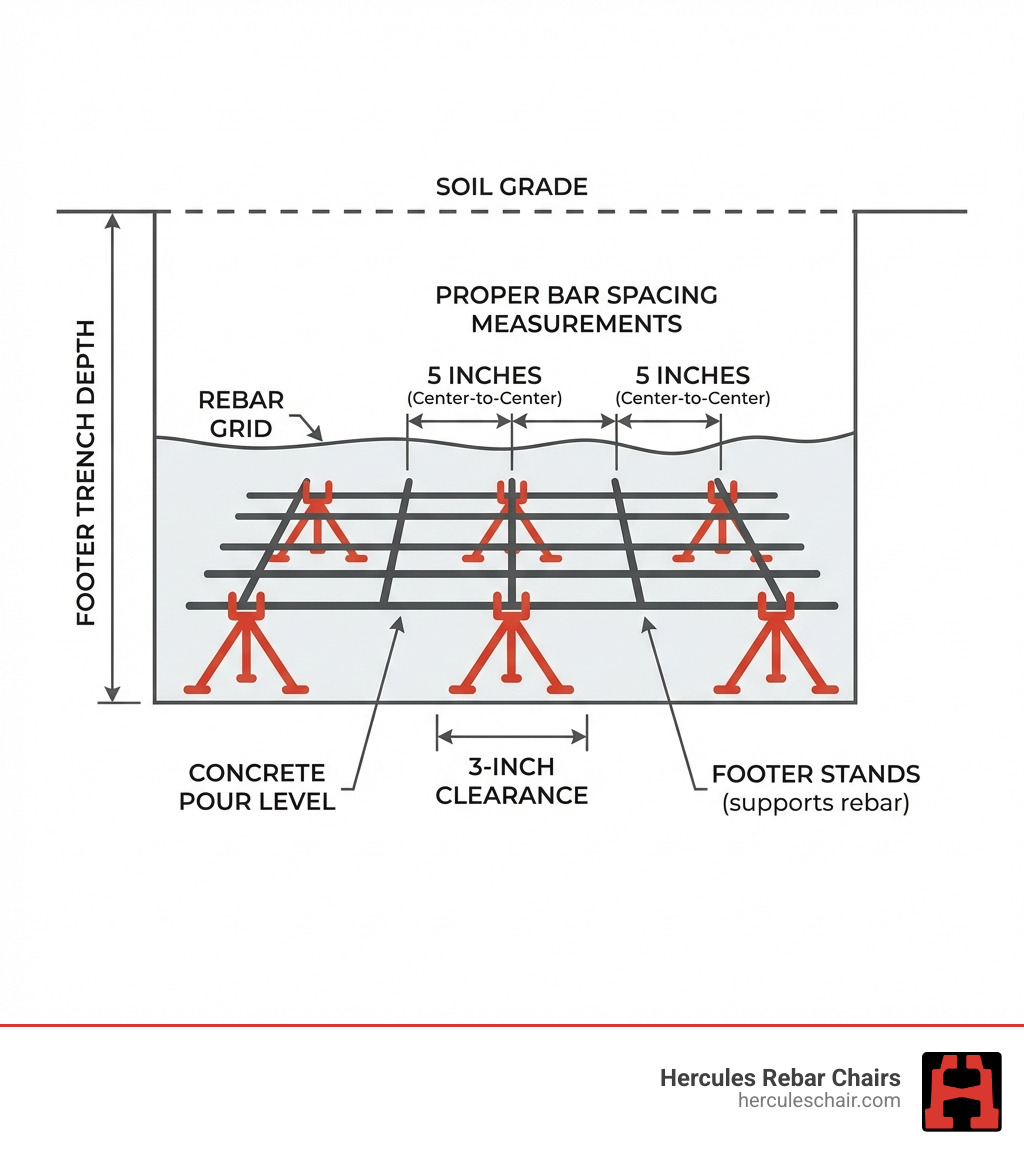
A footer stand is a specialized support device used in concrete construction to hold rebar at the proper height and position during a concrete pour. These plastic or metal chairs ensure that steel reinforcement maintains the required distance from the ground, typically 3 inches, which is critical for structural integrity and corrosion protection.
Key Footer Stand Specifications:
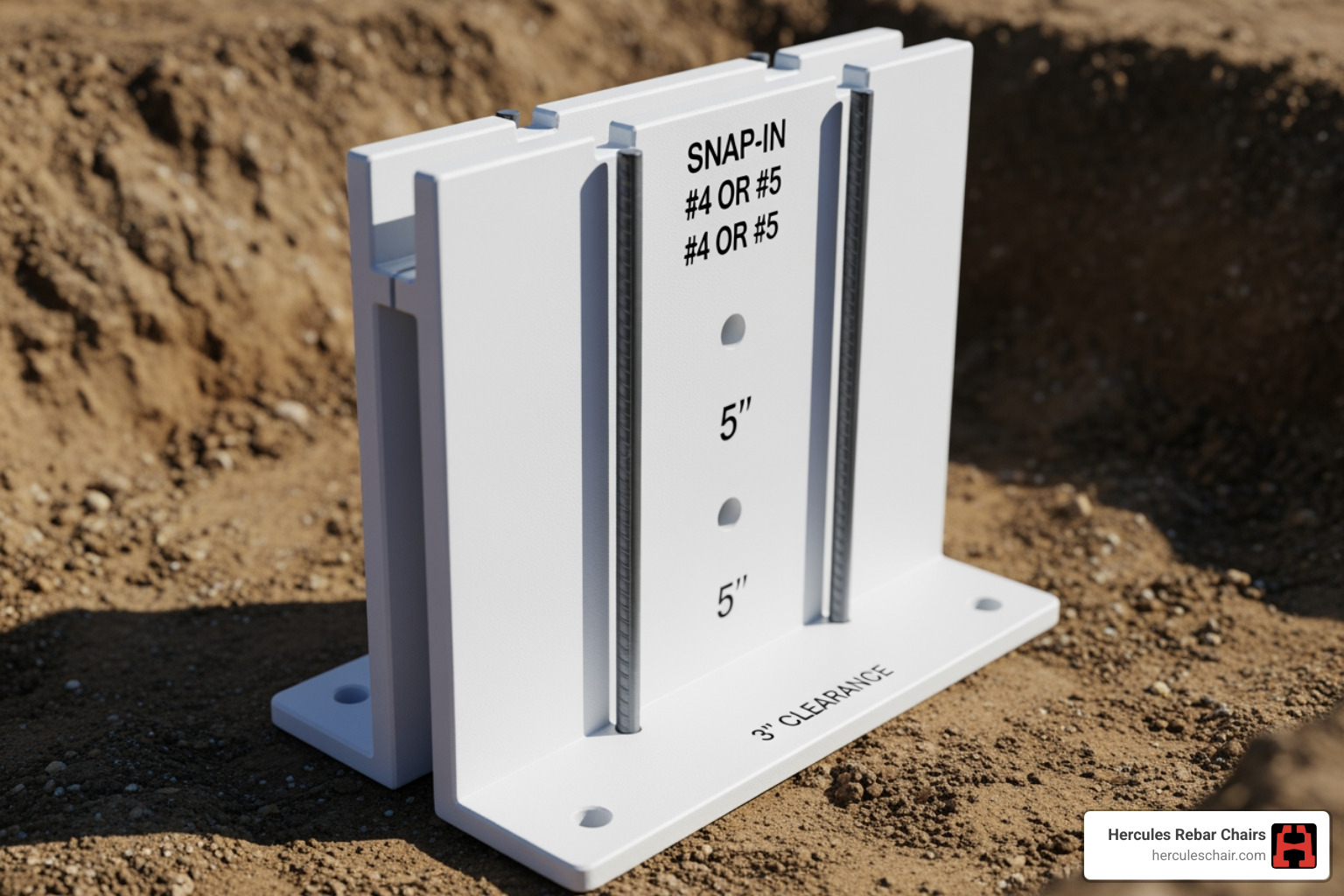
- Rebar Compatibility: Designed for #4 and #5 rebar sizes
- Ground Clearance: Provides 3 inches of space between rebar and soil
- Bar Spacing: Holds bars 5 inches apart (center to center)
- Overall Height: Stands 3-7/8 inches tall
- Recommended Spacing: Place stands every 4 feet along the rebar run
- Installation: Snap-in design eliminates wire tying
- During Pour: Stands remain buried in the concrete permanently
If you’ve ever tried tying rebar with wire in a muddy trench, you know how time-consuming and frustrating traditional methods can be. Modern footer stands solve this problem with a simple snap-in design that saves hours of labor while ensuring your rebar stays exactly where it needs to be—before, during, and after the concrete pour.
The consequences of improper rebar placement are serious. When reinforcement sits too low or shifts during the pour, it can’t properly distribute loads, and it becomes vulnerable to moisture and corrosion. When rebar sits directly on soil or gets knocked out of position, you’re looking at potential structural failures down the road and costly code compliance issues.
I’m Jordan Harris, a licensed Professional Engineer with five years of structural engineering experience on large-scale concrete projects, and I currently work at T.J. Harris Company, where we’ve manufactured over 14 million Hercules footer stands since 2002. In this guide, I’ll walk you through everything you need to know about choosing, placing, and using footer stands to make your concrete pours faster, easier, and code-compliant.
Understanding the Footer Stand in Concrete Construction
When we talk about the foundation of a building, we aren’t just talking about the concrete you see. We are talking about the unseen “skeleton”—the rebar—and the “muscles”—the concrete—working together. For that partnership to work, the rebar must be suspended precisely in the middle of the pour. This is where the footer stand comes into play.
In concrete footings, the rebar cannot simply sit on the dirt. If it does, the steel is exposed to ground moisture, which leads to rust. Rusting rebar expands, cracking the concrete from the inside out in a process known as “concrete cancer.” To prevent this, building codes across the United States, including specific Building code requirements for foundations, mandate a minimum “cover” or ground clearance.
For footings poured against the earth, that clearance is almost universally 3 inches. Our Hercules chairs are engineered to provide exactly that. By using a dedicated footer stand, we ensure that the reinforcement is perfectly positioned to handle tension loads while staying protected from the elements.
The Role of a Footer Stand in Structural Integrity
Structural integrity is all about load distribution. Concrete is incredibly strong when you push on it (compression), but it’s brittle when you try to pull it apart (tension). Rebar provides that necessary tension strength. However, if the rebar is at the very bottom of the footer or pushed to one side, it might as well not be there at all.
A 3-bar footer stand acts as a precision spacer. It suspends the rebar so that the concrete can flow completely around it. This creates a mechanical bond between the steel and the concrete. When the house or commercial building settles or experiences environmental stress, the properly positioned rebar absorbs the tension, preventing the footer from snapping.
Furthermore, using a high-quality footer stand prevents the “human error” factor. During a pour, workers are often walking in the trenches or dragging heavy hoses. Without sturdy chairs, the rebar cage can easily collapse or shift. Our chairs are designed to be high-strength and stable, meaning they won’t buckle under the weight of a worker or the force of wet concrete.
Key Benefits of the Modern Footer Stand
In the old days, contractors used “dobies” (small concrete blocks) or wire chairs that required tedious tying with pliers and rolls of wire. We realized there was a better way. The modern 2-bar footer stand offers several benefits:
- Time Savings: Time is money on a job site. Our snap-in design allows you to simply push the rebar into the clips. You’ll hear a satisfying “snap,” and you’re done. No wire tying required.
- Labor Reduction: Because the installation is so fast, you can prep a footer trench in a fraction of the time. This frees up your crew to focus on the pour itself.
- Maximum Concrete Flow: Our chairs are designed with a minimal footprint and open geometry. This allows the concrete to flow through and around the chair, ensuring there are no air pockets or “honeycombing” in the foundation.
- Consistency: Every chair is exactly the same height. This guarantees that your rebar cover is consistent throughout the entire project, making the building inspector’s job much easier.
Technical Specifications and Rebar Compatibility
When we designed the Hercules line, we focused on the most common reinforcement sizes used in residential and light commercial construction: #4 and #5 rebar.
| Feature | 2-Bar Footer Stand | 3-Bar Footer Stand |
|---|---|---|
| Rebar Size | #4 (1/2″) or #5 (5/8″) | #4 (1/2″) or #5 (5/8″) |
| Ground Clearance | 3 Inches | 3 Inches |
| Bar Spacing | 5 Inches (Center to Center) | 5 Inches (Center to Center) |
| Overall Height | 3-7/8 Inches | 3-7/8 Inches |
| Quantity per Box | 40 Chairs | 30 Chairs |
| Material | High-Strength Plastic | High-Strength Plastic |
Our chairs are made from a proprietary high-strength plastic that is non-corrosive. Unlike metal chairs, they will never rust, which is vital since they stay buried in your foundation forever. The 5-inch bar spacing is specifically chosen to meet common engineering specs for footer widths, providing a balanced reinforcement grid.
If you are ready to upgrade your next project, you can Shop for footer stands on Amazon and have them delivered directly to your site or office.
Best Practices for Footer Stand Placement and Usage
Getting the best results from your footer stand requires more than just buying the right product; it requires proper installation. We recommend a “4-foot rule.”
Placement Guidelines:
- Intervals: Place a footer stand every 4 feet along the length of your rebar. This spacing prevents the rebar from sagging under its own weight or the weight of the wet concrete.
- Trench Preparation: Ensure the bottom of your trench is relatively level and compacted. While our chairs are sturdy, they perform best on a solid base.
- The Snap-In: Simply align your #4 or #5 rebar over the clips and press down. The chair will grip the bar securely.
- Stability Check: Before the concrete truck arrives, walk the line. Ensure no chairs have been knocked over. Because our chairs are bright red, they are easy to spot even in low light or muddy conditions.
Whether you are working on residential footings for a new home or large-scale commercial foundations, following these steps ensures you meet code and build a structure that lasts. For those in specific regions looking for local expertise, you might look into Professional footing installation in Mobile AL to see how the pros handle these installations in varied soil conditions.
For a more detailed breakdown of layout strategies, check out our Footer stand placement guide.
Beyond Construction: Isolation Footers and Digital Layouts
While we spend most of our time talking about concrete, the term “footer” pops up in other interesting places. It’s important to distinguish our construction footer stand from these other types to avoid confusion during your research.
Audio and Electronic Isolation Footers
In high-end audio and electronics, “isolation footers” are used to manage vibrations. If you have a high-quality turntable or speaker system, even tiny vibrations from the floor can distort the sound.
These Isolation footers and spikes work by reducing the surface area where the device touches the stand. By concentrating the weight onto a tiny point (a spike), they “decouple” the equipment from the room, leading to much greater sound clarity. While these look nothing like our rebar chairs, they share a common goal: using a specialized stand to ensure a component (whether it’s a speaker or a piece of steel) stays in the optimal position for performance.
Web Design and Sticky Footers
If you are a contractor building your own website, you might also run into the term “sticky footer.” In web development, a footer is the section at the bottom of a webpage. A “sticky” footer is one that stays at the bottom of the screen even if the page content is short.
Developers use tools like CSS Grid and Flexbox to achieve this. According to the Sticky footers – CSS | MDN guide, a well-implemented footer ensures a professional user interface. Just like in construction, a “footer” in web design provides the base and final touch to the structure.
Frequently Asked Questions about Footer Stands
We get a lot of questions from DIYers and professional contractors alike. Here are the most common things people want to know about using a footer stand.
Do footer stands stay in the concrete during the pour?
Yes, absolutely! Our footer stands are designed to be a permanent part of the foundation. They are made from non-corrosive, high-strength plastic that creates a structural bond with the concrete. You do not remove them. Once the concrete is poured, they are buried forever, continuing to hold the rebar in that perfect 3-inch tension zone for the life of the building.
What is the recommended spacing for rebar chairs in a footer?
We recommend placing a footer stand every 4 feet. This is the “sweet spot” for weight distribution. If you space them further apart, the rebar might sag in the middle, especially if it’s #4 rebar which is more flexible than #5. Placing them every 4 feet ensures the rebar stays level and prevents it from being pushed into the dirt during the pour.
What rebar sizes work best with these stands?
Our chairs are specifically engineered for #4 (1/2 inch) and #5 (5/8 inch) reinforcement bars. These are the industry standard for most residential footings and light commercial slabs. The snap-in clips are sized to grip these specific diameters tightly, so you don’t have to worry about the bars popping out while you’re working.
Conclusion
At Hercules Rebar Chairs, we take pride in being America’s #1 choice for concrete supports. With over 14 million units sold, our “little red chairs” have become a staple on job sites from Alaska to Florida. We understand that a footer stand isn’t just a piece of plastic; it’s a tool that ensures code compliance, saves you hours of back-breaking labor, and protects the structural integrity of your build.
Whether you need a 3-bar footer stand for a wide commercial footing or a 2-bar setup for a residential garage, we have the solution. Don’t settle for “good enough” by using rocks or broken bricks to prop up your rebar. Do the job right, save money on labor, and give your clients the peace of mind that comes with a Hercules-supported foundation.
Next time you’re prepping a pour, look for the red chairs—because strength and quality are the only solutions that matter.