

Why Continuous Rebar Support Matters in Modern Concrete Construction
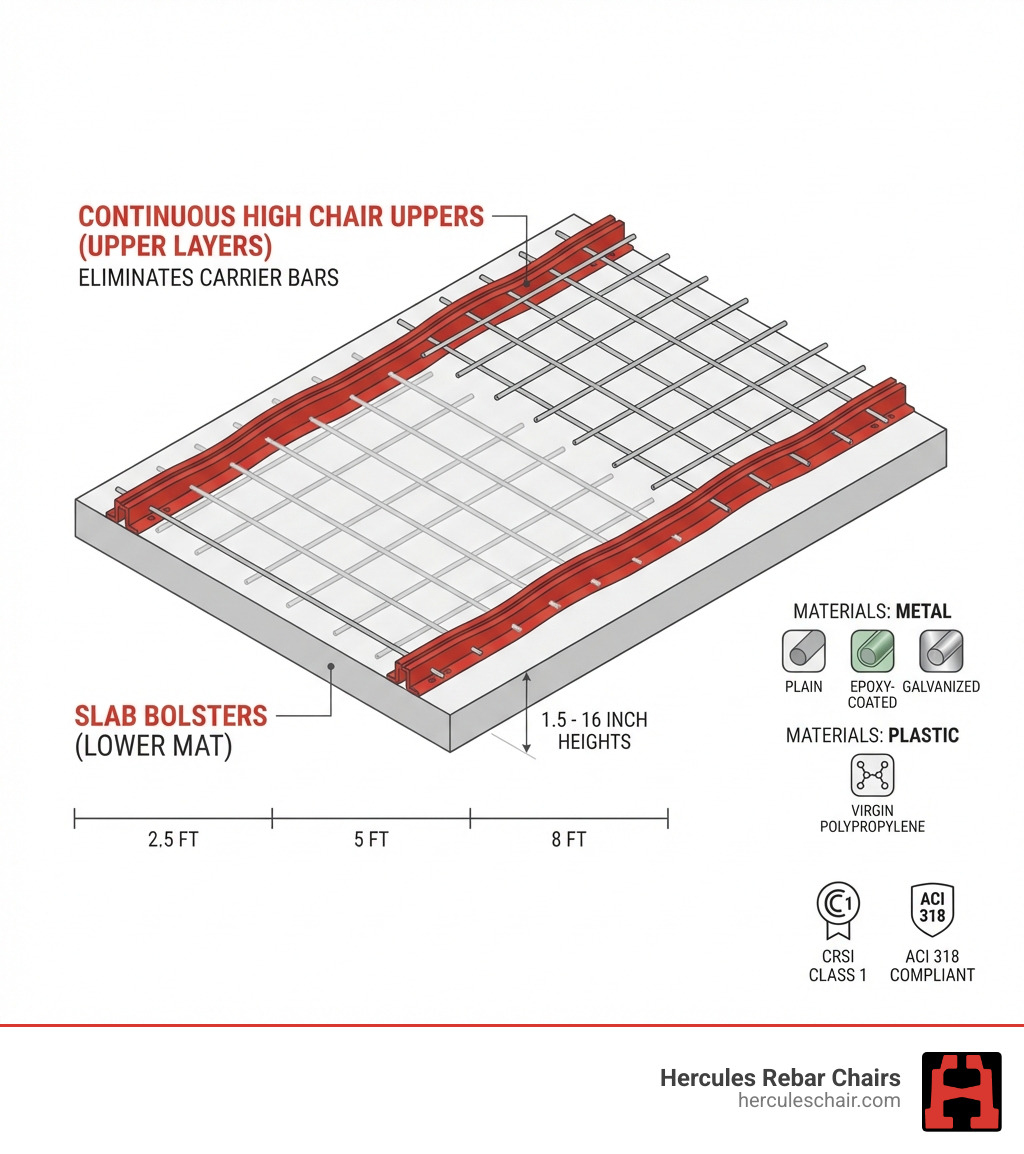
Continuous rebar support refers to long-span support systems that hold reinforcing steel at the correct elevation throughout a concrete pour, typically available in 2.5-foot to 8-foot lengths. Here’s what you need to know:
- Primary types: Slab bolsters (for lower mats) and continuous high chair uppers (for upper steel layers)
- Materials: Metal (plain, epoxy-coated, or galvanized) and plastic (typically virgin polypropylene)
- Key benefit: Eliminates the need for carrier bars and reduces the number of individual chair supports required
- Common heights: Available from 1.5 inches to 16 inches in half-inch increments
- Industry standards: Must meet CRSI Class 1 Bar Support specifications and comply with ACI 318 requirements
When you’re pouring a large slab or deck, traditional individual rebar chairs can be time-consuming to place and may not provide consistent support across long spans. Continuous rebar supports solve this problem by distributing the weight of reinforcing steel across their entire length, maintaining proper concrete cover and ensuring structural integrity.
These systems come in two main categories. Slab bolsters support the bottom mat of reinforcement in slabs, foundations, and other horizontal elements. Continuous high chair uppers elevate the top layer of steel above the bottom mat without requiring separate carrier bars—a significant labor and material savings.
The difference between continuous supports and individual chairs is similar to the difference between a bridge and stepping stones. Individual chairs create point supports, while continuous systems provide uninterrupted load distribution across the entire span. This results in more stable rebar positioning during concrete placement and less risk of displacement when workers walk on the steel or vibrators are used.
I’m Jordan Harris, a licensed structural engineer with five years of experience designing large-scale concrete projects before joining T.J. Harris Company, where we’ve manufactured over 14 million rebar support units including systems that address the need for reliable continuous rebar support. In this guide, I’ll explain everything you need to know about continuous rebar supports—from material options and specifications to installation best practices and code compliance.
What is Continuous Rebar Support?
In concrete, precision is everything. If your rebar shifts by just half an inch, you could compromise the entire structural capacity of the slab. Continuous rebar support is the heavy-duty answer to this challenge. Unlike individual chairs that support rebar at specific points, continuous supports—like slab bolsters and high chair uppers—run for several feet, providing a stable “rail” for the steel to rest upon.
The primary purpose of these supports is to maintain “concrete cover.” This is the distance between the steel reinforcement and the surface of the concrete. Proper cover protects the steel from corrosion and ensures the two materials work together as a composite system. According to our Rebar Placement Guide, using continuous supports is one of the most effective ways to achieve uniform cover in large-scale cast-in-place concrete projects.
Slab bolsters are typically used for the bottom mats of steel, while continuous high chair uppers (CHCU) are designed to separate the top and bottom layers of mesh or rebar. By using a CHCU, you create a dedicated space between the layers, ensuring the upper steel stays in the “tension zone” where it’s needed most. This design effectively manages load distribution, preventing the rebar from sagging under its own weight or the weight of construction crews.
Types and Materials of Continuous Rebar Support
Choosing the right material for your continuous rebar support depends heavily on the environment and the specific requirements of the project. We generally see two main contenders: metal and plastic.
Metal Supports
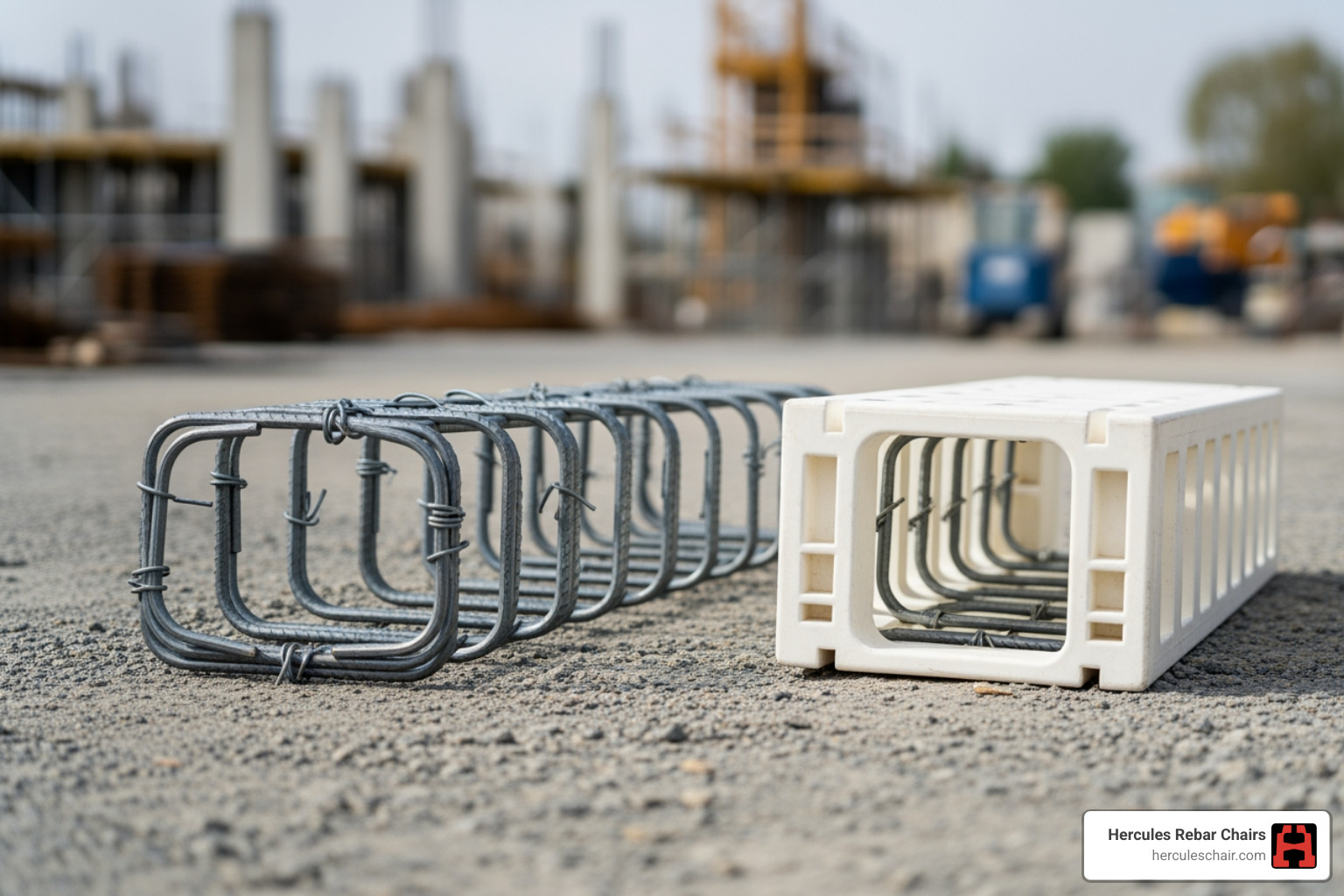
Metal supports are the traditional workhorse of the industry. They are typically made from steel wire and come in several finishes:
- Plain Steel: Best for interior slabs where moisture isn’t a concern.
- Epoxy-Coated: These are essential for corrosive environments or where the project specifications demand extra protection.
- Galvanized or Stainless Steel: Used in high-performance structures like bridges or marine applications.
- Dipped/Plastic-Tipped: These have plastic-covered feet to prevent rust from bleeding through to the surface of the concrete.
Plastic Supports
Plastic slab bolsters have gained massive popularity because they are 100% rust-proof. High-quality plastic bolsters are made from 100% virgin polypropylene, which ensures they don’t become brittle. They are lightweight, easy to cut to length, and often feature a “snap-lock” mechanism. For more on choosing between these materials, check out our guide on The Strong Silent Type: Choosing the Best Steel Rebar Chairs for Your Project.
| Feature | Metal Continuous Support | Plastic Slab Bolster |
|---|---|---|
| Standard Lengths | 5 ft or 8 ft | 2.5 ft (30 inches) |
| Material | Steel (Plain, Epoxy, Galv) | 100% Virgin Polypropylene |
| Corrosion Resistance | Varies by coating | Excellent (Rust-proof) |
| Weight | ~0.83 lbs/ft (for 8″ CHCU) | ~0.29 lbs per unit |
| Best Use | Heavy rebar mats, high elevations | Corrosion-prone areas, lightweight handling |
Metal Continuous Rebar Support Specifications
Metal supports offer the widest range of height options. You can find them in heights ranging from 2 inches all the way up to 16 inches, typically in 1/2-inch increments. They are usually sold in 5-foot or 8-foot lengths. For example, a standard 8-inch metal continuous high chair upper weighs about 0.83 lbs per linear foot and is often bundled in 50-foot or 80-foot quantities. If you’re working on a project with massive reinforcement, these metal options provide the rigid stability required. Learn more about these in our Keep Your Rebar Up: A Guide to Concrete Support Blocks.
Plastic Continuous Rebar Support Features
Plastic bolsters are the “Lego” of the concrete world. Many feature Snap-Lock Connection Holes, allowing you to click multiple 2.5-foot sections together to create whatever length you need. Because they are made of polypropylene, they meet CRSI Class 1 Bar Support standards, which is the highest rating for corrosion protection. They are also incredibly flexible; some can even be bent into a circle for specialized column or tank work. If you’re unsure which size to pick, our guide on How to Determine Bar Chair Sizes in 3 Easy Steps can help.
Key Benefits: Why Use Continuous Supports Over Individual Chairs?
If you’ve ever spent an afternoon placing hundreds of individual chairs, you know how tedious it can be. The biggest benefit of continuous rebar support is labor efficiency. Instead of placing a chair every few feet in every direction, you lay down a 5-foot or 8-foot bolster that supports multiple bars at once.
As we discuss in Elevate Your Concrete: Why Bar Chairs Are Essential for Strong Slabs, stability is the second major win. Individual chairs can tip over if someone trips on the rebar or if the concrete pump hose drags across the mat. Continuous bolsters have a much wider “footprint,” making them nearly impossible to knock over. This ensures that the concrete cover remains consistent across the entire slab, protecting the steel from the elements. For a deeper dive into why this matters, see Rebars Armor: Understanding Concrete Cover and Its Critical Role.
Enhancing Structural Integrity with Continuous Rebar Support
Structural integrity isn’t just about the strength of the concrete; it’s about the placement of the steel. In slab-to-wall connections or perimeter beams, ACI (American Concrete Institute) codes often require continuous reinforcement to handle seismic loads and prevent crack propagation.
Continuous supports ensure that bars remain in their designated “tension” or “compression” zones throughout the entire span. This is especially critical in “Seismic Critical Members” where the structure must be able to deform without collapsing during an earthquake. By maintaining the exact elevation of the steel, you ensure the building performs exactly as the engineer calculated. We call this being Foundation Strong: Mastering Rebar Placement for Lasting Concrete.
Installation and Industry Standards
Installing continuous rebar support is straightforward, but doing it right requires following industry standards set by the Concrete Reinforcing Steel Institute (CRSI) and ACI 318.
- Spacing: Bolsters should be spaced according to the weight of the rebar mat. Typically, they are placed 3 to 4 feet apart, but always check your project’s specific placing drawings.
- Connection: For plastic bolsters, use the snap-lock feature to create continuous runs. For metal bolsters, you may need to lap the ends slightly.
- Tying: While the bolsters provide the height, you should still tie the rebar to the supports using 16.5-gauge tie wire at regular intervals to prevent the steel from shifting laterally.
- Staggering: If you are using mechanical splices or couplers, ensure they are staggered according to code to avoid “weak spots” in the reinforcement.
Choosing the right height is also vital. You don’t want a support that is too tall (reducing top cover) or too short (reducing bottom cover). We recommend checking out The Goldilocks Guide to Concrete Bar Chair Sizes: Not Too Big, Not Too Small to find that perfect fit.
Frequently Asked Questions about Continuous Rebar Supports
Can continuous supports be used on soft surfaces?
Yes, but you need the right type. Standard bolsters might sink into soft dirt or fill material. For these applications, you should look for supports with “sand plates” or use a specialized base. In many foundation cases, we recommend using a Footer Stand Placement Guide or placing the supports on “dobies” (concrete blocks) to distribute the load across a wider surface area.
How do continuous high chairs eliminate extra support bars?
In traditional two-layer slab construction, you often need “carrier bars” (extra pieces of rebar) just to hold up the top mat. Continuous high chair uppers are designed with a top “rail” that acts as the carrier bar itself. This means you buy less rebar, spend less time tying, and reduce the overall weight and congestion of the steel mat. It’s a massive win for the budget, as noted in The Ultimate Guide to Rebar Chairs: Types, Uses, and Sizing for Concrete Slabs.
What is the standard length for a slab bolster?
It depends on the material!
- Plastic bolsters are almost always 2.5 feet (30 inches) long.
- Metal bolsters are typically 5 feet or 8 feet long. Custom configurations are possible for massive industrial projects, but these standard lengths are designed to be easily handled by a single worker on-site.
Conclusion
Whether you are pouring a residential driveway or a multi-story commercial deck, continuous rebar support is the professional’s choice for speed, stability, and structural accuracy. By choosing the right slab bolsters or high chair uppers, you ensure your project meets CRSI and ACI standards while saving significant time on labor.
At Hercules Rebar Chairs, we take pride in being “America’s #1” choice for concrete supports. With over 14 million units sold, our signature red chairs and bolsters are a symbol of quality and code compliance on job sites across the USA. We know that every minute saved on-site is money back in your pocket.
Ready to gear up for your next pour? Use our Hercules Rebar Chair Estimator to find exactly what you need, or visit our shop for More info about Hercules Rebar Chairs. Let’s build something that lasts!