

Why the Right Concrete Contractor Supplies Make or Break Your Project
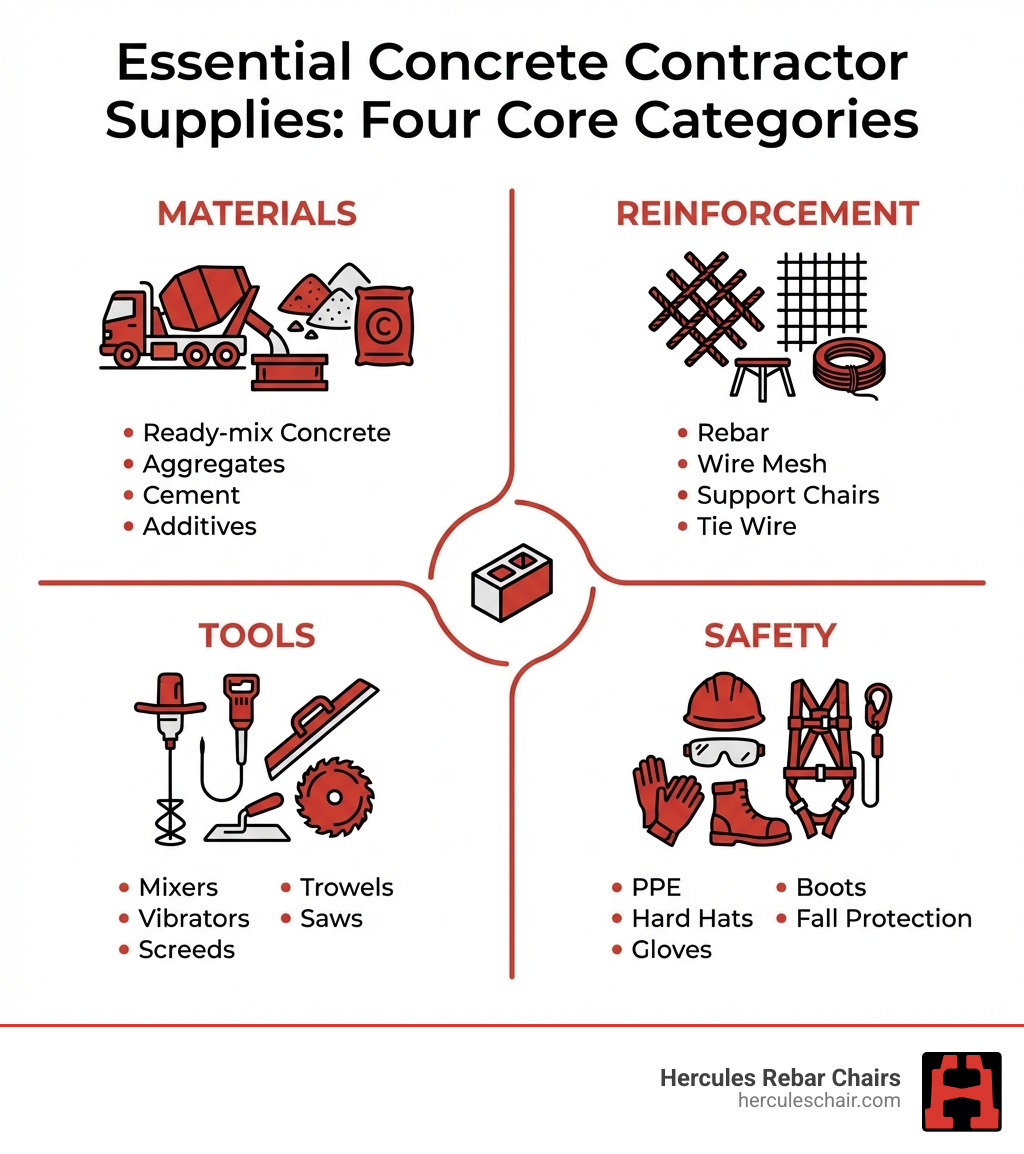
Concrete contractor supplies are the materials, tools, reinforcement products, and safety equipment needed to complete concrete construction projects from start to finish. These include ready-mix concrete, rebar and support systems, forming materials, finishing tools, sealers, repair products, and personal protective equipment (PPE).
Essential Categories of Concrete Contractor Supplies:
- Materials & Mixtures – Ready-mix concrete, aggregates, cement, additives, and specialty mixes
- Reinforcement & Support – Rebar, wire mesh, tie wire, rebar chairs, slab bolsters, and dowel bars
- Forms & Finishing – Concrete forms, release agents, sealers, curing compounds, and repair materials
- Tools & Equipment – Mixers, vibrators, screeds, floats, trowels, edgers, and concrete saws
- Safety Supplies – Hard hats, safety glasses, gloves, steel-toed boots, and rebar impalement caps
Finding the right supplier for your concrete needs is critical to project success. The reliability of your supplier directly impacts the quality and efficiency of your work. With the global concrete market valued at $136.5 billion in 2022 and projected to grow at 4.8% annually through 2030, contractors have more options than ever—but also more pressure to deliver quality results on time and within budget.
The difference between a smooth pour and a costly disaster often comes down to having the right supplies on hand. From the concrete mix itself to the rebar chairs that ensure proper reinforcement placement, every component plays a role in the final product’s strength, durability, and compliance with building codes. The American Concrete Institute provides extensive resources and standards that guide the industry in best practices for concrete construction.
I’m Jordan Harris. After years as a structural engineer on large-scale concrete projects, I joined my family’s company manufacturing rebar support products. My career in both fields has shown me how the right concrete contractor supplies save time, reduce callbacks, and ensure projects meet or exceed structural requirements.
The Foundation: Essential Concrete Materials & Mixtures
When we talk about concrete contractor supplies, it all starts with the concrete itself. The quality of your pour directly reflects the quality of your materials. Getting the foundation right means understanding the components that make up this incredibly versatile construction material.

Ready-mix concrete is a go-to choice for contractors, batched in a central plant and delivered ready to pour. This ensures consistency and quality control that’s hard to achieve with on-site mixing. The demand is high, driven by construction growth across residential, commercial, and infrastructure projects.
At its core, concrete is a mixture of four primary ingredients:
- Aggregates: These are the granular materials like sand, gravel, or crushed stone, which make up the bulk of the concrete’s volume. They provide strength and stability.
- Cement: Typically Portland cement, this acts as the binder. When mixed with water, it undergoes a chemical reaction (hydration) that hardens and binds the aggregates together.
- Water: Essential for the hydration process and for making the concrete workable. The water-to-cement ratio is crucial for strength and durability.
- Additives (Admixtures): These are specialized chemicals added to alter the properties of the concrete, which we’ll dive into next.
Types of Concrete Mixtures and Their Applications
Not all concrete is created equal, and understanding the different types of mixtures is key to selecting the right concrete contractor supplies for your project. The choice depends on the specific demands of the job, from structural strength to aesthetic finish.
- Standard Mixes: These are your everyday concrete mixes, suitable for general-purpose applications like sidewalks, driveways, and foundations where typical strength and durability are required.
- High-Strength Concrete: Designed for projects needing exceptional load-bearing capacity like high-rises and bridges, with compressive strengths far exceeding standard concrete.
- Lightweight Concrete: Uses lightweight aggregates to reduce a structure’s dead load, making it beneficial for tall buildings or areas with poor soil.
- Pervious Concrete: Features a high void content that allows water to pass through, making it excellent for managing stormwater runoff in paved areas and promoting sustainability.
- Fiber-Reinforced Concrete (FRC): Incorporates synthetic or steel fibers to improve toughness, impact resistance, and crack control. This is particularly useful for industrial floors, pavements, and precast products.
Today, there’s an increasing focus on the performance attributes of a given concrete product. Many producers are investing heavily in research and development to deliver innovative performance-based concrete mixtures. This engineering-driven approach ensures the concrete mix is custom to the intended project outcomes rather than relying only on traditional “prescription” mix designs.
Understanding Concrete Additives
Beyond the basic components, concrete admixtures are specialized concrete contractor supplies that fine-tune concrete properties. The global construction chemicals market, including admixtures, is projected to reach $65.1 billion by 2027, highlighting their increasing importance.
Admixtures offer a range of benefits, from improving workability and increasing strength to controlling setting times and enhancing durability. Here are some common types:
- Water Reducers (Plasticizers): Allow for a lower water-to-cement ratio while maintaining slump (workability), leading to stronger, denser concrete. They’re like magic potions for getting more strength with less water.
- Accelerators: Speed up the setting and hardening process, useful in cold weather or when rapid strength gain is needed to expedite project schedules.
- Retarders: Slow down the setting time, giving contractors more time to place and finish concrete, especially in hot weather or for large, complex pours.
- Air-Entraining Agents: Introduce microscopic air bubbles into the concrete, significantly improving its resistance to freeze-thaw cycles and de-icing chemicals. This is vital in colder climates.
- Superplasticizers (High-Range Water Reducers): A more potent version of water reducers, allowing for even greater water reduction or the production of flowing concrete without adding extra water, making it easier to place.
- Pigments: Used to color concrete, offering aesthetic versatility for decorative applications like stamped concrete, architectural finishes, or colored pavements.
These specialized additives contribute significantly to the durability, strength, and aesthetic appeal of finished concrete projects, ensuring they meet specific performance requirements and client expectations.
Building for Strength: Reinforcement and Support Supplies
Concrete is incredibly strong in compression, but it’s not so great when it comes to tension. That’s where reinforcement comes in, turning concrete into a formidable building material. These concrete contractor supplies are absolutely essential for ensuring structural integrity, load-bearing capacity, and long-term durability, all while meeting stringent building codes.
Rebar, Mesh, and Reinforcement Accessories
The backbone of reinforced concrete is, of course, steel.
- Steel Rebar (Reinforcing Bar): These steel bars are placed within concrete to absorb tensile and shear forces. They come in various diameters and grades, chosen based on structural design requirements. To ensure you never run short on a project, our Rebar Length Calculator You Need: Never Run Short Again can be a lifesaver.
- Wire Mesh (Welded Wire Reinforcement): Consisting of a grid of steel wires welded together, mesh is commonly used in slabs-on-grade, driveways, and pavements to control cracking caused by shrinkage and temperature changes.
- Tie Wire: Used to secure rebar intersections, ensuring the reinforcement cage remains stable during concrete placement. It’s like the stitching that holds the fabric of your reinforcement together.
- Dowel Bars: Smooth steel bars inserted into concrete to provide load transfer across joints, often seen in concrete pavements and floors.
- Rebar Couplers: When rebar needs to be joined end-to-end to create longer continuous lengths, couplers provide a strong, mechanical connection. For a comprehensive understanding, check out our Rebar Couplers: Your Ultimate Guide to Connecting Steel Strong.
The Critical Role of Concrete Reinforcement Supports
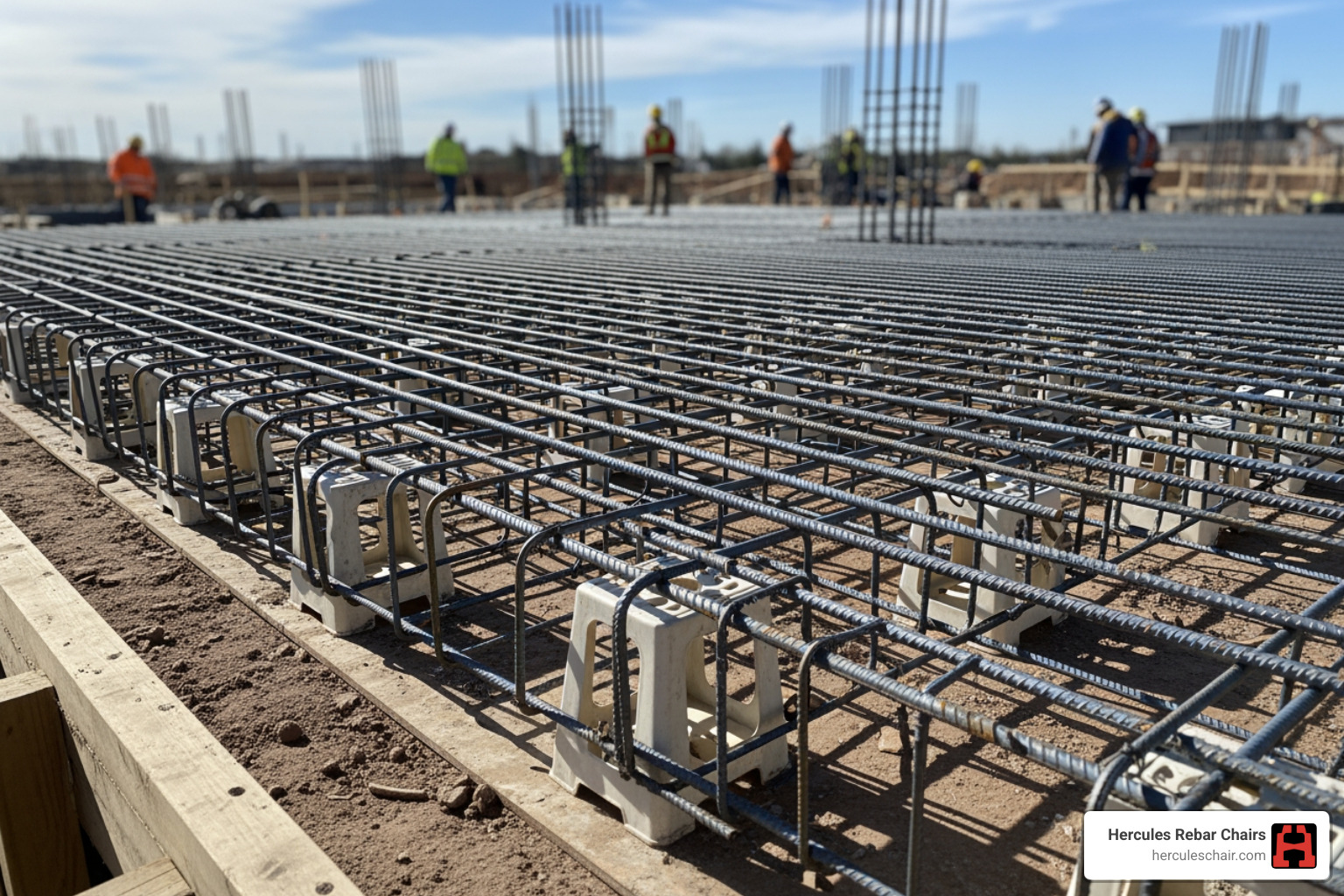
While rebar and mesh provide strength, supports like rebar chairs and slab bolsters ensure they are positioned correctly. Without proper support, rebar can sink to the bottom of the pour, rendering it ineffective and compromising the project’s structural integrity.
- Rebar Chairs: These small but mighty supports lift rebar to the correct height within the concrete, ensuring adequate concrete cover. Proper concrete cover is crucial for preventing corrosion of the steel, which can lead to spalling and structural failure over time. For guidance on achieving this, refer to our Rebar Placement Guide.
- Slab Bolsters: Similar to rebar chairs but typically longer, these supports are used to maintain the elevation of continuous runs of rebar or mesh in slabs.
At Hercules Rebar Chairs, we pride ourselves on manufacturing strong rebar chairs and concrete supports that are “America’s #1” choice. With over 14 million units sold, our red-colored supports are easily identifiable and trusted by contractors across the country. We understand that selecting the right size is paramount, which is why we’ve developed The Goldilocks Guide to Concrete Bar Chair Sizes: Not Too Big, Not Too Small. Our products are designed not only to save you time and money on the job site but also to ensure your projects consistently meet critical code compliance requirements. You can explore our full range of innovative products at Our Products.
Specialized Concrete Contractor Supplies for Performance and Aesthetics
Beyond the basic mix and reinforcement, a range of specialized concrete contractor supplies are available to improve a project’s efficiency, finishing quality, and long-term performance. This includes everything from the molds that shape the concrete to the protective layers applied once it’s set.
Forms, Sealers, and Repair Materials
These supplies are essential for shaping, protecting, and maintaining concrete structures.
- Concrete Forms: These are temporary molds that hold freshly poured concrete in place until it gains sufficient strength. They can be made from wood, steel, aluminum, or plastic, depending on the project’s complexity and reusability requirements. Standard form ties are used to hold plywood forming together.
- Form Release Agents: Applied to the inside of forms, these agents prevent concrete from sticking, allowing for easy removal of the forms and a clean, smooth concrete surface.
- Concrete Sealers: Applied to cured concrete, sealers penetrate the surface to protect against moisture, chemicals, abrasion, and staining. They also improve the aesthetic appeal, offering finishes from matte to high-gloss.
- Curing Compounds: Sprayed or rolled onto fresh concrete, these compounds form a membrane that slows down the evaporation of water, ensuring proper hydration and maximum strength development. This is a critical step for durability.
- Patching Materials: Over time, concrete can develop cracks, chips, or surface imperfections. Patching materials, feather finish, fine concrete dressing, and specific concrete patch products are used to repair these issues, extending the life and improving the appearance of existing concrete.
- Foam Expansion Joint Material: This is used to create isolation joints in concrete slabs, allowing for expansion and contraction without cracking the concrete.
Innovations in Concrete Contractor Supplies
The concrete industry is far from stagnant; it’s constantly evolving with new technologies and sustainable practices. These innovations in concrete contractor supplies are shaping the future of construction.
- Self-Healing Concrete: Researchers are developing concrete that can autonomously repair its own cracks, which could drastically increase the lifespan of structures and reduce maintenance costs.
- Eco-Friendly Concrete: With a growing emphasis on sustainability, options like low-carbon cement and recycled aggregates are becoming more important for contractors aiming for green building certifications.
- Smart Concrete Sensors: Embedded sensors can monitor concrete’s condition in real-time, providing valuable data for quality control and structural health monitoring.
- Advanced Forming Systems: Modular, reusable, and lightweight forming systems are improving efficiency, reducing labor, and allowing for more complex architectural designs.
- 3D Printing: While still emerging, 3D printing of concrete offers the potential for highly complex, customized structures with reduced material waste and faster construction times.
- Vapor Barrier Mats: Crucial for preventing moisture migration through concrete slabs, especially in interior spaces where flooring will be installed. Our Vapor Barrier Mat helps protect finished floor coverings from moisture damage.
These advancements not only improve the performance of concrete but also contribute to more sustainable and efficient construction practices.
Tools of the Trade and On-Site Safety
No matter how good your concrete contractor supplies are, you can’t get the job done without the right tools and, most importantly, a commitment to safety. Job site efficiency goes hand-in-hand with worker protection, and adherence to OSHA standards is non-negotiable.
Essential Concrete Tools
A well-equipped toolkit is the hallmark of a professional concrete contractor.
- Mixers: For smaller jobs, portable electric or gas-powered mixers are indispensable. For larger projects, ready-mix trucks handle the heavy lifting.
- Wheelbarrows and Concrete Buggies: For transporting concrete from the mixer or truck to the pour location.
- Shovels and Rakes: For spreading and leveling concrete immediately after it’s discharged.
- Concrete Vibrators: These remove air pockets from fresh concrete, increasing its density and strength and preventing honeycombing.
- Screeds: Used to level the concrete surface to the desired grade. Manual hand screeds are common, while vibrating power screeds offer greater efficiency for larger areas.
- Floats: Used after screeding to smooth the surface, embed aggregates, and prepare it for final finishing.
- Trowels: Hand or power trowels are used for the final smoothing and densifying of the surface to achieve a hard, durable finish.
- Edgers: Used to create a smooth, rounded edge on the perimeter of slabs and along joints, preventing chipping.
- Concrete Saws: Used for cutting control joints in cured concrete to manage cracking or for cutting sections for repair.
Essential Safety Supplies for Concrete Work
Safety is paramount on any construction site, especially when working with concrete, which involves heavy materials, powerful machinery, and caustic chemicals. Concrete contractor supplies extend to personal protective equipment (PPE) and other safety gear that protects workers from hazards.
- Personal Protective Equipment (PPE): This is your first line of defense.
- Hard Hats: Protect against falling objects and impacts.
- Safety Glasses or Goggles: Shield eyes from splashes, dust, and flying debris.
- Gloves: Chemical-resistant gloves protect hands from the alkaline nature of fresh concrete.
- High-Visibility Clothing: Ensures workers are seen, especially near moving equipment or in low light.
- Steel-Toed Boots: Protect feet from heavy falling objects and punctures.
- Hearing Protection: Crucial when operating noisy equipment like power trowels or concrete saws.
- Respirators: Needed when cutting concrete to protect against silica dust.
- Rebar Impalement Caps: These caps are placed on exposed rebar ends to prevent impalement injuries, a critical safety measure.
- Fall Protection: For work at heights, fall arrest systems, guardrails, or safety nets are essential.
- First Aid Kits: Readily available and fully stocked for immediate treatment of minor injuries.
- Wash Stations: Access to clean water is vital for rinsing skin or eyes that come into contact with concrete.
By prioritizing safety supplies and equipment, contractors not only protect their most valuable asset—their crew—but also foster a culture of responsibility and professionalism.
Sourcing and Strategy: Managing Your Concrete Supply Chain
Effective supply chain management is as crucial as the physical labor in concrete contracting. Optimizing how you acquire your concrete contractor supplies can significantly impact your bottom line and project timelines, with sustainable options also gaining traction.
Finding Reliable Concrete Contractor Supplies
Where you source your materials can make a world of difference. Reliability in a supplier means consistent quality, on-time delivery, and competitive pricing.
- National Distributors: Large-scale distributors offer extensive product inventories, broad geographic reach, and customer account benefits.
- Local Ready-Mix Plants: For the concrete itself, local ready-mix plants are your best bet. They understand local aggregate availability, weather conditions, and often have specialized mixes custom to regional needs.
- Building Supply Stores: For smaller quantities of tools, accessories, and packaged concrete products, local building supply stores offer convenience. Many contractors find their rebar chairs and other essential items at these locations. We encourage you to check out Buy Rebar Chairs / Building Supply Stores to find a retailer near you.
- Online Suppliers: The digital age has brought a wealth of online options for specialized concrete contractor supplies, offering convenience and a broader selection, especially for niche products.
- Becoming a Dealer: For consistent access to our high-quality rebar chairs, interested businesses can explore partnership opportunities by visiting Become a Hercules Dealer.
When choosing suppliers, consider not just price, but also their reputation for quality, delivery reliability, and customer service.
Optimizing Your Inventory and Choosing Sustainable Options
Optimizing your supply chain and inventory management for concrete materials involves strategic planning to minimize waste, reduce costs, and ensure materials are available when needed.
- Just-in-Time Delivery: For perishable materials like ready-mix concrete, coordinating just-in-time delivery is crucial to prevent waste and ensure fresh material. This requires excellent communication with your ready-mix supplier.
- Bulk Purchasing for Non-Perishables: For items like rebar, rebar chairs, and forms, bulk purchasing can lead to cost savings, but it requires adequate storage space and careful inventory tracking to avoid overstocking.
- Inventory Management Systems: Implementing a system to track your concrete contractor supplies helps monitor stock levels, reorder points, and usage patterns, preventing costly delays due to material shortages.
- Considering Sustainable Options:
- Recycled Aggregates: Using recycled concrete aggregates (RCA) or other recycled materials can reduce the demand for virgin resources and lower the environmental footprint of your projects.
- Low-Carbon Cement: Opting for cement types that produce fewer carbon emissions during manufacturing aligns with eco-friendly practices.
- Sustainable Concrete Mixes: As mentioned earlier, producers are increasingly offering sustainable concrete options that incorporate various green technologies.
- Reusability: Choosing durable, reusable forms and other equipment reduces waste over the long term.
By strategically managing your supply chain and embracing sustainable options, we can contribute to both project success and environmental stewardship. For more in-depth information, our Resources page offers valuable insights.
Frequently Asked Questions about Concrete Supplies
We often hear similar questions from contractors looking to optimize their projects. Let’s tackle some of the most common ones.
How do I choose the right supplies for a residential vs. a commercial project?
The choice of concrete contractor supplies differs between residential and commercial projects based on scale, load requirements, finishes, budget, and building codes.
- Project Scale: Residential projects are smaller and use less complex mixes, while commercial jobs require larger volumes, higher strengths, and specialized mixes.
- Load Requirements: Commercial projects demand high-strength concrete and robust reinforcement for heavier loads, while residential projects have lighter requirements.
- Aesthetic Finishes: Residential projects often prioritize decorative options for curb appeal, while commercial jobs may focus more on durable, functional finishes.
- Budget: Residential projects may have tighter budgets, while larger commercial budgets can allow for more specialized materials.
- Local Building Codes: Always consult local building codes. They dictate minimum strength requirements, concrete cover, reinforcement specifications, and other critical factors that vary by project type and location.
For example, a residential driveway might use a standard 3000 psi concrete mix with wire mesh, while a commercial parking garage would require 5000+ psi concrete with extensive rebar reinforcement.
What are the benefits of using admixtures in my concrete?
The benefits of using these specialized concrete contractor supplies are numerous and can significantly impact the quality and efficiency of your work:
- Improved Workability: Admixtures can make concrete easier to place, spread, and finish without adding extra water, which would weaken the mix.
- Increased Strength: Water reducers allow for lower water-to-cement ratios, resulting in stronger, more durable concrete.
- Improved Durability: Air-entraining agents improve resistance to freeze-thaw cycles, while other admixtures can improve resistance to chemical attack.
- Controlled Setting Time: Accelerators speed up setting for fast-track projects or cold weather, while retarders slow it down for complex pours or hot weather, giving you more flexibility.
- Better Finish: Some admixtures can improve surface quality, reduce efflorescence, and make decorative finishes more vibrant.
Admixtures allow us to tailor concrete to specific project needs, overcoming environmental challenges and achieving superior performance.
How much concrete do I need for my project?
Calculating the correct amount of concrete is crucial to save time and money. Ordering too little causes delays and additional costs, while ordering too much leads to waste.
Here’s how we approach it:
- Volume Calculation: For rectangular slabs, the formula is Length (feet) x Width (feet) x Thickness (feet) / 27 = Cubic Yards. For more complex shapes, break them down into simpler geometric figures.
- Cubic Yards: Concrete is measured in cubic yards, not square feet or linear feet.
- Using Online Calculators: Many suppliers and industry websites offer concrete calculators that simplify this process. For example, our Hercules Rebar Chair Estimator can help with related calculations, and general concrete calculators are widely available.
- Accounting for Waste and Irregularities: It’s a best practice to add 5-10% for waste, especially if the subgrade is uneven. An uneven subbase grade can significantly alter the required volume, so always ensure your subbase is level before measuring.
If you’re ever unsure, call your concrete supplier. They can often provide a specialist consultation to help you determine the exact amount needed for your specific job.
Conclusion: Building Success with Quality Supplies
In the competitive world of concrete contracting, success isn’t just about hard work; it’s about smart work. It’s about recognizing that every single one of your concrete contractor supplies plays a vital role in the final outcome. From the ready-mix concrete that forms the foundation to the rebar chairs that ensure its structural integrity, quality materials are the bedrock of durable projects and a stellar reputation.
We’ve explored the essential materials, the critical role of reinforcement and support, the specialized products that improve performance and aesthetics, and the indispensable tools and safety gear that keep projects running smoothly and safely. We’ve also touched on the importance of a well-managed supply chain and the growing trend towards sustainable options.
At Hercules Rebar Chairs, we understand these principles deeply. That’s why we’ve committed ourselves to manufacturing “America’s #1” rebar chairs, identifiable by our distinctive red color. With millions of units sold, our products are engineered to save you time and money on the job site by ensuring precise rebar placement and unwavering code compliance. We take pride in contributing to projects that stand the test of time, just as you do.
Choosing quality concrete contractor supplies isn’t just a purchase; it’s an investment in your project’s longevity, your company’s efficiency, and your reputation as a reliable contractor. We believe that when you build with the best, you build for lasting success.
To learn more about our commitment to quality and how our products can benefit your next project, read more About Hercules Rebar Chair. We invite you to View our innovative 2 Inch Steel Mesh Chair to ensure your next project is built to last.