

Why Proper Concrete Form Supports Are Critical to Every Pour
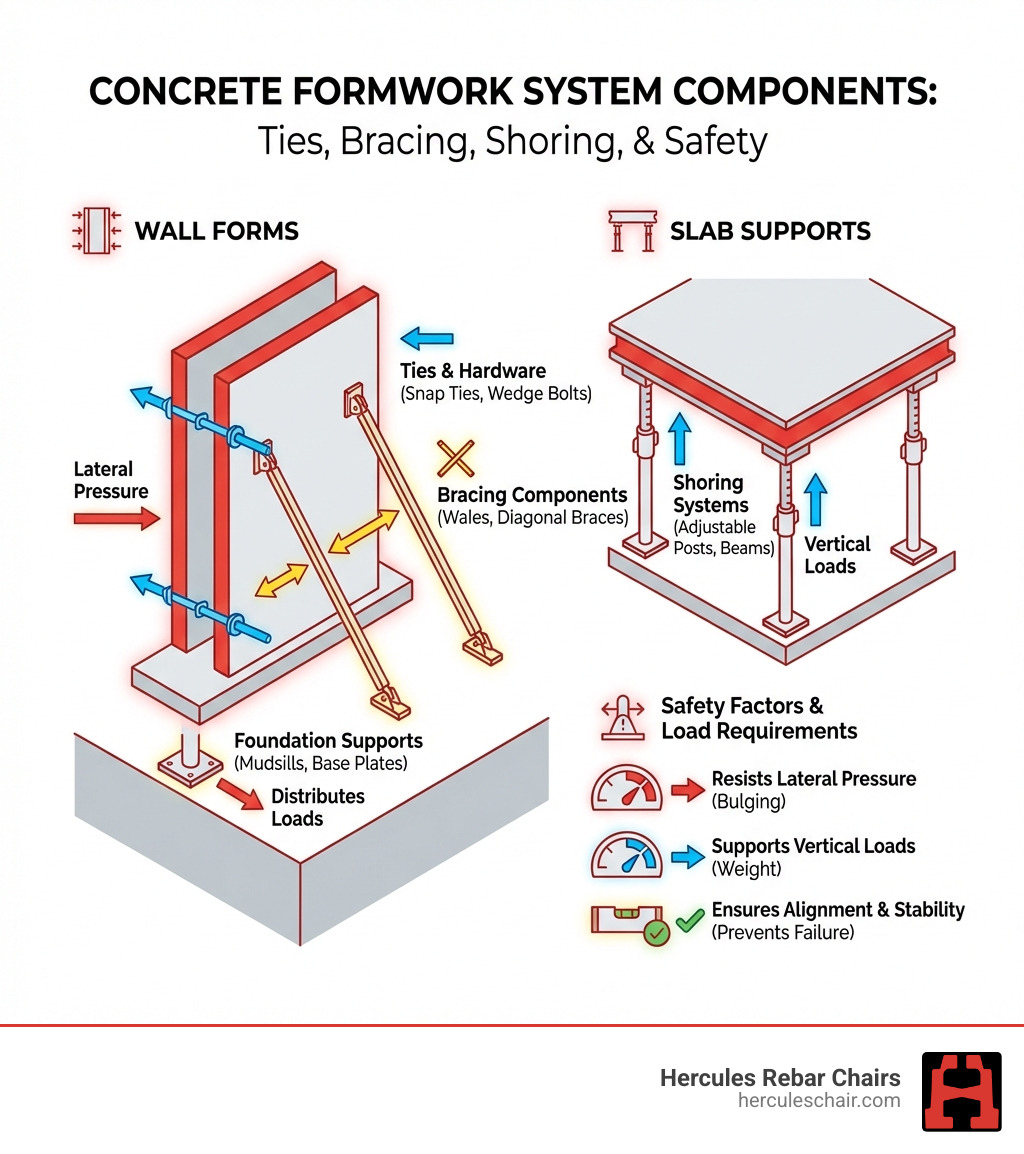
Concrete form supports are the temporary structural systems that hold formwork in place during concrete placement and curing. They provide the critical stability needed to shape fresh concrete while resisting lateral pressure and vertical loads until the concrete gains sufficient strength to support itself.
Key types of concrete form supports include:
- Ties and hardware – Snap ties, wedge bolts, and coil ties that hold wall forms together
- Shoring systems – Adjustable posts and beams that support slab and deck forms from below
- Bracing components – Wales, strongbacks, and diagonal braces that maintain alignment
- Foundation supports – Mudsills and base plates that distribute loads to the ground
- Accessories – Brackets, aligners, and spreaders for specific forming applications
According to industry research, formwork costs can represent up to 60% of the total cost of a completed concrete structure. This makes proper form support selection and installation one of the most important decisions on any concrete project. The right supports prevent costly failures like bulging, grout leakage, and misalignment while keeping workers safe.
I’m Jordan Harris, a licensed Professional Engineer with five years of structural engineering experience on large-scale concrete projects before joining the family business at T.J. Harris Company, where we manufacture concrete form supports and rebar positioning systems. Throughout my career working with concrete form supports, I’ve seen how the right products and techniques make the difference between a smooth pour and a costly disaster.
Understanding Concrete Form Supports and Their Essential Role
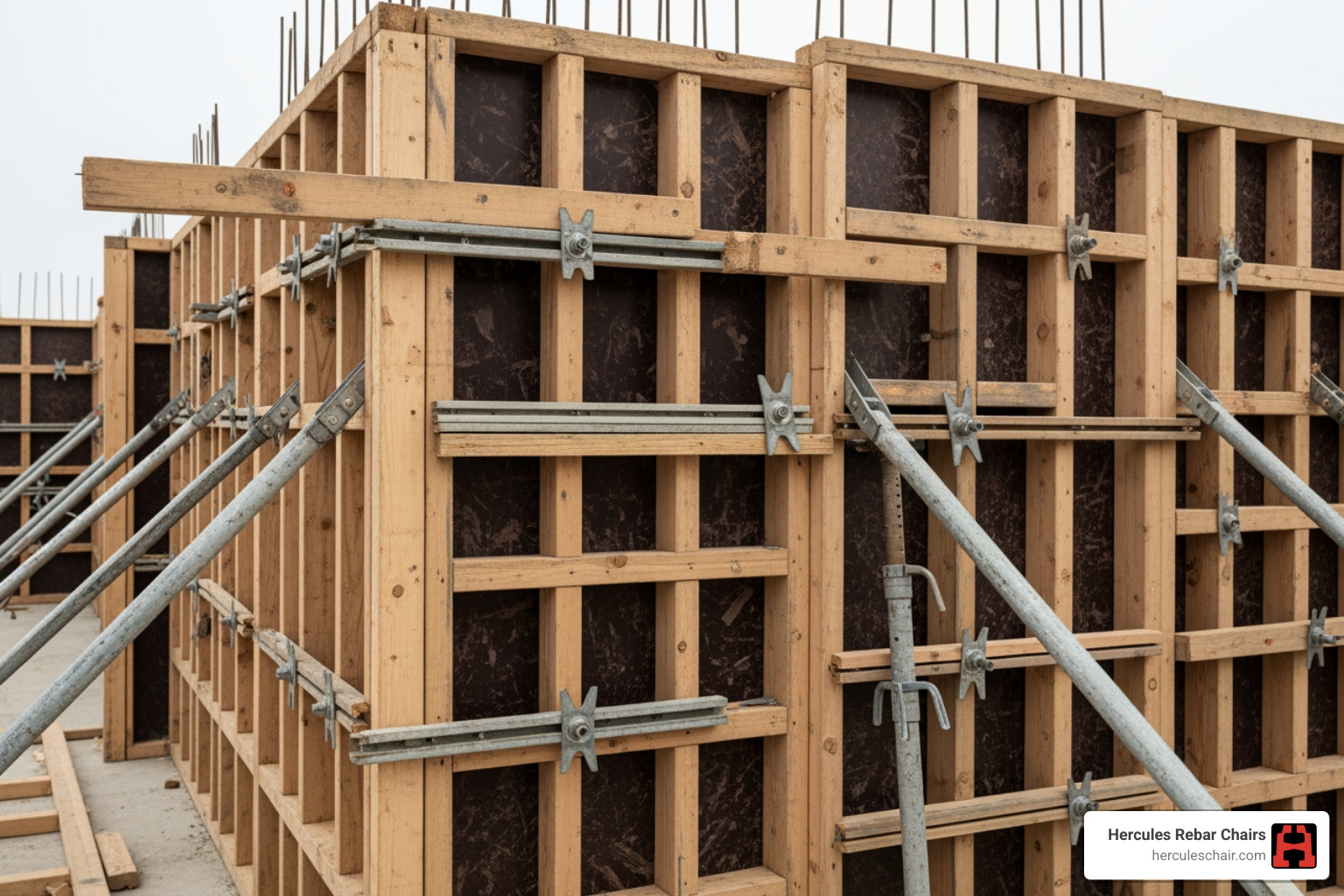
When we talk about Concrete form supports, we are talking about the “skeleton” that keeps the “skin” (the formwork) in place. Without these supports, fresh concrete – which is essentially a heavy, viscous liquid – would simply push the forms over. This lateral pressure is immense; at the bottom of a 10-foot wall pour, the pressure can exceed 1,000 pounds per square foot depending on the temperature and pour rate.
The ACI 347-04 Guide to Formwork for Concrete outlines that the primary goals of formwork are quality, safety, and economy. Supports ensure that the concrete cures in the exact shape and dimensions intended by the architect. If a support fails, even slightly, you end up with “pillowing” or bulges that require expensive grinding or, in the worst cases, a complete tear-out.
Using high-quality Wall Ties & Light Forming Hardware is not just about holding the wood together; it’s about creating a predictable environment for the concrete to gain strength. In the United States, from Alabama to Washington, contractors rely on these systems to maintain project timelines. When supports are engineered correctly, they allow for faster pour rates, which translates directly to lower labor costs and better project economy.
Concrete form supports for Walls and Columns
Vertical structures like walls and columns present a unique challenge: they have a small footprint but high vertical height. This creates significant “bursting” pressure at the base.
To combat this, we use a variety of specialized Concrete form supports:
- Snap Ties: These are high-tensile wire ties used to hold the two sides of a wall form together. They often feature plastic cones that act as internal spreaders, ensuring the wall stays at a consistent thickness (like 8″ or 12″) while preventing grout leakage.
- Wedge Bolts: Often used with modular steel-frame forms, these connect panels quickly and securely.
- Fiber Tubes: For round columns, Fiber Tubes are an economical choice. They are single-use and can form columns from 6″ to 60″ in diameter.
- Wales and Strongbacks: These are horizontal (wales) and vertical (strongbacks) reinforcing members – usually 2×4 or 2×6 lumber or steel channels – that provide rigidity to the form panels.
- Heavy Tie Systems: For massive infrastructure projects, Heavy Tie Components like taper ties and she-bolts are used, capable of supporting loads well over 30,000 pounds.
Concrete form supports for Slabs and Beams
When we move from walls to horizontal surfaces like floors and bridge decks, the support system changes from “tying” to “propping.” This is where shoring and falsework come into play.
Shoring must support the “dead load” of the wet concrete and steel, plus the “live load” of workers and equipment. A critical part of this system is ensuring the reinforcement stays exactly where it belongs. You can’t just throw rebar on the plywood and hope for the best. That’s why we emphasize that you Keep Your Rebar Up: A Guide to Concrete Support Blocks is essential for slab integrity.
In these setups, Concrete form supports include:
- Joists and Stringers: These are the horizontal beams that the plywood deck sits on.
- Shoring Posts: Adjustable metal or wood posts that transfer the weight to the ground.
- Mudsills: These are timber or concrete pads that sit on the earth to prevent the shoring from sinking into the soil – a common cause of structural collapse during a pour.
- Bar Chairs: These are the unsung heroes of the slab. Using products like our Hercules Chairs to Elevate Your Concrete: Why Bar Chairs Are Essential for Strong Slabs ensures that the rebar is perfectly positioned in the “tension zone” of the concrete, preventing future cracks and structural failure.
Design Considerations for Concrete Form Supports
Designing Concrete form supports isn’t just guesswork; it’s a branch of structural engineering. We have to account for several types of loads:
- Vertical Loads: The weight of concrete (roughly 150 lbs per cubic foot), rebar, the forms themselves, and the “live loads” of the crew.
- Lateral Pressure: The liquid concrete pushing outward against wall forms.
- Impact Loads: The force of concrete being dropped from a bucket or pumped at high speed.
One of the most important metrics we use is the Safety Factor. For most form ties, the industry standard is a 2.0:1 safety factor. This means if a tie is rated for a 3,000 lb Safe Working Load (SWL), its ultimate breaking strength must be at least 6,000 lbs. However, for form anchors—which might support workers or hanging forms—the safety factor jumps to 3.0:1.
When selecting supports, you also need to consider the height of your pour. If you’re pouring a deep slab, knowing How to Determine Bar Chair Sizes in 3 Easy Steps is vital. Using a chair that is too short will leave the rebar at the bottom of the slab where it can corrode, while one that is too tall might result in the steel “popping” through the surface.
Best Practices for Installation and Alignment
Even the best Concrete form supports will fail if they are installed poorly. Think of it like a high-performance engine; if the timing is off, it doesn’t matter how much horsepower you have.
Here are our top “pro-tips” for installation:
- Start Level: Always place your forms on a level footing or mudsill. If the base is crooked, the whole wall will be “out of plumb.”
- Mortar-Tight Joints: Ensure all plywood joints are tight. If water and cement paste (cream) leak out, you’ll end up with “honeycombing,” which looks like a bowl of Rice Krispies and is structurally weak.
- Use Turnbuckle Aligners: These allow you to fine-tune the verticality of your walls after they are erected but before the pour.
- Follow a Rebar Placement Guide: Always refer to a Rebar Placement Guide to ensure your steel is spaced correctly relative to your form ties. Ties should never interfere with the structural steel.
- Bracing Angles: Diagonal braces should ideally be at a 45-degree angle (though 30 to 60 is acceptable) to provide maximum stability against wind and vibration.
- Form Oil: Apply form release agents before you put your rebar in. If oil gets on the rebar, the concrete won’t bond to the steel, and you’ve essentially created a giant, expensive paperweight.
- Footer Stands: When working on footings, use a Footer Stand Placement Guide to ensure your base reinforcement is stable and won’t shift when the concrete hits it.
Safety, Inspection, and Removal Procedures
Safety is the #1 priority. Formwork failure is one of the leading causes of construction accidents. Before a single drop of concrete is poured, a thorough inspection is mandatory.
We use “tattletales”—small wooden blocks or marks placed on shoring—to monitor for settlement. If the tattletale moves more than 1/4 inch during the pour, it’s a sign that the ground is giving way or a support is failing, and the pour must stop immediately.
Choosing the right materials for your environment is also a safety factor. For example, if you are working in a coastal area like Florida or South Carolina, you might need to consider The Strong Silent Type: Choosing the Best Steel Rebar Chairs for Your Project to ensure they don’t rust out before the concrete is even poured.
When can you remove the supports? This is called “stripping.” You should never strip forms based on a “feeling.” It must be based on the concrete’s compressive strength, usually verified by field-cured cylinders. Stripping too early can cause the concrete to sag or collapse. When you do strip, use wooden wedges rather than metal pry bars to avoid damaging the “green” (fresh) concrete edges.
Preventing Failure in Concrete form supports
Most failures aren’t sudden collapses; they are small issues that snowball.
- Deflection: If your studs or wales are spaced too far apart, the plywood will bend (deflect), creating wavy walls.
- Grout Leakage: This happens at the base of the form. Use a “base tie” or foam gasket to seal the bottom.
- Reinforcement Corrosion: If your rebar isn’t held up by a 2 Bar Footer Stand or 3 Bar Footer Stand, it might touch the earth or the form. This leads to moisture reaching the steel, causing it to rust, expand, and pop the concrete off—a process called spalling.
Frequently Asked Questions about Concrete Form Supports
What is the difference between formwork and falsework?
Think of formwork as the “mold” (the plywood or steel that touches the concrete) and falsework as the “legs” (the shoring and scaffolding that holds the mold up).
How long should supports remain in place after a pour?
It depends on the span and the concrete mix, but typically 3 to 7 days for walls and up to 28 days for long-span beams, unless high-early strength concrete is used. Always follow the engineer’s specifications.
Why are safety factors higher for form anchors than for ties?
Ties are “redundant”—there are hundreds of them in a wall. If one fails, the others usually hold. Anchors often support the weight of the entire form system or a worker’s walkway. If an anchor fails, the consequences are much more severe, so we require a 3.0:1 safety factor instead of 2.0:1.
Conclusion
Mastering Concrete form supports is the key to a profitable and safe construction business. Whether you are pouring a driveway in Ohio or a high-rise in New York, the principles remain the same: design for the load, install with precision, and never cut corners on safety.
At Hercules Rebar Chairs, we take pride in supporting the American construction industry. We are “America’s #1” for a reason—with over 14 million units sold, our red chairs are a staple on jobsites across all 50 states. Our products are designed to save you time and money while ensuring full code compliance.
Ready to elevate your next project? Check out Our Products or Buy Rebar Chairs directly from us today. Let’s build something strong together!