

Why Proper Rebar Placement Makes or Breaks Your Concrete
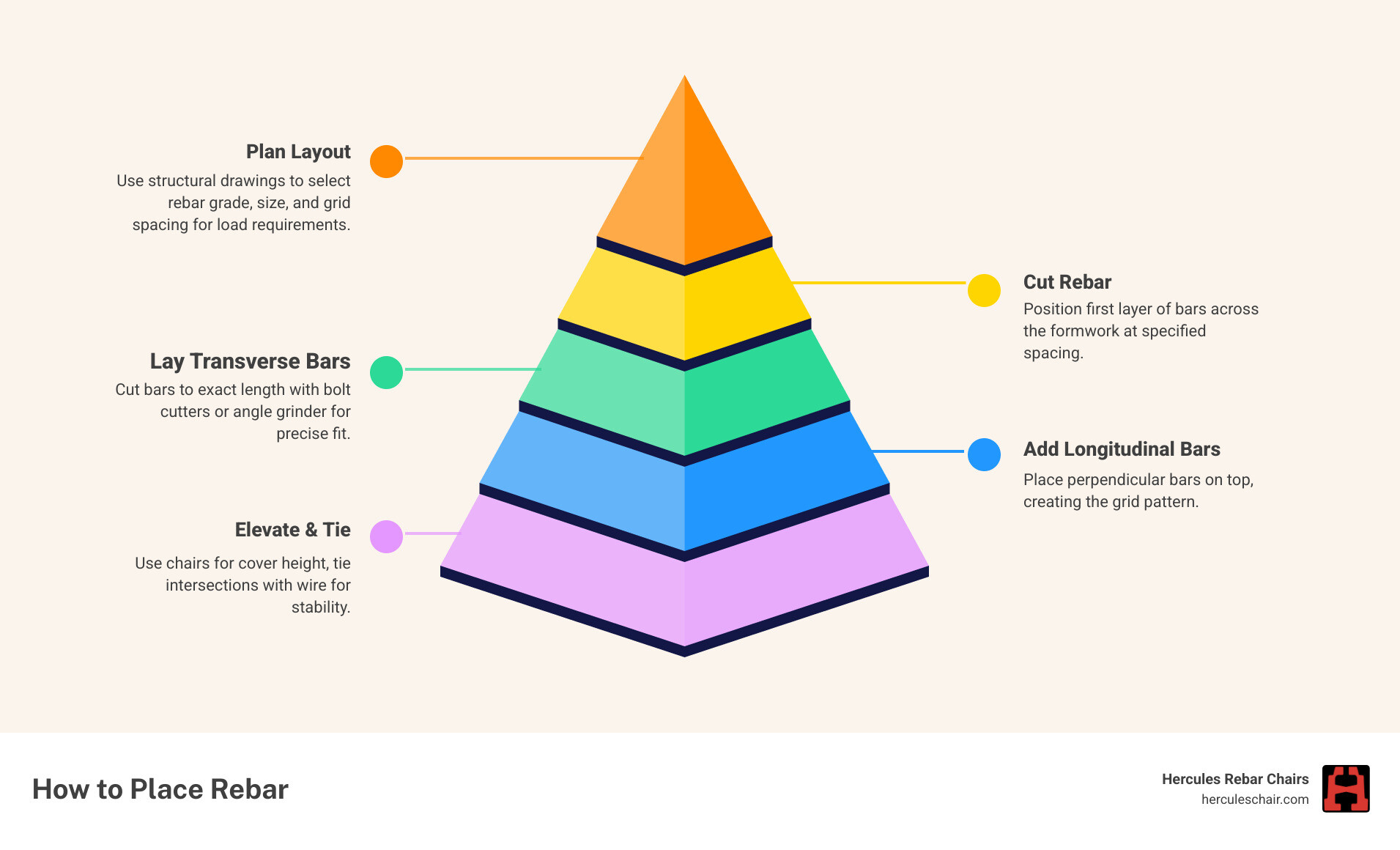
How to place rebar correctly comes down to a few core steps:
- Plan your layout using your structural drawings, and select the right rebar grade and size for the job.
- Cut rebar to length using bolt cutters or an angle grinder.
- Set transverse bars first, then lay longitudinal bars perpendicular on top.
- Elevate the grid with rebar chairs or spacers to achieve the correct concrete cover.
- Tie intersections with wire using saddle ties or figure-8 ties to lock the grid in place.
- Check position and spacing before the pour — tolerances are tighter than most people expect.
Concrete is incredibly strong under compression. But pull on it, and it cracks. That’s where rebar comes in — it handles the tensile forces that concrete simply can’t.
What most people don’t realize is how little margin for error there is. Research shows that misplacing rebar by just half an inch in a 6-inch slab can reduce its load-carrying capacity by 20%. That’s not a minor detail. That’s the difference between a structure that lasts decades and one that fails early.
Whether you’re pouring a driveway, a footing, or a structural slab, getting the rebar right — at the right height, spacing, and tie frequency — is the most important thing you can do before the truck arrives.
I’m Jordan Harris, a licensed Professional Engineer and structural engineering professional with hands-on experience designing large-scale concrete projects. At Hercules Rebar Chairs, I work every day to help contractors understand how to place rebar correctly and efficiently, using support systems built for the real demands of the job site. Let’s walk through exactly what you need to know.
Planning and Selecting Materials for Rebar Installation
Before you even touch a piece of steel, you need a plan. Selecting the right materials is the foundation of structural integrity. If you pick the wrong grade or size, the concrete won’t have the “backbone” it needs to handle the intended loads.
Rebar Grades and Sizes
Rebar isn’t “one size fits all.” In the United States, we primarily look at Grade 60 rebar for residential and commercial projects. The “60” stands for a minimum yield strength of 60,000 psi. This offers an excellent strength-to-cost ratio for driveways, patios, and foundations. You might encounter Grade 40 for lighter work like sidewalks, but Grade 60 is the industry workhorse.
Size is equally important. Rebar is measured in eighths of an inch:
- #3 Bar: 3/8-inch diameter (common for light slabs).
- #4 Bar: 1/2-inch diameter (the standard for most residential construction).
- #5 Bar: 5/8-inch diameter (used for heavy-duty retaining walls or footings).
To dive deeper into the specifics of steel types, check out this Guide to Concrete Rebar. Once you know your bar size, you can use our guide on How to Calculate Rebar for Slab the Right Way to ensure you order exactly what you need without wasting money.
Essential Tools for How to Place Rebar
You can’t master how to place rebar with just your bare hands. You need a specific kit to handle the steel safely and accurately.
- Cutting Tools: For smaller bars (#3 or #4), heavy-duty bolt cutters work well. For #5 bars and up, or for high-volume jobs, an angle grinder with a metal-cutting blade or a portable band saw is much more efficient.
- Tying Tools: You’ll need a 3-pound or 4-pound coil of 16-gauge or 16.5-gauge black annealed tie wire. To twist those ties, use a pair of lineman’s pliers or a specialized rebar tie-twister tool.
- Positioning Tools: A tape measure is non-negotiable for checking spacing, and a rubber mallet helps nudge bars into alignment without damaging the formwork.
For a visual walkthrough of these tools in action, this Rebar Installation Tips video is a great resource.
Calculating Spacing and Quantity
How much steel do you actually need? A common rule of thumb for residential slabs is a grid spaced 18 to 24 inches on center. However, if you are building something that needs to support heavy vehicles or equipment, you should tighten that spacing to 12 to 16 inches.
Here is a quick math example: For a 6ft x 6ft section, if you place bars 1 foot apart, you will need 4 pieces running horizontally and 4 pieces running vertically for each section, totaling 16 pieces of rebar. Always remember to keep the rebar at least 2 to 3 inches away from the edge of the forms to prevent “blowouts” or edge cracking. For more on grid design, see our article on Mastering Rebar Placement for Lasting Concrete.
How to Place Rebar: A Step-by-Step Guide
Now that the planning is done, it’s time for the “heavy lifting.” Placing rebar is a manual process that requires attention to detail.
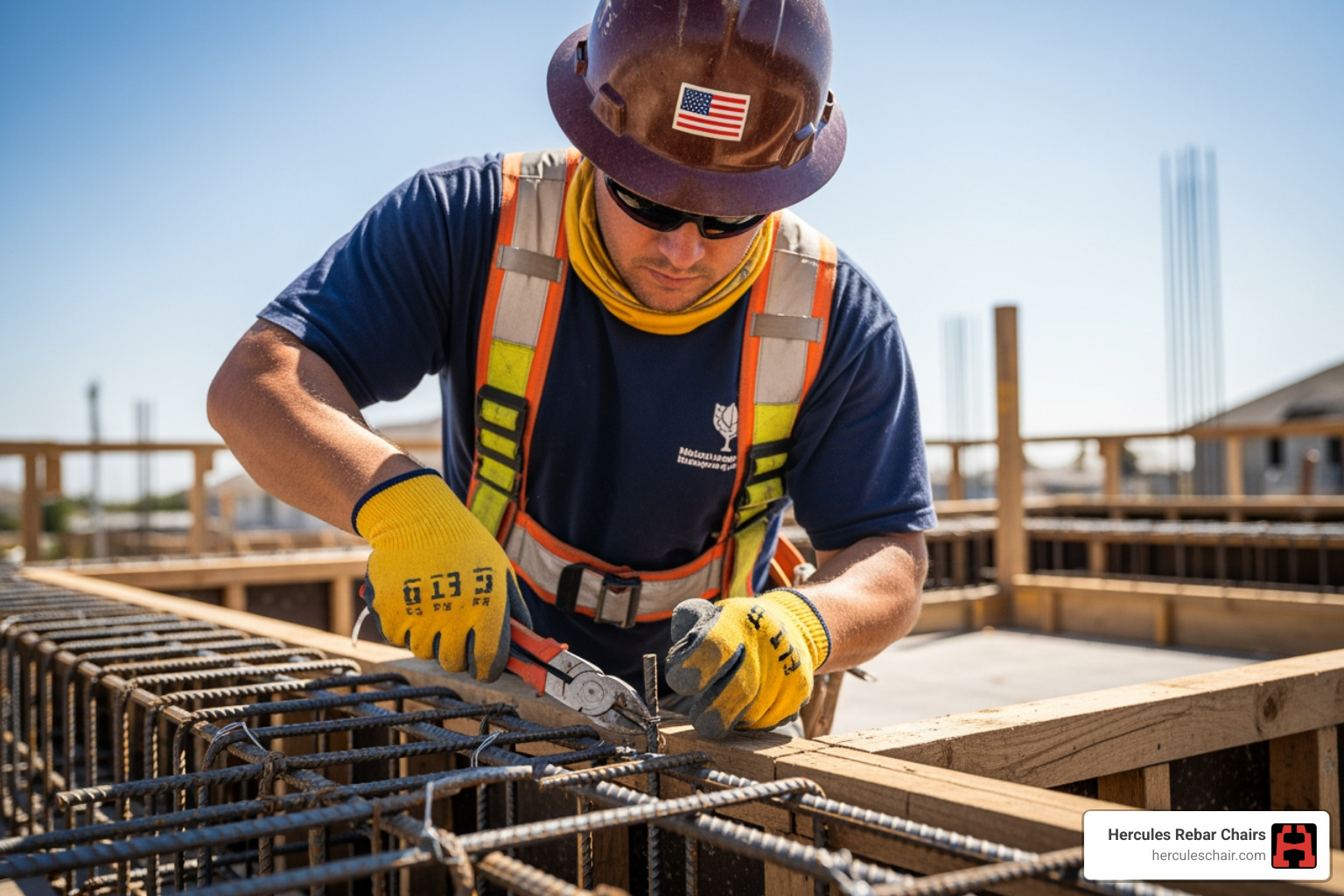
Step-by-Step Instructions on How to Place Rebar
- Prepare the Formwork: Ensure the sub-base is compacted and level. Any debris inside the forms should be cleared out.
- Lay Transverse Bars: Start by laying the bottom layer of bars (usually the shorter span) across the area. Use your tape measure to ensure they are parallel and spaced correctly.
- Lay Longitudinal Bars: Place the second layer of bars perpendicular to the first. This creates the “mat” or grid.
- Level and Adjust: Use a mallet to tap bars into place. Ensure you maintain the required perimeter clearance (usually 3 inches for footings cast against earth).
- Secure the Grid: Before you lift the grid onto chairs, you need to tie the intersections so the whole mat moves as one unit.
For specific guidance on footings, follow our Footer Stand Placement Guide to ensure your vertical bars stay upright during the pour. You can also find a detailed Step-by-Step Guide for general layouts here.
Tying Techniques for Stability
Tying rebar isn’t just about keeping it pretty; it’s about making sure the bars don’t shift when workers walk on them or when the concrete pump starts blasting. You don’t need to tie every single intersection—usually every fourth or fifth intersection is enough for flatwork, though you should tie every intersection along the perimeter.
Common tie types include:
- Snap Tie (Single Tie): The simplest tie, made by wrapping the wire once around the intersection and twisting.
- Saddle Tie: Pass the wire behind the rear bar, across the front, and back around. This is great for holding bars that are under tension.
- Figure-8 Tie: This is a more secure tie that prevents bars from sliding diagonally. It involves weaving the wire in a “8” pattern around the intersection.
For more technical details on tying, the Placing Reinforcing Steel guide is an industry standard.
Ensuring Proper Elevation and Concrete Cover
The most common mistake in the field is leaving the rebar sitting on the ground. Steel on the ground is steel that will rust. To work correctly, rebar must be completely encased in concrete. This is what we call concrete cover.
Using Chairs and Spacers for Support
To get the rebar off the dirt, we use rebar chairs. These are small supports that hold the steel at a specific height.
- Spacing: Place chairs every 3 to 4 feet (or about one per square yard). If the chairs are too far apart, the rebar will sag when you walk on it, losing its structural value.
- Materials: You can use precast concrete “dobies,” but plastic chairs—like our signature red Hercules chairs—are often preferred because they are lightweight, non-corrosive, and snap onto the bar for a secure fit.
For a deep dive into support options, check out The Ultimate Guide to Rebar Chairs and our breakdown of Rebar Chair Types.
Critical Cover Requirements and Tolerances
The American Concrete Institute (ACI) provides strict guidelines for cover. If the steel is too close to the surface, water and salt will penetrate the concrete, rust the steel, and cause the concrete to “spall” or flake off.
| Application | Minimum Concrete Cover |
|---|---|
| Footings (cast against earth) | 3 inches |
| Slabs (not exposed to weather, #11 bars or smaller) | 3/4 inch |
| Beams and Columns | 1.5 inches |
| Slabs/Walls exposed to weather (#6 bars and larger) | 2 inches |
Tolerances are also key. ACI 117 allows for a longitudinal deviation of about ±3 inches, but vertical placement is much stricter. As we mentioned, a half-inch error in a thin slab is a massive structural penalty. Learn How to Determine Bar Chair Sizes to ensure you hit these numbers every time.
Best Practices and Common Mistakes to Avoid
Even pros make mistakes. The goal is to avoid the big ones that lead to structural failure.
Common Mistakes
- “Hooking” the Rebar: Some workers try to pull the rebar up into the concrete while they are pouring. This is a terrible idea. You can never be sure exactly where the rebar ends up. Use chairs to set it and forget it.
- Tack Welding: Never weld rebar intersections unless specifically allowed by an engineer. The heat from welding can weaken the steel and reduce its cross-sectional area.
- Dirty Rebar: A little surface rust is actually good for bonding, but thick scales of rust, oil, or mud will prevent the concrete from “grabbing” the steel.
- Improper Support Spacing: If the rebar bounces when you walk on it, you need more chairs. Sagging rebar leads to uneven strength distribution.
Safety Precautions on the Jobsite
Rebar is heavy, sharp, and often rusty. Safety is paramount.
- PPE: Always wear high-quality gloves, safety glasses, and steel-toed boots.
- Rebar Caps: Any vertical rebar (like in a retaining wall) must be capped with “mushroom” caps to prevent impalement if someone falls.
- Lifting: Rebar comes in long bundles. Always lift with your legs, not your back, and work in teams to move long lengths.
For more on jobsite safety, see this Rebar Installation Guide.
Frequently Asked Questions about Rebar Placement
What is the minimum concrete cover for rebar in a footing?
For footings cast directly against the earth, the standard minimum cover is 3 inches. This thick layer of concrete protects the steel from the moisture and minerals in the soil that cause corrosion.
How often should I tie rebar intersections?
You don’t need to tie every single one. Usually, tying every fourth or fifth intersection is sufficient to keep the mat stable during the pour. However, ensure all perimeter intersections and any areas where you’ll be walking heavily are tied securely.
Why is it a mistake to pull rebar up during the concrete pour?
This is known as “hooking.” It’s unreliable because the rebar often sinks back down or ends up unevenly distributed. If the rebar isn’t at the precise depth specified in the plans, the slab loses a significant portion of its load-carrying capacity. Always use chairs to fix the height before the pour begins.
Conclusion
Mastering how to place rebar is the difference between a project that stands the test of time and one that ends in a pile of cracked debris. By selecting the right Grade 60 steel, calculating your grid spacing accurately, and using high-quality supports to maintain your concrete cover, you ensure structural longevity and code compliance.
At Hercules Rebar Chairs, we’ve sold over 14 million units across the USA because we know that “close enough” isn’t good enough in concrete construction. Our American-made, identifiable red chairs are designed to save you time and money while ensuring your steel stays exactly where it belongs.
Ready to start your next project with the right foundation? Check out our full Rebar Placement Guide for more expert tips and industry-leading support solutions.