

Why Plastic Rebar Chair Spacers Are the Backbone of Quality Concrete Work
A plastic rebar chair spacer is a support that lifts reinforcing steel (rebar) to the correct height within concrete forms. This ensures proper concrete coverage, which is essential for protecting rebar from corrosion, maintaining structural strength, and meeting fire resistance standards.
Quick Answer: What You Need to Know
- Primary Function: Holds rebar at the specified height to achieve proper concrete cover
- Key Materials: High-Density Polyethylene (HDPE) or Polypropylene (PP)
- Main Benefits: Non-corroding, lightweight, cost-effective, and easy to install
- Common Types: Individual chairs (A-frame), wheel spacers, continuous chairs, and stackable designs
- Typical Applications: Slabs, footings, walls, columns, tilt-up panels, and precast elements
- Size Range: Designed to support rebar from #3 to #18 and concrete cover heights from 1″ to 6″+
These simple devices are the hidden champions of concrete construction. Without them, rebar can settle during a pour, leading to inadequate concrete cover, rust, spalling, and structural failure. They are quick to install, eliminate labor-intensive wire tying, and ensure consistent placement across the job site.
Research shows that durable, non-corroding plastic rebar chair spacers maintain their shape under pouring stress, providing uniform concrete cover that traditional methods can’t match. They facilitate smooth concrete flow, prevent voids, and help contractors meet code requirements without adding significant cost or complexity.
I’m Jordan Harris, a licensed Professional Engineer who spent five years designing large-scale concrete structures before joining my family’s company, where we’ve sold over 14 million rebar support systems—including plastic rebar chair spacers that contractors trust for strength and consistency on critical pours. In this guide, I’ll walk you through everything you need to know about selecting and using plastic rebar chairs to improve your concrete work.
What Are Plastic Rebar Chair Spacers and Why Are They Essential?
Imagine baking a cake, but instead of putting the fruit evenly throughout, it all sinks to the bottom. Not ideal, right? In concrete construction, rebar is our “fruit,” and if it’s not positioned correctly, the entire structure suffers. This is where the mighty plastic rebar chair spacer steps in as our unsung hero.
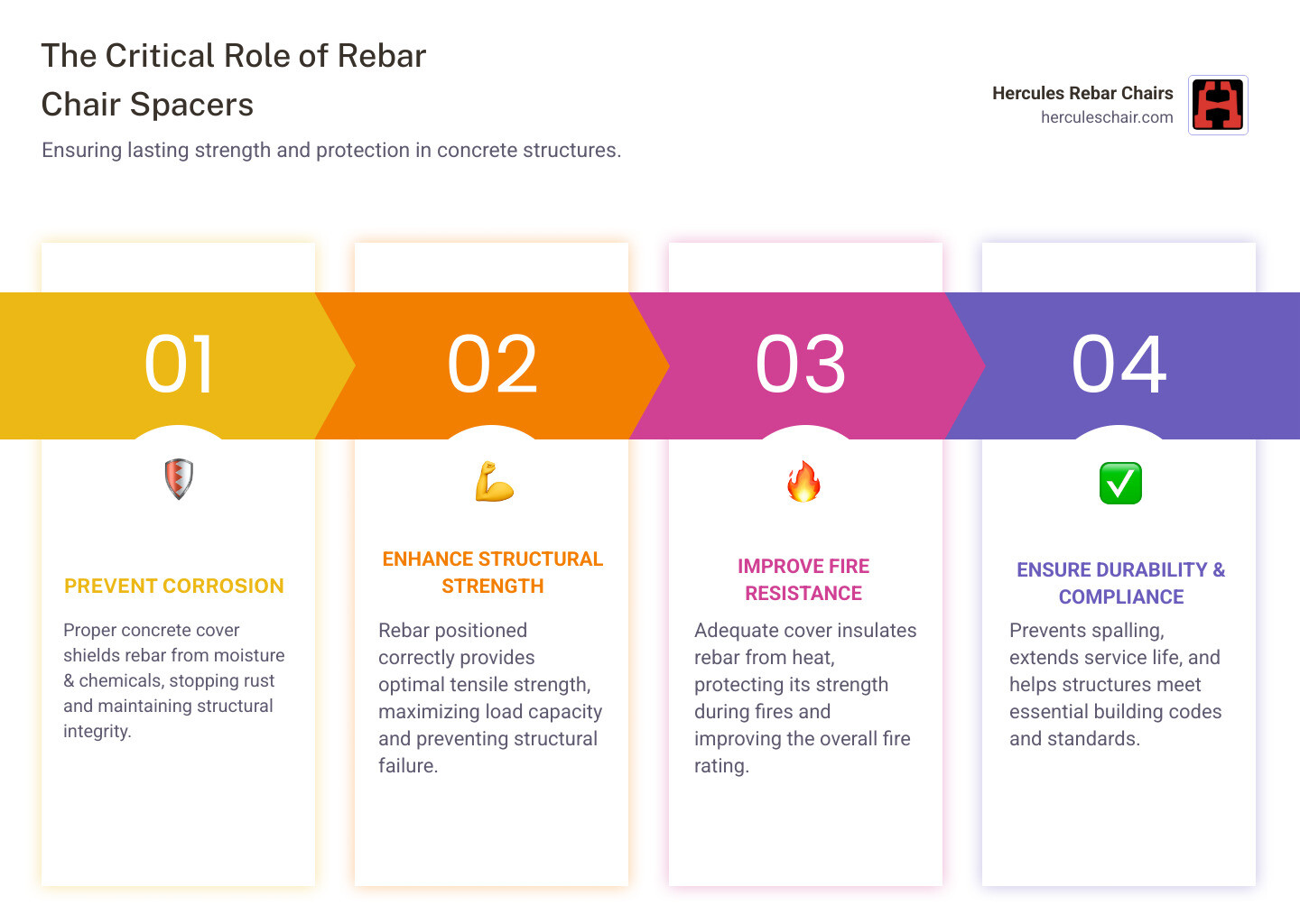
Its primary function is to lift and maintain reinforcing steel (rebar) at the precise height required within concrete forms. This ensures that the rebar is fully encapsulated by concrete, achieving what we call “proper concrete cover.” Without this crucial elevation, rebar can sag or shift during concrete pouring, ending up too close to the surface or resting on the formwork.
Why is this so critical? Proper concrete cover is the first line of defense for reinforcing steel. It protects the rebar from moisture and chlorides, which lead to corrosion. Corroded rebar expands, causing the concrete to crack and spall, compromising the structural integrity of the entire element.
Beyond corrosion prevention, plastic rebar chair spacers contribute to the overall strength, durability, and safety of concrete structures. They ensure rebar is positioned to carry tensile loads, maximizing its benefit. This precise placement is also vital for fire resistance, as sufficient concrete cover delays the heating of the rebar during a fire. Uniform cover also ensures optimal bonding between rebar and concrete, allowing them to act as a single, cohesive unit.
At Hercules Rebar Chairs, we understand these principles deeply. Our products are designed to guarantee that your rebar stays exactly where it needs to be, pour after pour. You can Learn more about Hercules Rebar Chair Spacers and how we help achieve these critical construction goals.
The Importance of Proper Concrete Coverage
Think of concrete cover as the rebar’s bodyguard. This protective layer ensures the longevity and performance of the entire concrete structure. Without it, even the strongest rebar is vulnerable.
The primary role of concrete cover is corrosion protection. Concrete is naturally alkaline, creating a passive film around the rebar that prevents rust. However, if rebar is too close to the surface, carbonation or the ingress of chlorides (from de-icing salts or saltwater) can destroy this film, leading to corrosion. This is a common issue in coastal states like Florida or California, or regions with heavy winter road salt usage.
Proper cover also dictates structural durability. When rebar is correctly encased, it performs as intended, handling tensile stresses and preventing cracks. This ensures the concrete and steel work together efficiently, distributing loads and maintaining the structure’s integrity over decades.
Moreover, meeting fire rating standards depends on adequate concrete cover. A thicker concrete layer acts as an insulator, delaying heat transfer to the rebar during a fire. This allows the steel to retain its strength longer, providing critical time for evacuation and mitigating structural collapse.
Maximizing rebar benefit and preventing spalling are direct results of proper coverage. Spalling, where concrete flakes off, is often a symptom of corroding rebar. By preventing this, we ensure the structure’s longevity and reduce costly repairs.
Materials Used for a High-Quality Plastic Rebar Chair Spacer
High-quality plastic rebar chair spacers are made from specific plastics that offer superior performance in demanding construction environments, most commonly High-Density Polyethylene (HDPE) and Polypropylene (PP).
These materials are chosen for several key advantages:
- Non-Corroding: Unlike metal supports, HDPE and PP are impervious to rust, preventing “rust bleed” stains on the finished concrete surface.
- Lightweight yet Strong: These plastics are engineered to be remarkably strong despite being lightweight. They withstand the weight of rebar, concrete pouring forces, and foot traffic without deforming.
- Chemical Resistance: HDPE and PP resist chemicals found on construction sites, including concrete admixtures, ensuring their long-term integrity.
- Durability and Shape Retention: These tough plastics resist impact and maintain their shape under stress, ensuring uniform concrete cover.
- Affordability: Plastic spacers are a cost-effective alternative to traditional methods.
Our plastic rebar chair spacers are crafted from these robust materials, ensuring they stand up to the rigors of any construction project, providing reliable support where it matters most.
A Guide to Different Types of Plastic Rebar Chairs
Just as there’s a specific tool for every job, there’s a plastic rebar chair spacer for every concrete application. The variety ensures you have the right support for any project, from a sprawling slab to a delicate precast element. These design variations cater to different rebar configurations, concrete covers, and installation needs.
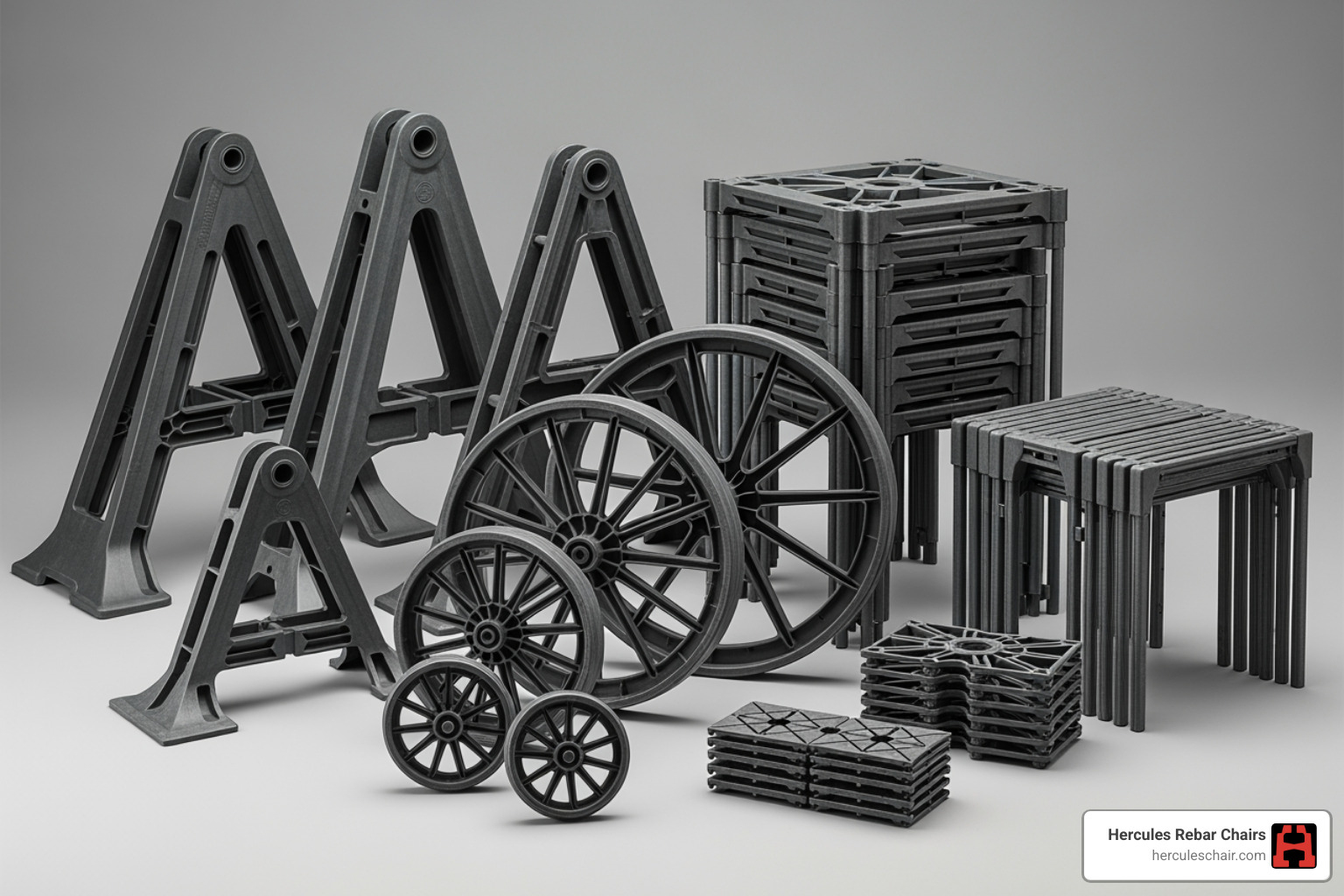
From individual chairs that provide pinpoint support to continuous systems that span long distances, each type has its unique strengths. We offer a comprehensive range to meet diverse project needs. You can find More info about our products and explore our full selection.
Individual Chairs (A-Frame, Round Base)
Individual chairs are the most common and versatile plastic rebar chair spacers, designed to provide stable, pinpoint support for rebar.
- A-Frame Chairs: Often feature a distinctive “A” shape, providing excellent stability. Some A-shaped chairs include a clip on top to hold the steel rebar securely, allowing them to be used horizontally for stirrups of beams/columns or vertically for wall structures.
- Round Base Chairs: These typically have a circular or broad base, which helps prevent them from sinking into softer sub-bases, like compacted earth or sand, commonly found in slab-on-grade construction or footings.
Individual chairs are ideal for:
- Slab-on-grade: Supporting rebar mats in concrete slabs poured directly onto the ground.
- Tilt-up panels: Ensuring consistent rebar placement within large precast panels that are later tilted into position.
- Footings: Elevating rebar cages in foundations to achieve the necessary concrete cover from the ground.
These chairs are quick and easy to place, ensuring precise rebar positioning without the need for intricate tying. For robust support in footings, be sure to Check out our 3 Bar Footer Stand.
Wheel Spacers
For vertical concrete elements like walls and columns, wheel spacers are essential for maintaining consistent rebar cover against the force of gravity.
These circular plastic rebar chair spacers are designed with a central hole to thread onto individual rebar bars. Their “wheel” shape allows them to roll easily along the rebar during installation. The key benefit is their ability to ensure consistent side cover in vertical applications. As concrete is poured, the wheel spacer maintains the rebar’s distance from the formwork on all sides, preventing blowouts or areas with insufficient cover.
Wheel spacers are perfect for:
- Walls: Guaranteeing uniform cover for vertical rebar in concrete walls, whether cast-in-place or precast.
- Columns: Ensuring the rebar cage within a column maintains its concentric position, critical for structural integrity.
- Cages: Providing all-around support for complex rebar cages, allowing for easy roll-on installation.
Continuous and Stackable Chairs
For projects requiring extensive rebar mats or multiple layers of reinforcement, continuous and stackable plastic rebar chair spacers offer efficient and reliable solutions.
- Continuous Chairs (Ladder Chairs/Beam Bolsters): These are long, often ladder-shaped supports that span across multiple rebar bars, providing continuous elevation. They are excellent for large rebar mats in expansive slabs, ensuring uniform support over a wide area. Beam bolsters, a type of continuous chair, are specifically designed to support rebar in beams.
- Stackable Chairs (High Chairs): These ingenious designs allow individual chairs to be stacked on top of each other, creating varying heights. This is particularly useful for suspended slabs or situations requiring double mat applications, where two layers of rebar need to be precisely separated.
These types are invaluable for:
- Large rebar mats: Providing consistent support across wide areas, reducing the number of individual chairs needed.
- Double mat applications: Accurately separating two layers of rebar in thicker slabs or structural elements.
- Suspended slabs: Ensuring the top mat of rebar is at the correct height, crucial for the slab’s structural performance.
We offer a range of these specialized supports, including our robust High Chairs – Hercules Rebar Chairs designed for various applications.
How to Select the Perfect Plastic Rebar Chair Spacer for Your Project
Choosing the right plastic rebar chair spacer is a critical decision that impacts the longevity and structural integrity of your concrete project. Making the right choice ensures your project meets specifications and code compliance, saving time and preventing costly rework.
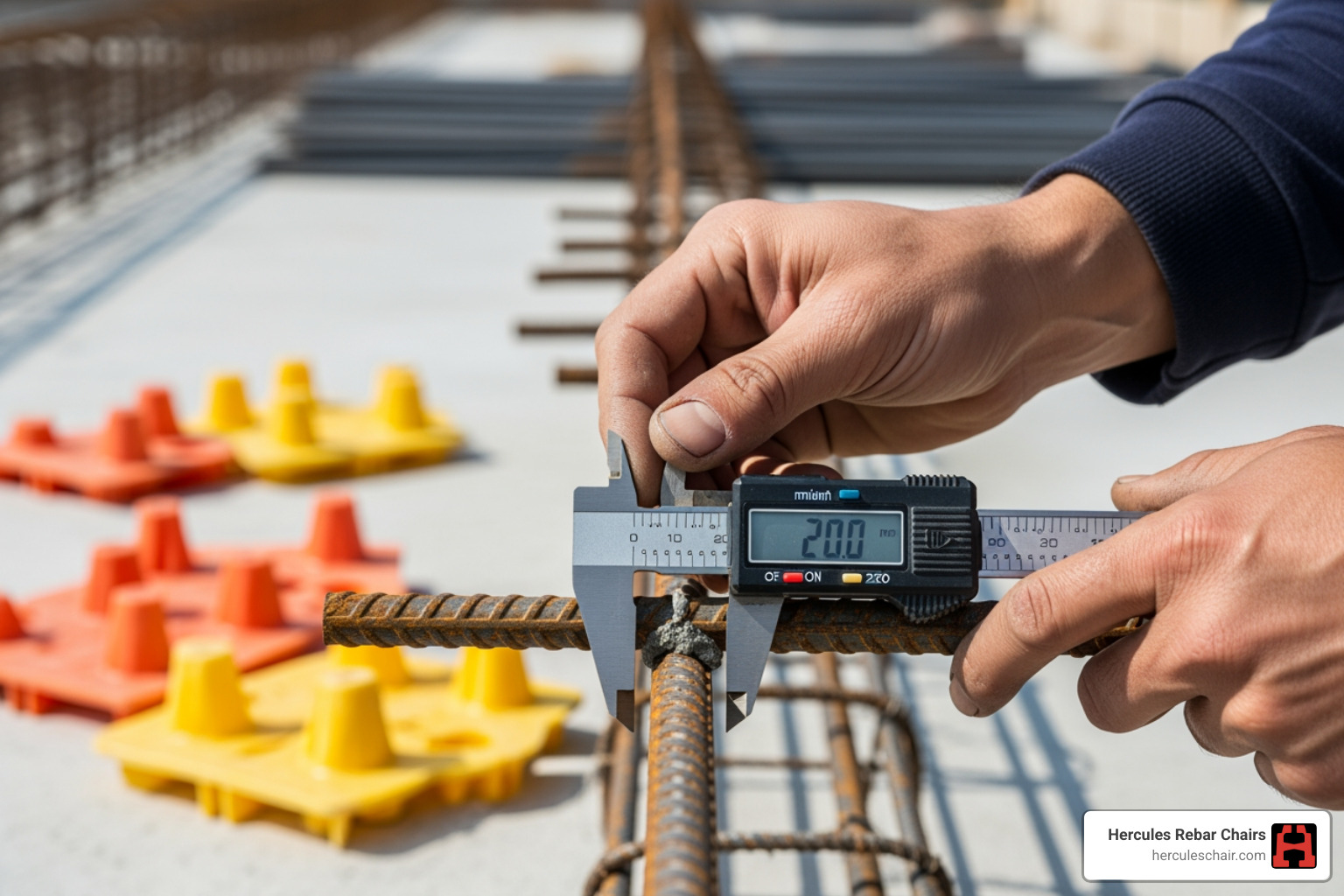
We always recommend consulting your project plans and specifications. These documents will outline the required concrete cover and rebar sizes, which are your primary guides. A little foresight here goes a long way in ensuring a smooth pour and a durable structure. For comprehensive guidance, refer to our Rebar Placement Guide.
Factor 1: Rebar Size and Concrete Cover
The most fundamental consideration is matching the plastic rebar chair spacer to the rebar diameter and the required concrete cover height.
- Matching Spacer to Rebar Diameter: Spacers are designed to grip specific rebar sizes. For instance, a spacer designed for #4 rebar might not securely hold #6 rebar. Common rebar sizes in the U.S. range from #3 (3/8″) to #18 (2 1/4″), and spacers are available to accommodate this entire spectrum.
- Required Cover Height: Your project’s structural drawings will specify the exact concrete cover needed (e.g., 1.5 inches, 2 inches, 3 inches). This height is dictated by factors like exposure conditions, fire rating, and structural demands. You must select a spacer that provides this precise elevation. Our The Goldilocks Guide to Concrete Bar Chair Sizes: Not Too Big, Not Too Small offers more detailed insights.
Factor 2: Load Capacity and Base Design
A plastic rebar chair spacer needs to do more than just hold rebar; it needs to withstand the dynamic forces of a construction site.
- Weight of Rebar and Workers: Consider the cumulative weight of the rebar mat, plus the weight of workers walking on it. The spacer must be robust enough to prevent crushing or deformation.
- Pouring Stress: The act of pouring concrete creates significant pressure. The spacers must maintain their position and height under this stress.
- Base Design:
- Wide Base: For softer ground conditions (e.g., vapor barriers over sand), a spacer with a wide, stable base is essential to prevent sinking.
- Minimalist Base: For hard, stable surfaces like existing concrete, a minimalist base might suffice, as sinking is less of a concern.
Selecting the appropriate load capacity and base design prevents issues like rebar sag or chairs tipping over, which can compromise concrete cover.
Factor 3: Project Application
The type of concrete structure you’re building will heavily influence the best plastic rebar chair spacer choice.
- Slab-on-Ground: Individual chairs (A-frame, round base) are common here.
- Foundations/Footings: Robust chairs designed for heavy loads and potentially uneven sub-bases.
- Tilt-up Walls: Chairs that provide consistent cover on vertical planes, often with clip-on features for stability.
- Precast Elements: Specialized spacers that ensure precise rebar placement within factory-controlled environments.
- Post-Tensioning: Often requires specific continuous supports that work with the post-tensioning cables and rebar.
For each project, consider the specific challenges. For instance, plastic rebar chair spacers can be used effectively in tilt-up and slab work. To help simplify this process, you can Use our Hercules Rebar Chair Estimator to determine the quantities and types of rebar chairs you’ll need for your specific application.
The Advantages of Plastic Spacers Over Traditional Methods
For decades, rebar was supported using anything from scraps of wood to broken bricks, or even small concrete blocks. While these methods sometimes got the job done, they often fell short in consistency and effectiveness. The advent of the plastic rebar chair spacer revolutionized this aspect of concrete construction, offering advantages that make it the preferred choice for modern projects.
Let’s look at how plastic spacers stack up:
| Feature | Plastic Rebar Chair Spacer | Traditional Methods (Concrete Blocks, Wire Ties, Wood) |
|---|---|---|
| Cost | More affordable alternative | Can be labor-intensive, inconsistent |
| Corrosion | Non-corroding, no rust bleed | Concrete blocks can cause rust stains, wire corrodes |
| Ease of Use | Quick and easy to install, often clip-on | Can be slow, requires tying, often unstable |
| Labor Time | Significantly reduces installation time | Can be very time-consuming |
| Consistency | Ensures uniform concrete cover | Highly inconsistent, prone to shifting |
| Concrete Flow | Lattice designs facilitate flow, prevent voids | Can impede flow, create voids |
| Weight | Lightweight, easy to transport and handle | Heavy (concrete blocks), awkward (wood) |
| Reusability | Many high-quality types can be reused | Generally not reusable or unreliable if reused |
Superior Performance and Durability
The engineered design of plastic rebar chair spacers delivers performance that goes beyond simple elevation:
- Facilitating Concrete Flow and Preventing Voids: Many plastic spacers feature an open, lattice-like design. This allows concrete to flow freely around and through the spacer, ensuring complete encapsulation of the rebar and preventing air pockets or voids that can weaken the structure. This is a significant improvement over solid concrete blocks which can block flow.
- Non-Corrosive Material: As we’ve discussed, the HDPE or PP material means there’s no risk of rust bleeding onto the finished concrete surface. This is particularly important for architectural elements or bridge decks, where aesthetic quality is crucial.
- Uniform Cover: The rigid, non-deformable nature of high-quality plastic ensures that the rebar stays at its intended height, providing uniform concrete cover across the entire pour. This consistency is vital for meeting stringent engineering specifications and code requirements.
- Durability and Stability: These spacers are designed to be strong and stable under the dynamic conditions of a concrete pour. They won’t crack under load like some brittle alternatives, and their wide bases prevent sinking into soft ground.
Our commitment to quality means our plastic rebar chair spacers are designed for superior performance and durability. Find more about how our rebar supports can improve your projects by visiting Learn more about rebar supports.
Sustainability and Customization of a Plastic Rebar Chair Spacer
Plastic rebar chair spacers contribute to both sustainability and efficiency in modern construction.
- Reusability and Reduced Waste: Many high-quality plastic spacers are designed to be reused. On projects where forms are stripped carefully, these spacers can be collected, cleaned, and deployed on subsequent pours. This practice significantly reduces construction waste and contributes to eco-friendly building practices.
- Eco-Friendly Plastics: While “plastic” sometimes carries a negative connotation, the specific types used for rebar chairs (HDPE, PP) are often recyclable. Many manufacturers are also exploring using recycled content in their spacers, further reducing environmental impact.
- Manufacturing Quality Control: Reputable manufacturers adhere to strict quality control, including rigorous testing for strength, durability, and chemical resistance. This ensures every plastic rebar chair spacer meets high performance standards.
- Customization Options: Plastic rebar chair spacers can also be customized. For large orders, options like custom sizing, specific colors, or branding with a company logo are often available. Color coding is a practical benefit, allowing crews to quickly identify different spacer heights. For example, a minimum order of 10,000 pieces might allow for custom logos, adding a professional touch and aiding site organization.
Frequently Asked Questions about Plastic Rebar Chairs
We often hear similar questions from contractors and builders. Let’s tackle some of the most common inquiries about plastic rebar chair spacers to help you make informed decisions.
How many rebar chairs do I need for my project?
This crucial question depends on the concrete element (slab, wall, footing), rebar size and spacing, and load capacity. While there’s no single answer, here are some general guidelines:
- Slabs-on-Grade: A common rule of thumb is to place chairs every 2-3 feet in a grid pattern to ensure adequate support.
- Footings and Beams: Spacing might be tighter, especially for heavier rebar cages or where concentrated loads are expected.
- Walls: Wheel spacers are typically used along the length of vertical rebar at regular intervals (e.g., every 3-4 feet vertically).
Always consult your project’s structural drawings for precise requirements. For accurate calculations, we highly recommend using our specialized tool: Use our Hercules Rebar Chair Estimator. It takes the guesswork out of ordering.
Can plastic rebar chairs be reused?
Yes, many high-quality plastic rebar chair spacers made from durable HDPE or PP are designed for reuse. This is a significant benefit for both cost savings and waste reduction.
However, careful inspection is key:
- Durability: High-quality plastics are robust and can withstand multiple uses.
- Inspection for Damage: Before reusing, always inspect chairs for cracks, deformation, or significant wear. Any damaged chair should be discarded.
- Cost Savings: Reusing chairs can lead to substantial material cost savings over multiple projects.
- Waste Reduction: It aligns with green building practices by diverting plastic from landfills.
While reusability is a great feature, always prioritize structural integrity. If there’s any doubt about a chair’s condition, use a new one.
Are plastic spacers strong enough for my project?
Yes. Modern plastic rebar chair spacers are engineered to be incredibly strong and reliable, with load-bearing capacity as a primary design consideration.
- Engineered Design: Reputable manufacturers design chairs to withstand the weight of rebar, the dynamic forces of concrete pouring, and incidental foot traffic without collapsing.
- Material Strength: Materials like HDPE and PP are chosen for their high strength-to-weight ratio and resilience.
- Preventing Collapse Under Load: When selected correctly based on rebar size, cover height, and anticipated loads, plastic chairs reliably support the rebar.
- Meeting Industry Standards: Our plastic rebar chair spacers, like others from leading manufacturers, are designed to meet or exceed relevant industry standards for rebar support.
The key is proper selection. By considering factors like rebar size, load capacity, and project type, you can confidently choose a plastic rebar chair spacer that is more than strong enough for your needs.
Conclusion
We’ve seen that plastic rebar chair spacers are the unseen heroes of concrete construction. From elevating rebar to ensuring proper cover, these small components are indispensable for the strength, durability, and longevity of any concrete structure.
Choosing the right spacer ensures proper concrete cover, which protects rebar from corrosion, improves fire resistance, and maximizes structural benefit. Their superior materials (HDPE, PP) provide non-corroding, lightweight, and strong support, outperforming traditional methods in cost, ease of use, and consistency. The ability to facilitate concrete flow and their reusability underscore their value in modern, sustainable building.
For strong, identifiable, and American-made rebar supports that save time and money while ensuring code compliance, explore the solutions offered by Hercules Rebar Chairs. Our commitment to quality and innovation ensures that every plastic rebar chair spacer we provide contributes to the excellence of your project.
Ready to secure your next concrete pour with confidence? Buy Rebar Chairs from Hercules Rebar Chairs today.