

Understanding Concrete Slab Rebar and When You Need It
Concrete slab rebar is essential for reinforcing concrete and preventing structural failure. The difference between a slab that lasts decades and one that cracks within years often comes down to a single question: Is the rebar in the right place?
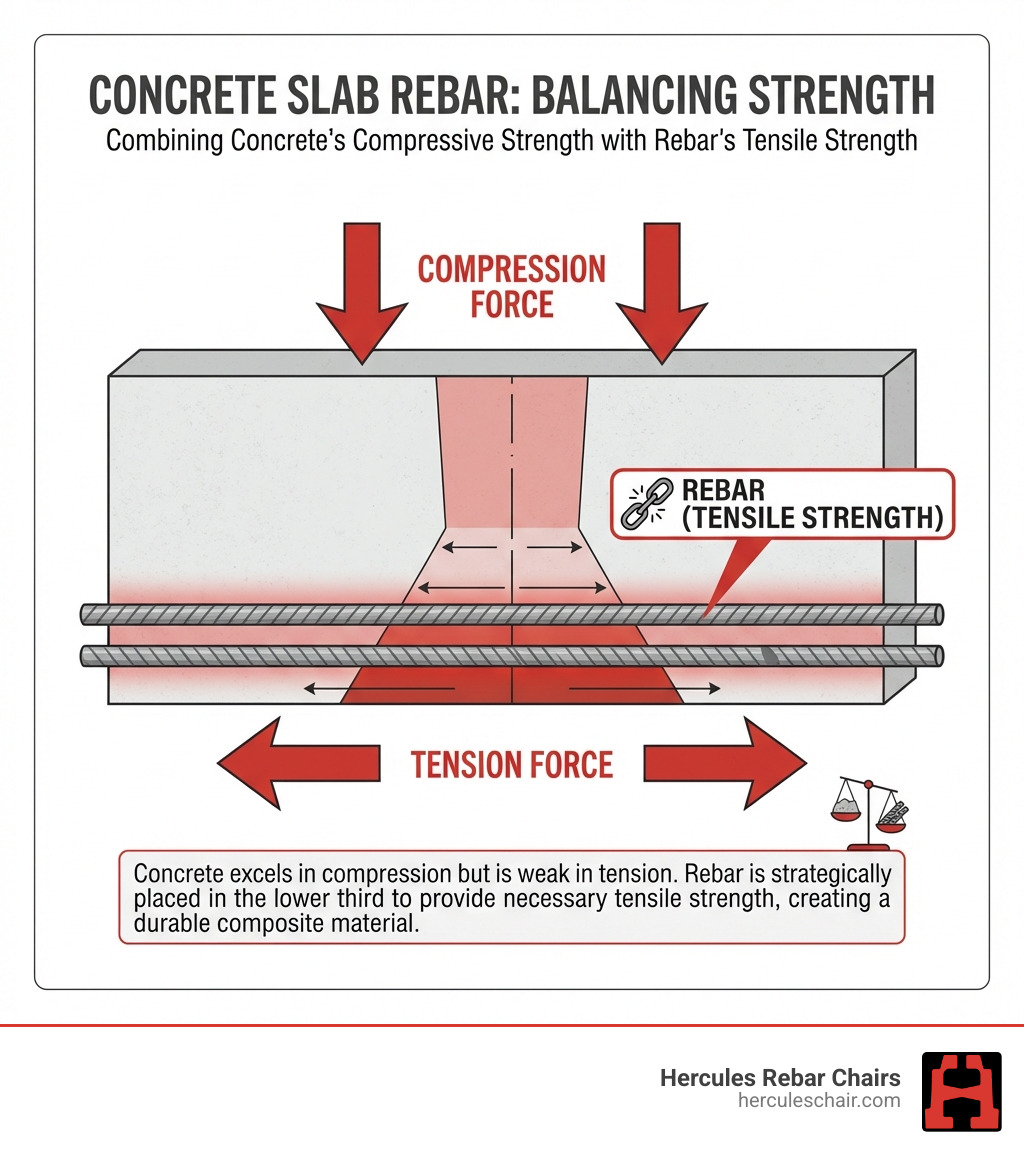
Most people think concrete is incredibly strong, and it is—but only in compression. When you squeeze it, it can handle massive loads. But when you pull or bend it, concrete is surprisingly weak. Its tensile strength is only about 10-15% of its compressive strength. That’s where rebar comes in.
Steel reinforcing bars transform brittle concrete into a composite material that handles both compression and tension. Without rebar, a slab is vulnerable to cracking from shrinkage, temperature changes, and everyday loads. With proper reinforcement, a concrete slab can last up to 100 years.
Rebar is necessary for foundations, driveways, slabs over 5 inches thick, and areas with poor soil. It can sometimes be omitted for thin, non-load-bearing slabs like small patios. Common sizes include #3 (3/8″) for light duty, #4 (1/2″) for driveways, and #5 (5/8″) for heavy-duty applications.
But here’s the catch: rebar only works if it’s positioned correctly. If it’s too high, too low, or improperly supported during the pour, you’ve wasted time and money on reinforcement that won’t do its job. This guide will walk you through everything you need to know about concrete slab rebar—why it matters, what to choose, and how to install it correctly.
I’m Jordan Harris, a licensed Professional Engineer with a master’s in structural engineering. At T.J. Harris Company, we manufacture the Hercules Chair and other rebar support systems. Our products have been used in more than 14 million concrete pours, ensuring concrete slab rebar stays exactly where it needs to be for maximum strength and durability.
The “Why”: Understanding Rebar’s Function in Concrete Slabs
Concrete is celebrated for its durability and strength, but it has a significant Achilles’ heel: weakness under tension. While it can handle immense compressive force (pushing), it cracks easily when pulled or bent. This is precisely why we use concrete slab rebar.
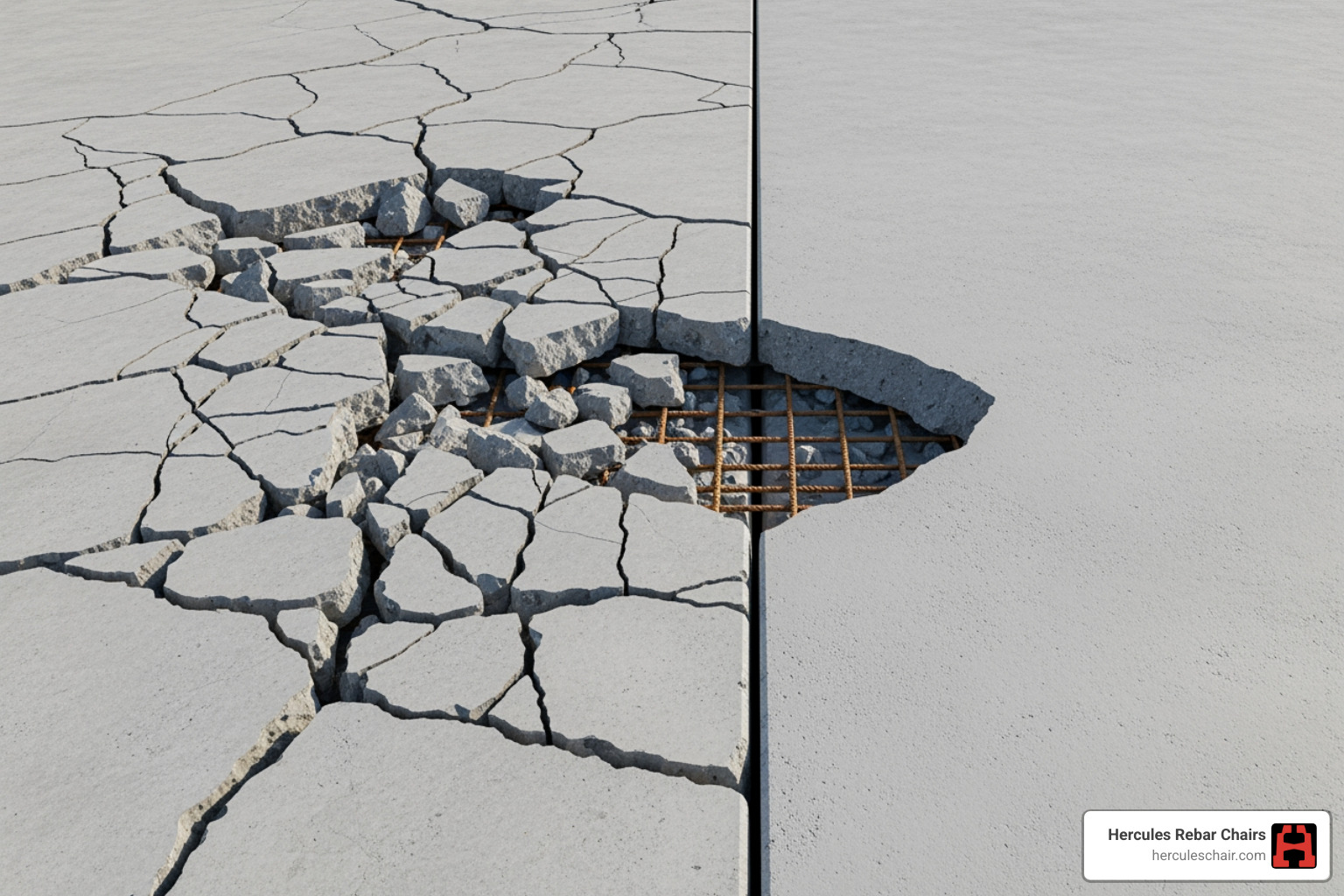
Concrete’s tensile strength is only about 10-15% of its compressive strength. Forces from ground settlement, heavy loads, drying shrinkage, and temperature changes will inevitably cause unreinforced concrete to crack. By embedding steel rebar—which is exceptionally strong in tension—we create a composite material. The concrete handles compression, and the rebar handles tension, turning concrete’s greatest weakness into a strength and nearly doubling its breaking point.
Primary Functions of Rebar
Concrete slab rebar serves several critical functions:
- Structural Integrity: It ensures the slab can withstand the stresses of its intended use, from a simple patio to a skyscraper foundation.
- Resisting Bending Forces: When a slab bends under a load, rebar in the lower portion resists the pulling forces (tension), preventing failure.
- Controlling Shrinkage Cracks: As concrete cures, it shrinks. Rebar holds the concrete together, ensuring that if cracks form, they remain hairline instead of becoming wide and structural problems.
- Temperature Variation Control: Rebar helps distribute the stresses from thermal expansion and contraction, mitigating the impact of temperature swings.
- Ductility Before Failure: Unreinforced concrete is brittle and fails suddenly. Rebar adds ductility, meaning a reinforced slab will show warning signs like cracks before a potential failure, allowing for intervention.
How Rebar Contributes to Longevity
The addition of concrete slab rebar is an investment in long-term durability. A properly reinforced slab can last up to 100 years by:
- Preventing Catastrophic Failure: Rebar prevents the brittle fracture of concrete, changing a sudden collapse into a more gradual degradation.
- Holding Cracks Together: If cracks do appear, rebar holds them tightly, maintaining the slab’s load-carrying capacity and reducing water ingress.
- Enhancing Durability: Rebar helps protect against environmental factors. It minimizes cracks where water can enter and freeze, causing damage (freeze-thaw cycles). In areas where deicing salts are used, selecting corrosion-resistant rebar types can further protect the slab’s integrity.
The “What”: Choosing the Right Reinforcement for Your Slab
Selecting the right reinforcement depends on your project’s specific needs, environmental conditions, and budget. While steel is the go-to, understanding the differences in materials, sizes, and alternatives is key to balancing cost and performance.
Common Types and Sizes of Rebar
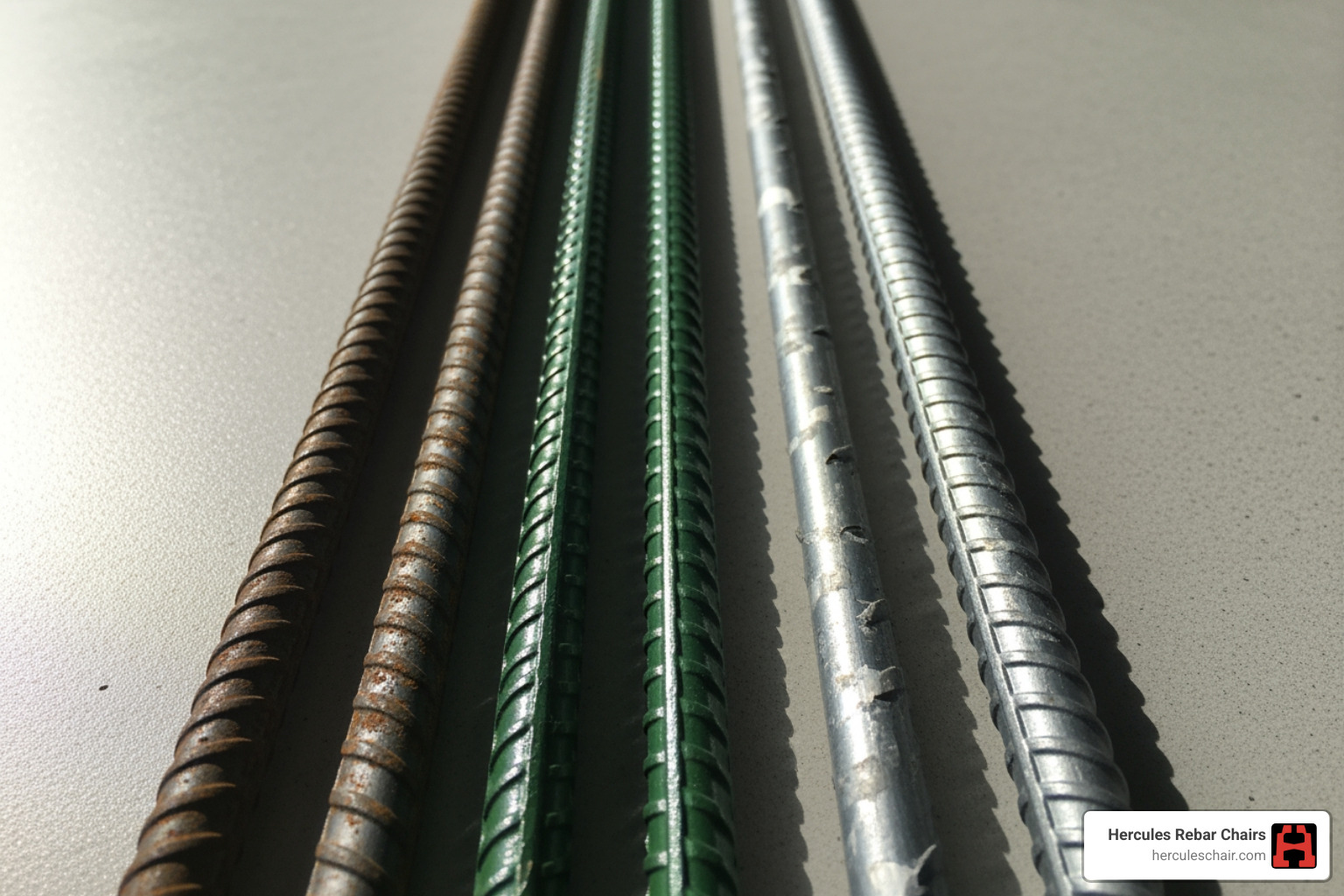
Here’s a look at the most common types of rebar:
- Carbon Steel Rebar: Often called “black bar,” this is the most common, cost-effective, and versatile type. Its main drawback is susceptibility to corrosion from moisture and deicing salts.
- Epoxy-Coated Rebar: This rebar is coated with epoxy, making it highly resistant to corrosion. It’s an excellent choice for areas exposed to saltwater or deicing salts, like parking structures and bridge decks.
- Galvanized Rebar: Coated with zinc, this rebar is significantly more resistant to corrosion than carbon steel, but is generally more expensive than epoxy-coated rebar.
- Stainless Steel Rebar: The champion of corrosion resistance, this is ideal for critical structures in extremely corrosive environments but comes at a significant cost.
- Glass-Fiber-Reinforced-Polymer (GFRP) Rebar: A composite material that is lightweight, non-corrosive, and non-conductive. It’s a great alternative in highly corrosive environments but can be more expensive.
Standard Rebar Sizes: Rebar sizes are designated by a number corresponding to its diameter in eighths of an inch.
- #3 Rebar (3/8″): Used for light applications like patios and sidewalks.
- #4 Rebar (1/2″): A standard choice for residential foundations and driveways.
- #5 Rebar (5/8″): Used for heavy-duty applications, larger foundations, and retaining walls.
- Larger Sizes (#6 and up): Reserved for major commercial and infrastructure projects.
How to Determine the Correct Reinforcement
Choosing the right rebar size and type isn’t a guessing game. It’s a critical decision based on several factors:
- Project Type and Load: A light-use patio has different needs than a foundation or a driveway supporting heavy trucks.
- Slab Thickness: Thicker slabs (over 5 inches) generally require rebar, and may need larger sizes or closer spacing to handle heavy loads.
- Soil and Environmental Conditions: Expansive soils or exposure to deicing salts may require more robust or corrosion-resistant reinforcement.
- Local Building Codes: Always consult your local building codes. They specify the minimum requirements for rebar size, spacing, and cover for your area and are the ultimate authority for your project.
To help plan your project, our Rebar Length Calculator You Need: Never Run Short Again! can assist in estimating material needs.
Alternatives to Traditional Rebar
For some projects, alternatives can be considered:
- Welded Wire Fabric (WWF): A grid of steel wires, WWF is a cost-effective option for thinner, non-load-bearing slabs. It’s quicker to install than individual rebar rods but is not as strong.
- Synthetic Fibers: Mixed into the concrete, fibers help reduce cracking from plastic shrinkage. They are considered secondary reinforcement and are not a substitute for structural steel rebar.
The decision to use rebar versus an alternative boils down to the slab’s intended use. For any structural element or slab bearing significant weight, steel rebar remains the gold standard.
The “How”: Best Practices for Rebar Installation
Even the highest quality concrete slab rebar is useless if not installed correctly. Placement is just as critical as the rebar’s type and size. The goal is to position the rebar precisely where it can maximize its tensile strength.
This section covers the best practices for rebar spacing, positioning, and the vital role of supports and concrete cover.
Rebar Spacing and Positioning
- Grid Pattern: Rebar is typically arranged in a grid to provide uniform reinforcement and distribute stress.
- Spacing: A common spacing for slabs is 18 to 24 inches on-center, but always refer to your project’s engineering plans or local building codes.
- Elevation: This is the most crucial aspect. Rebar must be placed at the correct height—typically in the lower third of the slab—to resist bending forces. Our Rebar Placement Guide provides detailed instructions.
The Critical Role of Rebar Supports and Concrete Cover
Gravity and the weight of wet concrete can easily push rebar to the bottom of the form, rendering it ineffective. This is where rebar supports, like our Hercules Rebar Chairs, are indispensable.
- Using Hercules Rebar Chairs: Our durable, red Hercules Rebar Chairs are designed to hold rebar firmly at the specified height, ensuring it stays in place during the pour. With over 14 million units sold, we help contractors ensure code compliance while saving time and money.
- Concrete Cover: The concrete between the rebar and the surface is called “cover.” It’s vital for protecting the steel from corrosion and ensuring a strong bond with the concrete. ACI (American Concrete Institute) codes specify minimum cover requirements, which vary based on exposure. For example, concrete exposed to earth (like footings) requires 3 inches of cover, while interior slabs may only need ¾ inch. Choosing the right size rebar chair is essential to meet these requirements. Our Goldilocks Guide to Concrete Bar Chair Sizes: Not Too Big, Not Too Small can help.
Consequences of Improper Placement
Ignoring proper placement leads to serious problems. Lowering or raising rebar by just 1/2 inch in a 6-inch slab can reduce its load capacity by 20%. Other issues include:
- Surface Cracking and “Bar Shadowing”
- Ugly Rust Stains from corroding rebar
- Reduced concrete’s structural integrity
- Catastrophic Structural Failure in the worst-case scenario
Proper placement, supported by reliable rebar chairs, is a fundamental requirement for a strong, durable concrete slab.
When to Use Concrete Slab Rebar: A Project-by-Project Guide
The decision to use concrete slab rebar depends on the slab’s intended use, thickness, expected loads, and ground conditions. Think of rebar as low-cost insurance for your concrete investment.
When Rebar is Absolutely Necessary
Omitting rebar in these situations is a critical mistake that can lead to premature failure:
- Foundations: All structural foundations for homes and buildings require rebar to resist ground movement and settling.
- Driveways for Heavy Traffic: Rebar is essential for any driveway that will support large trucks, RVs, or heavy daily traffic.
- Structural Walls and Columns: Any concrete element designed to bear a load must be reinforced.
- Large Slabs or Poor Soil: Rebar helps distribute stress in large slabs or in areas with unstable or expansive soil.
- Retaining Walls: These require substantial rebar to resist pressure from soil and water.
- Slabs Over 5 Inches Deep: Thicker slabs exposed to heavy loads need rebar to maintain structural integrity.
Situations Where Rebar Can Be Omitted
In some cases, rebar may be overkill, and alternatives like wire mesh or no reinforcement may suffice:
- Light-Use Patios and Paths: Small, non-load-bearing slabs for foot traffic only may not need rebar.
- Thin Slabs (Under 4 Inches): Very thin slabs for purely aesthetic purposes often do not require rebar.
- Well-Prepared Sites: On a well-compacted subgrade with proper control joints, the need for rebar in non-load-bearing slabs is reduced.
Building Codes and Professional Consultation
Always remember that local building codes are the law. They dictate the minimum requirements for concrete slab rebar for safety and structural integrity. Before starting any project, consult your local building department, as requirements can vary significantly by location. For complex projects, an engineer’s specifications must be followed precisely. If in doubt, always consult a professional concrete contractor. They can assess your project and recommend the most effective reinforcement method. You can find a local expert through our Find a Retailer network.
Frequently Asked Questions about Concrete Slab Rebar
How far apart should rebar be in a concrete slab?
Spacing for concrete slab rebar depends on the project. A common guideline is 18 to 24 inches on-center for general slabs, and no more than 18 inches for foundations. However, the exact spacing depends on rebar size, slab thickness, expected loads, and local building codes. Always refer to your project’s engineering plans, as improper spacing can significantly reduce the concrete’s strength.
Can you pour a 4-inch slab without rebar?
Yes, but only for light-duty applications like a small patio or walkway that only sees foot traffic. For these, a 4-inch slab on a well-compacted base with control joints may not need rebar. However, for any slab that will support vehicles or heavy loads, like a driveway or garage floor, rebar is highly recommended. Without it, the slab is very likely to crack and have a much shorter lifespan.
What happens if you don’t use rebar in concrete?
Without concrete slab rebar, concrete is brittle and weak against bending or pulling forces (tension). It will be highly prone to cracking from loads, drying shrinkage, temperature changes, and soil settlement. An unreinforced slab will lack structural integrity, crack easily, and fail prematurely, significantly reducing its durability and lifespan.
Conclusion: Build a Slab That Lasts a Lifetime
We’ve seen that concrete slab rebar is the unseen strength that transforms brittle concrete into a resilient, long-lasting material. It combats concrete’s weakness in tension, prevents cracks, and can extend a slab’s lifespan for decades.
Choosing the right rebar type and size depends on your project, loads, and local codes. But most importantly, the “how” of installation is what makes it work. Proper spacing, elevation, and concrete cover are non-negotiable for strength and durability.
Even the best rebar is useless if it’s not held securely in place during the pour. This is where high-quality supports like our Hercules Rebar Chairs shine, ensuring your reinforcement maintains its position and protects against cracks and structural failure.
Proper reinforcement is the low-cost insurance that protects your concrete investment. To ensure your rebar is perfectly positioned for a slab that stands strong for generations, using reliable supports is essential. For a complete walkthrough, consult our definitive Rebar Placement Guide.