

How Much Rebar Does a Concrete Patio Actually Need?
How much rebar in concrete patio projects is one of the most practical questions you can ask before a pour — and the short answer is this:
| Factor | Standard Recommendation |
|---|---|
| Rebar size | #3 (3/8″) for most patios; #4 (1/2″) for heavier loads |
| Grid spacing | 18″ to 24″ on center, both directions |
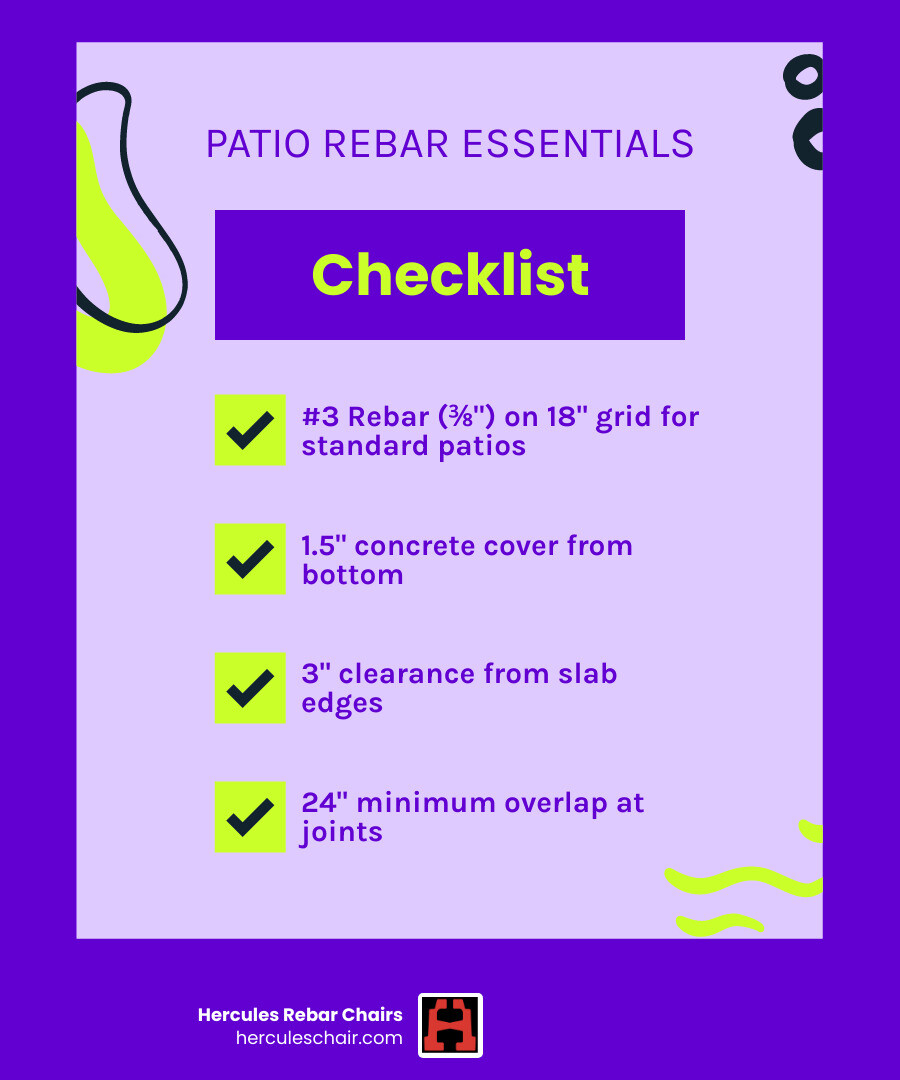
| Concrete cover | Minimum 1.5″ from bottom; 3″ from edges |
| Overlap length | At least 24″ where bars meet |
| Waste buffer | Order 10% extra |
For a typical residential patio — 4 inches thick, light foot traffic, stable soil — #3 rebar on an 18″ x 18″ grid is the go-to starting point. Heavier loads or poor soil conditions push you toward #4 rebar and tighter 12″ spacing.
Concrete is remarkably strong when something pushes down on it (compression), but it’s surprisingly weak when something pulls or bends it (tension). That’s exactly where rebar earns its place. Without it, temperature swings, soil movement, and everyday loads can crack an otherwise solid-looking slab.
I’m Jordan Harris, a licensed Professional Engineer with a master’s degree in structural engineering and five years of hands-on experience designing large-scale concrete projects — so I know how critical it is to get how much rebar in concrete patio work right before the truck arrives. Let’s walk through the math and planning steps so your patio is built to last.
How much rebar in concrete patio vocab explained:
Why Reinforcement is Essential for Your Concrete Patio
When we talk about concrete, we often think of it as an indestructible stone. While it is incredibly strong under compression (it can hold the weight of a truck without flinching), it has a “glass jaw” when it comes to tension. Tensile strength is the ability of a material to resist being pulled apart. Without steel reinforcement, concrete’s tensile strength is only about 10% of its compressive strength.
This is where rebar—short for reinforcing bar comes into play. By embedding a steel grid within the slab, we give the concrete the “bones” it needs to resist cracking.
Soil Stability and Environmental Resilience
Whether you are in the humid heat of Florida or the freeze-thaw cycles of Ohio, your soil is constantly moving. Soil expands when wet and shrinks when dry. In colder climates, the ground heaves as it freezes. This movement creates “voids” or uneven pressure under your patio. Without rebar, the concrete would simply snap under its own weight as the ground shifts.
Preventing Slab Curling and Cracking
Ever notice how some old patios have edges that seem to lift or “curl” up? This happens because the top of the slab dries or cools at a different rate than the bottom. Rebar helps hold the slab together as a single, cohesive unit. It also ensures “aggregate interlock.” If a small crack does form (and let’s be honest, all concrete eventually wants to crack), the rebar holds the two sides of the crack tightly together so they don’t widen or become a tripping hazard.
For those wondering if every single project needs steel, you can explore why your 4-inch slab might not need rebar (and when it does). Generally, for a long-lasting, professional-grade patio, we always recommend it.
Determining How Much Rebar in Concrete Patio Projects
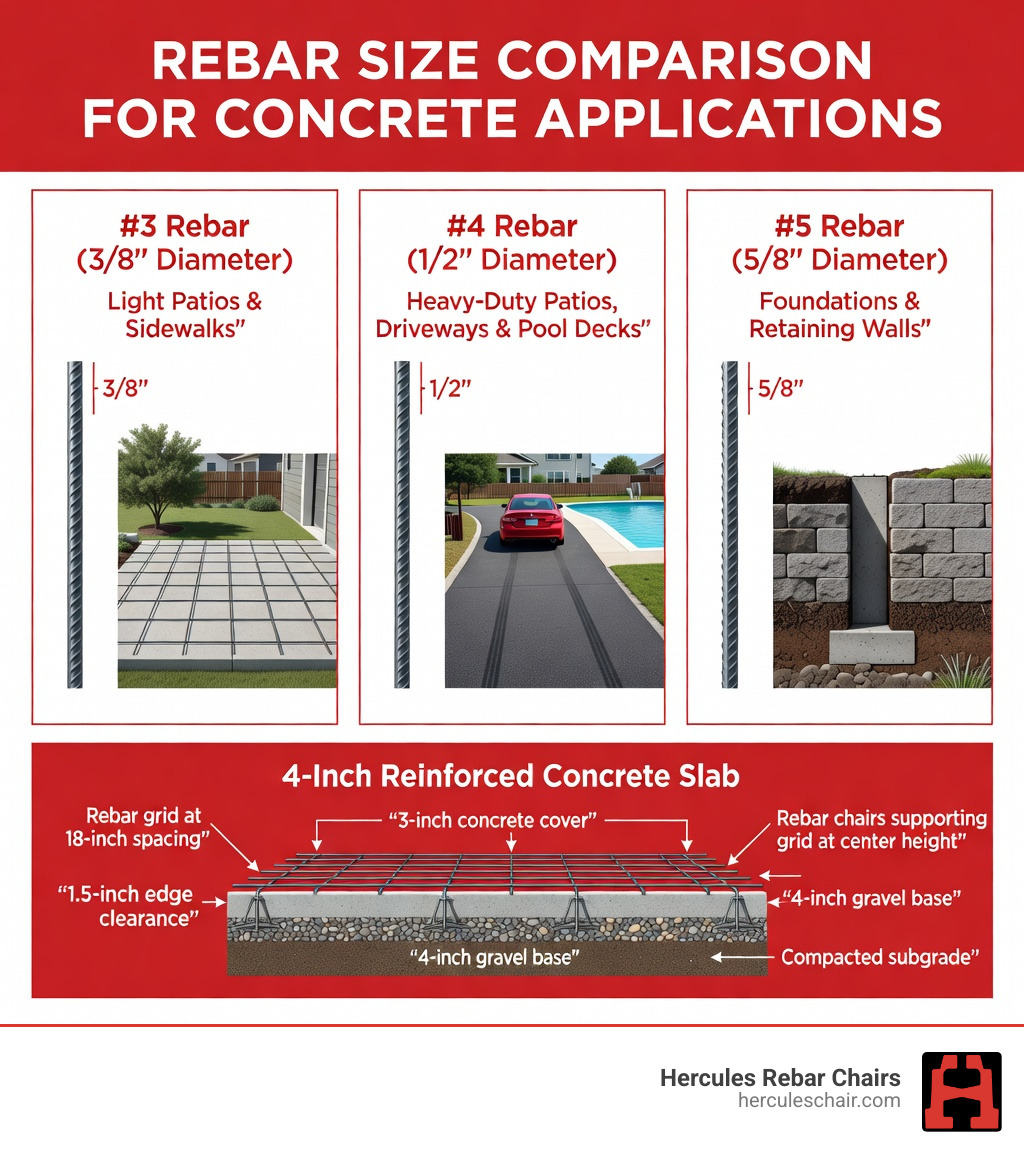
Before we pick up a calculator, we need to pick the right material. Rebar isn’t “one size fits all.” In the United States, rebar is sized by eighths of an inch.
- #3 Rebar: 3/8 inch diameter. This is the versatile choice for residential sidewalks and most patios.
- #4 Rebar: 1/2 inch diameter. This is the standard for driveways, pool decks, and patios that might eventually hold a heavy hot tub or a permanent outdoor kitchen.
Grade 40 vs. Grade 60
You’ll also see “Grades.” Grade 40 has a yield strength of 40,000 psi, while Grade 60 can handle 60,000 psi. For most residential patios, Grade 40 is sufficient, but Grade 60 is more common at big-box stores and provides a higher safety margin for a negligible cost difference.
When planning your layout, refer to a rebar placement guide to ensure you are following best practices for your specific soil type.
Standard Spacing: How Much Rebar in Concrete Patio Grids?
The “grid” is the lattice of rebar running both lengthwise and crosswise. The spacing of these bars determines the strength of the reinforcement.
- 12-inch centers: Used for heavy-duty applications or very poor, expansive soil.
- 18-inch centers: The “Goldilocks” zone for most 4-inch patios. It provides excellent strength without being overkill.
- 24-inch centers: The maximum recommended spacing for light-use residential slabs.
We measure these “on-center,” meaning from the middle of one bar to the middle of the next. Don’t forget corner reinforcement; corners are often the first place cracks start, so we often add “L-shaped” bars or tighter spacing at the edges.
Sizing for Success: How Much Rebar in Concrete Patio Slabs?
The thickness of your slab dictates the rebar gauge. For a standard 4-inch slab, #3 rebar is perfect because it allows for enough “concrete cover” (the amount of concrete surrounding the steel). If you go with a 6-inch slab for a heavy outdoor fireplace, we recommend stepping up to #4 rebar.
One pro tip we always share: if you are building a patio that might one day be enclosed as a sunroom, treat it like a foundation. This means perimeter thickening (making the edges 8-12 inches deep) and using #4 rebar. This is the true purpose of rebar in concrete: planning for the future.
Step-by-Step: How to Calculate Rebar for Your Patio
Now, let’s get into the math. Calculating how much rebar in concrete patio projects doesn’t require a PhD, but it does require a tape measure and a little patience.
Step 1: Measure Your Dimensions
Measure the total length and width of your patio area. Let’s use a 12′ x 12′ patio as an example.
Step 2: Account for Edge Clearance
You cannot run rebar all the way to the edge of the forms. If the steel is too close to the surface, it will rust, expand, and pop the concrete off (this is called “spalling”). You need a minimum of 3 inches of clearance from the edge of the slab.
- For our 12′ x 12′ patio, the actual rebar grid will be 11′ 6″ x 11′ 6″.
Step 3: Determine the Number of Bars
If we are using 18-inch spacing:
- Divide the grid width (138 inches) by the spacing (18 inches) = 7.66.
- Round up to 8 and add one for the end bar. You need 9 bars running in one direction.
- Since our patio is square, you need 9 bars running the other direction as well.
- Total bars = 18 pieces, each 11.5 feet long.
Step 4: Overlap and Waste
Rebar usually comes in 20-foot lengths. When you need to join two bars to cover a long span, you must overlap them. The standard rule is a 24-inch overlap. Secure these with tie wire. Always add a 10% waste factor to your final order to account for cuts and overlaps.
To make this easier, check out how to calculate rebar for slab the right way or use a Rebar Material Calculator.
Calculating Linear Footage
To buy the rebar, you’ll need the total linear footage.
- 18 bars x 11.5 feet = 207 linear feet.
- Add 10% for waste/overlaps = ~228 linear feet.
- If buying 20-foot sticks, you’d order 12 sticks.
Essential Tools and Supplies
Don’t try to “wing it” with the wrong tools. You’ll need:
- Rebar Cutters/Benders: A manual bender or a circular saw with a metal-cutting blade.
- 16-gauge Tie Wire: To secure the intersections of the grid.
- Safety Gear: Gloves (rebar is sharp and oily), safety glasses, and steel-toed boots.
- Supports: You’ll need something to hold that rebar up! Check out our products for the best supports in the business.
Proper Placement: Using Chairs for Structural Integrity
This is the most common mistake we see in DIY patio projects: laying the rebar directly on the ground and “pulling it up” during the pour. Don’t do this.
When you pour concrete, it is heavy. If you try to pull the rebar up with a hook, it inevitably sinks back down to the bottom. Rebar sitting on the dirt is 100% useless. It provides zero tensile strength and will rust almost immediately.
The Power of the Chair
To work correctly, rebar must be suspended in the middle of the slab (or slightly above the middle). This ensures it is completely encased in concrete, protecting it from corrosion and placing it exactly where the tension forces are highest.
Using rebar chairs is the only way to guarantee code compliance and structural integrity. At Hercules, our chairs are designed to be “un-crushable” during the pour. They snap onto the rebar and stay there, even if a contractor steps on the grid.
Why Vertical Positioning Matters
For a 4-inch slab, you want about 1.5 to 2 inches of concrete cover underneath the steel. This is why bar chairs are essential for strong slabs. They prevent “sinking” and ensure that your hard work actually pays off in the form of a crack-free patio.
Cost Considerations for Rebar Reinforcement
We often get asked, “Is rebar worth the extra cost?” Let’s look at the numbers for a standard 200-square-foot patio.
- Rebar Cost: At roughly $0.50 to $1.00 per linear foot, you might spend $150–$200 on steel.
- Chairs and Ties: Another $40–$60.
- Labor: If you’re doing it yourself, it’s just an afternoon of work. If hiring a pro, it adds a small percentage to the total quote.
Compare that $250 investment to the cost of a full patio replacement. If your slab cracks and heaves in three years because of poor reinforcement, you’ll be looking at thousands of dollars in demolition and replacement costs. Rebar is the cheapest insurance policy you can buy for your home. Ready to get started? You can buy rebar chairs directly from us to ensure your project starts on a solid foundation.
Frequently Asked Questions about Patio Rebar
What is the best rebar size for a standard 4-inch patio?
For almost all residential patios, #3 (3/8″) rebar is the best choice. It provides ample strength for foot traffic and patio furniture while allowing for proper concrete coverage in a relatively thin 4-inch slab.
How far from the edge should rebar be placed?
You should maintain at least 3 inches of clearance from the edge of your concrete forms. This prevents moisture from reaching the steel and causing rust, which would eventually lead to the concrete cracking or “spalling” at the edges.
What is the ideal concrete cover for rebar in a patio?
The “ideal” spot is the middle of the slab. For a 4-inch patio, aim for 1.5 to 2 inches of concrete cover both above and below the rebar. Using 2-inch Hercules Rebar Chairs is the easiest way to achieve this perfectly every time.
Conclusion
Building a patio is a big investment in your home’s value and your family’s enjoyment. Don’t let that investment crack because you skimped on the “hidden” details. Knowing how much rebar in concrete patio projects is required is the first step toward a professional result.
At Hercules Rebar Chairs (T.J. Harris Co.), we are proud to be America’s #1 choice for concrete supports. With over 14 million units sold across the USA — from the frosty winters of Alaska to the sun-drenched yards of Arizona — our iconic red chairs are synonymous with quality. They save you time, save you money, and most importantly, they ensure your patio meets local building codes.
Ready to calculate your needs? Use our Hercules Rebar Chair Estimator to find out exactly how many supports you need for your specific grid layout. Let’s build something that lasts!