

Why Proper Rebar Chair Code Compliance Matters for Every Pour
Rebar chair code requirements ensure that reinforcing steel maintains proper positioning and concrete cover throughout the pouring process—protecting your structure from corrosion, cracking, and early failure. While no single universal code governs every aspect of rebar chair placement, major standards like ACI 318, the CRSI Manual of Standard Practice, and regional building codes establish clear guidelines for spacing, positioning, and cover tolerances.
Quick Reference: Key Rebar Chair Code Requirements
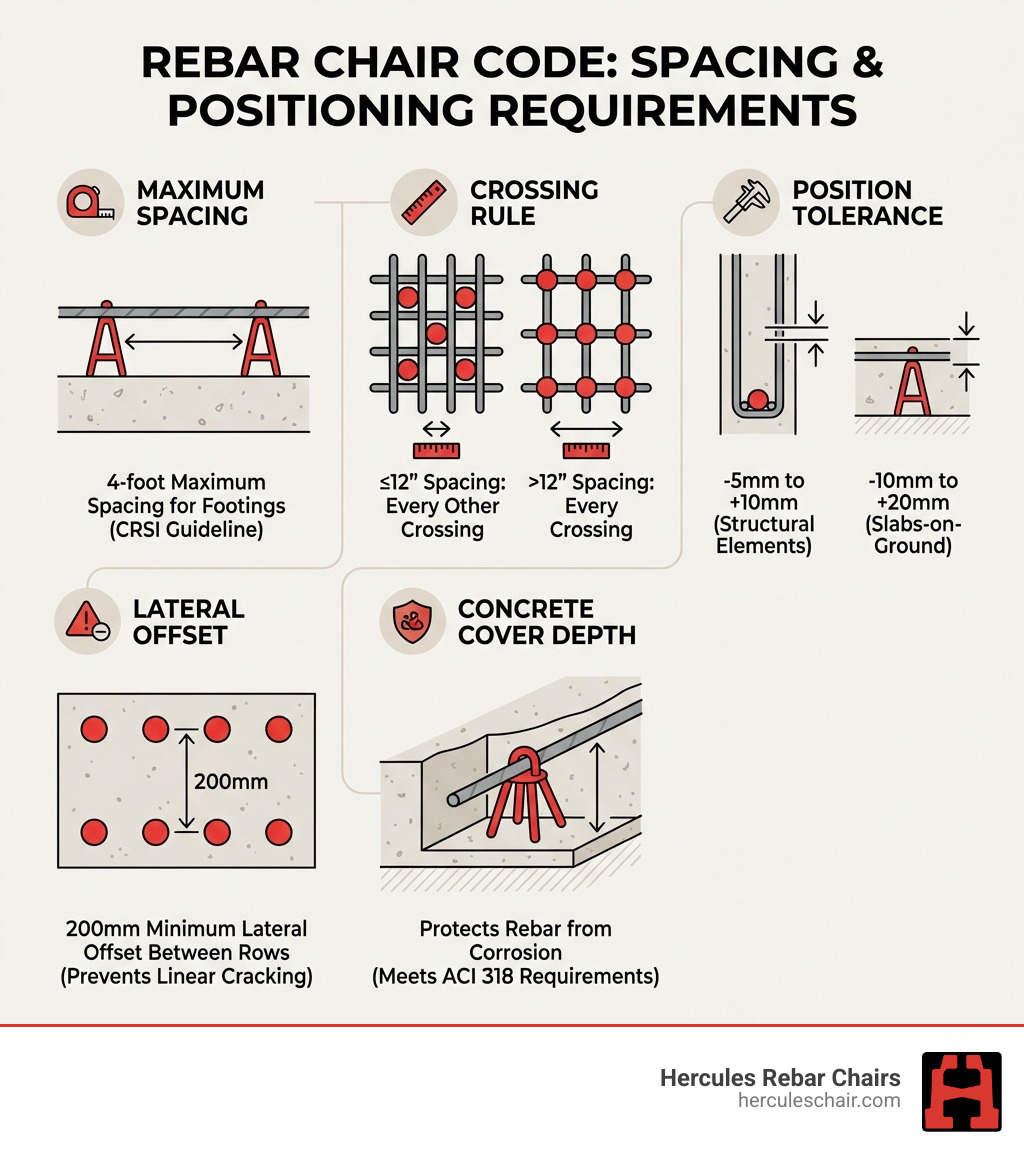
- Maximum spacing: 4 feet (CRSI guideline), 600mm for residential pavements (AS 3727.1:2016), 800mm for buildings (Australian NCC)
- Placement rule: Every other crossing for rebar spaced ≤12 inches; every crossing for spacing >12 inches
- Position tolerance: -5mm to +10mm for beams/slabs/columns; -10mm to +20mm for slabs-on-ground
- Lateral offset: Minimum 200mm between adjacent chair rows to prevent linear cracking
- Cover depth: Must meet ACI 318 clear cover requirements based on exposure conditions
When contractors run out of rebar chairs mid-pour or space them too far apart, the consequences can be serious. As one structural engineer noted in a 2008 forum discussion about a commercial driveway pour, “Contractor ran out of chairs and poured anyway under pressure”—a scenario that led to immediate quality concerns and the need for core testing to verify code compliance.
Rebar chairs do more than just hold steel off the ground. They maintain the critical concrete cover that shields reinforcement from moisture, chemicals, and temperature extremes. Without adequate support, rebar can sag during the pour, reducing cover depth below code minimums and compromising long-term durability.
The challenge for most contractors isn’t understanding why rebar chairs matter—it’s navigating the specific requirements that vary by application, region, and structural element. Different scenarios demand different approaches: a residential slab follows different spacing rules than a commercial footing, and a suspended deck requires different chair types than a slab-on-ground.
I’m Jordan Harris, a licensed Professional Engineer who spent five years designing large-scale concrete structures before joining the family business at T.J. Harris Company, makers of the Hercules Chair. My engineering background gives me a practical understanding of how rebar chair code requirements translate to real-world job sites—and where contractors most often run into trouble.
Understanding the Rebar Chair Code and Industry Standards
Navigating concrete reinforcement can feel like reading alphabet soup. Between ACI, CRSI, and various international standards, it’s easy to get overwhelmed. However, these codes exist for a reason: they provide a roadmap for structural safety.
The American Concrete Institute (ACI) 318 is the “big kahuna” of concrete codes in the United States. While ACI 318 focuses heavily on the required “clear cover” (the distance between the steel and the concrete surface), it doesn’t always dictate the exact number of chairs. Instead, it places the burden of proof on the final position of the steel. If your rebar sags because you didn’t use enough chairs, you’ve technically violated the code.
Complementing this is the CRSI (Concrete Reinforcing Steel Institute) Manual of Standard Practice. This is where we find more “boots-on-the-ground” advice. For instance, the CRSI recommends a minimum support spacing of 4 feet for many applications. We always tell our customers that while ACI sets the goal, CRSI provides the tools to get there.
For those working on international projects or looking at global best practices, standards like AS/NZS 2425:2015 (Australia/New Zealand) and the National Construction Code (NCC) offer very specific metrics, such as the 800mm maximum spacing for buildings. Even if you are working in the U.S., these standards highlight a global consensus: elevating your concrete is not optional.
One of the most debated topics in the industry is whether rebar can touch the soil. According to discussions on the Building Code Forum, the answer is a resounding “no.” Rebar in contact with soil is a recipe for moisture wicking and rapid corrosion.
Primary Purposes of Rebar Supports
We like to think of rebar chairs as the “unsung heroes” of the job site. Their primary purposes include:
- Reinforcement Positioning: Ensuring the steel stays exactly where the engineer intended.
- Structural Strength: Concrete is great under compression, but it needs steel for tension. If the steel is in the wrong place, the “teamwork” between the two materials breaks down.
- Durability: By maintaining the correct cover, chairs prevent “spalling”—where rusting rebar expands and blows the face off the concrete.
- Moisture Protection: Keeping steel away from the ground and the surface prevents the ingress of water and chlorides.
How Local Building Codes Take Precedence
While national standards provide a baseline, your local building official has the final say. Project specifications and engineering drawings often include requirements that are stricter than the general rebar chair code. For example, a coastal project in Florida might require more cover and more frequent chair spacing than a residential patio in Arizona due to salt-air corrosion risks. Always check your specific prints before starting the layout.
Critical Spacing and Placement Requirements
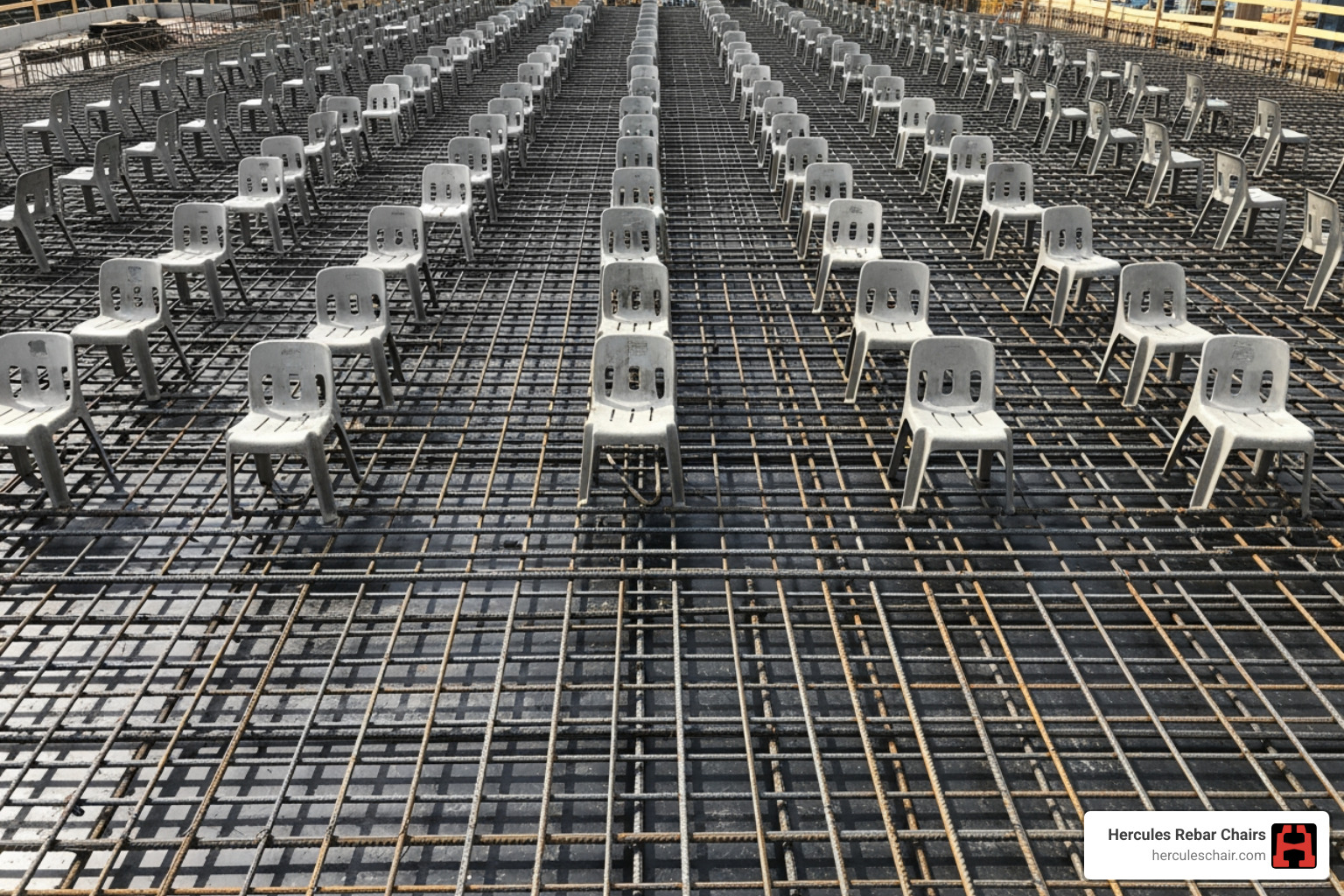
Spacing isn’t just a suggestion; it’s a calculation. If chairs are too far apart, the rebar will “belly” or sag between them. When the concrete truck arrives and the crew starts walking on the mat, that sag becomes a permanent structural defect.
The weight of the rebar itself, combined with the “live load” of workers and equipment during the pour, dictates how many supports you need. For a detailed breakdown of how to handle these variables, our Rebar Placement Guide is an excellent resource.
Maximum Spacing Guidelines Under the Rebar Chair Code
To keep things simple, we follow a few “golden rules” for maximum spacing:
- The 4-Foot Rule: Per CRSI guidelines and general best practices for foundation footers, you should never exceed 4 feet between supports.
- Residential Pavements: For driveways and sidewalks, a tighter spacing of 600mm (approx. 2 feet) is often recommended to account for thinner slabs.
- Commercial Buildings: Standards often cap spacing at 800mm (approx. 32 inches) to ensure the heavy steel mats used in commercial construction don’t shift.
Spacing Based on Rebar Size and Grid Density
The density of your rebar grid changes the math for chair placement. Here is the industry-standard logic:
- If rebar spacing is 12 inches or less: You can usually get away with placing a chair at every other rebar crossing.
- If rebar spacing is greater than 12 inches (e.g., 18″ or 24″): You must place a chair at every rebar crossing.
For those working specifically on footings, following a Footer Stand Placement Guide is crucial to ensure the heavy cages don’t sink into the dirt.
Position Tolerances and Concrete Cover Compliance
“Close enough” doesn’t cut it in structural concrete. The rebar chair code is very specific about tolerances. If an engineer calls for 3 inches of cover, they don’t mean “somewhere between 1 and 5 inches.”
Concrete cover acts as the “armor” for your steel. You can read more about this in our guide on understanding concrete cover and its critical role.
Meeting the Rebar Chair Code for Concrete Cover
The industry allows for slight variations, but they are tight:
- Beams, Slabs, Columns, and Walls: The tolerance is generally -5mm to +10mm.
- Slabs-on-Ground: Because the subgrade can be uneven, the tolerance is slightly more generous at -10mm to +20mm.
If you are using a 3-inch chair, you are aiming for that 3-inch sweet spot. If the chair settles into the dirt or the rebar sags, and you end up with only 2 inches of cover, you are officially out of code.
Edge Placement and Lateral Offsets
One common mistake is placing chairs in a perfectly straight line across the entire slab. This can actually create a “plane of weakness” in the concrete, leading to linear cracking.
To avoid this, we recommend a lateral offset of at least 200mm (about 8 inches) between adjacent rows of supports. Furthermore, chairs should be placed close enough to the formwork edges to prevent the ends of the rebar from dipping, but far enough away that the chair itself isn’t visible on the finished face of the concrete.
Calculating Quantities and Selecting Chair Types
Before you head to the job site, you need to know how many chairs to throw in the truck. Over-ordering wastes money, but under-ordering leads to the “pressure pour” disasters mentioned earlier.
We’ve simplified the math for you. Depending on your rebar grid, use these formulas:
Formula-Based Calculations for Slab Coverage
| Rebar Spacing | Placement Rule | Calculation Formula |
|---|---|---|
| 12″ or less | Every other crossing | Total Sq. Ft. / 180 = Boxes Needed |
| 24″ | Every crossing | Total Sq. Ft. / 330 = Boxes Needed |
If you prefer the metric system, a general rule of thumb is 1 chair per square meter. For more help, check out our guide on how to determine bar chair sizes in 3 easy steps.
Choosing the Right Support for the Job
Not all chairs are created equal. The “best” chair depends on what you are supporting:
- Mesh Chairs: Specifically designed for welded wire reinforcement. You can elevate your slab with concrete mesh chairs to prevent the mesh from being pushed to the bottom.
- High Chairs: Used for top mats in thick slabs or bridge decks.
- Stackable Chairs: Great for multi-layered reinforcement where you need to maintain spacing between two different levels of steel.
- Standard Plastic Chairs: Our Hercules Chairs are 100% non-corrosive, meaning they won’t rust or degrade, unlike metal bolsters with plastic tips that can eventually pop off.
Installation Best Practices and Common Mistakes
Installation is where the rubber meets the road—or rather, where the steel meets the chair. Following a step-by-step process for mastering rebar placement ensures that your hard work doesn’t go to waste during the pour.
Avoiding Failures in the Rebar Chair Code
We see the same mistakes over and over. Avoid these to stay in compliance:
- Linear Arrangement: As mentioned, don’t line them up like soldiers. Offset them.
- Insufficient Quantity: Trying to save $50 on chairs can lead to a $50,000 structural failure.
- Wrong Height: Don’t guess. If the spec calls for 2.5″ cover, use a 2.5″ chair.
- Vapor Barrier Damage: If you are pouring over a vapor barrier, use chairs with a wide, flat base (like our Hercules Chairs) to prevent puncturing the plastic.
Verification and Post-Pour Testing
If there is a dispute about whether the rebar chair code was followed, engineers may call for core sampling. This involves drilling a cylinder out of the hardened concrete to physically measure where the rebar ended up. It’s an expensive and destructive test, which is why it’s much better to take photos of your chairs and grid before the concrete truck arrives.
Frequently Asked Questions about Rebar Chair Code
How many rebar chairs do I need for a 1,000 square foot slab?
If your rebar is spaced at 12 inches, you would divide 1,000 by 180, which equals about 5.5 boxes. If your spacing is 24 inches, you would divide 1,000 by 330, requiring about 3 boxes.
What is the maximum allowed spacing for rebar chairs in a commercial footing?
Following CRSI guidelines, the maximum spacing should be 4 feet. However, for heavier rebar (like #5 or larger), we often see engineers specify 3-foot spacing to ensure stability.
Does the ACI code require a specific type of rebar chair material?
No, ACI 318 does not mandate a specific material (plastic vs. metal). However, it does mandate that the supports must not cause corrosion or staining on the concrete surface. This is why non-corrosive plastic chairs have become the industry standard.
Conclusion
At Hercules Rebar Chairs, we take the guesswork out of the rebar chair code. As “America’s #1” with over 14 million units sold, we’ve helped contractors across all 50 states—from the snowy job sites of Alaska to the humid pours of Florida—ensure their projects are stable, compliant, and built to last.
Our iconic red chairs are designed to save you time and money by snapping onto rebar quickly without the need for tie wire. More importantly, they provide the rock-solid support needed to meet ACI and CRSI standards every single time. Don’t leave your structural integrity to chance.
Shop Hercules Rebar Chairs today and build with confidence!