

Why Every Concrete Project Needs a Rebar Calculator
A rebar calculator is the fastest way to estimate how much reinforcing steel you need for a concrete slab, footing, or wall — before you order a single stick.
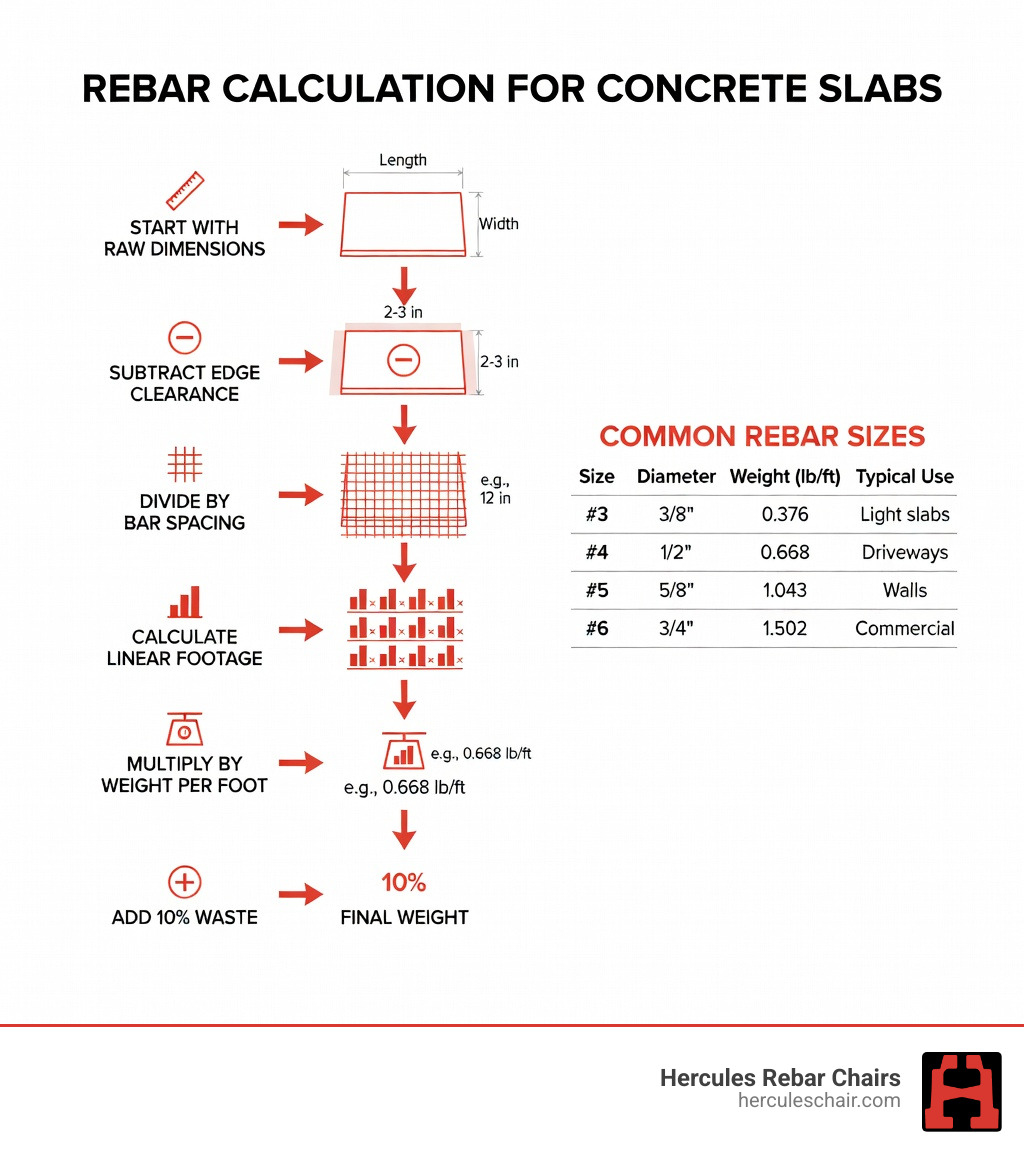
Quick answer — how to calculate rebar for a slab:
- Subtract edge clearance (typically 2–3 in) from each side to get your effective length and effective width
- Divide effective length by spacing (e.g., 12 in) and round up, then add 1 — that’s your row count
- Repeat for effective width to get your column count
- Multiply rows × slab width, and columns × slab length, then add both for total linear footage
- Multiply total linear footage by the weight per foot for your bar size (e.g., #4 rebar = 0.668 lb/ft)
- Add 10% for waste, overlaps, and cutoffs
| Bar Size | Diameter | Weight (lb/ft) | Common Use |
|---|---|---|---|
| #3 | 3/8 in | 0.376 | Patios, light slabs |
| #4 | 1/2 in | 0.668 | Driveways, footings, slabs |
| #5 | 5/8 in | 1.043 | Foundations, walls |
| #6 | 3/4 in | 1.502 | Heavy commercial, retaining walls |
Getting this estimate right matters more than most people realize. Concrete is incredibly strong under compression — but it’s weak in tension. Without rebar, a slab is essentially a crack waiting to happen. Rebar absorbs the tensile forces that concrete can’t handle on its own, preventing structural failure and keeping your project standing for decades.
Order too little rebar and you’re making emergency supply runs mid-pour. Order too much and you’re eating unnecessary material costs. A reliable rebar calculation gets you the right amount, the first time.
I’m Jordan Harris, a licensed Professional Engineer (PE) with a master’s degree in structural engineering and five years designing large-scale concrete and steel structures — and I use rebar calculators regularly, both in the field and in product development for T.J. Harris Company. In this guide, I’ll walk you through exactly how to use a rebar calculator to get accurate estimates for your next concrete project.
Understanding Rebar Basics and Standard Specifications
Before we dive into the math of a rebar calculator, we need to understand the material itself. Rebar, short for reinforcing bar, is the “skeleton” of your concrete. While concrete is great at supporting the weight of a house (compression), it’s terrible at resisting being pulled apart (tension). Steel rebar has a thermal expansion coefficient nearly identical to concrete, meaning they expand and contract together, preventing the bond from breaking during temperature swings.
Standard Specifications and Grades
In the United States, most residential and commercial projects rely on ASTM A615 carbon steel rebar. When you look at a rebar calculator, you’ll often see the term “Grade 60.” This refers to the yield strength of the steel — Grade 60 steel can withstand 60,000 pounds per square inch (PSI) before it begins to permanently deform. It is the industry standard for everything from backyard patios to skyscraper foundations.
Rebar Sizes and Types
Rebar sizes are categorized by numbers that represent eighths of an inch. For example, #4 rebar is 4/8″, or exactly 1/2 inch in diameter.
- Carbon Steel (Black Bar): The most common type. It’s strong and affordable but can rust if exposed to moisture.
- Epoxy-Coated Rebar: Often used in bridge decks or areas with high salt exposure (like coastal regions or snowy states that use road salt). The green coating acts as a barrier against corrosion.
- Stainless Steel: The “gold standard” for longevity. It’s virtually immune to rust but comes with a significantly higher price tag.
- GFRP (Glass Fiber Reinforced Polymer): A non-metallic alternative. It’s light and won’t rust, making it popular in MRI rooms where magnetic interference is a concern.
For more technical details on how these materials evolved, you can explore the Standard rebar material properties and history.
How to Use a Rebar Calculator for Slabs and Footings
Using a rebar calculator is about more than just plugging in the length and width of your slab. To get a “bid-ready” estimate, you have to account for how the steel actually sits inside the concrete.
Surface Area and Effective Dimensions
If you are pouring a 20×20 foot driveway, you aren’t actually buying 20-foot sticks of rebar and laying them end-to-end. You have to account for edge clearance (also called concrete cover).
Building codes typically require 2 to 3 inches of concrete between the steel and the edge of the slab or the dirt. This prevents the steel from rusting. So, for a 20-foot slab with a 3-inch clearance on all sides, your “effective” grid is actually 19 feet, 6 inches wide.
Grid Spacing and On-Center (O.C.) Measurements
Most residential slabs use a grid pattern. Common grid spacing is 12, 18, or 24 inches on-center (O.C.). “On-center” means the measurement is taken from the middle of one bar to the middle of the next.
If you’re wondering about the specifics for your particular project, check out our guide on How to Calculate Rebar for Slab the Right Way.
Perimeter Footings and Foundation Walls
Footings and walls are calculated differently than slabs. Instead of a grid, you usually have “longitudinal” bars (running the length of the footing) and “transverse” bars (shorter bars that wrap around or cross the longitudinal ones). A rebar calculator for a footing will ask for the total linear feet of the trench and how many parallel bars you need (usually 2 or 3).
Step-by-Step Formula for a Rebar Calculator Grid
If you don’t have an app handy, you can run the math manually. We use these formulas to double-check our automated estimates every day.
1. Find the Effective Dimensions
- Effective Length = Total Length – (2 × Edge Clearance)
- Effective Width = Total Width – (2 × Edge Clearance)
2. Calculate the Number of Bars
This is where many people make a mistake. They divide the length by the spacing and stop. But you have to round up and add one for the “starter” bar.
- Number of Rows = (Effective Width / Spacing) + 1
- Number of Columns = (Effective Length / Spacing) + 1
Example: For a 10ft (120in) effective width with 12in spacing: (120 / 12) + 1 = 11 bars.
3. Calculate Total Linear Footage
Once you have the counts, multiply them by the length of the bars.
- Total Length = (Number of Rows × Effective Length) + (Number of Columns × Effective Width)
To ensure you have enough material for every corner and turn, refer to The Rebar Length Calculator You Need Never Run Short Again.
Accounting for Lap Splices and Waste in Your Rebar Calculator
In the real world, rebar doesn’t come in infinite lengths. Standard stock lengths are usually 20 feet. If your driveway is 30 feet long, you’ll need to overlap two pieces of steel. This is called a lap splice.
The 40d-60d Rule
You can’t just butt two pieces of rebar together; the tension won’t transfer across the gap. You must overlap them. A common rule of thumb is 40d to 60d, where “d” is the diameter of the bar.
- For #4 rebar (0.5″ diameter), a 40d lap is 20 inches.
- For #5 rebar (0.625″ diameter), a 40d lap is 25 inches.
A professional rebar calculator will automatically add this overlap to your total linear footage. If you ignore this, you could end up 15-20% short on a large project!
The 10% Waste Factor
No matter how careful you are, there will be “drops” (short pieces of rebar that are too small to use) and mistakes. We always recommend adding a 10% waste factor to your final order. It is much cheaper to have three extra sticks of rebar than to pay a delivery fee for a single piece you forgot.
Tonnage Conversion
Suppliers often sell rebar by the ton. To convert your linear footage to weight:
- Find the weight per foot (e.g., #4 = 0.668 lb/ft).
- Multiply Total Linear Feet × Weight per Foot.
- Divide by 2,000 to get the tonnage.
Best Practices for Rebar Installation and Code Compliance
Calculating the rebar is only half the battle; you have to install it correctly to meet ACI 318 (American Concrete Institute) building codes.
The Importance of Rebar Chairs
One of the most common mistakes in concrete construction is “pulling” the rebar. This is when workers lay rebar on the ground and try to pull it up into the wet concrete during the pour. This does not work. The rebar almost always sinks back to the bottom, where it provides zero structural strength and eventually rusts because it’s touching the soil.
To ensure structural integrity, you must use rebar chairs to suspend the steel in the middle of the slab. At Hercules Rebar Chairs, we manufacture the industry’s strongest supports to keep your grid exactly where it belongs. Our chairs are identifiable by their bold red color and are designed to save you time and money while ensuring code compliance.
Tying and Inspection
- Tie Wire: Use 16-gauge annealed wire to tie your intersections. You don’t need to tie every single cross-section in a slab; every other intersection is usually sufficient to keep the grid from shifting while you walk on it during the pour.
- Safety Caps: Any vertical rebar (like those sticking out of a foundation wall) must be covered with “mushroom” safety caps to prevent impalement injuries.
- Rust vs. Flaking: A little surface rust is actually good—it helps the concrete bond to the steel. However, if the rust is “flaking” off in chunks, the bar is compromised and should be replaced.
If you’re unsure how many supports you need, our Hercules Rebar Chair Estimator can help you calculate the exact number of chairs for your grid.
Frequently Asked Questions about Rebar Estimation
How much does rebar cost per foot or ton?
Rebar pricing fluctuates based on the global steel market, but generally, you can expect to pay:
- #3 rebar: $0.35 – $0.70 per linear foot.
- #4 rebar: $0.55 – $1.00 per linear foot.
- Bulk Pricing: Buying by the ton (approx. $900 – $1,200) from a steel supplier is usually 25-40% cheaper than buying individual sticks from a “big box” home improvement store.
What is the standard spacing for driveways and patios?
For a standard 4-inch residential driveway, a grid of #4 rebar spaced at 12 to 18 inches O.C. is the gold standard.
- 12-inch spacing: Recommended for heavy loads like RV pads or delivery truck routes.
- 18-inch spacing: Standard for passenger car driveways and garage slabs.
- 24-inch spacing: Maximum allowed for light-duty patios or walkways.
Conclusion
Mastering the rebar calculator is the difference between a project that lasts a lifetime and one that cracks before the first winter is over. By understanding your effective dimensions, accounting for lap splices, and adding a sensible waste factor, you can order your materials with total confidence.
But remember: even the most perfect calculation won’t save a slab if the rebar is sitting on the dirt. At Hercules Rebar Chairs (T.J. Harris Co.), we’ve sold over 14 million units of “America’s #1” rebar supports. Our red chairs are designed to be the strongest in the industry, ensuring your steel stays exactly where the engineer intended.
Ready to start your project? Make sure your reinforcement is supported by the best. Buy rebar chairs today and build something that lasts.