

Understanding the Role of Rebar and Material Selection
steel reinforcement; tensile strength; compressive strength; Grade 60; #4 rebar; epoxy-coated; galvanized; stainless steel; GFRP
Before we pick up a single tie wire, we need to understand the relationship between steel and concrete. As mentioned, concrete is the king of compression, but it is brittle. Without concrete rebar placement, a slab would crack and pull apart under the slightest tension. Steel rebar acts as the “skeleton,” providing the tensile strength necessary to hold the structure together when the ground shifts or heavy loads are applied.
Choosing the right type of rebar is your first step toward a professional result. For most residential projects in the USA, Grade 60 carbon steel is the industry standard, offering a yield strength of 60,000 psi.
Common Rebar Types and Their Uses
- Carbon Steel (Black Bar): The “workhorse” for general construction. It’s cost-effective but prone to rust if the concrete cover is insufficient.
- Epoxy-Coated: Offers up to 1,700 times more corrosion resistance than black bar. It is essential for parking garages or bridges where salt is a factor.
- Galvanized Rebar: Performs about 40 times better than carbon steel against rust and can last 50 to 100 years. It is often used in wastewater facilities.
- Stainless Steel: The gold standard for coastal environments, providing 1,500 times the resistance of carbon steel, though it comes at a higher price point.
- GFRP (Fiberglass): Excellent for chemical exposure or MRI rooms where non-conductive materials are required.
Standard Sizes for Residential Projects
In the US, rebar sizes are identified by numbers representing the diameter in eighths of an inch.
- #3 (3/8-inch): Common for driveways and patios.
- #4 (1/2-inch): The standard for residential walls, columns, and slabs.
- #5 (5/8-inch): Used for heavy-duty footers and foundations.
Scientific research on reinforcing steel: Standard Procedure for Placing Reinforcement Bars in Concrete
Determining Spacing and Positioning for Maximum Strength
grid spacing; center-to-center; 12 inches; 18 inches; load distribution; structural plans; ACI 117; longitudinal bars; transverse bars
The strength of your reinforced concrete depends entirely on the geometry of the rebar grid. If the bars are too far apart, the concrete between them will crack. If they are too close, the aggregate in the concrete won’t be able to flow between the bars, creating “honeycombing” or air pockets that weaken the structure.
For a typical residential foundation or slab, a 12-inch center-to-center (C.C.) spacing is common for heavy loads, while 18 inches is often the maximum allowed by the International Building Code (IBC) for general footings.
How to Layout the Grid
We always start by laying out the longitudinal bars (the long ones) according to the structural drawings. Once these are in place, the transverse bars are laid perpendicularly on top. This creates a mesh that distributes weight evenly across the entire surface.
According to ACI 117 standards, the tolerance for longitudinal bar positioning is typically ±3 inches. However, we aim for much tighter precision. Why? Because concrete rebar placement is about more than just “getting it in there”—it’s about ensuring the steel is exactly where the engineers calculated the highest tension would occur.

The Critical Importance of Concrete Cover
concrete cover; corrosion protection; bond strength; ACI 318; 3 inches; 1.5 inches; moisture barrier; spalling; load capacity
If there is one thing that separates the pros from the amateurs, it is the management of “concrete cover.” This is the distance between the edge of the rebar and the outer surface of the concrete.
Why Cover Matters
- Corrosion Protection: Concrete is porous. If the rebar is too close to the surface, moisture and chlorides will reach the steel, causing it to rust. When steel rusts, it expands by 2-3 times its original size, which blows the concrete apart—a process called spalling.
- Bond Strength: The concrete needs enough “grip” around the bar to transfer loads effectively.
- Fire Resistance: Proper cover protects the steel from losing its strength quickly during a fire.
Standard Cover Requirements (ACI 318)
- Concrete cast against earth: 3 inches (minimum).
- Concrete exposed to weather (#6 bar or larger): 2 inches.
- Concrete not exposed to weather (slabs/walls): 0.75 inches to 1.5 inches depending on bar size.
Remember: Lowering the top bars by just ½ inch in a 6-inch slab can reduce the load-carrying capacity by 20%. We don’t take these measurements lightly.
More info about rebar placement: rebar-placement-guide/
Step-by-Step Methods for Manual and Mechanical Placement
manual placement; mechanical placement; tying methods; snap tie; saddle tie; figure-eight tie; rebar cages; roll reinforcement
The Manual Method
Most residential and small commercial jobs rely on manual concrete rebar placement.
- Preparation: Clean the rebar of loose rust, oil, or mud.
- Support: Place your rebar chairs. Space them every 3 to 4 feet to prevent the bars from sagging under the weight of the wet concrete or the workers walking on them.
- Assembly: Lay the bars and begin tying. Use 16-gauge or 16.5-gauge black annealed wire.
- Tying: You don’t need to tie every single intersection. Tying every second or third intersection is usually sufficient to hold the grid steady during the pour.
Mechanical Methods
For massive infrastructure projects like highways or airport runways, mechanical placement is used. Roll reinforcement systems can lay 6,000 feet of reinforcement in less than ten days. While efficient, these systems still require manual checks to ensure the tolerances meet ACI standards.
Scientific research on rebar installation: How to Lay Rebar for Concrete: A Step-by-Step Guide
Essential Tools and Supports to Secure the Grid
rebar chairs; bolsters; dobies; Hercules Rebar Chairs; tie wire; pliers; bolt cutters; rebar bender; PVC ties
To keep the rebar from sinking into the dirt or floating to the top, you need high-quality supports. We recommend using products that meet the Concrete Reinforcing Steel Institute (CRSI) standards.
Types of Supports
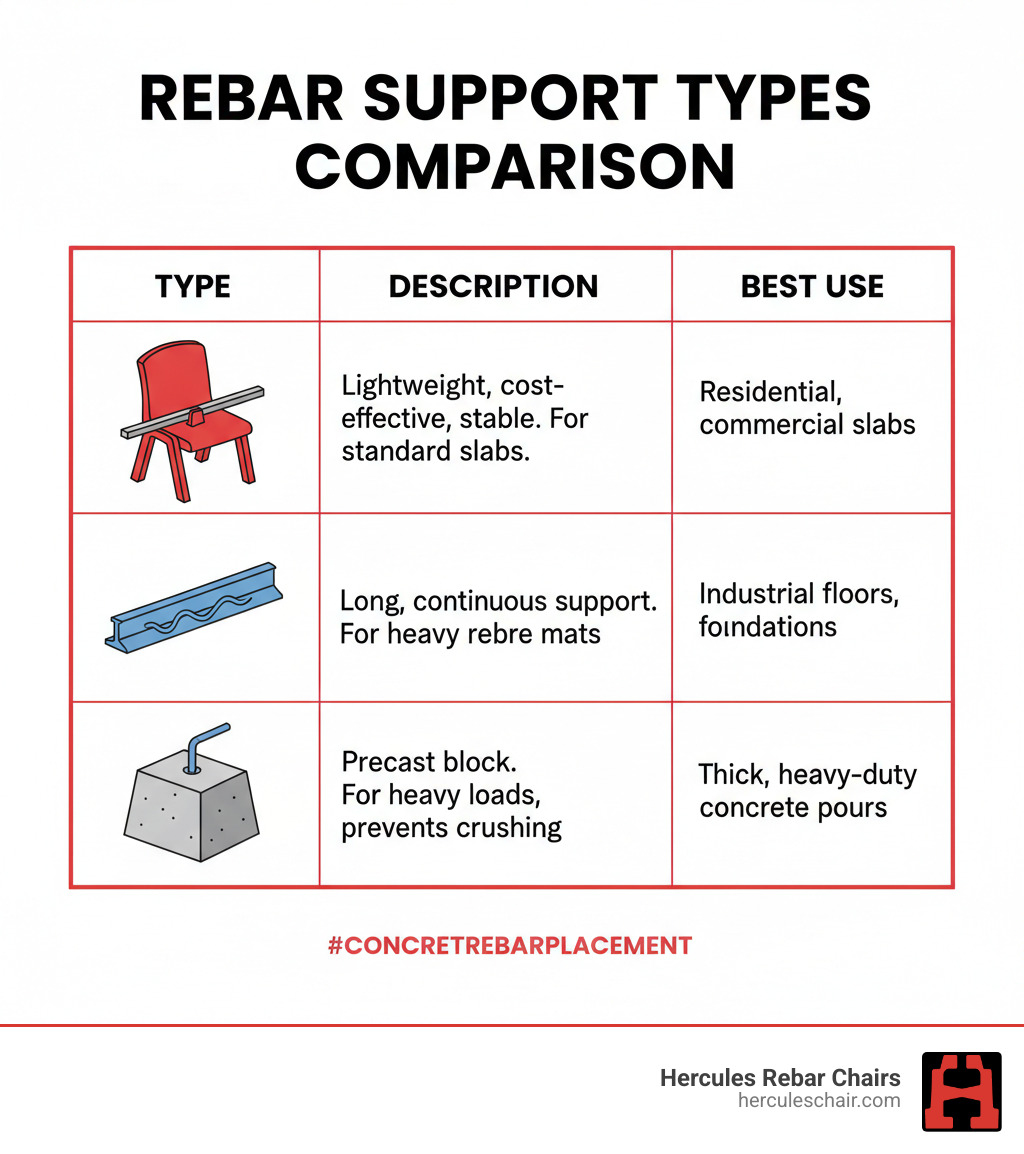
- Plastic Chairs: These are often the most cost-effective and are identifiable by their stability. At Hercules Rebar Chairs (T.J. Harris Co.), we manufacture the “America’s #1” red rebar chairs that have sold over 14 million units. They are designed to save time and ensure your project stays code-compliant.
- Metal Bolsters: Long continuous supports used for heavy mats.
- Concrete Dobies: Precast concrete blocks used primarily when the slab is heavy and might crush plastic chairs.
Tying Techniques
- Snap Tie (Single Tie): The simplest and most common tie.
- Saddle Tie: Used for securing heavy mats or vertical bars.
- Figure-Eight Tie: Excellent for holding bars that might shift diagonally.
More info about support types: the-ultimate-guide-to-rebar-chairs-types-uses-and-sizing-for-concrete-slabs/
Common Mistakes in Concrete Rebar Placement and How to Avoid Them
soil contact; improper spacing; tack welding; uncleaned rebar; shifting; sagging; building codes; IBC; ACI 318
Even experienced crews can make mistakes that compromise a foundation. Here is what to watch out for:
- Direct Soil Contact: Never let the rebar touch the ground. This creates a direct path for moisture to enter and corrode the steel. Always use chairs to maintain at least 3 inches of clearance for footings.
- Tack Welding: Many people think welding intersections is stronger than tying. In reality, tack welding is generally prohibited because it reduces the cross-sectional area of the bar and creates brittle points.
- Hooking Rebar Up During the Pour: Some contractors try to lay rebar on the ground and “hook” it up into the wet concrete during the pour. This is a recipe for disaster. The rebar almost always ends up too high or too low.
- Ignoring Tie Wire Ends: Ensure the “pigtails” of your tie wire are bent away from the surface. If they are too close to the edge, they will rust and create “rust bleeds” on your finished concrete.
Building Code Compliance
Always follow building codes like ACI 318 or the International Building Code (IBC). These codes aren’t just suggestions; they are the legal minimum requirements for safety.
Best Practices for Tying and Supporting Rebar Grids
support spacing; 4 feet o.c.; stability; substrate; regional codes; inspection checklist; structural integrity; corrosion resistance
To achieve a professional-grade concrete rebar placement, follow these final best practices:
- Check your substrate: Ensure the dirt or gravel is compacted. If a chair sinks into soft soil, your rebar sinks with it.
- Space chairs correctly: For #4 bars, place a chair every 3 feet. For #5 bars, you can go up to 4 feet on center (o.c.).
- Store rebar properly: Keep your steel off the ground on pallets and covered with tarps before installation to prevent pre-pour corrosion.
- Double-check everything: Before the truck arrives, walk the grid. Shake the bars; if they move significantly, add more ties or supports.
More info about foundation success: foundation-strong-mastering-rebar-placement-for-lasting-concrete/
Conclusion: Building for the Long Haul
Hercules Rebar Chairs; America’s #1; time savings; code compliance; structural safety; professional results
In the end, concrete rebar placement is the invisible guardian of your home or building. It’s a task that requires patience, precision, and the right equipment. By following the ACI guidelines, maintaining proper cover, and using reliable supports, you ensure that your concrete remains crack-free and structurally sound for decades.
At Hercules Rebar Chairs, we take pride in helping contractors across all 50 states—from Alabama to Wyoming—achieve these professional results. Using the right tools doesn’t just save you time; it provides the peace of mind that your structure is built to last.
More info about our products: https://herculeschair.com/our-products/