

Why Proper Rebar Installation Makes or Breaks Your Concrete
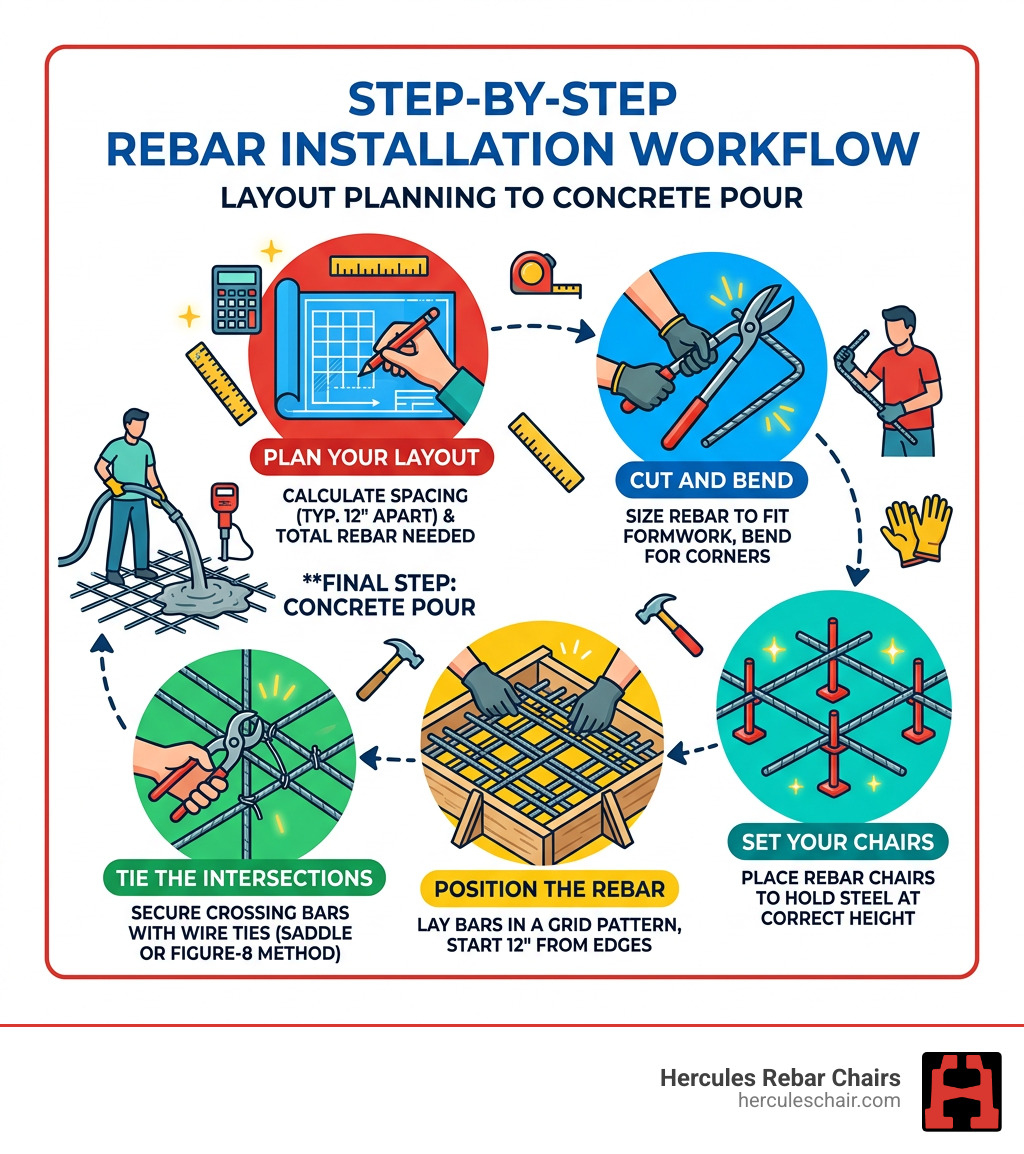
How to install rebar correctly comes down to five core steps:
- Plan your layout – Calculate spacing (typically 12 inches apart in both directions) and total rebar needed
- Cut and bend – Size rebar to fit your formwork, bending as needed for corners and edges
- Set your chairs – Place rebar chairs to hold the steel at the correct height off the ground
- Position the rebar – Lay bars in a grid pattern, starting 12 inches from each edge
- Tie the intersections – Secure crossing bars with wire ties (saddle or figure-8 method)
Concrete is incredibly strong under compression — but it cracks under tension without help. Rebar gives concrete the tensile strength it needs to hold up under heavy loads, temperature changes, and time. Get it wrong and you’re looking at cracks, costly repairs, or worse, structural failure.
The challenge is that most guides skip the details that actually matter on a job site: how high to set your chairs, which tying method holds best, how to stay code-compliant without slowing down your pour.
That’s exactly what this guide covers.
I’m Jordan Harris, a licensed Professional Engineer with a master’s degree in structural engineering and five years of hands-on experience designing large-scale concrete and steel projects — which means I know what it takes to get rebar installation right under real-world conditions. As part of the team behind the Hercules Chair rebar support system, I’ve seen how the right setup makes how to install rebar faster, safer, and more reliable on any job site.
Understanding the Two Types of Rebar
Before we grab the wire ties and pliers, we need to clear up a common point of confusion. “Rebar” refers to two very different things depending on whether you are standing on a construction site or sitting at a computer.
Construction Rebar
This is the physical steel reinforcement bar used in structural engineering. It is the “skeleton” of your concrete. Its job is to provide tensile strength, preventing the concrete from snapping or cracking when it is pulled or bent by heavy loads or shifting earth. When we talk about Foundation Strong: Mastering Rebar Placement for Lasting Concrete, we are talking about this physical steel.
Rebar3 Build Tool
If you are a software developer, specifically working with the Erlang/OTP programming language, “Rebar3” is your standard build tool and package manager. It handles compiling code, managing dependencies, and generating releases. While it won’t help you pour a driveway, it is essential for building robust software systems. You can find the official technical details in the Rebar3 Documentation | Rebar3 .
Because we want to be the most helpful resource on the internet, we are going to show you how to install both. If you’re here for the steel, skip down to the “Step-by-Step Guide” below!
How to Install Rebar3 Build Tool for Developers
For the coders among us, getting Rebar3 running is the first step toward Erlang mastery. Rebar3 supports the three newest major Erlang releases (for example, if OTP-24 is the latest, it supports back to OTP-22).
System Prerequisites
Before you start, you must have Erlang/OTP installed. Without Erlang, Rebar3 is just a lonely script. You can find installation guides for Erlang at Adopting Erlang.
Installation Methods
- Direct Download (Escript): The easiest way is to Download the latest stable release as an executable escript.
- Using Curl: Open your terminal and run:
curl -O https://s3.amazonaws.com/rebar3/rebar3chmod +x rebar3 - Windows Installation: For Windows users, download the same escript. You may need to create a
rebar3.cmdfile to call the script via the Erlang interpreter (escript.exe rebar3 %*).

PATH Configuration
To run Rebar3 from any directory, you must add it to your system’s PATH. On Linux or MacOS, you might add export PATH=$PATH:/path/to/rebar3 to your .bashrc or .zshrc file.
How to Install Rebar Locally via Command Line
While the portable escript works, it can be a bit slow because it has to “unpack” itself every time it runs. We recommend a local install for better performance.
- Local Install: Run
./rebar3 local install. This extracts the tool into~/.cache/rebar3/bin. - Update PATH: Add
~/.cache/rebar3/binto your environment variables. - Verification: Type
rebar3 versionin your terminal. If it spits out a version number, you’re in business! - Local Upgrade: To get the latest features, simply run
rebar3 local upgrade.
For more on managing Erlang packages, check out the Rebar3 usage | Hex guide.
Step-by-Step Guide: How to Install Rebar in Concrete
Now, let’s get back to the job site. Installing physical rebar is a labor-intensive process, but doing it correctly ensures your structure lasts for a century instead of a season.
1. Planning and Layout
Never start cutting steel without a plan. You need to calculate how much rebar you need. A standard rule of thumb for residential slabs is a grid with 12-inch increments. For a 6ft x 6ft area, you would typically need 16 pieces of rebar (4 rows and 4 columns) to create a 12-inch grid that stays 12 inches away from the edges of your forms.
2. Cutting and Bending
Use a circular saw with a metal-cutting blade or a dedicated rebar cutter. If your project has corners or “returns,” you’ll need to bend the steel. You can use a manual rebar bender or a hickey bar. Ensure your bends are smooth; sharp kinks can weaken the steel.
3. Positioning the Grid
Lay your bars according to your Rebar Placement Guide. Start by placing your perimeter bars about 12 inches from the formwork. This “concrete cover” is vital to prevent moisture from reaching the steel and causing rust.
How to Install Rebar Chairs for Proper Elevation
This is the most common place where DIYers and even some pros fail. If you lay rebar directly on the ground (or on “dobies” that sink), the steel ends up at the bottom of the slab. Rebar at the bottom provides zero tensile strength for the top of the slab.
We use rebar chairs to suspend the steel in the middle third of the concrete thickness. This is where the physics of reinforcement actually happens.
- Spacing: Place chairs every 2 to 3 feet along the bar. If the rebar sags when you step on it, you need more chairs.
- Stability: Use high-quality supports like our Hercules Chairs. They are designed to stay upright even when workers are walking on the grid before the pour.
- Types: For footers, you might use a 2 Bar Footer Stand or a 3 Bar Footer Stand depending on your cage design.
| Slab Depth | Recommended Chair Height | Hercules Product Choice |
|---|---|---|
| 4 Inches | 2 to 2.25 Inches | Standard Hercules Chair |
| 6 Inches | 3 Inches | Large Hercules Chair |
| 8+ Inches | 4+ Inches | Keep Your Rebar Up: A Guide to Concrete Support Blocks |
For more details on sizing, see The Ultimate Guide to Rebar Chairs: Types, Uses, and Sizing for Concrete Slabs.
Essential Tying Techniques and Tools
Once your rebar is sitting pretty on its chairs, you have to lock it together. If the bars shift during the concrete pour, your structural integrity goes out the window.
The Tools
You’ll need 16-gauge or 18-gauge annealed tie wire and a pair of lineman’s pliers or a specialized rebar tying tool.
The Ties
- Saddle Tie (The Workhorse): Pass the wire behind the bottom bar, diagonally over the top bar, back under the bottom bar, and twist. This is great for keeping bars from sliding.
- Figure 8 Tie (The Rock): This is a more complex tie that is exceptionally secure. It involves wrapping the wire around the bottom bar, crossing it over the top, wrapping it back around, and twisting. It’s perfect for heavy mats.
Proper tying ensures that when the “mud” hits the grid, nothing moves. For a deep dive into placement stability, read Foundation Strong: Mastering Rebar Placement for Lasting Concrete.
Safety Protocols and Post-Installed Methods
Working with rebar is inherently dangerous. The steel is heavy, the edges are sharp, and the environment is often unstable.
Safety Gear Essentials
- Gloves: Heavy-duty leather is a must to prevent “rebar bite” (scrapes and cuts).
- Eye Protection: Essential when cutting steel or snapping tie wire.
- Rebar Caps: If you have vertical bars (dowels) sticking up, you must use safety caps to prevent impalement in case of a fall.
Post-Installed Rebar (Drilling and Epoxy)
Sometimes you need to add rebar to a slab that is already dry—this is called “post-installed rebar.”
- Locate existing steel: Use GPR or a ferrous scanner to avoid hitting existing bars.
- Drill: Use a hammer drill to create a hole. The depth is usually determined by an engineer (often 10-15 times the bar diameter).
- Clean: This is the most important step. Use compressed air and a wire brush to remove all dust. If the hole is dirty, the epoxy won’t bond.
- Inject Adhesive: Fill the hole about 2/3 full with high-strength structural epoxy.
- Insert Bar: Twist the bar as you push it in to ensure even coverage.
Understanding the “armor” of your concrete is key here. Learn more about Rebars’ Armor: Understanding Concrete Cover and Its Critical Role.
Frequently Asked Questions about Rebar Installation
What Erlang version is required for Rebar3?
Rebar3 is designed to be compatible with the current and two previous major releases of Erlang/OTP. For example, if the latest version is OTP-26, Rebar3 will support OTP-26, 25, and 24. Always check the Rebar3 Documentation | Rebar3 for the most current compatibility matrix.
How far apart should construction rebar be spaced?
For most standard residential driveways and patios, a 12-inch or 18-inch grid is standard. However, always check your local building codes or project blueprints. Heavy-load areas like garage floors or retaining walls may require 6-inch or 8-inch spacing.
Can I install rebar in existing concrete?
Yes, using the post-installed method mentioned above. You must use specialized structural adhesives (epoxy) and ensure the hole is cleaned to “white-metal” standards to ensure the new bar becomes part of the existing structure.
Conclusion
Whether you are building a world-class software application or a foundation that will stand for a century, the quality of your “build” depends on the strength of your reinforcement.
When it comes to the job site, don’t settle for flimsy supports or “good enough” placement. At Hercules Rebar Chairs, we’ve sold over 14 million units because contractors know our red chairs ensure code compliance and structural durability while saving time on the labor line.
Ready to make your next pour easier? Explore Our Products and see why we are America’s #1 choice for rebar support.