

Why Rebar Footing Support Matters for Your Foundation’s Future
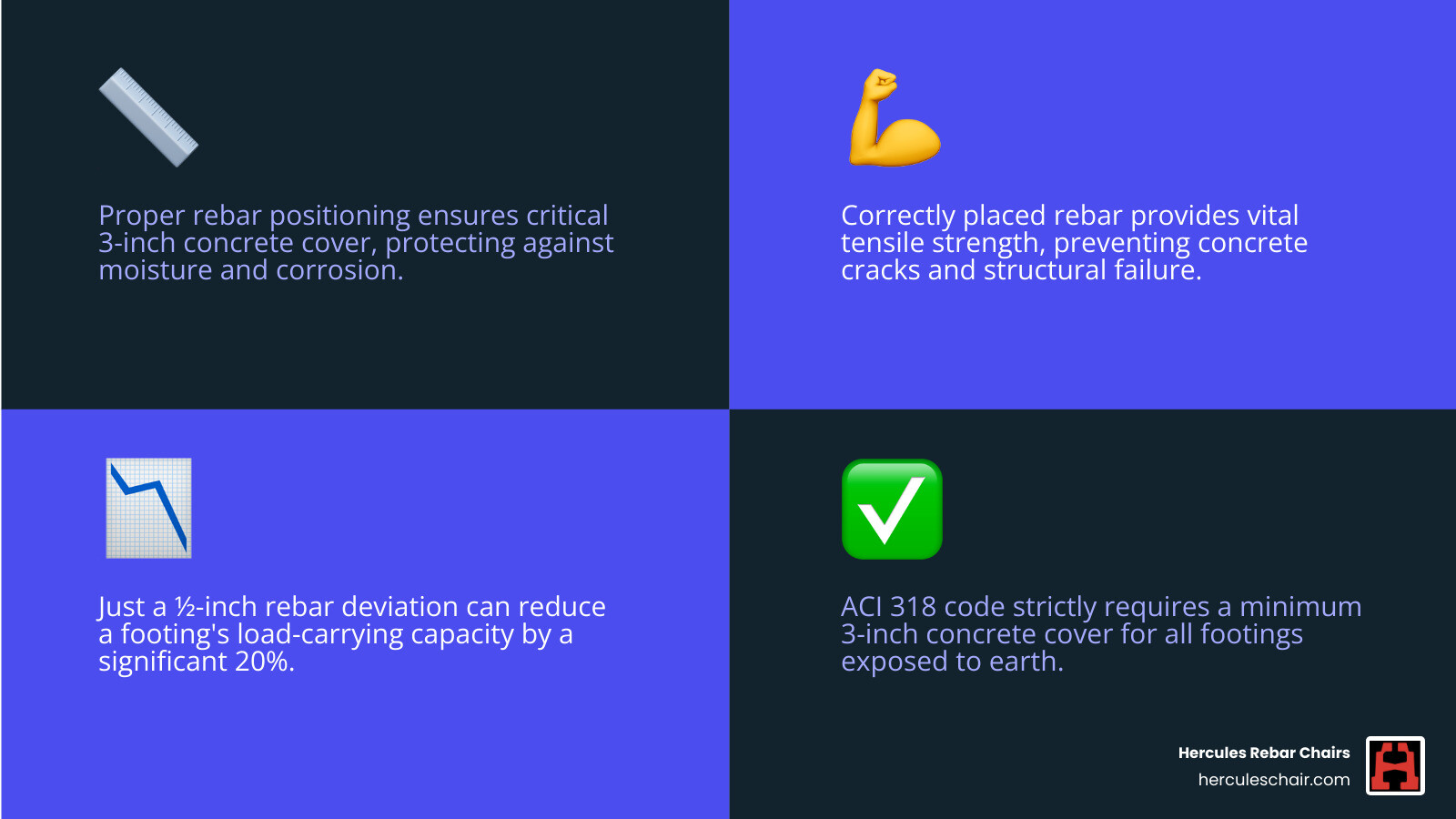
Rebar footing support systems are the unsung heroes of concrete construction, holding reinforcing steel at the precise height needed to ensure proper concrete cover and structural integrity. Without them, your concrete footings are at serious risk of premature failure, corrosion, and costly repairs.
Quick Answer: What You Need to Know About Rebar Footing Support
- Purpose: Keep rebar positioned at the correct height (minimum 3″ from bottom) to maintain proper concrete cover
- Types: Plastic chairs, footer stands, bolsters, and continuous supports (zig-zags)
- Why It Matters: Prevents corrosion, ensures proper bond strength, and maintains structural integrity
- Cost of Mistakes: Just ½-inch misplacement can reduce load capacity by 20%
- Code Requirement: ACI 318 mandates 3-inch minimum cover for footings exposed to earth
Here’s what most contractors learn the hard way: concrete is incredibly strong under compression but weak under tension. That’s where rebar comes in—it provides the tensile strength that keeps your foundation from cracking and failing. But here’s the catch: rebar only works if it’s positioned correctly within the concrete.
The research is clear on this. When rebar sits directly on the ground or shifts during the pour, you’re looking at accelerated corrosion, reduced bonding, and a foundation that won’t meet code. Even small deviations matter—moving rebar just half an inch from its specified location can slash your footing’s load-carrying capacity by 20%.
That’s where proper rebar footing support systems come in. These engineered supports—whether plastic chairs, footer stands, or continuous supports—hold your steel at exactly the right height, ensuring that critical 3-inch concrete cover that protects against moisture, corrosion, and structural failure.
The good news? Installing proper supports is neither complicated nor expensive. The bad news? Skipping them or using makeshift solutions like rocks or broken bricks is one of the most common—and most dangerous—shortcuts in concrete construction.
Why Proper Rebar Placement is the Bedrock of Your Build
Imagine constructing a house on a foundation that’s compromised from day one. It’s a scary thought, right? Yet, this is precisely the risk we run when we overlook the critical importance of proper rebar footing support. Concrete, our sturdy friend, is fantastic at handling compressive forces—it loves to be squeezed. But when it comes to pulling or stretching (tensile forces), concrete is surprisingly weak. This is where reinforcing steel, or rebar, steps in as the hero, providing the much-needed tensile strength to prevent cracking and structural failure.
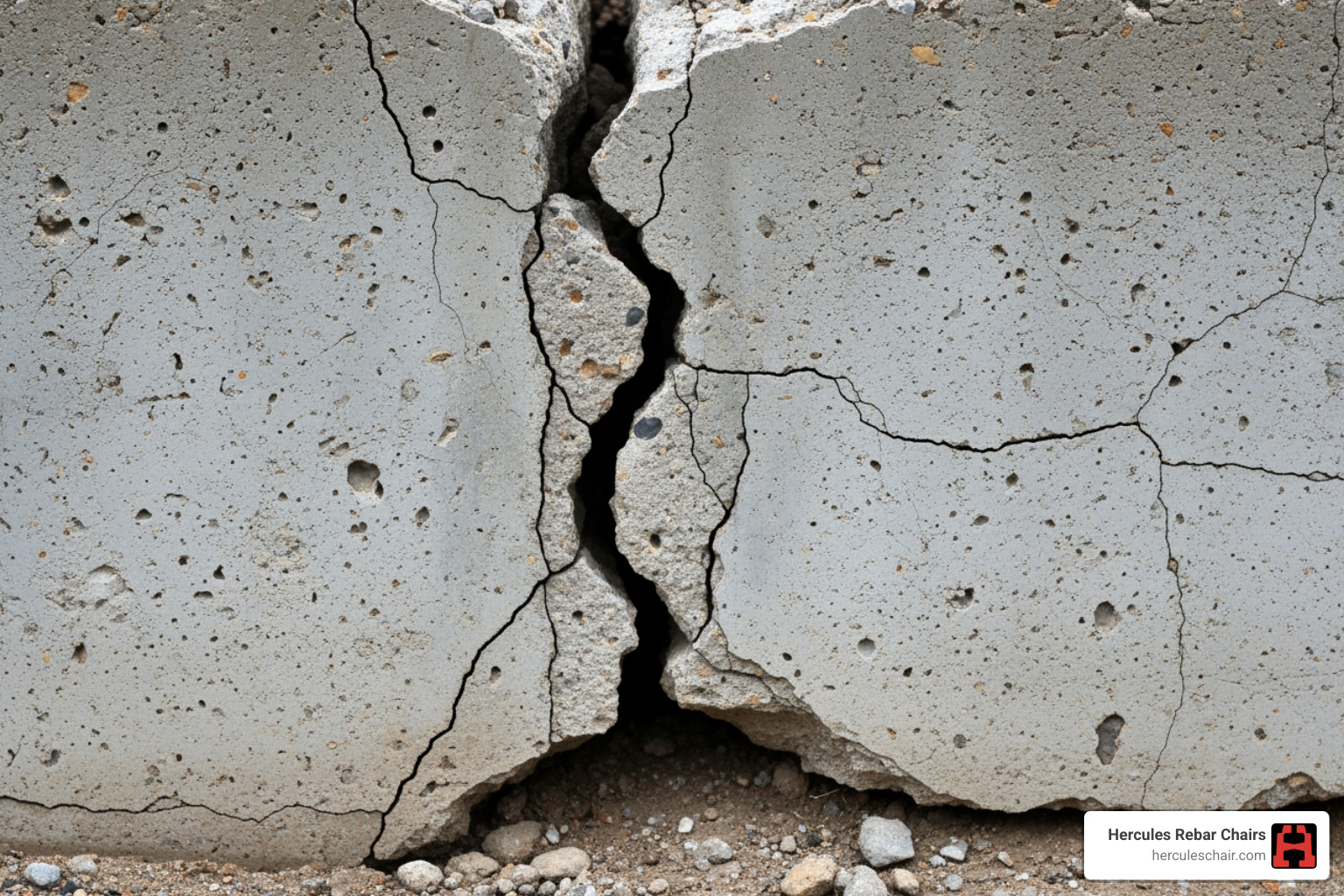
While the International Residential Code might allow for plain concrete deck foundations without rebar under minimum standards, we know that adding rebar provides increased performance and can prevent cracking, especially in footings with large bearing areas or those situated on unstable soil. Footings are the unsung heroes themselves, preventing foundation settling, particularly in areas with troublesome soils across our diverse landscapes in the USA. Even a mere quarter-inch of uneven settling, known as differential settlement, can lead to unsightly and costly damage like cracks in masonry, tile, or plaster. The goal is always to build for longevity, ensuring our structures stand strong for decades to come.
Corrosion protection is another vital aspect. If rebar is allowed to project out of footings or isn’t adequately encased, it becomes susceptible to rapid corrosion. This weakens the footing over time, leading to cracking and significantly shortening the lifespan of the entire structure. Our job is to ensure every foundation we pour is built to last, resisting the elements and the test of time.
The Critical Role of Concrete Cover
So, what exactly is “concrete cover,” and why do we talk about it so much? Simply put, concrete cover is the thickness of concrete between the reinforcing steel and the surface of the concrete member. It’s not just a guideline; it’s a non-negotiable requirement outlined in the ACI 318 Building Code, which sets the standards for concrete construction across the United States.
Why is this so crucial? Because concrete cover is the single most important factor in protecting reinforcing steel from corrosion. Without adequate cover, moisture and corrosive elements can reach the rebar, causing it to rust and expand. This expansion creates internal pressure within the concrete, leading to cracking and spalling (when pieces of concrete break off). Furthermore, proper cover ensures that the rebar bonds well with the concrete, allowing both materials to work together as a single, cohesive unit, developing their full strength.
For footings that are cast against and permanently exposed to the earth, the ACI 318 code mandates a minimum concrete cover of 3 inches. This generous buffer is essential for the long-term durability and structural integrity of your foundation, protecting the steel from the harsh realities of soil exposure and moisture. To explore how our products help achieve this, visit our products page.
The High Cost of Getting It Wrong
We’ve all heard the saying, “An ounce of prevention is worth a pound of cure.” In concrete construction, this couldn’t be truer, especially when it comes to rebar footing support. The consequences of improper rebar placement are far more severe than just cosmetic flaws; they can lead to significant structural compromises and incredibly expensive repairs down the line.
Consider this startling fact: improper rebar placement can significantly reduce a footing’s load-carrying capacity. Research shows that lowering top bars or raising bottom bars by as little as half an inch more than specified in a 6-inch-deep slab could reduce its load-carrying capacity by a staggering 20%. That’s a huge chunk of structural integrity lost due to a seemingly minor deviation. Imagine a foundation designed to support a certain weight, suddenly losing a fifth of its strength before it even carries a load. It’s like building a bridge with a hidden flaw—it’s just waiting for trouble.
When rebar isn’t adequately protected by concrete cover, it corrodes. This leads to spalling, where the concrete surface breaks away, exposing the rebar to further deterioration. This isn’t just an eyesore; it’s a sign of underlying structural weakness. Over time, this can lead to long-term structural failure, jeopardizing the entire building. The cost of repairing a failing foundation, often involving underpinning or extensive concrete replacement, can easily skyrocket into tens of thousands of dollars, far outweighing the minimal investment in proper rebar footing support from the start. We believe in doing it right the first time, every time.
A Contractor’s Guide to Rebar Footing Support Types
When it comes to building robust foundations, selecting the right rebar footing support system is paramount. The market offers a variety of materials and designs, each suited for different applications and project requirements. Historically, contractors might have used steel wire supports or even precast concrete blocks, known as dobies. However, our focus, and what we champion, are high-impact plastic supports. These modern solutions provide superior performance, ease of use, and durability, ensuring your rebar stays exactly where it needs to be.
Hercules Rebar Support Solutions
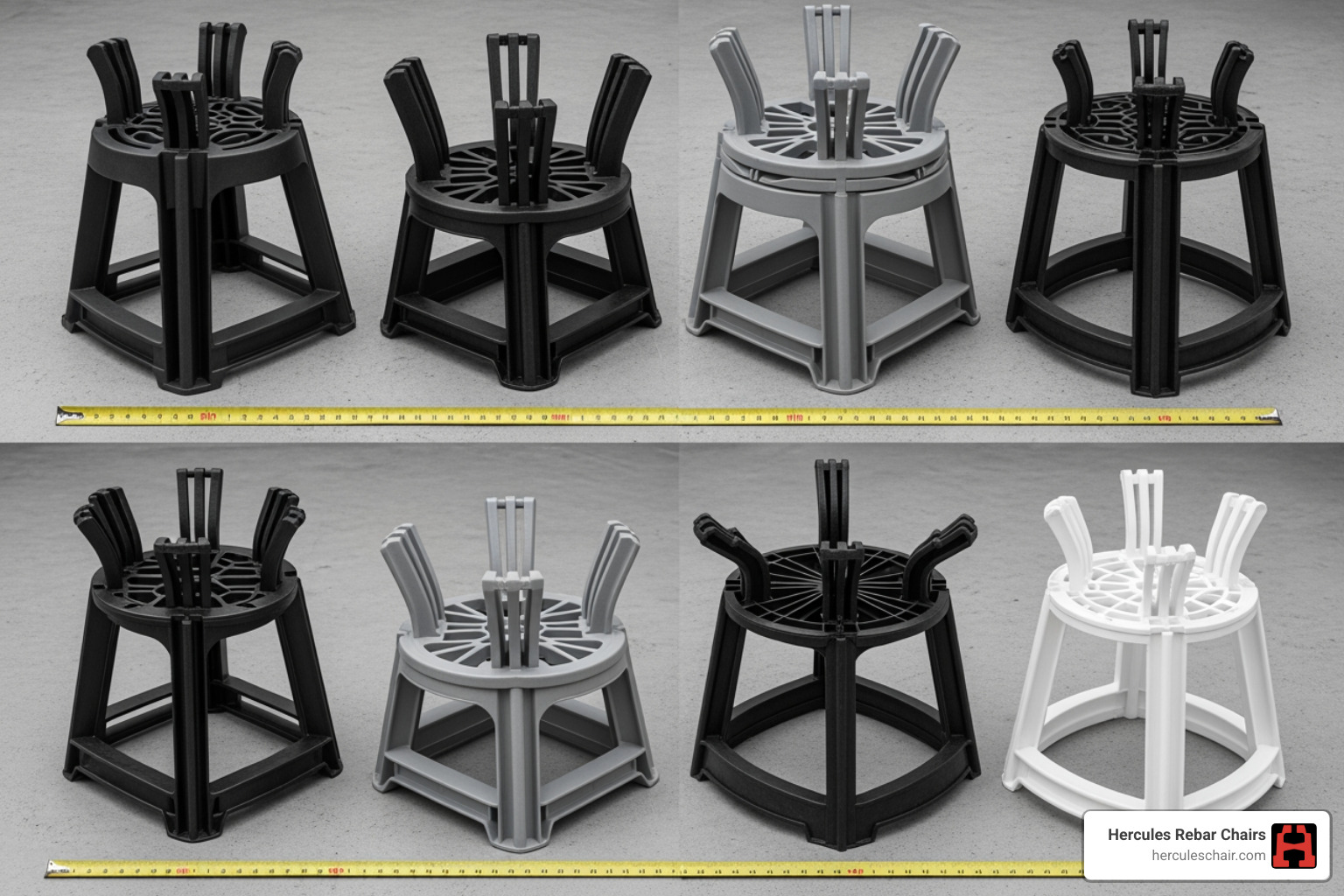
At Hercules Rebar Chairs, we pride ourselves on manufacturing strong rebar chairs and concrete supports designed specifically for the concrete construction industry. Our range of solutions is engineered to meet the rigorous demands of various projects, from residential builds to large commercial foundations across the USA.
Our product line includes:
- Bar Chairs: These are fundamental for supporting lighter steel in slab and deck construction, offering stability with their 4-point contact base.
- Slab Bolsters: Designed to support one layer of steel above another, often used in larger projects where multiple layers of reinforcement are required.
- Continuous High Chairs (Zig-Zags): These supports are excellent for thick concrete applications, such as highways and runways, and can even be bent around partitions while maintaining their load-bearing capacity.
- Footer Stands: Crucial for footings, these stands ensure that the rebar cage is liftd to the precise height required for adequate concrete cover. We offer specialized solutions like our 2 Bar Footer Stand and 3 Bar Footer Stand, designed for stability and ease of installation.
These engineered supports are not just pieces of plastic; they are critical components that ensure quality assurance for everyone involved—the contractor, subcontractor, engineer, and ultimately, the owner. They are built to withstand the rigors of the job site, providing confidence that your rebar will remain in its specified, engineered position. For detailed guidance on placement, refer to our Footer Stand Placement Guide.
The Advantages of Hercules Plastic Rebar Supports
We’re not just selling rebar chairs; we’re offering solutions that transform your construction projects. Our high-impact plastic rebar supports bring a host of benefits that make them the preferred choice for forward-thinking contractors.
First and foremost, our plastic supports are designed for labor savings and installation efficiency. They are lightweight, easy to handle, and often feature snap-on mechanisms that drastically reduce installation time compared to traditional, more cumbersome methods. This means your crew spends less time wrestling with rebar and more time moving the project forward. We know that every minute saved on the job site translates directly into cost savings and faster completion times.
The stability on soft ground is another significant advantage. Unlike some metal supports that can sink into soft soil or vapor barriers, our plastic designs, particularly our footer stands, often feature wide bases that prevent displacement. This ensures that your rebar maintains its precise elevation, even before the concrete pour. This stability is particularly important when working with sensitive materials like our Vapor Barrier Mat, where puncturing the barrier could lead to moisture issues down the line.
Our supports contribute to a cleaner, more organized worksite. The lightweight design not only makes them easier to transport and install but also reduces material waste and cleanup time. This commitment to efficiency and a tidy site is part of our promise to simplify the construction process without ever compromising quality. We believe that struggling with rebar installation should be a thing of the past. Our products are game-changers, making rebar work quicker, safer, and more efficient than ever before.
Selecting the Right Support: A Project-Specific Checklist
Choosing the correct rebar footing support isn’t a one-size-fits-all decision. It’s a critical step that demands careful consideration of your project’s unique specifications, load requirements, and environmental factors. Just like Goldilocks, you need a support that’s “just right”—not too big, not too small, but perfectly suited for the job. Our Goldilocks Guide to Concrete Bar Chair Sizes is an excellent resource to help you steer this choice.
The choice of rebar support depends heavily on the surface underneath, the specific structural elements being reinforced, and the overall project design. Taking the time to assess these factors upfront will save you headaches and potential costly corrections later.
Key Factors for Choosing a Rebar Footing Support
When we’re selecting the perfect rebar footing support for a project, several key factors guide our decision-making process:
- Concrete Thickness: The overall depth of your concrete footing will dictate the height of the rebar support needed to achieve the required concrete cover. A thicker footing might require a taller support to ensure the rebar is centrally located or at the correct tension side.
- Rebar Size: The diameter of your rebar (e.g., #4, #5, #18) is crucial. Supports must be compatible with the rebar size to hold it securely without slipping. While some supports are universally adaptable to variable bar diameters, fitting even large #18 bars, others are specific. We ensure our supports are robust enough for various bar sizes.
- Application Type: Are you pouring a footing, a slab, a wall, or a column? Each application has different structural requirements and cover specifications. For instance, continuous supports are often ideal for extensive slab work, while individual chairs or footer stands are perfect for footings.
- Load Capacity of Support: This is often overlooked but incredibly important. The supports must be strong enough to bear the weight of the rebar cage, and potentially the crew walking on it, without deforming or breaking. While general guidelines exist (e.g., one support per 1500 lbs. of steel cage weight, or a minimum of one support every other vertical bar), understanding the specific load requirements for your project is key. Our Hercules Rebar Chair Estimator can assist you in calculating what you need.
By carefully evaluating these factors, we can ensure that the chosen rebar footing support system will perform its essential role flawlessly, contributing to a strong and durable foundation.
How Site Conditions Influence Your Choice
Beyond the specifics of the rebar and concrete, the actual site conditions play a significant role in dictating the optimal choice for your rebar footing support. We’re not just building in a vacuum; we’re dealing with the real world, and Mother Nature has a say in our plans!
- Soil Type (Soft vs. Hard): The ground beneath your footing is a major consideration. If you’re working with soft, muddy soil, supports with a wider base are essential to prevent them from sinking, which would compromise your concrete cover. In contrast, harder, more stable ground might allow for supports with a smaller footprint. Assessing soil conditions is crucial for determining the proper depth and width for footings and, consequently, the type of support. In weak or marginal soils, it’s always best to exercise caution.
- Vapor Barriers: Many projects require a vapor barrier to prevent moisture migration into the structure. When using these, select supports that won’t puncture or damage the barrier. Our plastic supports are designed to be friendly to vapor barriers, maintaining their integrity.
- Water Table Level: If your site has a high water table or is prone to standing water, the durability of your supports becomes even more critical. Plastic supports are inherently resistant to moisture and corrosion, making them an excellent choice for wet conditions, ensuring the rebar stays protected even before the concrete is poured.
- Exposure to Earth and Weather: As we’ve discussed, footings cast against and permanently exposed to the earth require a minimum of 3 inches of concrete cover. This exposure means your supports must be robust enough to maintain that cover in potentially damp or aggressive soil environments. Our plastic supports are built for this challenge, providing consistent elevation and protection.
For more comprehensive information on foundation construction and how site conditions impact footing design, refer to the Foundation Manual on Footing Foundations from the California Department of Transportation. Understanding these environmental factors allows us to make informed decisions that safeguard the long-term performance of every foundation we help build.
The Ultimate Guide to Installing Rebar in Footings
Proper installation of rebar in footings is an art and a science. It’s about precision, adherence to codes, and an unwavering commitment to quality. We always emphasize best practices because a strong foundation begins long before the concrete truck arrives. A thorough pre-pour inspection is non-negotiable, ensuring everything is perfectly in place according to the plans and ACI placement tolerances. For a deeper dive into these guidelines, check out our Rebar Placement Guide.
Step 1: Prepare the Rebar Grid
The first step in achieving a flawless rebar installation is carefully preparing the rebar grid. This involves:
- Cutting and Bending Rebar: Based on your engineering drawings, rebar needs to be cut to specific lengths and bent into the required shapes. Accuracy here is key to forming a cage that fits perfectly within your footing.
- Assembling the Mat: Once cut and bent, the individual rebar pieces are assembled into a rigid mat or cage. For footings, this typically involves horizontal bars running in both directions, often with vertical bars (dowels) extending upwards for connection to walls.
- Tying Intersections: This is where tie wire comes into play. Its purpose is to secure and prevent rebars from displacement during construction activities and concrete placement. While tie wire doesn’t contribute to the structural strength of the concrete, it’s absolutely vital for maintaining the integrity of the rebar cage until the concrete sets.
- Tying Frequency: Here’s a common misconception: you do not need to tie every rebar intersection. Tying every fourth or fifth intersection is normally sufficient to create a stable grid. Over-tying is time-consuming and unnecessary.
- Tie Wire Types: Tie wire is typically 16½- or 16-gauge black, soft, annealed wire. For heavier reinforcement, 15- or 14-gauge wire may be used.
- Bending Tie Wire Ends Inward: Always ensure that tie wire ends are bent inward, away from the concrete surface. This prevents them from being exposed to the elements, which could lead to rust stains or even initiate corrosion within the concrete.
By taking the time to carefully prepare your rebar grid, you’re setting the stage for a foundation that will perform as designed.
Step 2: Install the Rebar Footing Support System
With your rebar grid prepared, the next crucial step is to install the rebar footing support system. This is where our Hercules Rebar Chairs truly shine, ensuring your rebar is liftd and precisely positioned.
- Proper Support Spacing: The spacing of your supports is critical. It needs to be frequent enough to prevent any sagging or displacement of the rebar, especially under the weight of the rebar itself and any incidental loads during construction. While specific project plans will dictate exact spacing, general guidelines (like using one support per 1500 lbs. of steel cage weight, or a minimum of one support every other vertical bar) provide a good starting point. Our Footer Stand Placement Guide offers detailed instructions to ensure optimal support.
- Attaching Supports Securely: Our supports are designed for ease of use. Whether you’re using our 2 Bar Footer Stand or 3 Bar Footer Stand, ensure they are firmly placed beneath the rebar and securely hold the bars in their designated positions. They should lift the rebar to achieve the proper depth of concrete cover, preventing the bars from resting directly on the soil or formwork.
- Ensuring Stability: Once installed, the entire rebar cage, with its supports, should feel stable. Walk the area (carefully!) to check for any wobbling or weak points. The goal is a rebar framework that will not shift or deform during the concrete pour. Bar supports are used to hold reinforcing bars in place to attain the proper depth of cover, preventing them from being placed directly on the soil or shifting during concrete placement.
This step is the linchpin of proper rebar placement. Investing in quality supports and installing them correctly is a small effort that yields immense returns in structural integrity and peace of mind.
Step 3: Final Placement and Pre-Pour Checks
You’ve carefully prepared your rebar grid and carefully installed your rebar footing support system. Now comes the moment of truth: final placement and the all-important pre-pour checks. This is our last chance to catch any issues before the concrete starts flowing.
- Lowering Grid into Trench: Carefully lower the assembled rebar grid, with its supports attached, into the footing trench. Ensure it settles evenly and doesn’t get hung up on any obstacles.
- Verifying Concrete Cover: This is absolutely critical. Use a tape measure or a rebar depth gauge to carefully verify that the minimum concrete cover is achieved on all sides of the rebar. For footings exposed to earth, this means a consistent 3 inches of cover. Check multiple points along the length of the rebar. This verification ensures that the rebar is protected from corrosion and can bond properly with the concrete.
- Checking for Stability: Give the rebar cage a gentle shake. It should feel robust and stable. Any movement could indicate insufficient tying or improperly placed supports, which could lead to displacement during the pour. The position of the rebar must not change during concrete pouring.
- Avoiding “Snagging” or “Hooking”: We cannot stress this enough: never set your reinforcement directly on the subgrade and attempt to “snag” or “hook” it up during concrete placement. This practice is considered poor and often results in inconsistent concrete cover, leading to weakened sections and potential structural failure. Our supports are designed to prevent this, ensuring the rebar is held precisely where it needs to be from the start.
- Allowable Deviation: While precision is key, there are some allowable tolerances. In slabs and walls (excluding stirrups and ties), the allowable deviation from the specified rebar location is typically ±3 inches. However, for footings, aiming for exact placement is always the best practice to maximize strength and longevity.
By performing these final checks, we guarantee that the rebar is perfectly positioned to deliver the full structural benefits it was designed for, ensuring a foundation that will stand strong for generations.
Frequently Asked Questions about Rebar in Footings
How much concrete cover do I need for a footing?
The ACI 318 code requires a minimum of 3 inches of concrete cover for rebar in footings that are cast against and permanently exposed to the earth. This protects the steel from moisture and corrosion.
Do I need to tie every rebar intersection in my footing grid?
No, it’s not necessary. Tying every intersection can be time-consuming and doesn’t add structural strength. Standard practice is to tie every fourth or fifth intersection, or as needed to ensure the grid is rigid and won’t shift during the concrete pour.
Can I just use rocks or broken bricks to support my rebar?
This is a common but dangerous shortcut. Rocks and broken bricks are not engineered for this purpose. They can create voids, absorb water, and fail to provide consistent cover, leading to weak spots, corrosion, and potential structural failure. Always use proper, manufactured rebar supports.
Conclusion
We’ve journeyed through the critical world of rebar footing support, uncovering why it’s not just a detail but the bedrock of a successful construction project. We’ve seen how proper rebar placement, secured by reliable supports, is indispensable for a foundation’s structural integrity, tensile strength, and longevity. The importance of adequate concrete cover, especially the mandated 3 inches for footings exposed to earth, cannot be overstated—it’s your rebar’s best defense against corrosion and your structure’s safeguard against premature failure.
The consequences of getting it wrong, from a 20% reduction in load-carrying capacity due to a mere half-inch misplacement to costly structural repairs, underscore the absolute necessity of doing it right the first time. We explored the various types of rebar supports, highlighting the significant advantages of high-impact plastic solutions like those from Hercules Rebar Chairs—advantages that translate into labor savings, installation efficiency, and superior stability on diverse job sites across the USA.
Choosing the right support isn’t guesswork; it’s a calculated decision based on concrete thickness, rebar size, application type, load capacity, and crucial site conditions like soil type and water table. And finally, we walked through the ultimate guide to installation, emphasizing the meticulous preparation of the rebar grid, the strategic placement of supports, and the vital pre-pour checks that guarantee code compliance and optimal performance.
At Hercules Rebar Chairs, we believe in empowering contractors with the tools and knowledge to build foundations that stand the test of time. Our strong, identifiable red rebar chairs are a symbol of quality, efficiency, and code compliance, proudly “America’s #1” with millions of units sold. The small investment in proper rebar footing support pays dividends in the long-term security and reputation of every structure you build. Don’t compromise on the foundation—it’s simply not worth the risk.
Ready to secure your next project with confidence? Explore our range of solutions and buy rebar chairs directly from us.