

Why Getting Bar Chair Sizes Right Matters for Comfort and Function
Bar chair sizes depend on three key measurements: your counter or bar height, the ideal seat height for legroom, and the spacing needed per stool. Here’s the quick breakdown:
| Surface Height | Ideal Seat Height | Space Per Stool |
|---|---|---|
| 34-37″ (Counter) | 24-27″ | 24-25″ |
| 40-43″ (Bar) | 29-31″ | 24-25″ (or 30″ with arms) |
| 44-48″ (Spectator) | 33-35″ | 24-25″ |
You know that feeling when you sit down at a bar and something just feels off? Maybe the stool is too low and you feel like a kid. Maybe it’s too high and you’re hunching over your drink. These small discomforts can ruin what should be a pleasant experience.
Getting bar chair sizes right isn’t complicated, but it’s as critical as getting foundational measurements correct in a construction project. The wrong height means uncomfortable guests, wasted money on furniture that doesn’t fit, and a space that lacks the proper support and function you planned for.
This is the same mindset concrete pros use in the field every day: start with accurate measurements, choose the right support, and the finished surface performs better and lasts longer. Hercules Rebar Chairs are designed around that exact idea of precision and support in concrete work, and here we are simply applying the same discipline to a finished surface your clients will see and use.
Whether you’re outfitting a home kitchen island, a commercial bar, or designing built-in seating above a concrete slab, the same principles of precision and support apply. Just as a structure needs a solid foundation to stand strong, your seating needs the right measurements to be truly functional. Measure your surface height. Calculate the right seat height. Plan your spacing. That’s the blueprint for success.
This guide walks you through all three steps with the exact measurements you need. No guesswork, no returning furniture that doesn’t fit, no guests shifting awkwardly in their seats. And if you are a builder, GC, or concrete contractor, it is a simple example of how the same measurement discipline you use when placing rebar and setting chairs can dramatically improve the experience in the finished space.
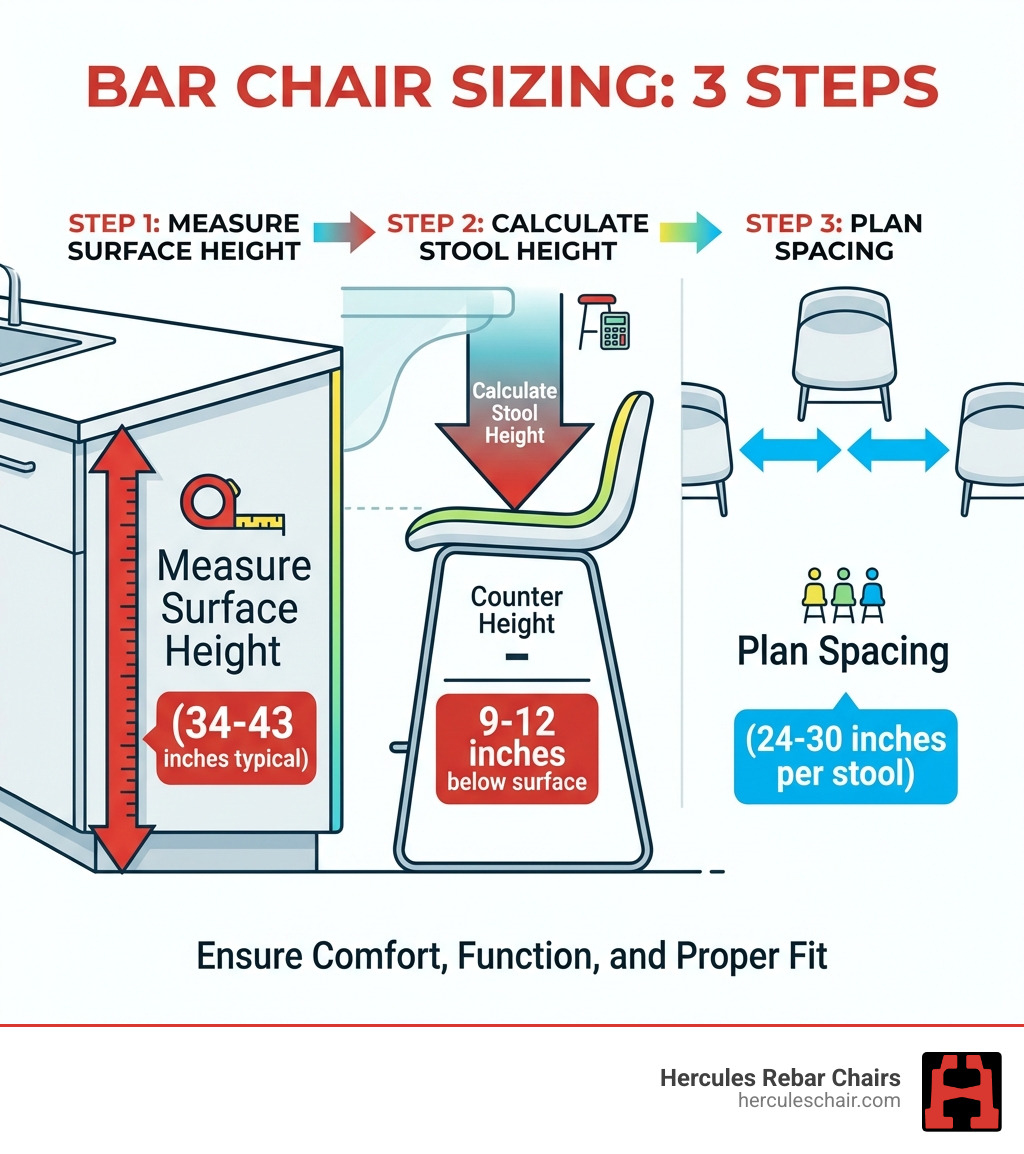
Step 1: Measure Your Counter or Bar Height
The very first step in determining the right bar chair sizes is to grab a tape measure and find out how tall your counter or bar actually is. This foundational step is critical because all other measurements hinge on it. We’re talking about measuring from the floor all the way up to the top of your surface.
If you work in concrete construction, this step will feel familiar. It is the same idea as verifying slab thickness or reinforcing placement before you set Hercules Rebar Chairs: once the basic dimension is right, everything else falls into place more efficiently and more safely.
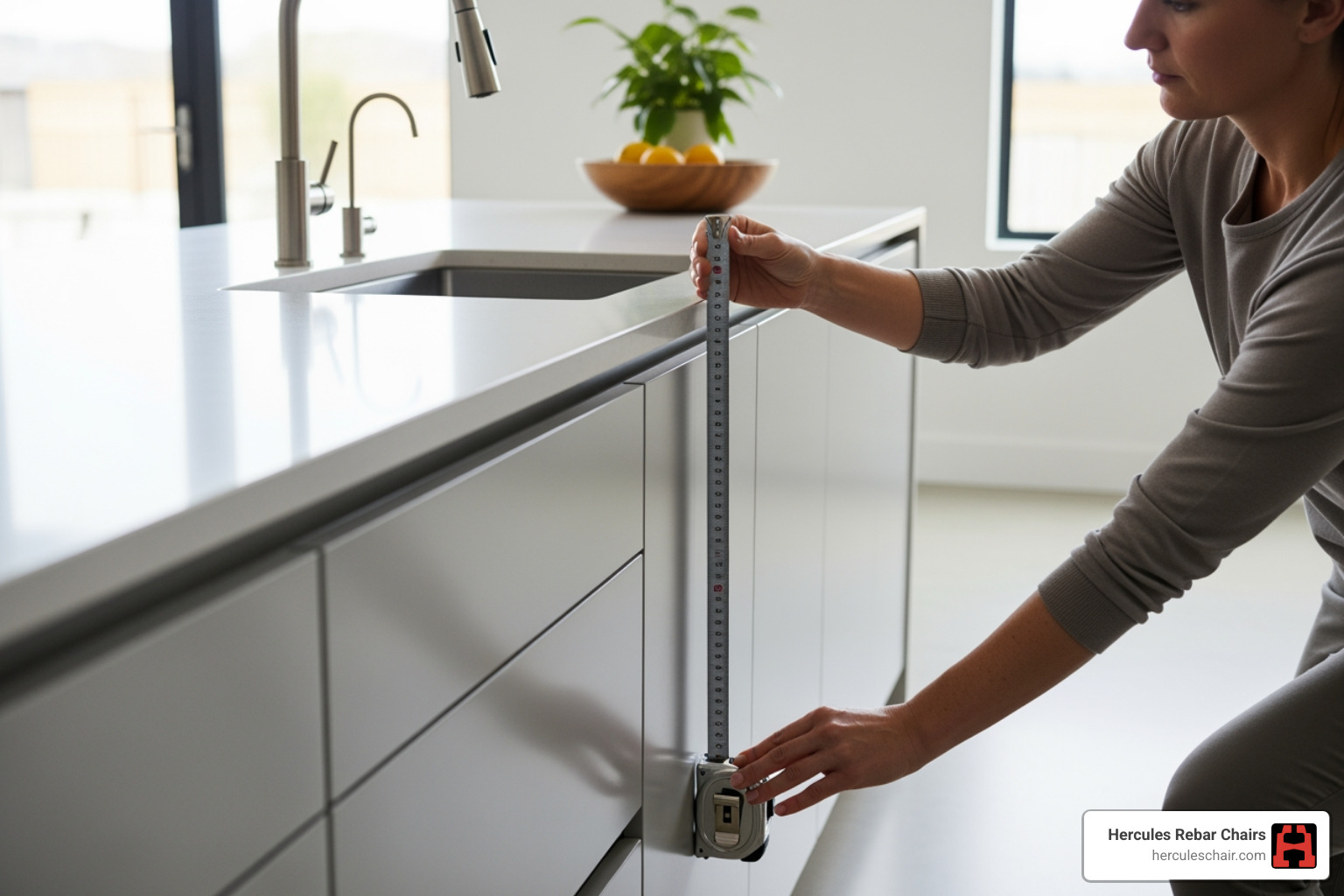
Understanding Standard Surface Heights
When we talk about liftd seating, we generally encounter three main standard surface heights:
- Counter Height: This is typically the height of a standard kitchen countertop or island, usually ranging from 34 to 37 inches from the floor. It’s designed for a relaxed, slightly liftd feel, perfect for casual dining or gathering in the kitchen. Most kitchen islands and breakfast bars fall into this category.
- Bar Height: Taller than counter height, a standard bar table or home bar typically measures between 40 to 43 inches from the floor. This is the height you’d commonly find in a pub or commercial bar, encouraging a more social and energetic atmosphere where people can comfortably stand or sit on taller stools.
- Spectator Height: Sometimes referred to as extra-tall, these surfaces are even higher, generally falling between 44 to 48 inches. These are less common in residential settings but exist for specific high-top tables or custom designs.
Knowing your surface height is like knowing the foundation of your house – everything else is built on it. On the jobsite, that same principle is why contractors rely on consistent chair heights and cover: a small miss early on can throw off the performance of the whole slab or beam.
Key Differences in Bar Chair Sizes: Bar vs. Counter Stools
One of the most common mistakes we see is confusing bar stools with counter stools. They might look similar, but their distinct bar chair sizes are designed for different table heights, impacting both comfort and functionality.
- Counter Stools: These are designed for counter-height surfaces (34-37 inches). Their seat height usually ranges from 24 to 27 inches from the floor. They allow for comfortable dining and socializing at kitchen islands.
- Bar Stools: These are taller, specifically made for bar-height surfaces (40-43 inches). The seat height for a bar stool is typically between 29 and 31 inches from the floor. They are perfect for traditional home bars or pub-style tables.
The key difference is purely height. As one source puts it, “It all comes down to height! Counter stools are shorter (24 to 26 inches) for kitchen counters, while bar stools are taller (28 to 30 inches) for pub tables and high-top bars.” Getting this wrong can mean your knees are bumping the underside of the counter, or you’re left awkwardly craning your neck to reach your drink. For a more detailed look at these differences, check out this Counter Stools vs Bar Stools Guide – Measurement Chart.
For builders and remodelers, avoiding this simple sizing error is another way to hand over a project that feels as solid in everyday use as the concrete work hidden below the finished floor.
Step 2: Find the Perfect Stool Seat Height
Once you have your counter or bar height locked in, the next step is to determine the ideal seat height for your bar chairs. This measurement is all about providing the right support for comfort and ergonomics. Just as a rebar chair provides the perfect clearance for concrete to flow, the right gap between your seat and counter provides the perfect clearance for your legs.
This is a direct parallel builders will recognize: on a slab or deck, Hercules Rebar Chairs control the distance between the reinforcing steel and the surface so the concrete can perform to spec. At the bar, you are simply controlling the distance between the seat and the surface so people can use the space comfortably.
The Golden Rule for Legroom
The secret to comfortable bar seating lies in a simple, golden rule: there should be an approximate 9 to 12-inch gap between the top of your stool’s seat and the underside of your counter or bar. This space ensures adequate legroom and allows you to slide in and out of your seat easily without bumping your knees.
Let’s say your counter is 36 inches tall. Subtracting 10 inches gives us a 26-inch seat height. Subtracting 12 inches gives us 24 inches. So, for a 36-inch counter, we’d look for stools with a seat height between 24 and 26 inches. Easy, right?
This “10 to 12-inch rule” is consistently recommended across the industry for optimal comfort. It’s the simple formula that prevents those “off” feelings we talked about earlier. To learn more about how to measure for your perfect stool, take a look at this guide on How to Measure Bar Stools.
Standard Bar Chair Sizes for Every Surface
To make things even easier, we’ve compiled a table of standard bar chair sizes that pair perfectly with common surface heights:
| Surface Type | Surface Height (Floor to Top) | Ideal Stool Seat Height (Floor to Seat) |
|---|---|---|
| Dining Table | 28″ – 30″ | 16″ – 18″ |
| Counter Height | 35″ – 37″ | 24″ – 27″ |
| Bar Height | 40″ – 43″ | 29″ – 31″ |
| Spectator Height | 44″ – 46″ | 33″ – 34″ |
- Counter Stool Dimensions: For a 36-inch tall counter, a 24-inch stool is often considered perfect. If your counter is a bit taller, say 37-38 inches, a 25-26 inch stool would be ideal.
- Bar Stool Dimensions: The standard 42-inch bar top pairs best with a 30-inch stool. This is the most popular bar seating dimension, seating guests at a comfortable 30 inches.
- Spectator Stool Dimensions: For the tallest surfaces (44-48 inches), you’ll need extra-tall stools with seat heights typically ranging from 33-35 inches.
These are general guidelines. Always double-check your specific counter height and aim for that 9-12 inch gap.
What About Adjustable Height Stools?
Sometimes, a fixed-height stool just won’t cut it. Perhaps you have a custom-height counter that doesn’t fit standard dimensions, or maybe you want the flexibility to accommodate different users – from children to adults – at the same spot. This is where adjustable height bar stools shine.
Adjustable stools offer fantastic versatility. They typically work with one of two mechanisms:
- Gas Lift: Similar to an office chair, a lever activates a pneumatic cylinder, allowing smooth height adjustments. These are great for quick, effortless changes.
- Screw Mechanism: These stools adjust by rotating the seat, screwing it higher or lower. While not as fast as a gas lift, they offer robust stability.
Adjustable height stools are “a good option for those who have trouble finding the perfect height” or for spaces where versatility is key. They allow you to fine-tune the seating experience, making them a popular choice for families or multi-purpose areas. For more on different bar stool styles, including adjustable options, see these popular style examples.
For professionals who already rely on Hercules Rebar Chairs to dial in reinforcement cover precisely, thinking about stool height this way is just extending that same accuracy into the finished interior details.
Step 3: Plan Your Layout and Spacing
You’ve established the vertical support; now it’s time to plan the horizontal structure. Planning your layout and spacing is just as crucial as getting the right seat height. Proper spacing ensures your seating arrangement is strong and functional, not cramped and unstable. It’s about creating a well-engineered space where everyone has room to move and relax.
On the structural side, concrete contractors think in a very similar way when they lay out rebar grids and specify Hercules Rebar Chairs at the correct spacing: too tight and you waste material and labor, too loose and you risk performance or code issues. With bar seating, the stakes are comfort and usability instead of structural capacity, but the logic is exactly the same.
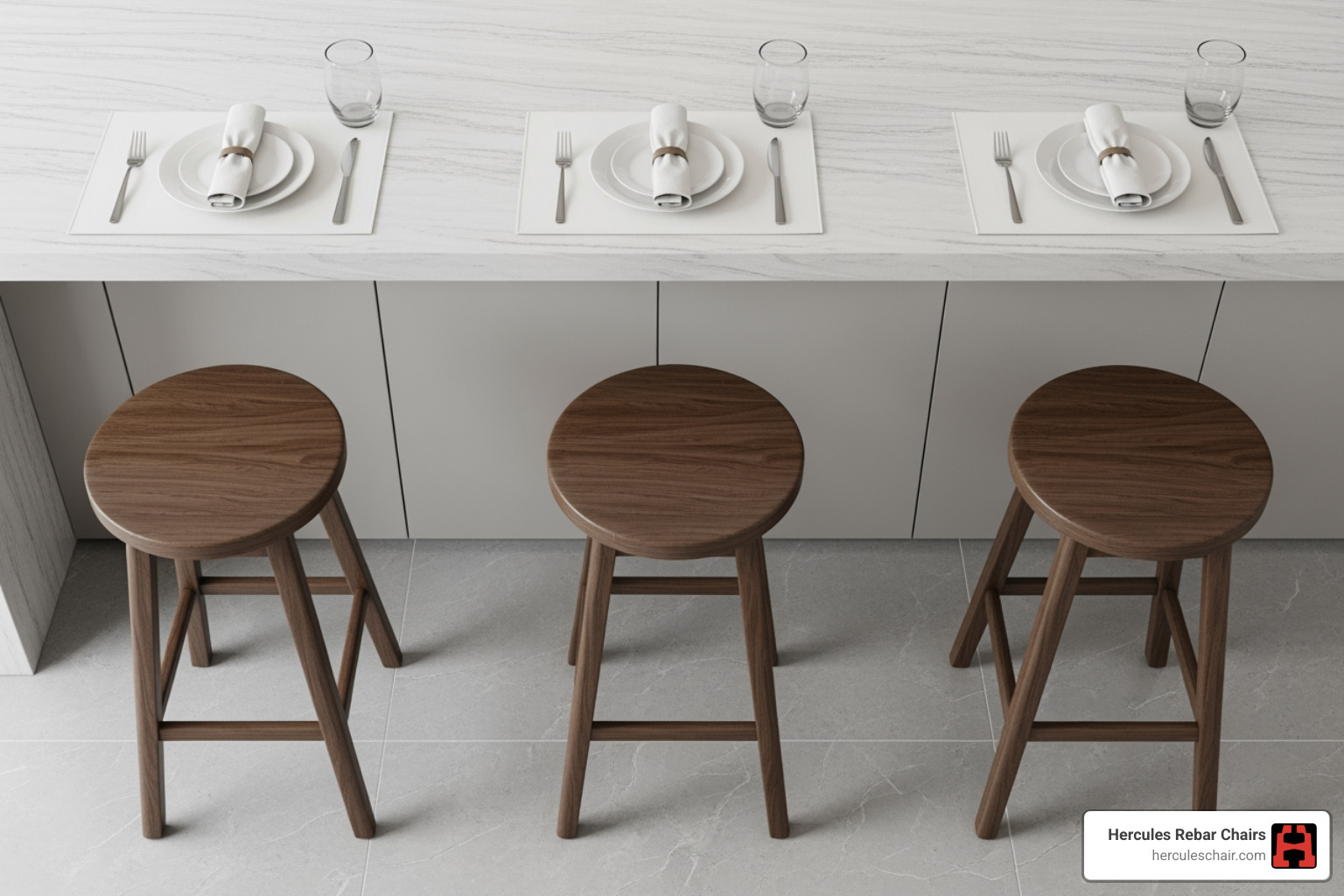
How Much Space per Stool?
To avoid awkward elbow bumps and ensure a comfortable “place setting” for each person, we need to allocate enough width per stool. This isn’t just about the width of the stool itself, but the overall space a person occupies when seated.
- For standard bar stools up to 22 inches wide, we recommend allowing approximately 24 to 25 inches per stool. This provides a good balance of comfort and efficient use of space.
- If your stools are wider than 22 inches, or if they have armrests or swivel features, you’ll need more room.
To figure out how many bar stools you can fit, measure the total length of your counter or bar. Then, divide that length by the recommended space per stool (e.g., 24 inches). Round down to the nearest whole number, and you’ll have your maximum capacity. For example, a 72-inch counter divided by 24 inches per stool means you can comfortably fit 3 stools.
Spacing Between Stools and the Impact of Arms
Beyond the space per stool, we also need to consider the gaps between them.
- For narrower, backless bar stools (16-18 inches wide), a minimum of 6 inches of space between stools is recommended.
- For wider seats or those with armrests or swivel capabilities, increase that spacing to 8 to 10 inches apart. Some experts even suggest an “ideal measurement of 28 inches between stools” from center to center for commercial settings.
Armrests and swivel mechanisms require extra consideration. While armrests offer added comfort and support, they also demand more space. Similarly, swivel stools are fantastic for conversation and ease of movement, but they need room to rotate without bumping into the person next to them. If your stools have these features, lean towards allocating 30 inches or more per stool to ensure everyone has ample room. As one source notes, “Stools that swivel or have armrests will take up more space, so lean towards giving those stools 25 inches of space or more.” We often find that 26-32 inches from the center of one bar stool to the next is a good range for comfortable seating.
If you lay out stools the way you lay out reinforcement – starting from the ends, checking center-to-center distances, and confirming clearances to walls and walkways – you will arrive at a clean, repeatable layout that feels intentional instead of improvised.
Don’t Forget Clearance: The Space Behind the Stool
Finally, let’s talk about the space behind your bar chairs. This often-overlooked detail is crucial for comfortable passage and ease of movement, especially in high-traffic areas.
- A minimum of 24 inches of clearance behind a bar stool is recommended. This allows an average-sized person to sit down and get up comfortably, and for others to pass behind them without a squeeze.
- For busy areas, or if you prefer a more spacious feel, aim for 30 to 36 inches of space behind your stools. This feels very generous and comfortable.
Consider the type of stool as well. Backless stools are fantastic for smaller spaces because they can often be tucked completely under the counter overhang when not in use, freeing up valuable floor space. Stools with backs, while offering more support, will always protrude more, so factor that into your clearance calculations. If your bar backs up to another table or a wall, make sure to account for that additional space to maintain a clear walkway.
On a project where the slab, rebar, and chairs are already in your scope, thinking through these finished clearances early can help you coordinate footing locations, steps, and transitions so the bar area and its seating work perfectly with the concrete shell around them.
Frequently Asked Questions about Bar Chair Sizes
We know that selecting the perfect bar chairs can sometimes feel like a puzzle. Here are some of the most common questions we hear, answered to help you make the best choice.
How much space should be between the bar stool seat and the counter?
The ideal space is between 9 and 12 inches. This provides comfortable legroom for most adults without making the seating position too low or too high, ensuring you can easily slide in and out of your seat and relax without bumping your knees.
How many bar stools can I fit at a 6-foot (72-inch) counter?
For a 72-inch counter, you can typically fit 3 standard-width stools. This is calculated by dividing the counter length (72 inches) by the recommended space per stool (24 inches). If your stools have armrests or are wider than 22 inches, you may only fit 2 comfortably, as those typically require about 30 inches per stool.
What’s the difference between bar height and counter height?
Counter height is the standard height of a kitchen counter or island, typically 34 to 37 inches tall from the floor. Bar height is taller, ranging from 40 to 43 inches from the floor, similar to what you’d find in a commercial pub or bar. The stools designed for these surfaces will also differ in height, with counter stools being shorter than bar stools.
Conclusion
Choosing the right bar chair sizes is a matter of precision and planning, much like a construction project. By following our three easy steps—measuring your surface, calculating the ideal seat height, and planning your layout—you can engineer a space with bar chairs that are not only stylish but also incredibly comfortable and functional.
If you work in concrete construction, you already live by these same principles on every pour: correct cover, consistent spacing, and the right support under every bar. The more accurately you measure and support what is hidden in the slab, the better the finished structure performs. The more care you take with details like bar stool height and spacing, the better that finished structure feels for the people using it every day.
From ensuring proper legroom (clearance) to allowing ample space for movement (structure), every measurement plays a vital role in creating an inviting and practical environment. Just as we ensure the foundational supports in concrete construction are precisely the right size and strength to meet code and stand the test of time, the same principle applies to your seating. The right support, whether for rebar or for your guests, is always key.
Hercules Rebar Chairs are engineered to make that kind of precision easier on every jobsite, with strong, red, easy-to-spot supports that help contractors across the United States save time, save money, and stay on code.
For foundational supports that ensure your concrete projects meet code and stand the test of time, explore Our Products.