

Calculate Rebar Weight in Kg Before You Order
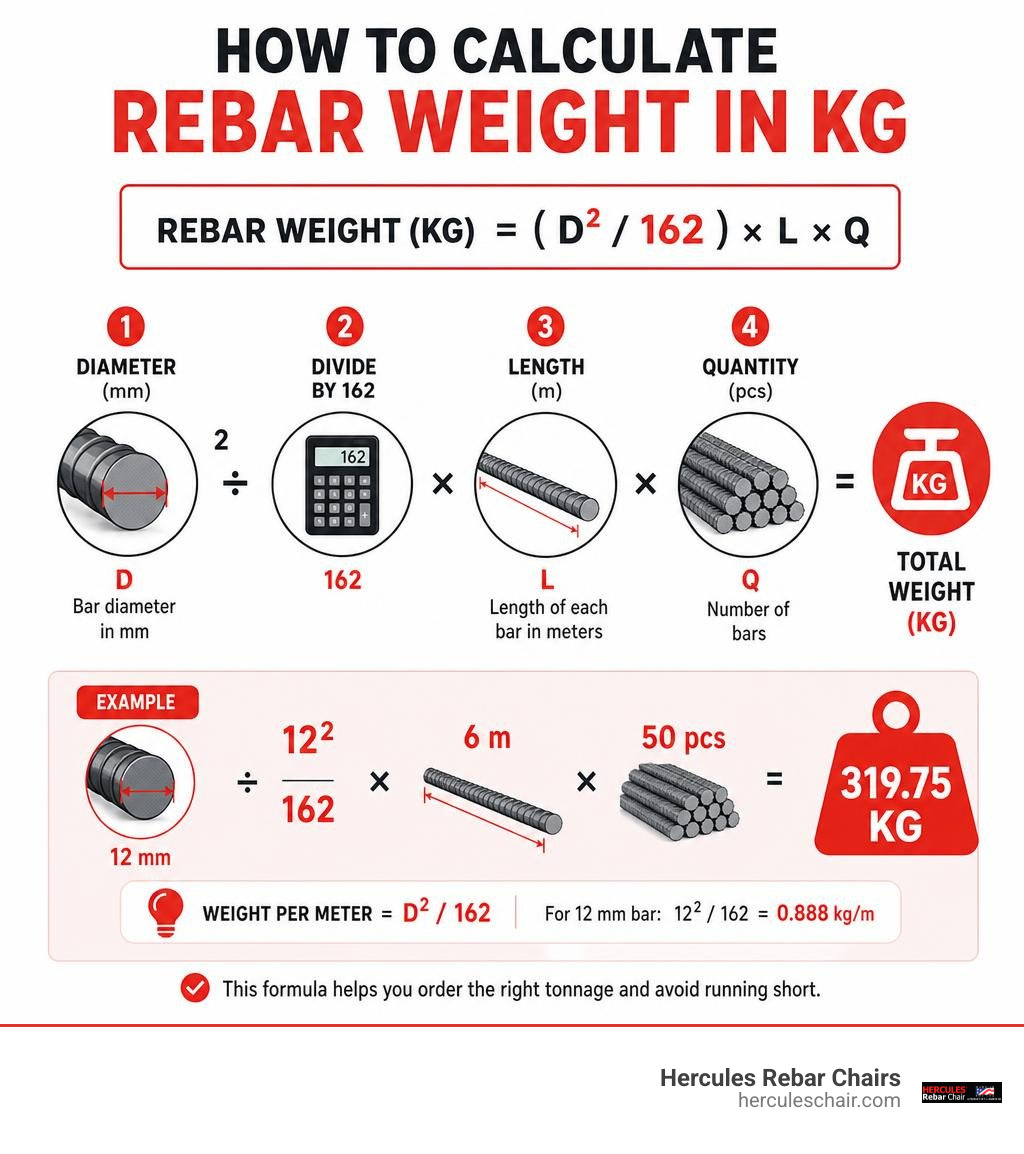
How to calculate rebar weight in kg is simple: square the bar diameter in millimeters, divide by 162, then multiply by the total length in meters.
Rebar weight (kg) = (D² / 162) x L x Q
Where:
- D = bar diameter in mm
- L = length of each bar in meters
- Q = number of bars
For example, a 12 mm bar weighs about 0.888 kg per meter. Accurate weights help you order the right tonnage, estimate delivery costs, and avoid running short during a concrete pour. The final takeoff should also include the real cut lengths, lap splices, hooks, bends, and a reasonable allowance for waste.
I’m Jordan Harris, a Tennessee PE with civil and structural engineering experience on large concrete and steel projects. I have used the same practical math behind how to calculate rebar weight in kg to support clear material takeoffs and better job-site planning.
Important how to calculate rebar weight in kg terms:
The Core Formula: How to Calculate Rebar Weight in Kg Per Meter
When we work on job sites or review material estimates at our desks, we don’t always have an active internet connection or specialized software handy. Knowing how to calculate rebar weight in kg manually using a simple, time-tested mathematical equation is one of the most practical skills any contractor, estimator, or site supervisor can master.

The universal formula used throughout the structural steel industry to determine the weight of a cylindrical steel bar per meter is:
Weight (kg/m) = D² / 162
Where:
- D represents the nominal diameter of the steel reinforcing bar in millimeters (mm).
- 162 (more precisely 162.2 or 162.28) is a mathematical constant derived directly from the standard density of carbon steel.
Alternatively, you can express this same physical calculation as:
Weight (kg/m) = 0.006165 × D²
Both variations give virtually identical results because they are rooted in basic geometry and physics. Carbon steel used for reinforcing bars—whether Grade 40, Grade 60 (Fe500), or Grade 80—has a standardized density of 7,850 kilograms per cubic meter (kg/m³) (or approximately 490 lbs/ft³). Yield strength variations alter the steel’s structural capacity, but they do not alter its mass density.
To see why this works, consider a 1-meter cylinder of steel with a cross-sectional area equal to $(\pi / 4) \times D^2$. When you multiply that volume by steel’s density of 7,850 kg/m³ and convert units, the constant 162 naturally falls out of the equation.
It is worth noting that standard catalog figures evaluate rebar mass based on the plain-round equivalent cylinder. The raised ribs or deformations rolled into modern rebar to bond with concrete are not added on top of the nominal mass calculation; standards already account for these surface deformations within allowable manufacturing rolling tolerances.
For a deeper dive into unit weights and standard specifications across metric sizes, check out this comprehensive Weight of Steel Rebar per Meter Chart (kg/m) & Formula Guide.
Step-by-Step Guide: How to Calculate Rebar Weight in Kg for Single Bars
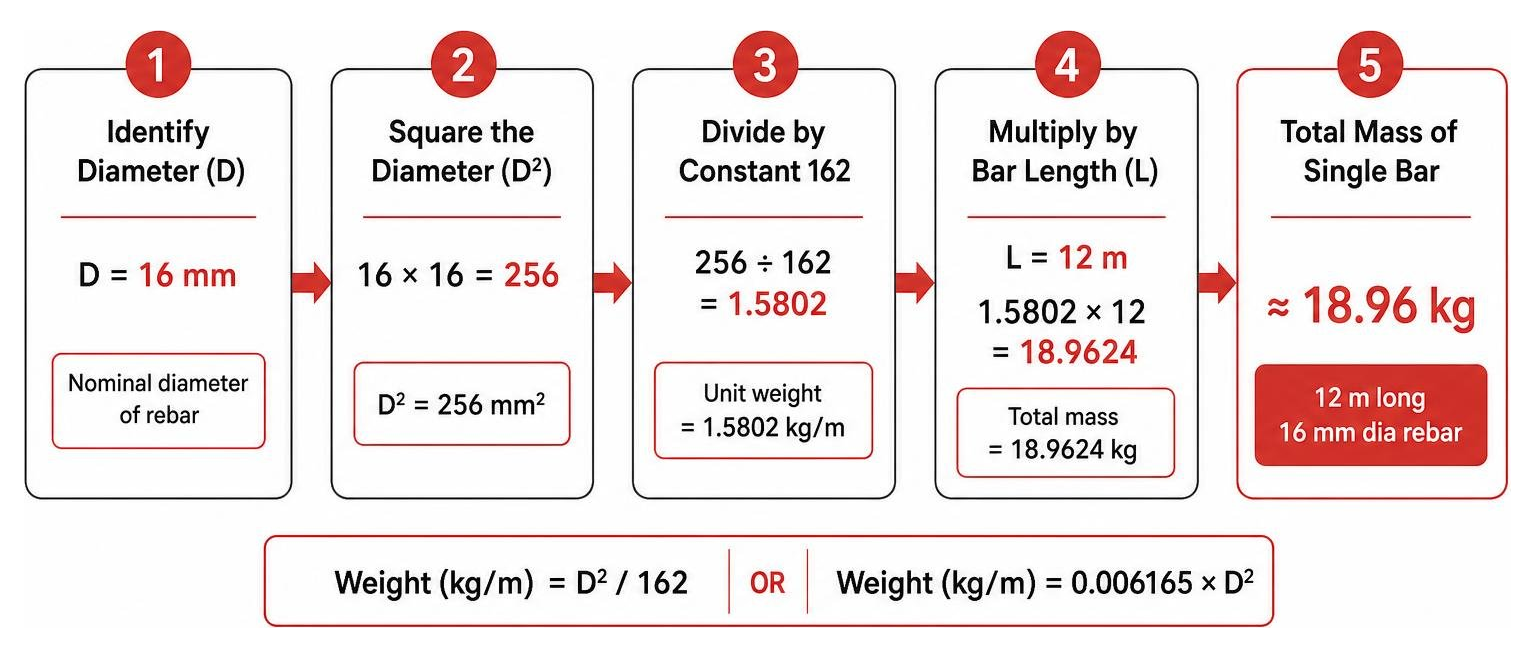
Let’s walk through a practical example of how to calculate rebar weight in kg for a single piece of rebar. Supposing we have a standard 12-meter (39.37 ft) stock length bar with a nominal diameter of 16 mm, how do we calculate its weight?
Here is the step-by-step calculation breakdown:
- Identify the Diameter (D): Our bar diameter is 16 mm.
- Square the Diameter (D²): Multiply 16 by 16 ($16 \times 16 = 256$).
- Divide by the Constant 162: Divide 256 by 162 to determine the unit weight per meter. $$\text{Unit Weight} = \frac{256}{162} = 1.580 \text{ kg/m}$$
- Multiply by the Total Length (L): Since our stock bar is 12 meters long, multiply $1.580 \text{ kg/m} \times 12 \text{ m} = 18.96 \text{ kg}$.
A single 12-meter bar of 16 mm rebar weighs approximately 18.96 kg (41.80 lbs).
Let’s try another common size: a 10 mm rebar that is 6 meters long.
- Square diameter: $10 \times 10 = 100$
- Divide by 162: $100 / 162 = 0.617 \text{ kg/m}$
- Multiply by length: $0.617 \text{ kg/m} \times 6 \text{ m} = 3.70 \text{ kg}$
By mastering this three-step process, you can double-check delivery slips, verify bundle tickets, and make fast field estimations without pulling out a computer. If you want to refine your workflow further, explore our guide on Mastering the Rebar Calculator for Your Next Concrete Project.
Batch Estimation: How to Calculate Rebar Weight in Kg for Entire Projects
On actual construction jobs, we rarely order just one bar. Whether we are pouring a residential raft foundation, casting bridge piers, or building commercial columns, we deal with dozens or thousands of bars. Scaling up single-bar math to handle full project batches requires combining unit mass with total bar counts and project cut lengths.
Let’s look at a real-world scenario: estimating the total steel mass for a multi-column pour in a commercial building.
Suppose our structural drawings specify:
- 40 concrete columns
- Each column requires 12 main vertical bars of 25 mm rebar
- Each bar has a cut length of 3.5 meters
Here is how we calculate the total tonnage:
- Calculate Total Quantity of Bars (Q): $$Q = 40 \text{ columns} \times 12 \text{ bars/column} = 480 \text{ bars}$$
- Calculate Total Linear Meters (L_total): $$L_{\text{total}} = 480 \text{ bars} \times 3.5 \text{ m} = 1,680 \text{ linear meters}$$
- Calculate Unit Weight in kg/m: $$\text{Unit Weight} = \frac{25^2}{162} = \frac{625}{162} = 3.858 \text{ kg/m}$$
- Calculate Total Mass in Kilograms: $$\text{Total Weight} = 1,680 \text{ m} \times 3.858 \text{ kg/m} = 6,481.44 \text{ kg}$$
- Convert to Metric Tonnes: $$\text{Total Tonnes} = \frac{6,481.44 \text{ kg}}{1,000} = 6.48 \text{ metric tonnes}$$
When placing an order with a steel fabricator or mill supplier, you can instantly see that this column pour requires roughly 6.5 tonnes of steel. Knowing total order mass is essential not only for material costing, but also for site logistics. Standard delivery flatbed trucks generally carry between 20 and 25 metric tons per shipment. Knowing your total batch weight lets you schedule the right number of trucks and plan crane or forklift capacities for safe offloading.
For more tips on automating project-wide takeoffs and eliminating ordering errors, read our article on how to Stop Guessing and Start Measuring with a Rebar Weight Calculator.
Standard Rebar Weight Chart and Unit Conversions
To save time on job sites, engineers and superintendents often rely on quick-reference tables rather than calculating every diameter manually. Metric rebar diameters typically span from 8 mm up to 40 mm, while US Imperial designations range from #3 to #18 (where the bar number indicates diameter in eighths of an inch).
Below is a standard reference table comparing common metric rebar sizes, their nominal unit weights in kilograms per meter (kg/m), nominal weight per standard 12-meter bar, and their closest imperial size equivalents in pounds per foot (lb/ft):
| Metric Bar Diameter (mm) | Unit Weight (kg/m) | Weight per 12m Stock Bar (kg) | Closest Imperial Designation | Unit Weight (lb/ft) | Equivalent Unit Weight (kg/m) |
|---|---|---|---|---|---|
| 8 mm | 0.395 kg/m | 4.74 kg | #2 (1/4″) | 0.167 lb/ft | 0.249 kg/m |
| 10 mm | 0.617 kg/m | 7.40 kg | #3 (3/8″) | 0.376 lb/ft | 0.560 kg/m |
| 12 mm | 0.888 kg/m | 10.66 kg | #4 (1/2″) | 0.668 lb/ft | 0.994 kg/m |
| 16 mm | 1.580 kg/m | 18.96 kg | #5 (5/8″) | 1.043 lb/ft | 1.552 kg/m |
| 20 mm | 2.469 kg/m | 29.63 kg | #6 (3/4″) | 1.502 lb/ft | 2.235 kg/m |
| 25 mm | 3.853 kg/m | 46.24 kg | #8 (1″) | 2.670 lb/ft | 3.973 kg/m |
| 32 mm | 6.313 kg/m | 75.76 kg | #10 (1-1/4″) | 4.303 lb/ft | 6.404 kg/m |
| 40 mm | 9.865 kg/m | 118.38 kg | #12 (1-1/2″) | 6.410 lb/ft | 9.539 kg/m |
Notice a key mathematical property: rebar mass grows with the square of the diameter. If you double the diameter of a bar from 10 mm to 20 mm, the unit weight doesn’t merely double—it quadruples! A 10 mm bar weighs 0.617 kg/m, whereas a 20 mm bar weighs $4 \times 0.617 = 2.469 \text{ kg/m}$.
Unit Conversions: Switching Between Metric and Imperial
When working across international blueprints or dealing with imported steel products, you may need to convert unit weights between metric and imperial systems.
Keep these simple conversion factors handy:
- Convert Kilograms to Pounds: Multiply kg by 2.20462 (e.g., $10 \text{ kg} \times 2.20462 = 22.05 \text{ lbs}$).
- Convert Pounds to Kilograms: Multiply lbs by 0.453592 (e.g., $100 \text{ lbs} \times 0.453592 = 45.36 \text{ kg}$).
- Convert Meters to Feet: Multiply meters by 3.28084 (e.g., $12 \text{ m} \times 3.28084 = 39.37 \text{ ft}$).
- Convert Unit Mass (kg/m to lb/ft): Multiply kg/m by 0.67197 (e.g., $1.580 \text{ kg/m} \times 0.67197 = 1.061 \text{ lb/ft}$).
- Convert Unit Mass (lb/ft to kg/m): Multiply lb/ft by 1.48816 (e.g., $0.668 \text{ lb/ft} \times 1.48816 = 0.994 \text{ kg/m}$).
Understanding these standard sizes and conversion formulas ensures clear communication with suppliers. To learn more about bar grading systems and yield strengths, consult The Essential Guide to Rebar Sizes and Grades.
Practical Site Factors: Lap Splices, Wastage, and Bent Bars
If you order steel based strictly on neat drawing dimensions without accounting for site realities, you will run short mid-pour. In actual concrete construction, straight bar lengths are limited by standard shipping sizes (typically 12 meters or 20/40 feet), structural continuity requirements, and fabrication details.
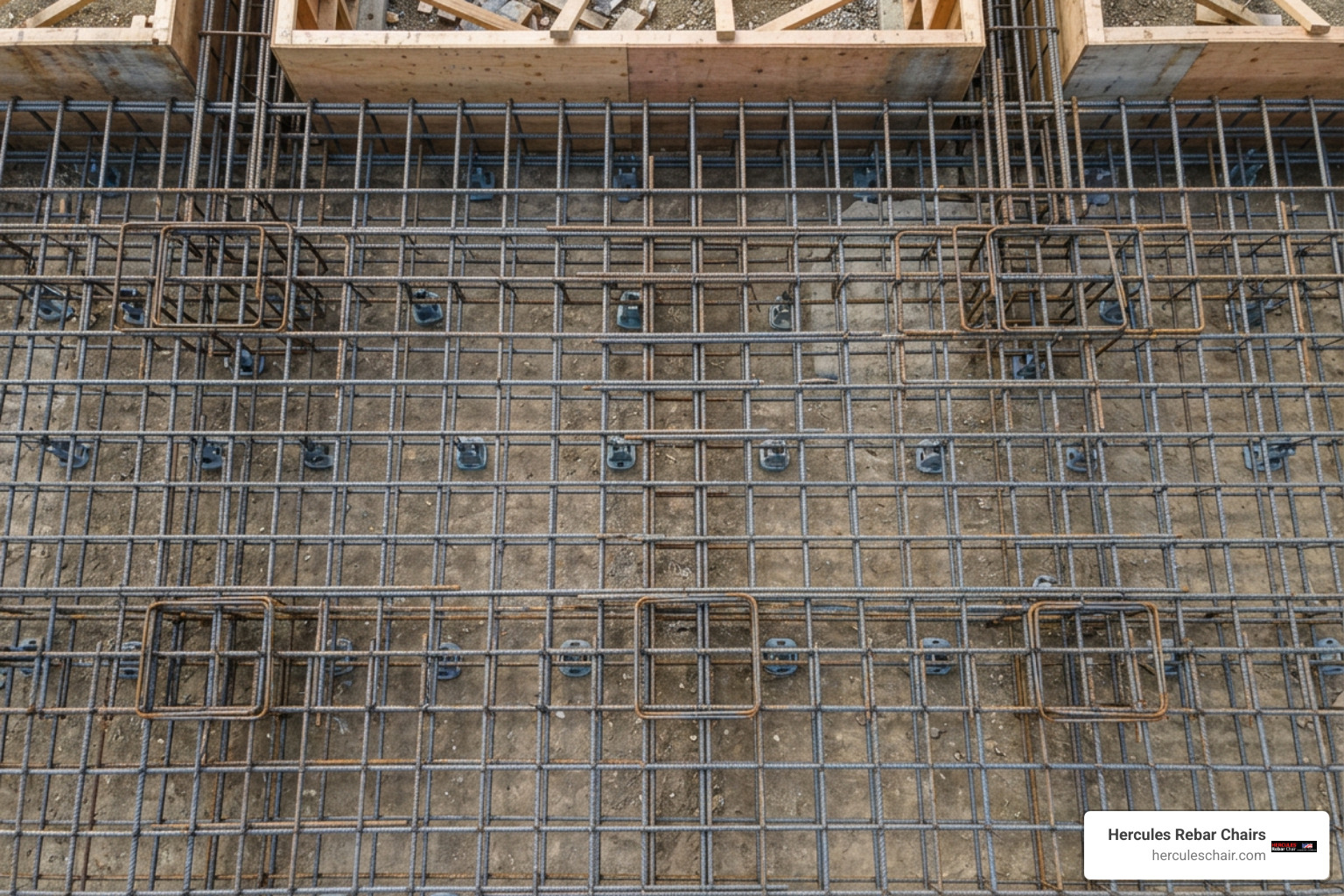
To arrive at a realistic procurement weight, three practical site factors must be incorporated into your takeoff:
1. Lap Splices and Development Lengths
Because concrete cannot transfer tensile forces across discontinuous steel gaps, overlapping bars (lap splices) are required to transfer stress through bond with surrounding concrete. Standard structural codes (such as ACI 318, Eurocode 2, and NBR 6118) typically require lap lengths equal to 40 to 60 times the bar diameter ($40d$ to $60d$), depending on concrete grade and bar location.
For instance, overlapping two 16 mm bars with a $40d$ lap requires: $$\text{Lap Length} = 40 \times 16 \text{ mm} = 640 \text{ mm} = 0.64 \text{ meters}$$
That extra 0.64 meters represents paid steel that exists twice in the overlapping cross-section. Across an entire concrete slab or elevated deck, lap splices can add 5% to 15% to total theoretical steel mass.
2. Cutting Loss and Wastage Factors
When stock 12-meter bars are cut into custom lengths, offcuts are inevitably generated. While careful nesting software minimizes scrap, small end pieces often cannot be reused. Standard job-site wastage allowances recommended by estimators are:
- Straight bar grids (foundations, simple slabs): Add 3% to 5% waste factor.
- Complex beams, columns, and walls: Add 5% to 8% waste factor.
- Highly irregular shapes with extensive stirrups: Add 8% to 12% waste factor.
A solid rule of thumb for general concrete estimating is adding a combined 7% to 10% safety margin covering both lap splices and cutting waste.
3. Bent Bars, Stirrups, and Bend Elongations
Calculating steel weight for hooks, L-bends, U-stirrups, and column ties requires calculating the developed cut length of the shaped bar before bending.
When rebar is bent cold on site or in a fabrication yard, steel on the outer radius stretches. To calculate accurate cut lengths for bent stirrups, standard detailing practices apply bend deductions:
- Subtract $1d$ for each 45° bend.
- Subtract $2d$ for each 90° bend.
- Subtract $3d$ for each 135° hook.
Additionally, shape multipliers can be applied to straight bar weights when estimating complex pre-bent cages:
- L-Shape Bends: Multiply straight weight by ~1.05
- U-Shape Bends: Multiply straight weight by ~1.08
- Closed Stirrups & Ties: Multiply straight weight by ~1.10
For step-by-step guidance on calculating rebar grids for foundation pours, read How to Calculate Rebar for Slab the Right Way.
Nominal Weight vs. Delivered Weight and Common Calculation Mistakes
A frequent point of confusion for concrete contractors occurs when weight tickets from the steel mill do not match theoretical line-item calculations. Understanding the difference between nominal weight (theoretical) and actual delivered weight (scale weight) prevents billing disputes and freight overload issues.
Manufacturing Tolerances and Coatings
- Mill Rolling Tolerances: International standards like ASTM A615 and BS 4449 permit mill rolling tolerances of ±3% to ±6% on physical bar diameter. A bar rolled slightly thick (e.g., 20.2 mm instead of nominal 20.0 mm) remains within legal structural tolerances, but adds noticeable scale weight across a 100-ton order.
- Epoxy Coatings: Protective epoxy coatings applied to corrosion-resistant rebar add film thickness. Epoxy coatings typically increase physical bar weight by 1% to 3% (and up to 9% for heavy multi-layer industrial specifications).
- Rust and Surface Scale: Light surface rust (tight mill scale) changes mass negligibly, but heavy flaking rust scale can alter scale weight while compromising bond strength.
Common Calculation Mistakes to Avoid
Over our years in structural estimating, we’ve seen a few recurring errors cause costly ordering mistakes:
- Mixing Units in the Formula: The $D^2/162$ formula strictly requires entering diameter in millimeters and length in meters. Entering diameter in inches or length in feet yields nonsense numbers.
- Substituting Bars by Count Instead of Cross-Sectional Area: If a job experiences a shortage of 20 mm bars (area = 314 mm²), you cannot simply substitute them with an equal count of 16 mm bars (area = 201 mm²). To match structural capacity, you must match total steel area ($A_s$), which requires $314 / 201 = 1.56$ times as many bars—meaning 5 pieces of 20 mm rebar must be replaced by 8 pieces of 16 mm rebar!
- Forgetting “The +1 Rule” in Grid Spacing: When calculating bar counts across a slab span, dividing length by spacing gives the number of spaces, not the number of bars. You must add 1 to account for the starting end bar! $$\text{Bar Count} = \left\lfloor \frac{\text{Span}}{\text{Spacing}} \right\rfloor + 1$$ A 10-meter slab width with bars spaced at 0.2 meters requires $(10 / 0.2) + 1 = 51 \text{ bars}$, not 50.
For additional online reference tools and interactive conversion tables, check out this Steel Rebar Calculator — Weight Chart kg/m & lb/ft.
Frequently Asked Questions About Rebar Weight Calculations
Why is the constant 162 used in the rebar weight formula?
The constant 162 (more precisely 162.2) is a mathematical shortcut derived directly from the volume formula of a cylinder and the physical density of carbon steel.
The physical equation for mass is $\text{Mass} = \text{Volume} \times \text{Density}$.
For a cylinder of diameter $D$ (in meters) and length $L = 1 \text{ meter}$: $$\text{Volume} = \frac{\pi}{4} \times D^2 \times 1$$
Using standard steel density ($\rho = 7,850 \text{ kg/m}^3$), and converting diameter from millimeters ($d$) to meters ($D = d / 1,000$): $$\text{Weight (kg/m)} = \frac{\pi}{4} \times \left(\frac{d}{1,000}\right)^2 \times 1 \times 7,850$$ $$\text{Weight (kg/m)} = \frac{3.14159 \times 7,850}{4 \times 1,000,000} \times d^2 = \frac{24,661.5}{1,000,000} \times d^2 = 0.006165 \times d^2$$
Taking the reciprocal of $0.006165$: $$\frac{1}{0.006165} \approx 162.2$$
Thus, dividing $d^2$ by 162 yields the precise mass in kilograms per meter without needing to calculate $\pi$ or steel density every time!
How much extra rebar weight should be added for lap splices and waste?
For typical reinforced concrete construction, we recommend adding a combined 7% to 10% allowance to your theoretical straight-bar takeoff. On simple, large footings or slab-on-grade projects, a 5% allowance is usually sufficient. On complex structures featuring dense beam-column joints, heavy hooks, and frequent size transitions, plan for a 10% to 15% addition to cover lap splices, development lengths, and cut scrap.
Does epoxy coating or rust significantly affect rebar weight?
For standard procurement estimates, epoxy coating adds approximately 1% to 3% to actual bar mass, which falls comfortably within standard mill manufacturing tolerances (±3% to ±6%). Commercial estimators do not typically alter theoretical line-item formulas ($D^2/162$) for epoxy-coated steel, but keep this minor mass increase in mind when calculating total truckload freight weights. Light surface flash rust does not measurably change rebar weight.
Conclusion
Knowing how to calculate rebar weight in kg manually gives you complete control over your project’s material estimates, budget takeoffs, and job-site logistics. By applying the standard $D^2/162$ formula, factoring in real-world lap splices and waste allowances, and cross-referencing standard weight tables, you eliminate guesswork and ensure your job stays profitable and on schedule.
Calculating exact steel tonnage is only half the battle—keeping that steel held firmly in position during the concrete pour is what guarantees structural integrity. Heavy reinforcing steel grids will sag under foot traffic and concrete pressure unless supported at the correct elevation.
At Hercules Rebar Chairs (manufactured by T.J. Harris Co.), we produce America’s #1 rebar chairs and concrete supports. Instantly recognizable by their bright red color, our supports have sold over 14 million units nationwide across Alabama, Texas, California, Florida, Ohio, and beyond. Designed to save time and money while ensuring strict structural code compliance, our chairs hold your steel exactly where the engineer specified.
Ready to size supports for your next concrete project? Use our free Hercules Rebar Chair Estimator to calculate exact chair quantities and keep your steel rock-solid!