

Why the Right Rebar Slab Support Tool Makes or Breaks Your Concrete Slab
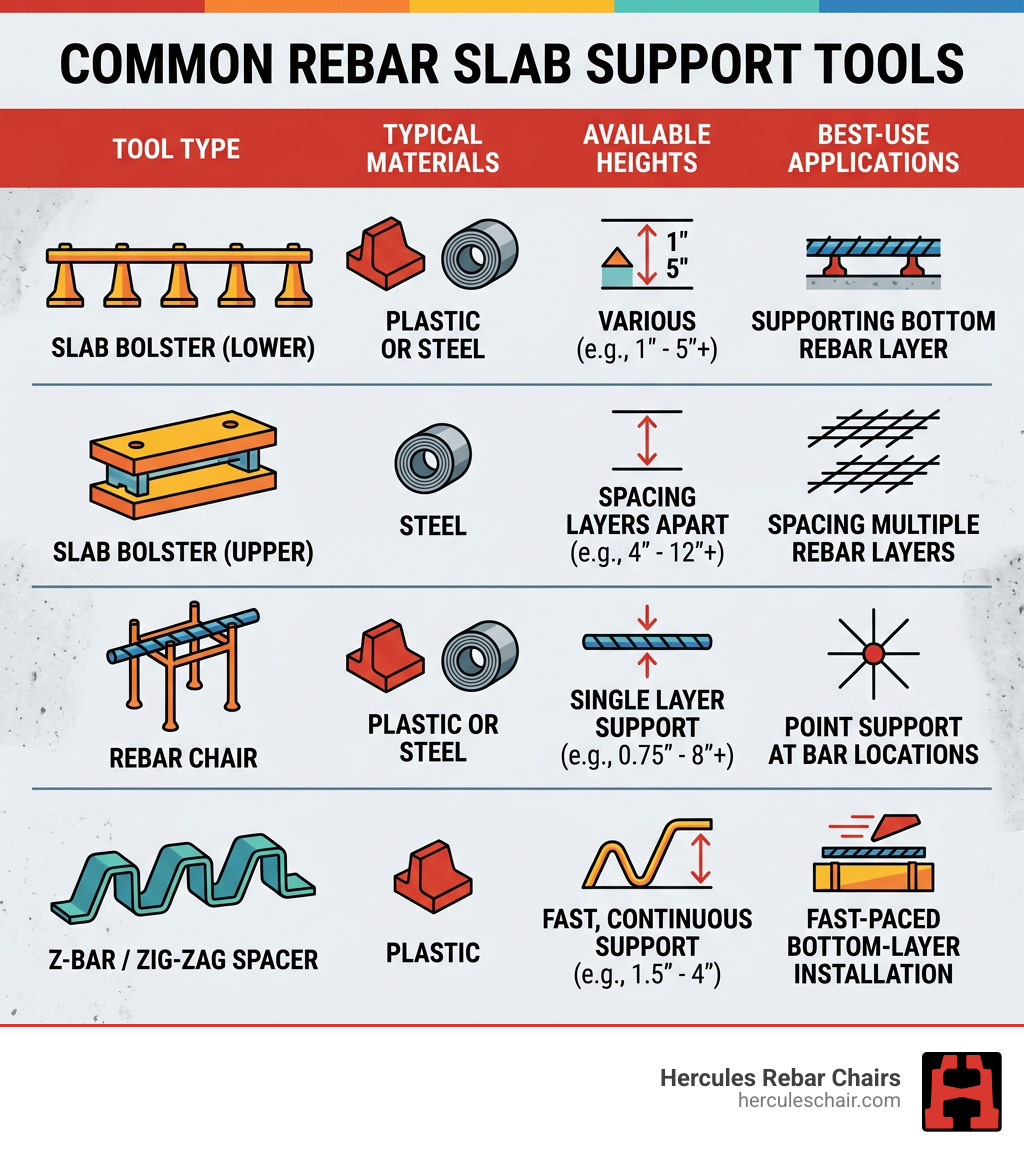
A rebar slab support tool is any device used to hold reinforcing steel at the correct height inside a concrete slab before and during a pour. Here are the most common types:
| Tool Type | Material | Best For |
|---|---|---|
| Slab bolster (lower) | Plastic or steel | Supporting bottom rebar layer |
| Slab bolster (upper) | Steel | Spacing rebar layers apart |
| Rebar chair | Plastic or steel | Point support at individual bar locations |
| Z-bar / zig-zag spacer | Plastic | Fast, continuous bottom-layer support |
If rebar sags or shifts during a pour, it ends up in the wrong position inside the hardened concrete. That means less cover where you need it most — and a slab that’s weaker than designed.
Getting the rebar exactly where your plans call for it isn’t optional. It’s the difference between a slab that lasts decades and one that cracks prematurely.
The good news: the right support tool makes proper placement fast and consistent, with no wire tying required.
I’m Jordan Harris, a licensed structural engineer and product developer at Hercules Rebar Chairs, where I’ve spent years designing and refining rebar slab support tools used on concrete projects across the country. I’ll walk you through everything you need to choose the right tool for your next pour.
Understanding the Rebar Slab Support Tool: Bolsters vs. Chairs
When you are standing on a job site looking at a sea of reinforcing steel, you have two primary ways to keep that metal off the ground: individual chairs or continuous bolsters. While both serve the same ultimate goal—maintaining the structural integrity of the concrete reinforcement—they go about it in very different ways.
A rebar slab support tool like a slab bolster is essentially a long, continuous chair. Instead of supporting the rebar at a single “point,” it provides a linear path of support. Think of it like the difference between a stool and a bench. A rebar chair (the stool) is fantastic for specific intersections, while the bolster (the bench) provides a steady, unyielding line of elevation.
The primary function of these tools is to prevent the rebar from sinking into the dirt or resting against the formwork. If the steel isn’t encased in the “sweet spot” of the concrete—usually the middle or a specific distance from the edge—it can’t do its job of resisting tension. For a deeper dive into individual supports, check out The Ultimate Guide to Rebar Chairs: Types, Uses, and Sizing for Concrete Slabs.
When to Use a Continuous Rebar Slab Support Tool
We often recommend continuous bolsters when you’re dealing with heavy reinforcement or high-traffic pours. If your crew is going to be walking on the rebar mats, individual chairs can sometimes tip or shift. A continuous rebar slab support tool distributes that load across a much wider area, making the entire cage more stable.
Continuous supports are also the go-to choice for:
- Heavy Reinforcement: When the weight of the steel exceeds the point-load capacity of standard chairs.
- Irregularly Shaped Slabs: Where you need to maintain consistent elevation across curves or odd angles.
- Uniform Spacing: When you want to ensure the rebar stays perfectly parallel without measuring every single chair placement.
Types of Slab Bolsters and Their Applications
Choosing the right material for your rebar slab support tool is just as important as the height. In the industry, we generally break these down into plastic and metal options. Each has its place depending on whether you are working on a slab on grade, an elevated deck, or a bridge.
| Feature | Plastic Bolsters | Metal Bolsters |
|---|---|---|
| Corrosion | 100% Rust-proof | Requires coating (Epoxy/Plastic) |
| Weight | Lightweight/Easy to carry | Heavier/Higher load capacity |
| Connection | Snap-and-lock ends | Interlocking wire tabs |
| Visibility | Minimal (Gray blends in) | Can show “rust bleeds” if uncoated |
For more on how different supports handle various environments, see our guide: Keep Your Rebar Up: A Guide to Concrete Support Blocks.
Comparing Plastic and Metal Rebar Slab Support Tool Options
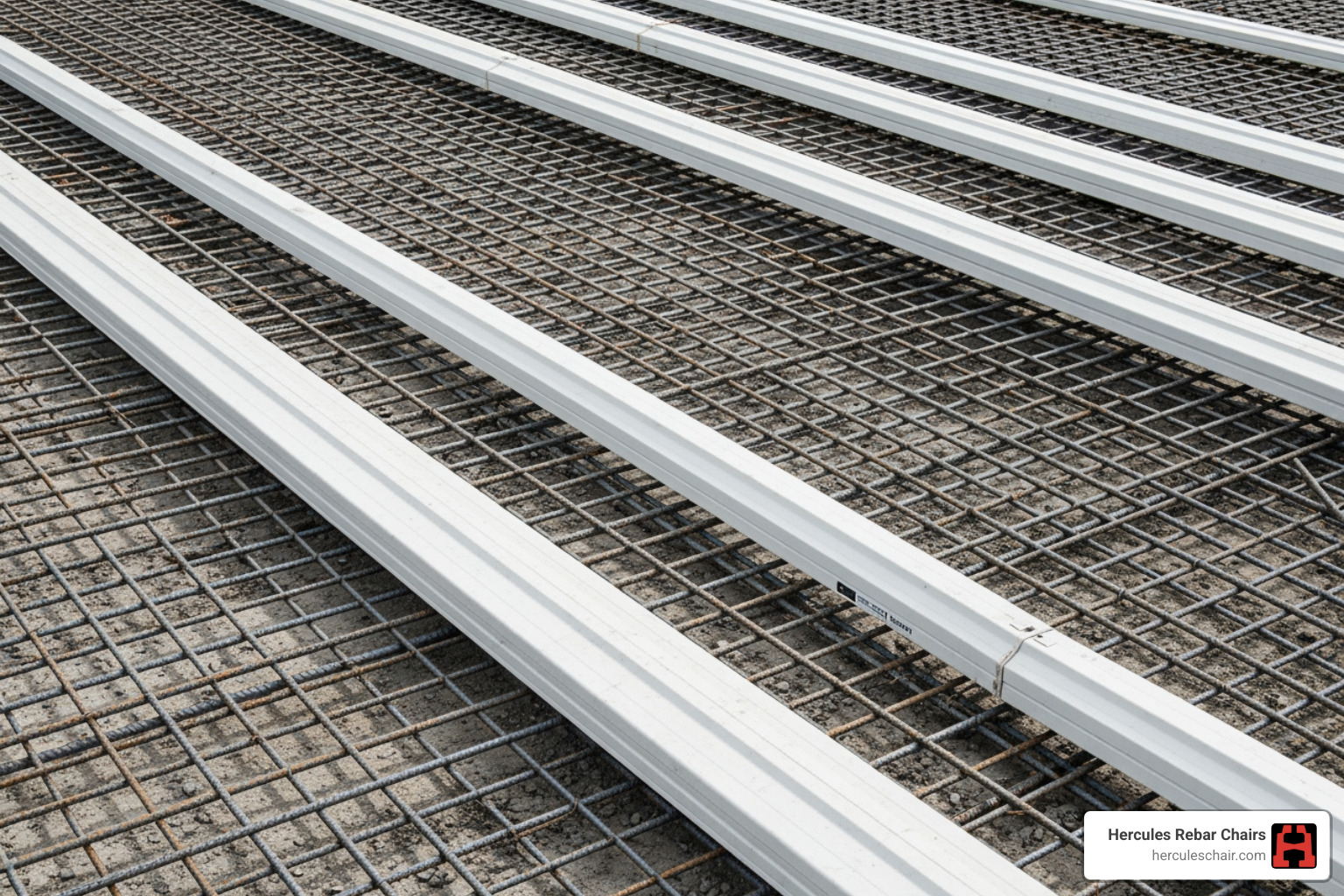
Plastic Bolsters: Most modern plastic bolsters are made from high-strength, 100% virgin polypropylene. This material is superior to recycled plastics because it won’t become brittle in the cold or soft in the summer heat. One of the coolest features of plastic bolsters is the “zig-zag” or Z-bar design. This shape provides extreme stability and prevents the tool from tipping over during the pour. It also allows for maximum concrete flow, ensuring there are no air pockets (voids) underneath the support.
Metal Bolsters: These are the workhorses of heavy construction. Often manufactured from 6-gauge steel wire (conforming to ASTM A82/82M standards), they offer exceptional strength. To prevent the metal from rusting and staining the finished concrete surface, these are available in various finishes:
- Plain: For interior use where moisture isn’t an issue.
- Epoxy Coated: For corrosive environments like bridge decks.
- Plastic Tipped/Dipped: Where the legs touch the formwork, plastic tips prevent “rust spots” from showing on the ceiling of the floor below.
Key Specifications: Height, Material, and Finishes
Precision is everything in concrete. That’s why a rebar slab support tool comes in such a wide variety of heights, typically ranging from 3/4″ all the way up to 3″ in 1/4″ increments (and sometimes higher for specialized beams).
When selecting your tool, you must consider the “concrete cover”—the thickness of the concrete that will surround the rebar. If your slab is 6 inches thick and you need 2 inches of cover at the bottom, you need a 2-inch bolster. It sounds simple, but getting it wrong can lead to structural failure or code violations. For help picking the perfect size, refer to The Goldilocks Guide to Concrete Bar Chair Sizes: Not Too Big, Not Too Small.
Slab Bolster Uppers vs. Lowers
This is a common point of confusion for those new to the trade.
- Slab Bolster Lowers: These have a flat “runner wire” or a wide plastic base designed to sit directly on the vapor barrier or formwork. They support the very first layer of steel.
- Slab Bolster Uppers: These are used in “multi-mat” reinforcement. If you have two layers of rebar, the “upper” bolster sits on top of the bottom layer of rebar to support the top layer. They act as a structural foundation to space the layers exactly where they need to be.
Installation Best Practices and Spacing Guidelines
Proper installation is the difference between a smooth pour and a disaster. For standard slabs, the industry rule of thumb is to space your rebar slab support tool every 5 inches on center. However, this can vary based on the diameter of your rebar and the weight of the crew walking on it. We always recommend checking with your project engineer for specific spacing requirements.
To create a continuous run of support, many plastic bolsters feature “snap-and-lock” connection holes. You can simply click the ends together to cover 50 or 100 feet in seconds. Metal bolsters often use interlocking tabs to achieve the same goal. This ensures that the supports don’t move independently when the concrete pump hose starts swinging around.
For a step-by-step walkthrough, our Rebar Placement Guide is an invaluable resource for your crew.
Avoiding Common Issues in Concrete Pours
We’ve seen it all on job sites, and most “concrete fails” come down to a few avoidable issues:
- Torsion and Buckling: If you use supports that are too flimsy, they can twist under the weight of the wet concrete. Look for bolsters with angled legs or a wide footprint to prevent this.
- Poor Consolidation: If a bolster is too “solid,” it can block the flow of concrete. This is why many high-quality supports have an “open center” design. This allows the aggregate to flow through and around the support, ensuring the concrete is one solid mass.
- Shadowing: In architectural concrete, you don’t want to see the “feet” of the chair once the forms are stripped. Using supports with tapered feet minimizes their visibility, leaving a clean, professional finish.
Frequently Asked Questions about Rebar Slab Support
How do I determine the correct bolster height for my slab?
The height of your rebar slab support tool is determined by your required concrete cover. Subtract the required cover from the total slab thickness, but always defer to the structural drawings. For example, in a 4-inch slab requiring 1.5 inches of bottom cover, you would use a 1.5-inch bolster.
What is the difference between a slab bolster and a beam bolster?
While they look similar, a beam bolster is specifically designed to support the heavy, large-diameter steel used in concrete beams. They are often built with even heavier gauge wire to handle the concentrated loads of a beam form compared to a standard flat slab.
Why is CRSI compliance important for rebar supports?
The Concrete Reinforcing Steel Institute (CRSI) sets the standards for bar supports. Using a CRSI Class 1 or Class 2 support ensures that the tool meets specific load-bearing and corrosion-resistance requirements. It’s your insurance policy that the building is safe and meets national codes.
Conclusion
At Hercules Rebar Chairs, we take pride in being America’s #1 choice for concrete supports. With over 14 million units sold, we’ve helped contractors across all 50 states—from the heat of Texas to the winters of Alaska—save time and labor while ensuring their projects are 100% code compliant.
Our iconic red chairs and heavy-duty bolsters are designed to be the “strong, silent type”—they do the hard work of holding up your infrastructure so you never have to think about them again. Don’t risk your reputation on sagging rebar or flimsy supports. Choose the tools that are built to handle the pressure.