

Why Elevated Deck Supports Make or Break Your Outdoor Build
Elevated deck supports are the structural foundation components that hold a raised deck surface above the ground, a rooftop, or any uneven substrate — keeping it level, stable, and load-bearing.
Here is a quick overview of what they are and why they matter:
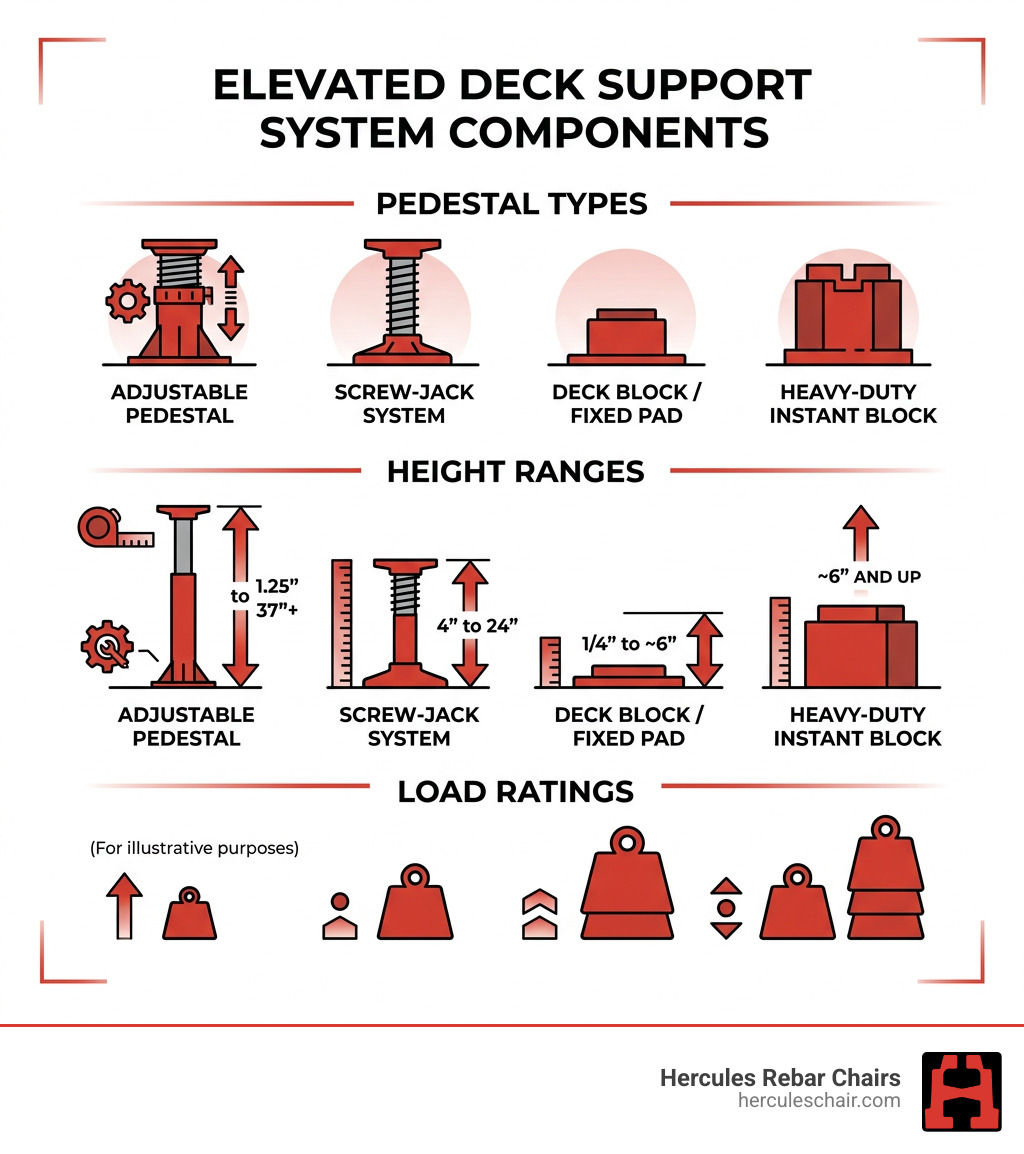
| Type | Best For | Height Range |
|---|---|---|
| Adjustable pedestals | Rooftops, balconies, slopes | 1.25″ to 37″+ |
| Screw-jack systems | Uneven concrete, plazas | 4″ to 24″ |
| Deck blocks / fixed pads | On-grade, flat ground | 1/4″ to ~6″ |
| Heavy-duty instant blocks | DIY decks, sheds, walkways | ~6″ and up |
The right support system affects more than just height. It determines how well your deck handles freeze-thaw cycles, heavy loads, wind uplift, and long-term structural movement.
A deck that looks solid on day one can become a safety hazard if the foundation underneath it is undersized, improperly installed, or not suited to the surface it sits on. As one structural guide puts it plainly: height magnifies small issues. A flaw that goes unnoticed on a ground-level deck can become a serious hazard at 10 feet in the air.
Whether you are building over a sloped rooftop, covering cracked concrete, or creating a floating platform on a backyard lawn, choosing the right elevated support system from the start saves you time, money, and risk down the road.
I’m Jordan Harris, a licensed Professional Engineer (PE) with a background in structural engineering and over five years of experience working on large-scale concrete and steel projects — experience that directly informs how I think about load paths, footings, and the foundations beneath elevated deck supports. In this guide, I’ll break down every major support type, compare top systems side by side, and help you make a confident, code-aware decision.
Understanding the Types of Elevated Deck Supports
When we talk about elevated deck supports, we aren’t just talking about one-size-fits-all blocks. The industry has evolved significantly from the days of simply pouring a concrete pier and hoping for the best. Today, we use a variety of specialized components designed to handle specific site challenges, from the “instant foundation” of a backyard shed to the complex, sloped environment of a high-rise rooftop.
Traditional deck foundations typically involve digging deep holes, pouring concrete footings, and waiting days for the material to cure. In contrast, modern elevated supports are often “surface-mounted,” meaning they sit directly on the substrate—whether that’s soil, gravel, or a waterproof membrane. This eliminates the mess of digging and allows for immediate construction.
The main categories include:
- Fixed-height pads: Simple rubber or plastic shims for very low elevations.
- Adjustable pedestals: High-tech “screw-jack” cylinders that can be fine-tuned to the millimeter.
- Deck blocks: Heavy-duty, portable bases that cradle wood joists or posts.
- Screw-jack systems: Modular systems that often incorporate structural piping to reach significant heights.
Choosing between these often comes down to cost-effectiveness and the specific “on-grade” or “above-grade” requirements of your project. Modern support options are designed to cater to everything from porcelain pavers to traditional wood planks.
Adjustable Pedestal Systems for Precision Elevated Deck Supports
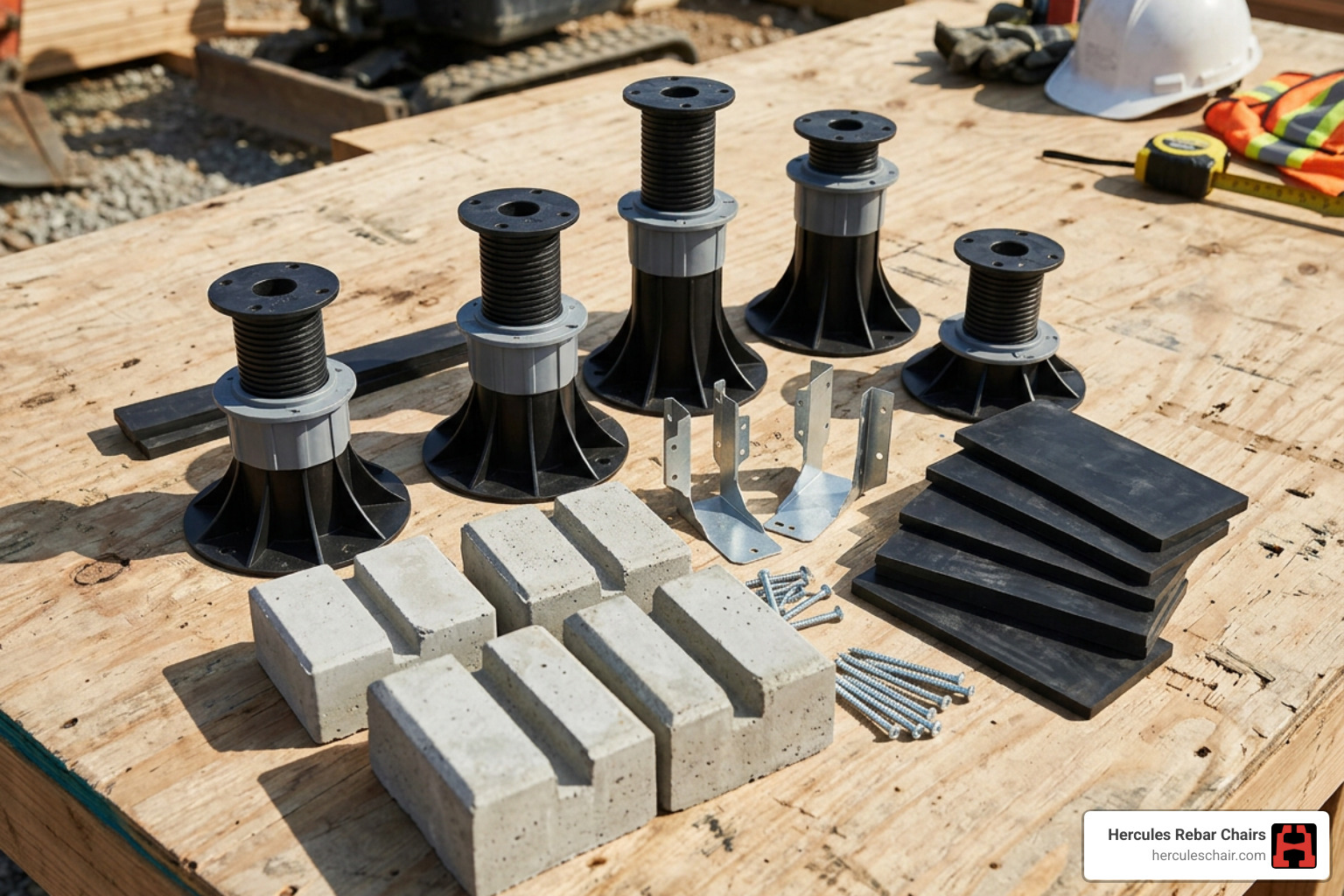
If you are dealing with a rooftop or a balcony where the floor needs to be perfectly level but the roof underneath is sloped for drainage, adjustable pedestals are your best friend. These systems typically cover a height range from 1.25 inches to as high as 37 inches when using extension elements.
The “magic” of these systems lies in their self-leveling heads. High-end models can automatically compensate for slopes up to 5 degrees (that’s a 5% grade), ensuring your deck tiles or pavers sit flat without you having to manually shim every single support. Some systems even integrate standard 4-inch PVC Schedule 40 pipe. By cutting the pipe to the required length on-site, builders can achieve custom heights with incredible stability.
Furthermore, many of these pedestals feature a “top-entry” adjustment tool. This allows us to fine-tune the height after the pavers are already laid, which is a massive time-saver during the final leveling phase of a project.
Low-Profile Fixed Supports and Heavy-Duty Blocks
Not every project needs 30 inches of lift. Sometimes, you just need to get the wood off the wet concrete. Fixed-height rubber pads provide ground clearance as low as 1/4 inch, which is essential for protecting wood from moisture rot while allowing water to flow freely to drains. These pads are often stackable, allowing for minor height adjustments in 1/8-inch increments.
For ground-level DIY projects like sheds or walkways, heavy-duty instant blocks are a game-changer. These blocks are incredibly lightweight (often around 1.5 lbs) yet can support up to 1,700 lbs per block. They require no digging and no concrete. You simply drop them on firm, level ground, check your level, and start building. Made from UV-stabilized recycled polyolefin, they are as environmentally friendly as they are tough.
Key Advantages for Rooftops and Uneven Surfaces
Why choose an elevated system over a traditional one? The advantages go far beyond just avoiding a shovel. On rooftops, these supports create a “cavity” between the deck and the roof membrane. This space is vital for:
- Drainage management: Water falls through the deck gaps and flows unimpeded to the roof drains.
- Utility concealment: You can hide unsightly pipes, cables, and ductwork beneath the deck while maintaining easy access for repairs.
- Acoustic dampening: Rubber-faced heads on pedestals reduce the “click-clack” sound of footsteps, providing a quieter environment for the rooms below.
For a thorough look at the engineering behind these structures, we recommend reading How to Build an Elevated Deck: Ensure Strong Structure through Safe Design, which emphasizes the importance of load paths and lateral stability.
Material Durability and Weather Resistance
Elevated supports are built to live in the harshest environments. Most professional-grade pedestals are manufactured from polypropylene resin reinforced with 20% talc. This specific blend is crucial for freeze-thaw resistance. While standard plastic might crack when the temperature swings from 80°F to -10°F, talc-reinforced resin remains flexible and strong.
These materials are also:
- UV-stabilized: They won’t become brittle after years of sun exposure.
- Pest-resistant: Unlike wood posts buried in the dirt, plastic and steel supports offer no food for termites or carpenter ants.
- Moisture-proof: They are impervious to rot and mold, with some brands offering warranties up to 25 years.
Technical Specifications: Load Ratings and Code Compliance
When we design these systems, we look at more than just “will it hold a grill?” We look at live loads and dead loads. Most professional pedestal systems are rated for a maximum permissible load of 1,200 lbs to 1,700 lbs per unit. However, it is vital to look for a Factor of Safety (FS). For example, a support rated for 750 lbs with an FS of 3 actually survived testing at 2,250 lbs before failure.
Compliance with the International Building Code (IBC) and International Residential Code (IRC) is non-negotiable. Look for products that are ICC-certified. This ensures the supports have been tested for:
- Lateral force resistance: Can the deck withstand someone running and stopping suddenly?
- Seismic considerations: How does the system behave during an earthquake?
- Wind uplift: Will a hurricane lift the pavers off the pedestals?
Structural Reinforcement with Elevated Deck Supports
For taller decks, the support system is only as good as the ground it sits on. While surface-mounted blocks work for low decks, taller structures often require concrete footings. This is where our expertise at Hercules Rebar Chairs comes in. To ensure a deck doesn’t sink or shift, those concrete footings must be reinforced correctly.
Using high-quality supports ensures your rebar stays exactly where it needs to be during the pour. You can learn more about this in our guide on how to Elevate your slab with concrete mesh chairs or check out The ultimate guide to rebar chairs: Types, uses, and sizing for concrete slabs. Proper reinforcement creates a solid load path from the deck surface, through the pedestals, and into the stable soil below.
Installation Guide: From Site Prep to Final Leveling
Preparation is 90% of the work. If you are installing on soil, you must ensure the ground is firm and well-drained. We often recommend a base of crusher dust or gravel to prevent the supports from settling over time.
| Substrate | Preparation Needed | Spacing Tip |
|---|---|---|
| Soil/Grass | Remove turf, compact soil, add gravel | Check joist span limits |
| Concrete | Clean surface, check for major cracks | Use buffer pads |
| Rooftop | Inspect membrane, verify load capacity | Use 3/16″ spacer tabs |
For rooftop installations, perimeter containment is critical. Because many of these decks are “floating,” they rely on the surrounding walls (parapets) to keep them from shifting laterally. If no walls exist, you must install structural blocking or retention walls.
To combat wind uplift in high-wind zones, we use specialized “lock-it down” washers. These washers clip into the kerf-cut corners of deck tiles and screw directly into the pedestal head, providing up to 166 lbs of hold-down strength per corner.
Managing Slopes and Substrate Preparation
If your substrate has a significant pitch, swivel-head pedestals are a lifesaver. They allow for 0-5% slope compensation automatically. When installing over waterproof membranes, we always suggest using a buffer pad under the base. This protects the roof from abrasion and actually makes it easier to rotate the screw-jack base for final height adjustments.
Pro-tip: If you find a pedestal is too hard to turn, don’t force it! The weight of the deck tile might be too heavy. Simply lift the tile slightly to release the load, make your adjustment, and set it back down. For complex projects, always seek professional architectural advice to verify that your substrate can handle the concentrated point loads created by the pedestals.
Frequently Asked Questions about Elevated Deck Supports
What decking materials are compatible with these supports?
Modern systems are incredibly versatile. You can use:
- Porcelain and Concrete Pavers: Ideal for low-maintenance rooftops.
- Wood Tiles and Planks: Ipe and other hardwoods are popular for a warm, natural look.
- Composite Decking: Works well with pedestals designed for wood bearers.
- Specialty Surfaces: Fiberglass grating, artificial turf, and even natural stone can be supported with the right adapter.
Can I install an elevated deck as a DIY project without digging?
Yes! No-dig systems like heavy-duty deck blocks or adjustable plastic pedestals are perfect for DIYers. They require standard tools—a spirit level, a drill, and perhaps a saw for your joists. However, keep in mind that as the deck gets higher, the leveling becomes more complex. For decks on soil in high-wind areas, you must use ground anchors or hurricane tie-downs to ensure the deck stays put.
When should I consult a structural engineer for my project?
We generally recommend consulting an engineer if:
- The deck surface is more than 30 inches above the ground.
- You are building in a high-wind or hurricane zone.
- The deck will support a heavy load, like a hot tub (which can weigh 3,000+ lbs).
- You are attaching the deck to a house ledger on a multi-story building.
Conclusion
Building a deck is an investment in your home’s value and your own quality of life. By choosing the right elevated deck supports, you ensure that investment stands level and safe for decades. From the precision of adjustable pedestals for a rooftop lounge to the rugged simplicity of deck blocks for a backyard shed, there is a solution for every terrain.
A great deck starts from the ground up. Whether you are pouring reinforced concrete footings or setting pedestals on a balcony, structural integrity is key. At Hercules Rebar Chairs (T.J. Harris Co.), we are proud to be America’s #1 choice for concrete supports, helping builders across the USA ensure their foundations meet the highest standards of code compliance and strength.
Ready to start your next project with the best supports in the business? You can find more info about rebar chairs and our full range of professional construction products on our website. Happy building!