

Why Wire Mesh Chair Concrete Supports Matter for Every Pour
Wire mesh chair concrete supports are small plastic or steel devices that hold reinforcement mesh at the correct height during a concrete pour, ensuring proper concrete coverage, structural strength, and long-term durability.
Quick Answer: Wire Mesh Chair Concrete Essentials
- What they do: Lift wire mesh off the ground to maintain proper positioning during concrete placement
- Why they matter: Prevent mesh from sinking, ensure uniform concrete coverage, and maximize structural strength
- Types available: Individual plastic chairs (3/4″ to 6″), steel chairs (2″ to 3″), and continuous wire chairs (3/4″ to 8″)
- Recommended spacing: Place one chair every 24 inches in each direction
- Wire compatibility: Designed for #4, 6, 8, and 10 gauge wire mesh
- Installation: Snap onto wire intersections from below—they stay buried in the finished concrete
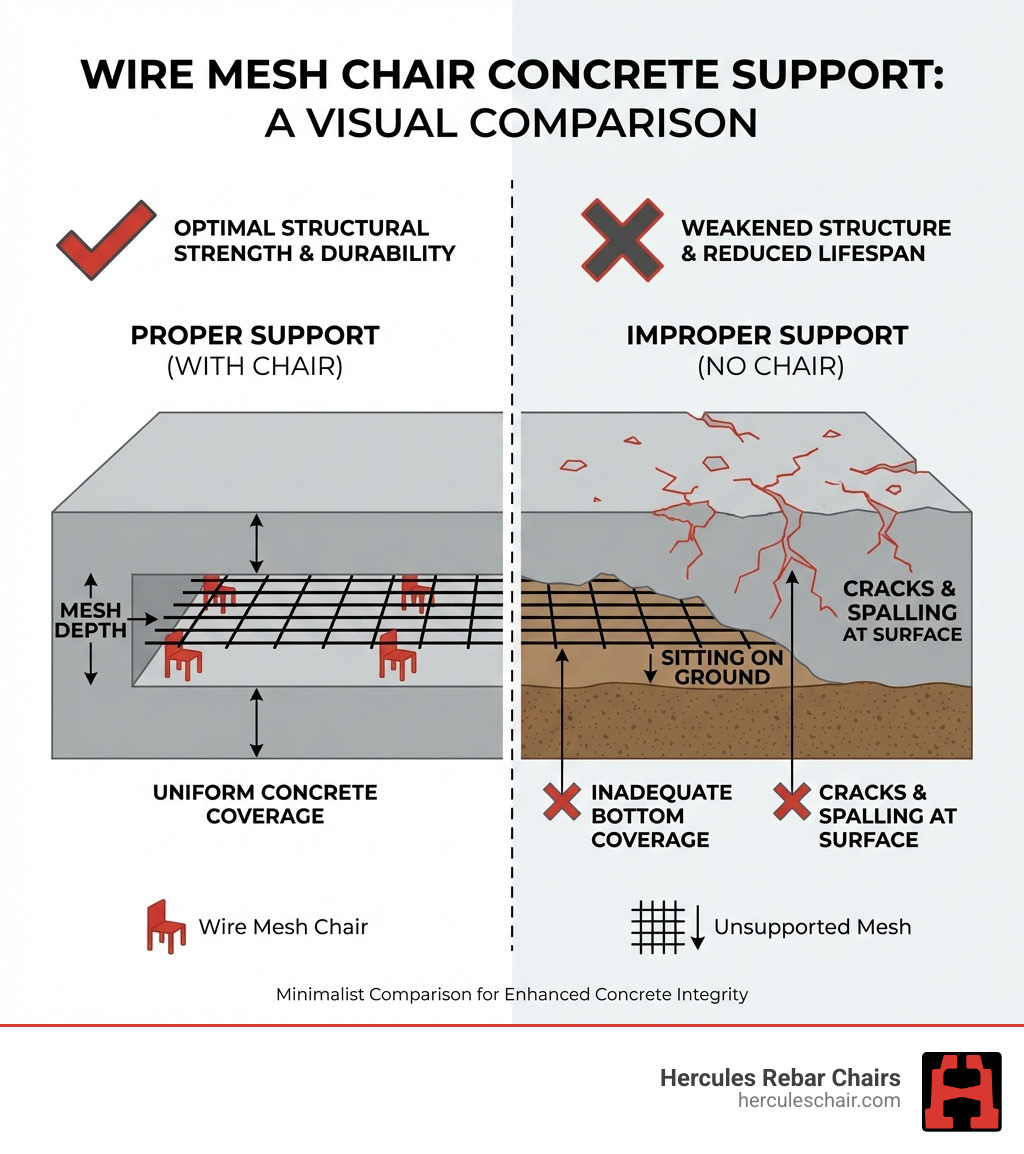
If you’ve ever watched wire mesh sink into the mud during a pour, or seen concrete crack because the reinforcement wasn’t properly positioned, you know why these simple supports are so critical. Without proper support, your reinforcement ends up at the bottom of the slab instead of where it needs to be—in the center of the concrete where it can actually provide tensile strength.
Traditional methods like using bricks, rocks, or scrap materials create inconsistent heights and often sink into soft ground. Wire mesh chairs solve this problem by providing stable, code-compliant support that maintains the correct concrete cover throughout the entire pour. They also allow concrete to flow freely underneath the mesh, ensuring proper consolidation without air pockets.
The result? Stronger concrete that resists cracking, lasts longer, and meets building codes—all while reducing labor time and eliminating the need for workers to constantly adjust the mesh during the pour.
I’m Jordan Harris, a licensed Professional Engineer who spent five years designing large-scale concrete structures before joining our family business, where we’ve now sold over 14 million rebar and wire mesh chair concrete support systems to contractors across the country. Through thousands of job sites and countless pours, I’ve seen how the right support system transforms both the installation process and the final product quality.
What Are Wire Mesh Chairs and Why Are They Critical for Concrete?
A wire mesh chair concrete support is a crucial,, component in quality concrete construction. Its primary function is simple but profoundly impactful: to lift and maintain the reinforcing wire mesh at a precise, predetermined height within a concrete slab or structure. Think of it as the unsung hero ensuring your concrete has the skeletal strength it needs to stand the test of time.
Why is this elevation so important? Concrete is incredibly strong under compression, but it’s relatively weak under tension (pulling forces). That’s where steel reinforcement, like wire mesh, comes in. Wire mesh provides the necessary tensile strength to resist cracking and hold the concrete together. However, for this reinforcement to work effectively, it must be properly embedded within the concrete, with adequate concrete cover both above and below it.
Without wire mesh chairs, the mesh would simply lie on the subgrade, offering little to no benefit to the slab’s structural integrity. This leads to common problems like early cracking, spalling, and reduced durability. By consistently holding the mesh at the correct elevation, wire mesh chair concrete supports ensure:
- Optimal Tensile Strength: The mesh is positioned where it can best resist pulling forces.
- Improved Durability: Proper placement helps the concrete structure last longer.
- Effective Crack Prevention: By distributing stress, the mesh minimizes the formation and spread of cracks.
- Proper Concrete Flow and Consolidation: The chairs are designed to allow concrete to flow freely underneath the mesh, filling all voids and preventing air pockets, which are critical for a strong, uniform pour.
For us, it’s about building foundations that truly last. You can find More info about concrete reinforcement on our site.
How Supports Boost Concrete Strength
The strength of a concrete slab isn’t just about the concrete mix; it’s equally about how well its reinforcement is positioned. Wire mesh chair concrete supports contribute significantly to this strength by:
- Ensuring Proper Placement: They guarantee the wire mesh is suspended in the middle to upper third of the slab, where it can most effectively counteract tensile stresses. This proper placement is vital for the mesh to perform its intended function.
- Optimizing Load Distribution: When the mesh is correctly positioned, it helps distribute loads evenly across the slab, preventing concentrated stress points that could lead to failure.
- Preventing Corrosion: By maintaining adequate concrete cover, these chairs protect the steel reinforcement from moisture and chemicals, which could otherwise lead to rust and deterioration over time. This protection is key to the long-term stability and integrity of the structure.
- Promoting Long-Term Stability: A properly reinforced slab, thanks to accurate mesh placement, will exhibit superior resistance to settlement, shifting, and environmental stresses, ensuring its stability for decades.
Understanding proper placement is so important that we’ve even put together A guide to proper rebar placement to help you get it right every time.
Ensuring Proper Concrete Coverage
“Concrete cover” refers to the thickness of concrete between the reinforcement and the surface of the slab. It’s a critical factor in the durability and longevity of any concrete structure. Wire mesh chair concrete supports are instrumental in achieving this by:
- Maintaining Slab Thickness: They ensure the mesh isn’t too close to the surface (which can lead to spalling) or too close to the bottom (which renders it ineffective).
- Protecting Steel: A sufficient concrete cover acts as a protective barrier, shielding the steel from external elements. This prevents rust bleed, where corrosion products stain the concrete surface, and more importantly, stops the corrosion process that can weaken the steel.
- Promoting Uniform Strength: Consistent concrete cover across the entire slab means consistent protection and consistent strength, preventing weak spots.
- Meeting ACI Standards: Industry standards, such as those set by the American Concrete Institute (ACI), specify minimum concrete cover requirements for different applications. Using wire mesh chair concrete supports helps you meet these crucial code compliance standards, ensuring your project is built to last and passes inspection.
Exploring the Types of Wire Mesh Chair Concrete Supports
When it comes to wire mesh chair concrete supports, one size definitely doesn’t fit all. We offer a variety of types, each designed for specific needs and conditions on the job site. Understanding the differences in materials, form factors, and application suitability is key to making the right choice for your project.
Individual Chairs: Plastic vs. Steel
Individual chairs are the most common type of wire mesh chair concrete support, perfect for providing discrete, targeted elevation for your wire mesh. They come in two primary materials: plastic and steel.
Plastic Chairs:
Our plastic mesh chairs are made from heavy-duty, durable plastic designed to withstand significant loads. They feature a wide, circular base that provides excellent stability on various surfaces, including softer subgrades. This design ensures that the chair won’t sink into the ground, maintaining consistent elevation. They also often offer dual placement options to adjust for uneven surfaces. We find them incredibly versatile, with product heights ranging from 3/4″ to 6″ to fit almost any job site requirement. They’re a cost-effective and easy-to-handle option for many projects.
Steel Chairs:
For projects demanding robust support, our steel mesh chairs are an excellent choice. The Hercules 2″ Steel Mesh Chair, for example, is designed for 6, 8, and 10 Gauge Steel Wire. These chairs are known for their high load support and durability. They are typically made from sturdy wire, ensuring they can hold heavy mesh without deforming during the pour. The overall height of the Hercules 2″ Steel Mesh Chair is 2-3/8”. Steel chairs are often preferred in situations where maximum strength and minimal deflection are paramount.
Here’s a quick comparison to help you choose:
| Feature | Plastic Chairs | Steel Chairs |
|---|---|---|
| Material | Heavy-duty plastic | High-strength steel wire |
| Load Support | Good, suitable for most residential/light commercial | Excellent, ideal for heavy loads and larger projects |
| Stability on Soft Ground | Very good due to wide, circular base | Good, depends on base design |
| All-Weather Use | Excellent, non-corrosive | Excellent, though some may rust over time if not treated |
| Gauge Compatibility | Variety of sizing to fit all jobsite needs from 3/4″-6″ | Designed for 6, 8, and 10 Gauge Steel Wire |
| Cost | Generally more economical | Slightly higher |
You can View different types of supports on our website.
Continuous Chairs (Bolsters)
Sometimes, you need more than just individual points of support. That’s where continuous chairs, often called bolsters, come into play. These are long, linear supports designed to provide uniform height and continuous reinforcement elevation over larger areas.
Our continuous mesh chairs are manufactured in 60″ Lengths, offering extensive coverage with fewer individual pieces. They are particularly advantageous in commercial projects, liftd concrete decks, footings, slab on metal deck, and bridge decks, where consistent, long-span support is critical. These chairs are available in a wide range of heights, from 3/4″ to 8″ in 1/4″ increments, allowing for precise concrete cover. They are typically constructed from robust wire, such as 3/3.5mm bottom & side wires with a 4mm top wire, ensuring they can support required loads without bending.
Continuous chairs ensure that not only is your mesh at the right height, but it’s also held perfectly straight and level across large expanses, which is crucial for structural integrity in big projects.
The Ultimate Guide to Selecting and Installing Your Supports
Choosing and installing the right wire mesh chair concrete supports is where the rubber meets the road—or rather, where the mesh meets the concrete! It’s a critical step that directly impacts the success and longevity of your project. Let’s walk through how to get it right.
Choosing the Right Size and Type for Your Project
Selecting the correct wire mesh chair concrete for your project involves a few key considerations:
- Slab Thickness and Cover Height: This is perhaps the most crucial factor. The chair’s height determines the concrete cover above and below your mesh. For example, if you’re pouring a 4-inch slab, you might want your mesh positioned around 2 inches from the bottom to ensure adequate cover on both sides. Our plastic mesh chairs have a variety of sizing to fit all jobsite needs from 3/4″-6″, while our continuous mesh chairs are available in heights ranging from 3/4″ to 8″ in 1/4″ increments. We even have The Goldilocks Guide to Concrete Bar Chair Sizes: Not Too Big, Not Too Small to help you with this decision.
- Wire Gauge Compatibility: Ensure your chosen chair is compatible with the gauge of your wire mesh. Our Hercules 2″ Steel Mesh Chair is designed for 6, 8, and 10 Gauge Steel Wire. Always check the product specifications to ensure compatibility with your mesh!
- Base Stability and Subgrade: For softer subgrades, plastic chairs with wide, circular bases are excellent as they resist sinking. For harder, more stable surfaces, steel chairs also perform exceptionally well.
- Load Requirements: Consider the weight of the mesh and any anticipated foot traffic or equipment during the pour. Heavy-duty steel chairs or continuous bolsters might be necessary for larger, more demanding projects.
A Step-by-Step Installation Guide for wire mesh chair concrete
Installing wire mesh chair concrete supports is straightforward, but precision is key:
- Prepare the Subgrade: Ensure your subgrade is level and compacted according to project specifications. Lay down any necessary vapor barriers or insulation.
- Lay Out the Wire Mesh: Unroll and position your wire mesh sheets across the pour area. Overlap sheets as required by your plans.
- Determine Quantity: While we recommend placing a chair every 24 inches in each direction, you can use our Hercules Rebar Chair Estimator to calculate the exact number of chairs needed for your specific project dimensions. This ensures you have enough support without overspending.
- Place the Chairs: Begin placing your wire mesh chair concrete supports. The recommended spacing for the 2″ Steel Mesh Chair is every 24″ in each direction.
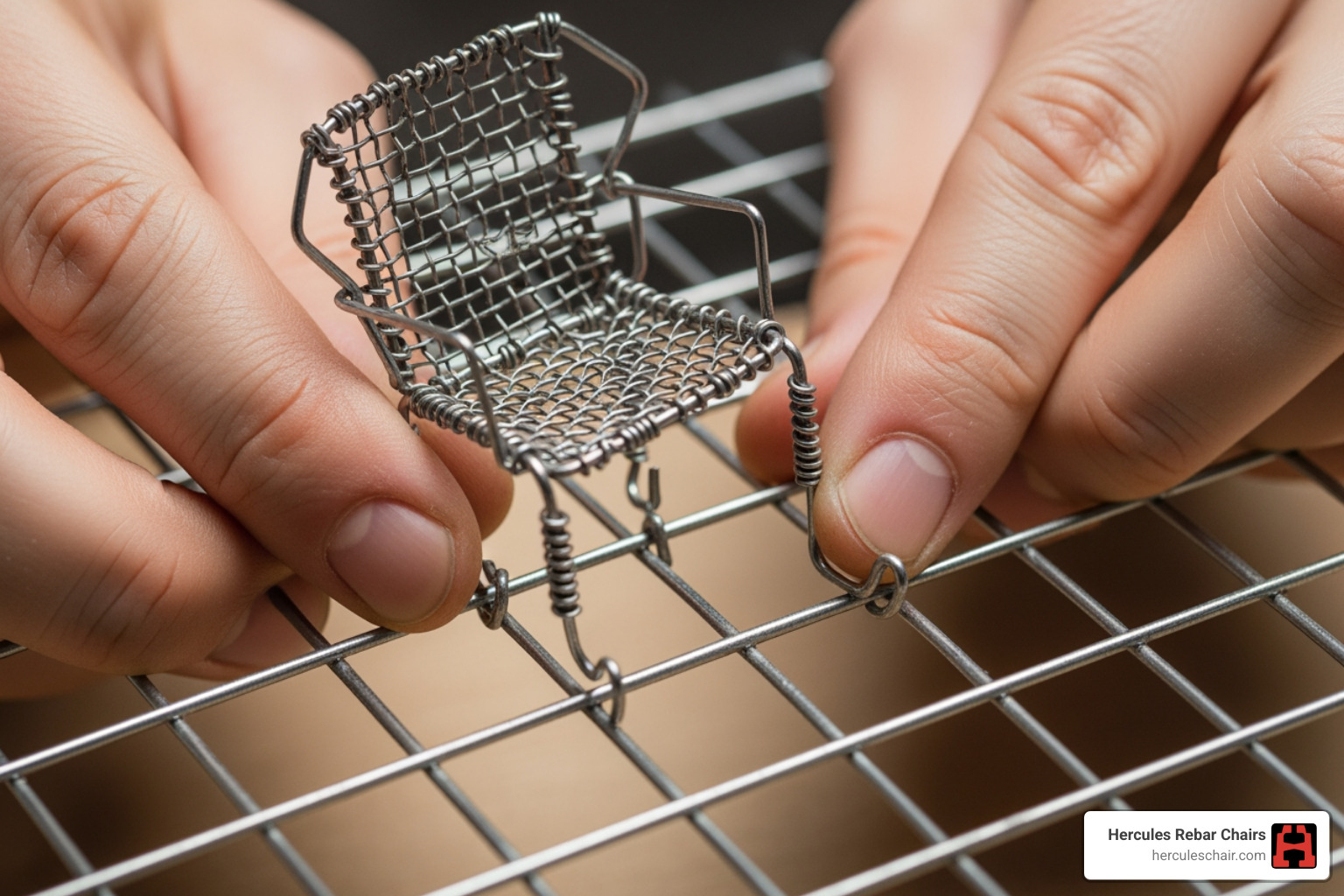
- Snap to Intersections: Our chairs are designed to snap easily and firmly onto the wire mesh’s intersections from the bottom. This secure connection prevents the mesh from dislodging during the pour.
- Verify Height: Double-check that the mesh is consistently at the desired height across the entire area. Make any necessary adjustments.
- Walk with Confidence: A key benefit of proper spacing is that it allows you and your crew to walk on the mesh between chairs without it permanently deforming. This is a huge time-saver during the pour.
- Pre-Pour Inspection: Before concrete is placed, do a final walk-through to ensure all chairs are properly installed and the mesh is secure and at the correct height. This quick check can prevent costly issues later.
Common Applications for wire mesh chair concrete
Wire mesh chair concrete supports are incredibly versatile and find their place in a wide array of concrete projects across the US, from our backyard patios to major commercial installations. Some of the most common applications where they are particularly advantageous include:
- Patios: Ensuring a smooth, crack-resistant surface for outdoor living.
- Sidewalks: Providing durability against foot traffic and environmental stress.
- Driveways: Crucial for handling vehicle loads and preventing common cracking.
- Garage Floors: Building a strong, resilient base for vehicles and heavy storage.
- Slab-on-Grade Construction: The most frequent application, where they support mesh in concrete slabs poured directly on the ground.
- Liftd Decks and Footings: Continuous mesh chairs are often used here for their consistent linear support.
Essentially, any flatwork concrete project that uses wire mesh reinforcement will benefit significantly from the proper use of wire mesh chair concrete supports. We design our products to excel in these real-world scenarios. You can See our product applications for more examples.
The Advantages Over Traditional Methods
For generations, contractors improvised ways to support rebar and wire mesh. We’ve all seen it: bricks, rocks, scraps of wood, or even just having a “hook man” lift the mesh with a hook during the pour. While these methods might seem to save a few bucks upfront, they introduce significant risks and often lead to costly failures down the line. Using dedicated wire mesh chair concrete supports offers undeniable advantages:
- Consistency and Precision: Unlike haphazard bricks or rocks, specially designed wire mesh chair concrete supports provide a consistent, uniform height for your reinforcement. This precision ensures the mesh is exactly where it needs to be for optimal structural performance, every single time.
- Time Savings and Labor Reduction: Imagine the frantic dance of a “hook man” trying to lift the mesh while concrete is being poured. It’s inefficient, inconsistent, and requires extra labor. Our chairs eliminate the need for this, allowing your crew to work more efficiently. They snap quickly and firmly to the mesh, saving valuable time.
- Eliminating the ‘Hook Man’: This isn’t just about saving a person’s back; it’s about optimizing your workflow. By pre-setting the mesh with chairs, your crew can focus on the pour itself, leading to a smoother, faster, and higher-quality job. Our chairs, for example, are praised for reducing manpower by eliminating this role.
- Superior Structural Integrity: Bricks and rocks can shift, crumble, or create voids in the concrete, leading to weak spots. Dedicated chairs are engineered to become an integral part of the concrete, supporting the mesh effectively without compromising the slab’s integrity. They ensure proper concrete flow and coverage around the reinforcement, crucial for a strong, durable finish.
- Code Compliance: Building codes mandate specific concrete cover for reinforcement. Using professional wire mesh chair concrete supports helps you meet these requirements consistently, avoiding costly rework or inspection failures. This is a non-negotiable for us.
- Why Bricks and Rocks Fail: Bricks absorb water, which can lead to localized weakness in the concrete. They’re also irregularly shaped and can easily tip, causing the mesh to sag. Rocks are even worse, introducing foreign materials with unknown properties and often creating air pockets. These improvised methods simply cannot provide the stable, consistent, and code-compliant support that engineered chairs do. Contractors with decades of experience note that engineered chairs do the vast majority of the work in getting wire up in a slab compared to makeshift solutions.
In short, investing in proper wire mesh chair concrete supports isn’t just about convenience; it’s about building stronger, safer, and more reliable concrete structures.
Frequently Asked Questions about Wire Mesh Chairs
We get a lot of questions about wire mesh chair concrete supports, and that’s great! It shows that people care about getting their concrete right. Here are some of the most common inquiries we receive:
Do the chairs get buried in the concrete?
Yes, absolutely! This is one of the most common questions, and the answer is a resounding yes. Our wire mesh chair concrete supports are specifically designed to be left in place and become an integral part of the finished concrete slab. They are not removed after the pour.
Once the concrete hardens, the chairs are fully encapsulated, continuing to hold the mesh in its correct position. They are made from materials like durable plastic or steel that are compatible with concrete and will not degrade or cause issues within the slab. This permanent integration ensures that the reinforcement remains effective for the entire lifespan of the concrete structure. You can even See a steel mesh chair in action to understand how they are intended to be used.
What is the recommended spacing for wire mesh chairs?
Proper spacing of your wire mesh chair concrete supports is crucial for preventing the mesh from sagging between support points, which would defeat its purpose. The standard recommendation, and what we advise for our Hercules 2″ Steel Mesh Chair, is to place one chair every 24 inches in each direction.
This 24-inch grid spacing provides sufficient support to hold the wire mesh firmly in place, even when subjected to the weight of concrete and foot traffic during the pour. This allows your crew to move across the mesh without causing permanent deformation or displacement. For precise calculations and to ensure you have the right quantity, we encourage you to Use our estimator tool. It takes the guesswork out of planning and helps you determine exactly how many chairs you’ll need for your project.
What wire gauges do these chairs support?
The compatibility of wire mesh chair concrete supports with different wire gauges is an important consideration. Our chairs are designed to accommodate common wire mesh sizes used in construction.
For instance, our Hercules 2″ Steel Mesh Chair is specifically designed for 6, 8, and 10 Gauge Steel Wire. It’s always essential to check the product specifications for the particular chair you are using to ensure it matches your wire mesh. You can always See Hercules Steel Mesh Chair specs to verify compatibility.
Conclusion: Build Stronger, Smarter, and Faster
We’ve explored wire mesh chair concrete supports, from their fundamental role in elevating reinforcement to the various types available and the critical importance of correct selection and installation. What ties all of this together is a commitment to quality, durability, and efficiency in concrete construction.
By consistently using high-quality wire mesh chair concrete supports, you’re not just buying a small piece of plastic or steel; you’re investing in the long-term strength and integrity of your concrete project. You’re ensuring proper concrete cover, preventing costly cracks, and ultimately building structures that stand the test of time. This translates to less rework, happier clients, and a reputation for excellence.
At Hercules Rebar Chairs, we pride ourselves on manufacturing strong, reliable rebar chairs and concrete supports for the construction industry. With over 14 million units sold across the US, we’re America’s #1 choice, recognized for saving time and money, ensuring code compliance, and our distinctive red color. We believe in providing solutions that make your job easier and your results superior. You can learn more about our commitment to quality on our About Hercules Rebar Chair page.
Don’t let your reinforcement sink to the bottom. Lift your expectations and your concrete projects with the right support.
Ready to build a foundation that lasts? Buy Rebar Chairs and supports for your next project today!