

Why Rebar Footing Stands Matter in Modern Concrete Construction
Rebar footing stands are essential plastic or steel supports that hold reinforcing bars (rebar) at the correct height above the ground during concrete pours. They eliminate the need for wire tying and ensure consistent rebar placement for stronger, code-compliant foundations.
Quick Overview:
- Primary Purpose: Maintain proper concrete cover (typically 3 inches) between rebar and ground
- Key Benefit: Save time by snapping rebar into place instead of tying with wire
- Common Types: 2-bar stands for standard footings, 3-bar stands for wider applications
- Compatibility: Work with #4 and #5 rebar (most common sizes)
- Recommended Spacing: Place stands every 4 feet along the footing
- Installation: Stays buried in concrete—no removal needed after pour
If you’ve ever struggled with rebar shifting during a concrete pour or spent hours tying wire in muddy trenches, you know the frustration. Traditional methods using bricks, wood blocks, or wire ties are inconsistent and labor-intensive. They slow down your crew and create uncertainty about whether the rebar will stay positioned correctly.
Modern rebar footing stands solve these problems. They provide stable, reliable support that keeps reinforcement exactly where it needs to be—before, during, and after the pour. This means better concrete flow, stronger foundations, and significantly less labor time on site.
For concrete contractors working on residential foundations, commercial slabs, or trench footers, these stands have become the industry standard. They’re designed to snap rebar securely into place, maintain proper clearance from the ground, and withstand the pressure of fresh concrete without collapsing.
The difference is measurable: what used to take a crew several hours of wire tying now takes minutes with snap-in stands. And because the stands ensure consistent rebar placement, you get better structural integrity and easier code compliance.
What Are Rebar Footing Stands & Why Are They Essential?
Imagine building a house without a solid foundation – it simply wouldn’t stand the test of time. In concrete construction, rebar acts as the skeletal system, providing the tensile strength that concrete lacks. But for rebar to do its job effectively, it needs to be precisely placed within the concrete. That’s where rebar footing stands come into play.
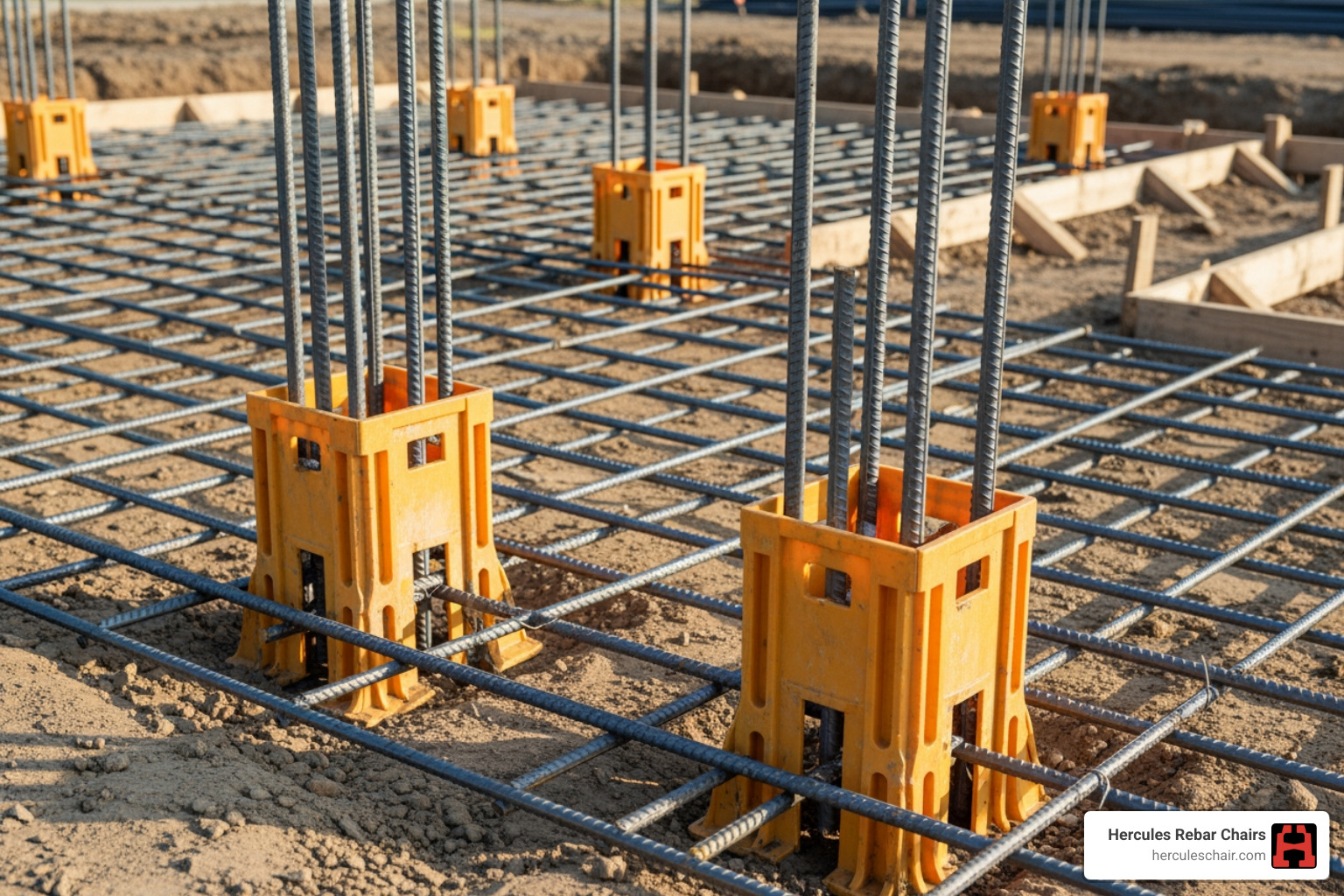
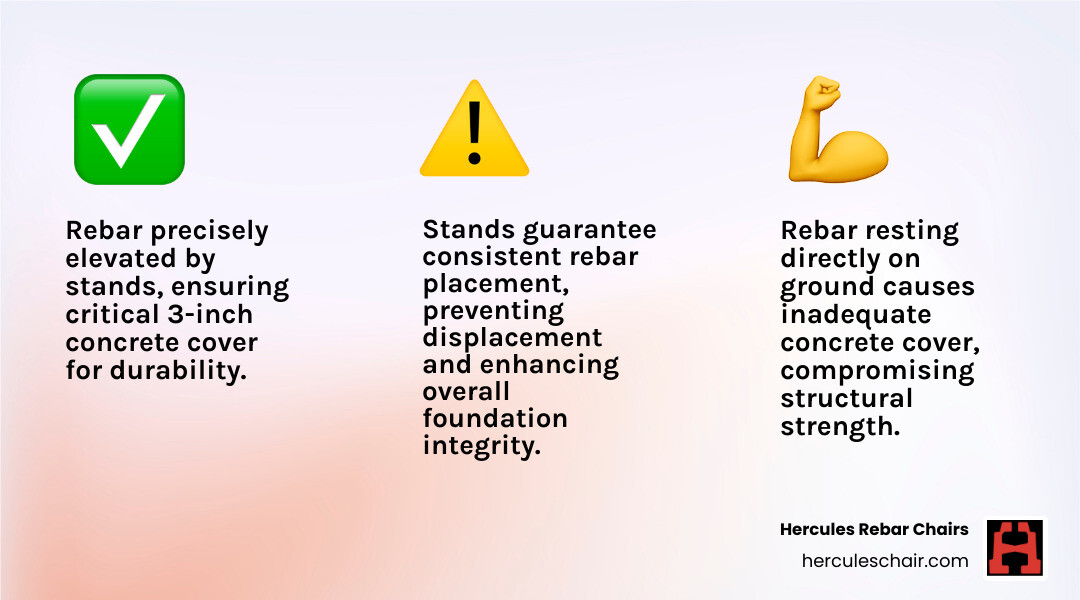
Our primary function is quite simple yet profoundly important: we lift and secure the rebar grid, ensuring it maintains its intended position throughout the concrete pouring and curing process. Without proper elevation, rebar can sink to the bottom of the footing, becoming ineffective. This can lead to reduced structural integrity, increased risk of cracking, and ultimately, a compromised foundation. By elevating the rebar, we ensure it’s encased in concrete from all sides, creating a stronger, more resilient structure.
Proper concrete cover is crucial. Industry guidelines, such as those from the American Concrete Institute (ACI), typically require a minimum of 3 inches of concrete cover between the rebar and the ground. This cover protects the rebar from corrosion, which can weaken the entire structure over time. Our rebar footing stands are specifically designed to achieve this critical 3-inch clearance, giving you peace of mind that your foundation meets these vital standards. They eliminate the guesswork and ensure your rebar is always where it needs to be, preventing costly rebar displacement during the pour.
The Key Benefits: Efficiency, Strength, and Savings
When we talk about the advantages of using rebar footing stands, we’re really discussing a revolution in concrete construction efficiency. Our stands offer a trifecta of benefits: unparalleled time savings, superior strength, and significant cost reductions.
First, let’s talk about time savings. Traditional rebar tying methods involve bending down in trenches, carefully tying each intersection of rebar with wire. It’s a back-breaking, time-consuming process that can eat up hours, if not days, on a project. Our rebar footing stands, especially those with snap-in clips, eliminate the need for wire tying altogether. You simply lay your rebar into the cradles, and it snaps securely into place. This dramatically reduces labor costs and frees up your crew to focus on other critical tasks, keeping your project on schedule. Imagine the difference: instead of hours spent tying, your rebar grid is set in minutes.
Second, our stands contribute to improved concrete flow and consolidation. Because the rebar is held firmly in place and liftd, concrete can flow freely around and beneath the bars. This prevents voids and honeycombing, ensuring a dense, uniform concrete pour. A well-consolidated concrete footing means greater strength and durability for the entire structure. The stands are engineered to be robust, designed to not collapse during the pour, maintaining that critical rebar placement even under the pressure of wet concrete.
Finally, the result is superior strength and consistent rebar placement. By ensuring the rebar is always at the correct height and spacing, our stands guarantee that the tensile strength of the rebar is fully used. This consistent placement is vital for the overall structural integrity of the foundation, helping to prevent cracks and mitigate natural settling. It’s about building foundations that are not just strong, but consistently strong, from one end to the other.
Rebar Footing Stands vs. Outdated Methods
For decades, concrete contractors used makeshift solutions to support rebar in footings. Bricks, rocks, wood blocks, or even piles of dirt were common sights in trenches, meant to prop up the rebar before a pour. While these methods were cheap, they came with significant hidden costs and risks.
Outdated methods are inherently inconsistent. A brick might hold rebar at 3 inches in one spot, but a loose rock might only provide 1 inch a few feet away. This inconsistency leads to uneven concrete cover, leaving parts of your rebar exposed to moisture and corrosion, or sinking into the ground where it can’t provide proper reinforcement. They are also highly labor-intensive, requiring constant adjustment and often failing to hold rebar securely, leading to displacement during the pour. Imagine the frustration of seeing your carefully laid rebar shift as the concrete truck discharges its load!
Our rebar footing stands offer a modern, reliable solution. They provide precise, consistent elevation and spacing for your rebar, ensuring every inch of your foundation benefits from optimal reinforcement. This means fewer call-backs, greater peace of mind, and a foundation built to last.
Here’s a quick comparison to highlight the stark differences:
| Feature | Hercules Rebar Footing Stands (Modern Solution) | Makeshift Supports (Bricks, Wood Blocks, etc.) |
|---|---|---|
| Rebar Placement | Consistent, precise height and spacing | Inconsistent, variable height and spacing |
| Installation Time | Fast, snap-in design, no tying | Slow, labor-intensive, manual adjustment |
| Stability During Pour | High strength, will not collapse | Prone to shifting, collapse, displacement |
| Concrete Cover | Guaranteed 3-inch clearance | Variable, often inadequate |
| Corrosion Protection | Maximized by proper cover | Compromised by poor cover |
| Structural Integrity | Improved, reliable foundation | Reduced, potential for cracks and failure |
| Labor Costs | Significantly reduced | High, due to manual work and potential rework |
| Code Compliance | Easier to achieve and verify | Difficult to ensure consistent compliance |
A Guide to Types, Materials, and Sizing
Just as a tailor customizes a suit, different concrete projects demand different types of rebar footing stands. Whether you’re laying a simple residential foundation, pouring a massive commercial slab, or constructing intricate trench footers, understanding the various options ensures you choose the right tools for the job.
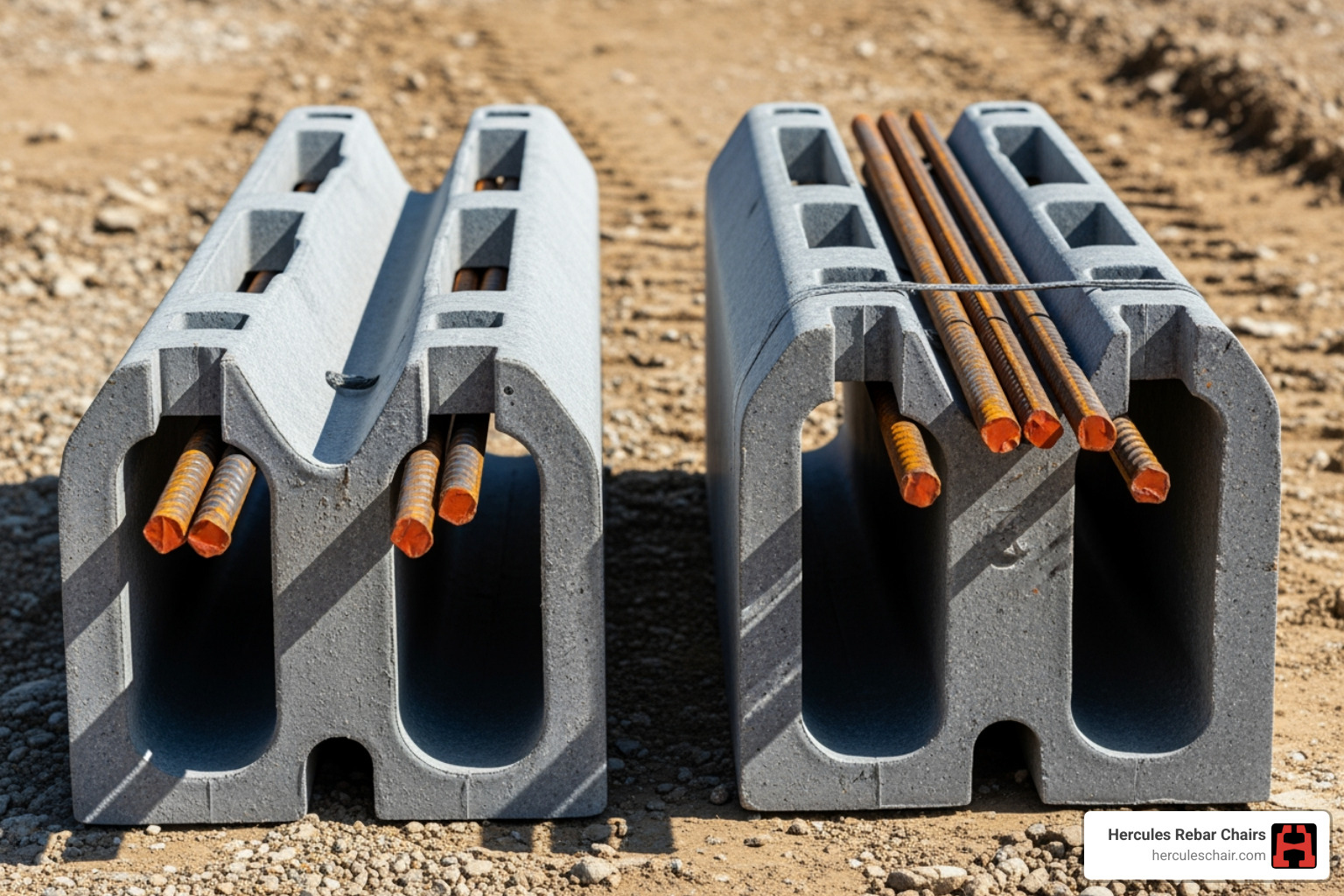
Common Types of Rebar Footing Stands
We offer a range of rebar footing stands designed to meet diverse project needs:
2-Bar Stands: These are our workhorses for standard footing applications. The #928 Hercules 2-Bar Footing Stand, for example, is designed for two-bar setups, holding #4 and #5 rebar 5 inches apart with a crucial 3-inch clearance from the ground. They are incredibly strong and won’t collapse during the pour. You can Learn about 2 Bar Footer Stands on our website.
3-Bar Stands: When your footings are wider or require additional reinforcement, our 3-bar stands are the ideal choice. The #924 Hercules 3-Bar Footer Stand accommodates three bars of #4 and #5 rebar, also maintaining 5 inches of spacing and a 3-inch ground clearance. Like their 2-bar counterparts, these are built for strength and stability. Explore 3 Bar Footer Stands to see how they can improve your project.
Double Rod Chairs: These versatile chairs are often made of steel and can support two pieces of rebar, elevating them 3 inches off the ground. They are robust and can typically accommodate a wider range of rebar sizes, from #3 to #8 (3/8 inch to 1 inch diameter). Double rod chairs are mostly used for foundation slabs and trench footers, providing a solid base for your reinforcement.
Slab Bolsters: For continuous support, especially in large slab applications or liftd decks, slab bolsters are excellent. These are longer, often continuous supports that ensure consistent elevation across a wider area, preventing any sagging of the rebar grid.
Material Matters: Plastic Options
The material used for rebar footing stands directly impacts their durability, performance, and ease of use. While steel chairs are common, we’ve found that high-quality plastic, specifically polypropylene, offers significant advantages.
Our rebar footing stands are made from robust polypropylene. This material is lightweight, making our stands easy to handle and transport around the job site. Unlike steel, polypropylene is non-corrosive, meaning it won’t rust or degrade when exposed to moisture within the concrete, preserving the integrity of your foundation long-term.
Polypropylene also allows for innovative designs like our snap-fit clips, which secure rebar without the need for wire. This material is engineered for high strength, capable of withstanding the weight of the rebar and the pressure of wet concrete without collapsing. This ensures that your rebar stays precisely positioned from start to finish. For detailed specifications and performance data, we encourage you to View product data sheets.
Understanding Sizing and Compatibility
Choosing the correct rebar footing stand also involves understanding its compatibility with different rebar sizes and the clearance it provides.
Rebar Sizes: Our Hercules 2-Bar and 3-Bar Footer Stands are specifically designed for #4 and #5 rebar, which are among the most common sizes used in residential and light commercial foundation work across the USA. Other rebar chairs, particularly steel double rod chairs, offer broader compatibility, often working with #3 to #8 rebar (ranging from 3/8 inch to 1 inch in diameter). It’s crucial to match the stand to the rebar size you are using to ensure a secure fit.
Clearance Height: A consistent 3-inch clearance from the ground is a standard requirement for many footing applications. This ensures adequate concrete cover, protecting the rebar from environmental elements and contributing to the foundation’s longevity. Both our 2-bar and 3-bar stands provide this essential 3-inch clearance.
Bar Spacing: For multi-bar applications, the spacing between the rebar is also important. Our Hercules stands feature a 5-inch spacing between each bar, optimizing the reinforcement grid. Steel double rod chairs might offer a 6-inch spacing, depending on the design. This consistent spacing is critical for distributing loads evenly throughout the footing.
Installation Best Practices for Rebar Footing Stands
The effectiveness of your concrete foundation hinges on precise rebar placement. Our rebar footing stands are designed to simplify this process, allowing you to create a secure rebar grid that will lead to a seamless concrete pour. For a comprehensive guide, always refer to our Rebar Placement Guide.
Recommended Spacing and Placement
To achieve optimal support and ensure your rebar remains perfectly positioned, adhering to our recommended spacing guidelines is key. For both our 2-Bar and 3-Bar Footer Stands, we recommend placing a stand every 4 feet along the length of your footing. This spacing provides ample support, preventing any sagging or displacement of the rebar, even when subjected to the weight and vibration of a concrete pour.
Ensuring your stands are placed on stable ground within the footing trench is also vital. A solid base for each stand contributes to the overall stability of the rebar grid.
Calculating the quantity of stands you’ll need for your project is straightforward. You can easily estimate the number required by measuring the total linear footage of your footings and dividing by the recommended 4-foot spacing. For a precise calculation, we’ve developed an intuitive tool: Use the Rebar Chair Estimator. And for more detailed instructions on optimal placement, consult our Footer Stand Placement Guide.
Step-by-Step Installation for Rebar Footing Stands
Installing our rebar footing stands is a quick and efficient process that will save you time and effort:
- Prepare the Footing Trench: Ensure your trench is excavated to the correct depth and width, with a level and stable base. Remove any loose soil or debris.
- Place Stands at Intervals: Position your rebar footing stands along the length of the trench, adhering to the recommended 4-foot spacing. For corners and intersections, ensure adequate support for the intersecting rebar.
- Snap Rebar into Cradles: Lay your rebar into the designated cradles on top of the stands. Firmly press the rebar down until it snaps securely into place. Our snap-in design eliminates the need for tedious wire tying, significantly speeding up the process.
- Check Alignment Before Pouring: Once all rebar is snapped into place, do a final visual check. Ensure the rebar grid is straight, level, and that all bars are firmly seated in their stands. This final check is crucial to guarantee proper alignment before the concrete pour begins.
Common Mistakes to Avoid
Even with the simplest tools, a few common pitfalls can lead to headaches down the line. Here are some mistakes to steer clear of when using rebar footing stands:
- Incorrect Spacing: Placing stands too far apart can lead to rebar sagging between supports, compromising the critical 3-inch concrete cover. Always stick to the 4-foot recommendation.
- Unstable Placement: If a stand is placed on uneven or soft ground, it can shift or tilt during the pour, causing rebar displacement. Ensure each stand has a firm, level base.
- Using Damaged Stands: While our stands are incredibly strong, always inspect them before use. A damaged stand might not provide adequate support and could fail during the pour. Discard any compromised stands.
- Forgetting Vertical Rebar Integration: While our stands secure horizontal rebar, don’t forget about vertical dowels or hooks that may be required for wall connections. Ensure these elements are properly integrated and tied (if necessary) to the horizontal rebar grid, creating a complete reinforcement system.
Frequently Asked Questions
We understand that you might have questions about incorporating rebar footing stands into your projects. Here are answers to some of the most frequently asked questions we receive from contractors and DIYers alike.
Do the chairs get buried in the concrete?
Yes, absolutely! This is one of the most common questions we hear, and the answer is a resounding yes. Our rebar footing stands are specifically designed to be left in place and become an integral part of the concrete structure. They are made from durable materials like polypropylene that are compatible with concrete and will not degrade within the pour. There’s no need for removal after the concrete sets, which further saves time and labor on your job site. They simply become part of the finished footing, continuously supporting the rebar.
Where can I purchase rebar footing stands?
We’ve made it incredibly easy for you to get your hands on our high-quality rebar footing stands. You can find our products at major hardware retailers across the USA, including your local Home Depot. For example, the Hercules 3-Bar Rebar Footer Chair is available in a convenient 30-pack at Shop Now at Home Depot, and our 2-Bar Footer Chairs come in 40-packs.
If you prefer shopping online, our rebar footing stands are also available through major online marketplaces. You can Buy directly on Amazon for quick delivery straight to your job site or doorstep. We offer various packaging options, from packs of 30 or 40 for smaller projects to bulk boxes for larger commercial endeavors, ensuring you always have the right quantity on hand. While there’s an upfront cost for our stands, the time and labor savings they provide often make them a more cost-effective solution compared to traditional, labor-intensive methods.
How do they integrate with other concrete accessories?
Our rebar footing stands are designed to be part of a complete, efficient concrete reinforcement system. They integrate seamlessly with a variety of other concrete construction accessories:
- Vertical Rebar Hooks/Dowels: For connecting walls or columns to the footing, vertical rebar hooks or dowels are often required. Our horizontal rebar grid, secured by the stands, provides a stable base to which these vertical elements can be tied or snapped, ensuring a robust connection between different structural components.
- Formwork Systems: The stands work within your formwork, ensuring the rebar maintains its position relative to the forms. This helps achieve accurate dimensions for your footings and walls.
- Wire Mesh: In some slab-on-grade applications, wire mesh might be used in conjunction with rebar. While our stands primarily support rebar, they contribute to the overall stability of the reinforcement, allowing other elements like mesh to be properly positioned above or below the rebar grid.
By using our stands, you’re not just supporting rebar; you’re creating a robust, interconnected reinforcement framework. We encourage you to Explore additional resources on our website, including data sheets and guides, to learn more about how our products fit into a comprehensive concrete construction strategy.
Conclusion: Build a Stronger Foundation with Confidence
In the demanding world of concrete construction, efficiency, strength, and reliability are paramount. Rebar footing stands are no longer just an accessory; they are a modern standard, changing how we build foundations across the USA. By choosing our innovative solutions, you’re investing in more than just a product; you’re investing in peace of mind.
We’ve seen how our stands deliver significant time savings by eliminating tedious wire tying, allowing your crew to work faster and smarter. We’ve highlighted their role in ensuring superior strength and longevity for your concrete foundations, thanks to precise rebar placement and optimal concrete flow. And critically, our stands help you achieve consistent, verifiable code compliance, safeguarding your projects from future issues.
As America’s #1 choice, with millions of units sold, Hercules Rebar Chairs stands for Strength, Quality, and Solution. Our identifiable red color is a mark of proven performance and trust on job sites nationwide. We are committed to providing you with the tools you need to build foundations with unwavering confidence.
Ready to experience the difference that superior rebar footing stands can make? Don’t let outdated methods hold you back. Lift your next project with the reliability and efficiency that only Hercules Rebar Chairs can provide.
Buy Rebar Chairs for your next project and build a foundation that truly lasts.