

Why Rebar Connection Tools Matter for Modern Concrete Construction
Rebar connection tools are devices used to secure steel reinforcement bars (rebar) together at intersection points, maintaining proper positioning during concrete placement. They range from manual tying pliers to automated battery-powered tying machines and mechanical coupling systems.
Quick Overview: Types of Rebar Connection Tools
- Manual Tying Tools – Traditional pliers, wire twisters, and hooks that require hand-twisting tie wire around rebar intersections
- Automated Tying Machines – Battery or air-powered tools that automatically wrap and twist wire or install clips in seconds
- Mechanical Splicing Systems – Couplers and threaded connections for end-to-end rebar joining
- Rebar Processing Equipment – Cutters, benders, and doweling tools for on-site fabrication
Every concrete pour depends on rebar staying exactly where you put it. Whether you’re forming up a foundation, tying a deck, or assembling walls for tilt-up construction, the connections between rebar pieces determine whether your grid maintains its engineered spacing and coverage.
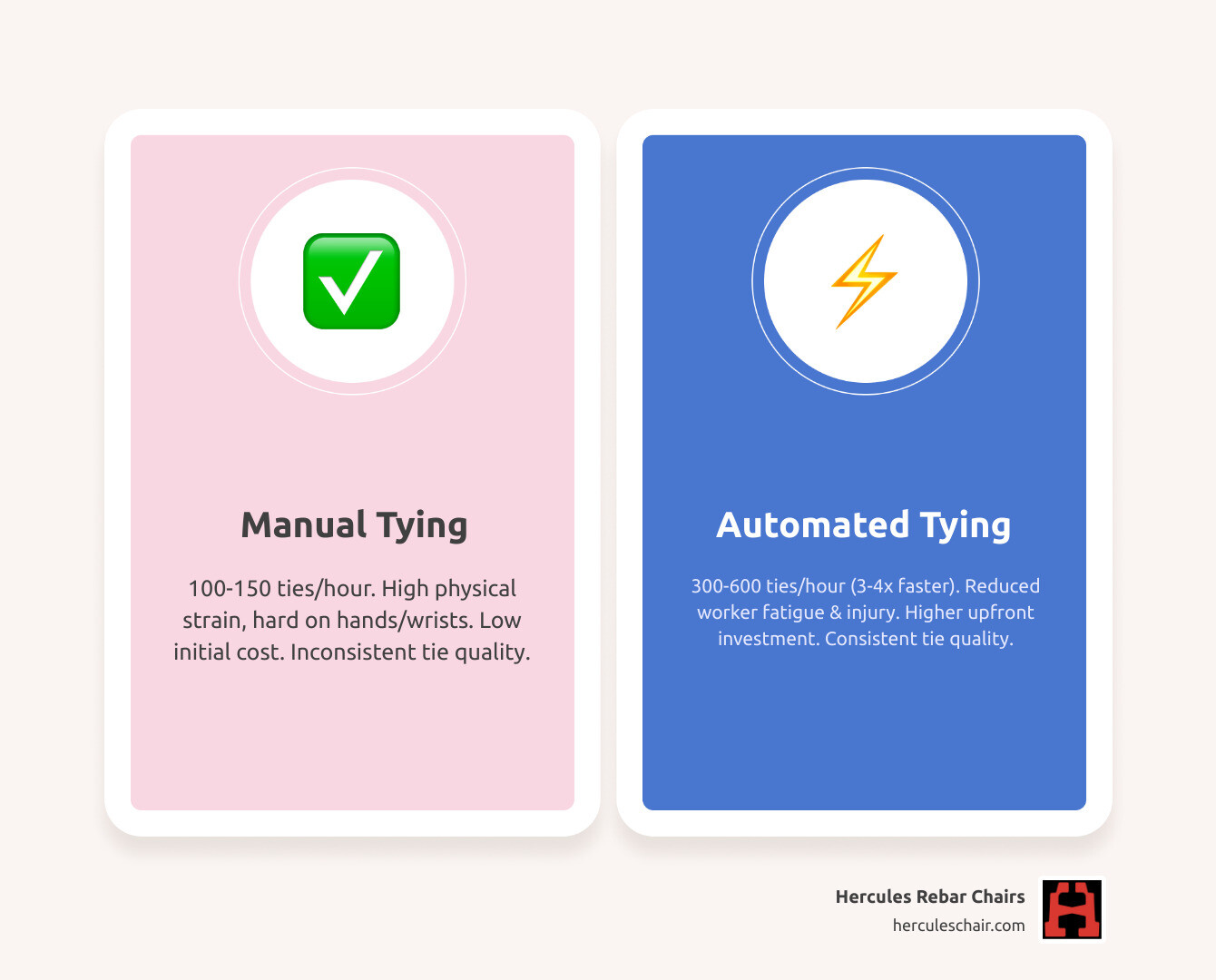
For decades, contractors relied exclusively on manual tying—a repetitive, physically demanding task that’s hard on workers’ hands and wrists. Today’s automated rebar tying machines can improve efficiency by 3-4 times compared to manual methods, with some models completing up to 4,000 ties per battery charge. These tools don’t just speed up the work—they reduce worker fatigue, deliver more consistent tie quality, and help prevent the musculoskeletal injuries that plague manual tiers.
The choice between manual and automated tools isn’t always straightforward. Budget, project scale, rebar size, and site conditions all play a role. Manual tools offer flexibility in tight spaces and zero upfront investment, while automated systems shine on large-scale projects where speed and ergonomics justify the initial cost.
Understanding your options helps you make informed decisions that balance productivity, safety, and project economics—all while ensuring your rebar stays put during the critical concrete placement phase.
Understanding the Spectrum of Rebar Connection Tools
When we talk about rebar connection tools, we’re discussing a whole family of devices designed to ensure your rebar grid is robust and ready for concrete. From simple hand tools to sophisticated machines, each plays a vital role in construction projects across the USA, from Alabama to Wyoming.
Manual Rebar Tying Tools
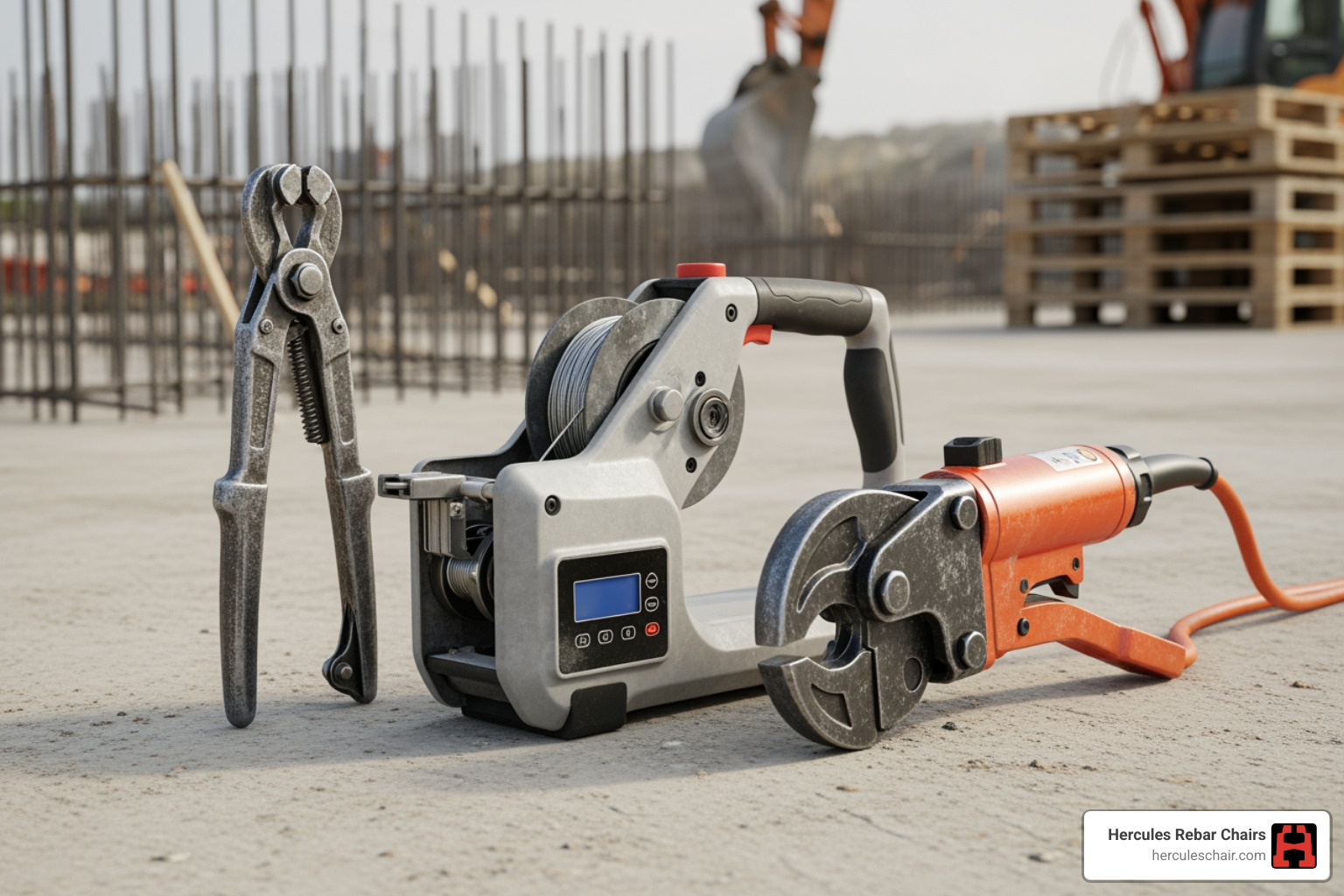
Ah, the classics! Manual rebar tying has been the backbone of concrete construction for generations. These tools are straightforward, requiring no power source, making them incredibly flexible for various site conditions.
- Tying Pliers and Wire Twisters: These are the workhorses for many small to medium-sized projects. They allow workers to quickly twist tie wire around rebar intersections. While simple, they require considerable physical effort.
- Tying Hooks: Often used with pre-cut wire, these hooks allow for rapid twisting with a flick of the wrist. They offer high flexibility and convenience, especially for small tying work or in complex, confined environments where larger tools simply won’t fit.
The advantages are clear: low initial cost, simple operation, and remarkable versatility. They are perfect for those small, intricate tying jobs or situations where power isn’t available. However, their limitations include low efficiency, high labor intensity, and a tendency for inconsistent tie quality if not performed by a skilled hand.
Automated Rebar Tying Machines
Now, let’s talk about the future, which is very much here! Automated rebar tying machines have revolutionized how we connect rebar, especially on larger projects. These rebar connection tools are designed to reduce manual labor and significantly boost productivity.
- Battery-Powered Tools: These handheld, self-contained units are incredibly popular. They intelligently complete all steps of rebar tying automatically, often using spools of rebar tie wire. Certain models can handle various rebar sizes, from #3 x #3 up to #14 x #14, using 19ga or 21ga wire. They’re cordless, powered by lithium-ion battery platforms (like 18V, 25.2V, or even 18V/36V MultiVolt systems), and offer thousands of ties per charge. This cordless freedom is a game-changer, eliminating the need for power connections or air lines.
- Air-Powered Tools: Some systems use air power with a cartridge-fed polycarbonate clip connecting system. This type of system can use a four-point grip for consistent and stable rebar connections. It’s an alternative to wire-based tying, offering specific job-based advantages. These tools are ideal for applications like site-pour, precast, tilt-up, and even pools, handling common rebar sizes such as #4 and #5.
The advantages of automated tying machines are substantial: greatly improved work efficiency (3-4 times faster than manual), reduced labor intensity, uniform and stable tying quality, and a significant reduction in wire usage (around one-third of what manual tying requires). They also improve safety by reducing repetitive strain injuries and worker burnout.
Other Essential Rebar Processing Tools
Beyond just connecting rebar, there are other crucial rebar connection tool categories that help prepare rebar for its final position. These tools are vital for on-site fabrication and ensuring structural integrity.
- Portable Rebar Cutters: These tools quickly and safely cut rebar to the exact lengths needed. Options range from cold-cutting shear models that can handle up to #10 (1-1/4″) GR-60 rebar to cordless and electric multi-purpose saws cutting up to #8 (1″) rebar. A quality cordless cutter can make hundreds of cuts on a single charge and may feature a 360-degree rotatable head for maneuverability.
- Stationary and Portable Rebar Benders: Rebar often needs to be shaped to fit specific designs. Benders can create standard hooks, stirrups, or offset bends. Stationary models are great for fabrication shops, while portable benders allow for bending steel in place, even in tight areas, handling up to #9 (1-1/8″) rebar. There are also combo units that combine bending and cutting for ultimate versatility.
- Rebar Doweling and Anchoring Systems: For connecting new concrete elements to existing ones, or anchoring rebar into concrete, specialized tools and systems are used. This often involves adhesive anchors and specific drill bits, ensuring a strong, reliable connection. Some manufacturers offer configurators to help build rebar doweling solutions, including OSHA Table 1 compliant options.
These tools, together with our high-quality concrete supports, ensure that every piece of rebar is precisely placed and secured. You can explore a wide range of solutions, including our own Our Products, designed to make your rebar work easier and more efficient.
Manual vs. Automated: A Head-to-Head Comparison
Choosing the right rebar connection tool for your project can feel like a heavyweight championship match. In one corner, we have the seasoned veteran, manual tying. In the other, the agile, high-tech challenger, automated tying. Let’s break down their performance across key metrics.
| Metric | Manual Tying | Automated Tying Machines |
|---|---|---|
| Speed (Ties/Hour) | 100-150 ties/hour (average) | 300-600 ties/hour (3-4x faster) |
| Labor Intensity | High; physically demanding, repetitive strain | Low; significantly reduced worker fatigue |
| Safety/Ergonomics | Higher risk of hand/wrist injuries, burnout | Lower risk of injury; ergonomic design, lightweight |
| Upfront Cost | Very low (cost of pliers/hooks and wire) | High (investment in machine, batteries, and specialized wire) |
| Tie Consistency | Varies greatly with worker skill and fatigue | Highly consistent and stable tie quality |
The Efficiency and Safety Revolution
The numbers don’t lie. Automated rebar tying machines can improve efficiency by 3-4 times compared to manual methods. This means projects move faster, hitting deadlines more reliably. We’ve seen machines designed to maximize tying capacity, featuring up to 4,000 ties per battery charge. This kind of speed means fewer workers are needed for the same amount of work, or the same crew can accomplish much more.
Beyond pure speed, the impact on safety and worker well-being is profound. Manual tying is a highly technical, yet incredibly strenuous job. It leads to high labor intensity and can cause significant fatigue and musculoskeletal injuries. Automated tools, with their ergonomic designs and lightweight construction, dramatically reduce the physical burden. This translates to fewer injuries, less downtime, and a happier, healthier workforce across our construction sites. By using these tools, we’re not just making connections; we’re protecting our most valuable asset: our people. For guidance on how to properly lay out your rebar, refer to our Rebar Placement Guide.
Analyzing the Cost Implications
While the upfront cost of an automated rebar connection tool might seem daunting compared to a simple pair of pliers, it’s crucial to look at the bigger picture—the long-term cost-benefit analysis.
- Initial Tool Investment: Manual tools are cheap, often just a few dollars. Automated machines can cost hundreds or thousands of dollars. This is the biggest hurdle for many smaller contractors.
- Consumable Costs: Both methods require tie wire or clips. Automated machines, however, often use about a third of the wire needed for manual tying jobs due to precise, consistent ties. This can lead to significant savings over a large project.
- Labor Savings ROI: This is where automated tools truly shine. By reducing the number of workers needed or speeding up the work, labor costs plummet. A fully automatic steel bar bundling machine, for example, can achieve a 2-turn bundling time of less than 0.85 seconds. When you multiply that efficiency across an entire project, the return on investment (ROI) for the machine can be surprisingly quick.
- Project Timeline Reduction: Faster rebar tying means faster project completion. Time is money in construction, and shaving days or weeks off a schedule can lead to substantial savings and the ability to take on more projects.
For small-scale projects or very complex, tight areas, manual tying might still be the most cost-effective and flexible option. But for any significant concrete pour, automated rebar tying tools offer undeniable advantages in efficiency, safety, and overall project economics. To get an idea of the materials needed for your project, check out our Hercules Rebar Chair Estimator.
Key Features for Choosing the Right Rebar Connection Tool
Selecting the perfect rebar connection tool isn’t just about picking the fastest or cheapest option. It’s about finding the right fit for your specific needs, considering factors that impact performance, longevity, and your bottom line.
Power and Performance: The Role of Battery Technology
Modern battery technology has transformed power tools, and rebar tying is no exception. Cordless freedom is a huge advantage, allowing workers to move unrestricted around the job site without tripping hazards or the need for generators and extension cords.
- Battery Platforms: Tools operate on various lithium-ion battery platforms, such as 18V, 25.2V, or even 18V/36V MultiVolt systems. These platforms often share batteries with other tools from the same manufacturer, streamlining your equipment inventory.
- Ties Per Charge: This is a crucial metric. Some tools can deliver up to 4,000 ties on a single battery charge, dramatically reducing interruptions for battery swaps.
- Battery Charge Time: Quick charge times mean less downtime. Many modern batteries can be fully charged in under an hour.
- Brushless Motors: Many advanced tools incorporate brushless DC motors, which are more efficient, run cooler, and have a longer lifespan than their brushed counterparts. This translates to increased tool reliability and less maintenance.
When choosing, we always consider the balance between battery capacity, charge speed, and compatibility with our existing tool ecosystem.
Matching the Tool to the Job: A crucial rebar connection tool consideration
Not all rebar is created equal, and neither are the tools designed to connect it. Matching the tool to the specific demands of your project is paramount.
- Rebar Diameter Range: Tools are designed to handle specific rebar sizes. For instance, some clip-based tools are compatible with #4 and #5 rebar, while wire-based models can handle everything from mesh x mesh up to #14 x #14 combinations. There are machines suitable for rebar from 4mm to 45mm (roughly #3 to #14). Ensure the tool’s capacity covers the largest and smallest rebar you’ll be working with.
- Tie Strength Requirements: While rebar ties are primarily for positioning, a consistent, strong tie prevents displacement during the concrete pour. Automated tools deliver uniform ties, which is a significant advantage.
- Wire Gauge Compatibility: Automated tying tools use specific wire gauges, commonly 19ga or 21ga. Ensure the tool you choose uses readily available and cost-effective wire. Some tools use specialized polycarbonate clips instead of wire.
- Application-Specific Needs:
- Precast: High-volume, repetitive work often benefits most from automated systems for speed and consistency.
- Foundations/Slabs: A mix of manual for intricate corners and automated for large grids is common.
- Walls/Columns: Ergonomics become critical as workers are tying vertically or overhead.
- Residential vs. Commercial: Larger commercial projects almost always justify automated tools due to scale.
Durability and Maintenance of your rebar connection tool
A tool is only as good as its lifespan and how easy it is to keep running. Investing in a durable rebar connection tool with good support is a smart move.
- Build Quality: Look for robust construction that can withstand the rigors of a construction site. Tools are often subjected to dust, moisture, and accidental drops.
- Manufacturer Warranty: A solid warranty offers peace of mind and protection for your investment.
- Serviceability: Can the tool be easily maintained or repaired? Are parts readily available? Some distributors even offer professional repair and rebuilding services to “new tool standards.”
- Routine Cleaning Procedures: Simple daily cleaning can significantly extend a tool’s life. Dust and concrete residue can quickly gum up moving parts.
- Availability of Replacement Parts: Consumable components, like cutting blades on cutters or specific internal parts, will eventually need replacing. Ensure these are accessible.
Choosing a tool that is not only effective but also built to last and easy to maintain will save you headaches and money in the long run.
Applications and Impact on Structural Integrity
The versatility of rebar connection tools means they are indispensable across the entire spectrum of concrete construction, from the smallest residential project to the largest commercial and infrastructure endeavors.
Where Are Rebar Connection Tools Used?
The short answer is: everywhere concrete is poured! From the ground up, these tools ensure that the skeletal structure of our buildings and infrastructure is correctly formed.
- Foundations and Footers: The very base of any structure relies on accurately placed and tied rebar to bear the load.
- Concrete Slabs: Whether it’s a ground slab for a warehouse or a suspended deck for a high-rise, rebar connection tools ensure the mesh or grid stays uniform.
- Retaining Walls: These structures hold back soil and require precise rebar placement to prevent collapse.
- Columns and Beams: The vertical and horizontal load-bearing elements of a building are heavily reinforced, and every intersection needs to be secured.
- Swimming Pools: Even curved and intricate rebar cages for pools benefit from efficient tying to maintain their shape before shotcrete application.
- Precast Concrete Manufacturing: In factory settings, automated tools are crucial for the rapid and consistent production of reinforced precast elements.
- Tilt-up Construction: For large wall panels, rebar is tied horizontally on the ground before the panels are lifted into place.
- Road and Bridge Construction: Infrastructure projects demand robust and reliable rebar connections to withstand constant stress and environmental factors.
These applications span residential construction, commercial buildings, and infrastructure projects across all the states we serve. For specific guidance on footer stand placement, we offer a dedicated Footer Stand Placement Guide.
Ensuring Structural Soundness
This is where the critical role of rebar connection tools truly comes into focus. The primary purpose of tying rebar is not to add structural strength itself, but to secure the rebar’s position within the concrete formwork. The concrete provides the compressive strength, and the rebar provides the tensile strength. For this partnership to work effectively, the rebar must be exactly where the engineers designed it to be.
- Holding Rebar Position During Pour: Concrete is heavy and fluid. As it’s poured, it exerts pressure, which can easily displace untied or loosely tied rebar. Proper connections prevent this movement.
- Maintaining Correct Concrete Cover: The rebar needs a specific amount of concrete surrounding it (known as “cover”) to protect it from corrosion and fire. If rebar shifts, the cover can be compromised. Our rebar chairs and supports, for instance, are designed to help maintain this critical cover.
- Preventing Rebar Displacement: During the hustle and bustle of a construction site—workers walking on the grid, formwork being adjusted, concrete vibrated—tied rebar is much less likely to shift out of alignment.
- Aiding Code Compliance: Building codes, such as those from the American Concrete Institute (ACI), specify precise rebar spacing and cover requirements. Rebar connection tools help us achieve and maintain these specifications, ensuring the structure meets safety standards.
The binding and installation of reinforcement is the last and most important process in the reinforcement project. It’s about fixing the position of the reinforcement, ensuring its correct position in the concrete, and maintaining the thickness of the protective layer, ensuring the stability and safety of the structure. We take this seriously, and it’s why we’re committed to providing the best supports for your rebar. Learn more about our mission on our About Hercules Rebar Chair page.
Frequently Asked Questions about Rebar Connection Tools
We often get asked a lot of great questions about rebar connection tools, and we’re always happy to shed some light on how these essential devices work.
How many ties can an automated rebar tier make on a single battery charge?
This is a popular question, and the answer, like many things in construction, is “it depends!” However, modern automated rebar tying machines are incredibly efficient. Some models can perform up to 4,000 ties per battery charge.
Factors influencing this number include:
- Battery Capacity: Larger voltage and amp-hour (Ah) ratings mean more ties.
- Wire Gauge and Number of Wraps: Thicker wire or more wraps per tie consume more power.
- Tie Settings: Some tools allow you to adjust the tightness of the tie, which can affect battery life.
- Rebar Size: Tying larger rebar combinations might require slightly more power per tie.
- Brushless Motor Efficiency: Tools with brushless motors are generally more energy-efficient, extending battery life.
So, while 4,000 ties is an impressive benchmark, always check the specific tool’s specifications for real-world performance estimates.
Do automated tying tools replace the need for proper rebar placement and support?
Absolutely not! This is a crucial point we cannot stress enough. Automated tying tools are fantastic for securing rebar intersections quickly and consistently. However, they are just one piece of the puzzle.
- Tying tools secure rebar: Their job is to hold the rebar in its intended position relative to other rebar pieces.
- Proper placement is critical: The overall layout and spacing of the rebar grid, as designed by an engineer, must be achieved using accurate measurements and layout techniques.
- Use of rebar chairs and supports: This is where our products come in! Rebar chairs, like those we manufacture, are essential for maintaining the correct concrete cover and ensuring the rebar is held at the specified height within the formwork. Without proper supports, even perfectly tied rebar could sag to the bottom of the form, compromising its effectiveness.
- Maintaining specified cover: The concrete cover protects the rebar from corrosion and fire. Chairs and supports ensure this cover is maintained, while tying tools secure the grid’s integrity.
Think of it this way: the tying tool connects the bones, but the chairs and supports keep the skeleton standing tall and straight. Both are vital for a structurally sound concrete element.
Is the tie from an automated tool for structural strength?
No, the tie from an automated rebar connection tool, or any rebar tie for that matter, is not for structural strength. This is a common misconception.
The purpose of tying rebar is purely positional. It’s about:
- Positional Hold: Keeping the rebar grid or cage intact and preventing individual bars from shifting or separating before and during the concrete pour.
- Preventing Rebar Movement: As workers walk on the rebar, as forms are erected, and especially as concrete is poured and vibrated, the ties ensure the rebar stays put.
- Consistent Tension: Automated tools provide a uniform tie, which is more reliable for holding the grid than variable manual ties.
- Ensures Grid Integrity: The ties maintain the specified spacing and overlap (lap splicing) of the rebar, which is critical for the overall structural integrity of the concrete element once it cures.
The actual structural strength of the concrete element comes from the bond between the cured concrete and the rebar itself, and the tensile strength provided by the steel bars. The ties are merely the temporary glue that keeps everything aligned until that permanent bond forms.
Conclusion: Making the Right Connection for Your Project
As we’ve explored, rebar connection tools is diverse and constantly evolving. From the tried-and-true manual methods to the high-tech efficiency of automated machines, each tool has its place in modern concrete construction.
The benefits of choosing the right rebar connection tool are clear:
- Efficiency: Automated tools drastically speed up tying, allowing projects to progress faster and reducing labor hours.
- Safety: Reduced physical strain, repetitive motion injuries, and worker fatigue lead to a safer and more productive job site.
- Quality: Consistent, uniform ties from automated machines ensure the rebar grid maintains its engineered integrity.
When making your choice, consider your project scale, budget, the types and sizes of rebar you’re working with, and the importance of worker ergonomics. For smaller, intricate jobs or where budget is a primary concern, manual tools remain a flexible option. However, for larger projects across the USA, from the busy cities of New York to the sprawling construction sites of Texas, the investment in automated rebar tying machines often pays dividends in speed, safety, and consistent quality.
The rebar connection tool is just one part of the complete rebar support system. Here at Hercules Rebar Chairs, we understand that maintaining proper rebar placement and concrete cover is paramount to the structural integrity of your concrete elements. Our robust rebar chairs and concrete supports work hand-in-hand with effective rebar tying to ensure your projects stand strong for years to come.
For innovative solutions that go beyond just tying, we invite you to Explore innovative rebar splicing solutions on our website.