

Why Mechanical Couplers Are the Smarter Way to Splice Rebar
Mechanical couplers are steel devices that directly connect two reinforcing bars end-to-end, creating a continuous load path without relying on overlapping bars or the surrounding concrete for strength. Here’s a quick overview of what you need to know:
| Feature | Mechanical Couplers |
|---|---|
| Strength requirement | Develops ≥125% of bar yield strength (ACI 318-19) |
| Main types | Threaded, swaged, bolted, grout-filled, metal-filled |
| Key advantage | No lap length needed — works even in tight spaces |
| Best for | Large bars (#11+), seismic zones, congested columns, precast |
| Code types | Type 1 (125% yield) and Type 2 (full tensile strength) |
Lap splices have been the default for decades. But they come with real problems: they require extra rebar, create congestion, and depend on the concrete itself to transfer load between bars. When bars are large, space is tight, or seismic performance matters, that approach starts to break down.
Mechanical couplers solve this directly. They transfer force from bar to bar through a mechanical connection — no concrete needed, no doubled-up rebar, no guesswork on lap lengths.
The cost difference is real too. For large bars like #10, using a mechanical coupler instead of a lap splice can be 140% more cost-effective when you factor in the steel savings alone.
I’m Jordan Harris, a licensed structural engineer and product developer at T.J. Harris Company, where I’ve worked extensively with rebar connection systems including mechanical couplers in concrete construction. In this guide, I’ll walk you through the best options on the market so you can make a confident, code-compliant choice for your next pour.
The Engineering Behind High-Performance Mechanical Couplers
When we talk about structural integrity, we are really talking about the “load path.” In a traditional lap splice, the load travels from one bar, through the concrete via bond stress, and into the adjacent bar. If the concrete cracks or degrades, that path is compromised. Mechanical couplers change the game by making the steel continuous, independent of the concrete’s condition.
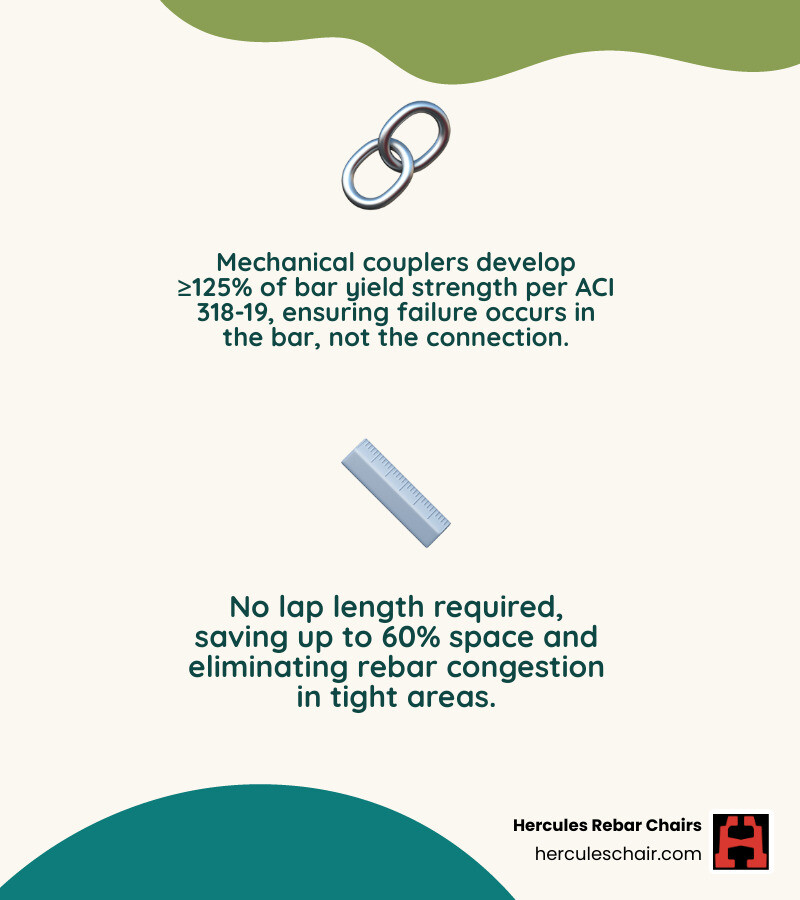
According to ACI 318-19, specifically clause 25.5.7.1, mechanical splices must deliver at least 125% of the specified yield strength ($1.25 Ab fy$) of the bar. This ensures that the bar will yield before the connection fails. However, not all couplers are created equal. The industry divides them into two critical categories:
- Type 1 Mechanical Splices: These must develop 125% of the yield strength in both tension and compression. They are typically used in areas where the rebar is not expected to undergo significant inelastic deformation (yielding).
- Type 2 Mechanical Splices: These are the “heavy hitters.” They must meet the Type 1 requirements and also develop the full specified tensile strength of the spliced bars. This makes them essential for “yielding regions” or “plastic hinge regions” in seismic designs, where the structure needs to absorb energy without collapsing.
In May 2026, as we build taller and more complex structures, the demand for Type 2 performance has become the standard for high-rise columns and bridge piers. For a deeper dive into how these tools compare, check out A Comprehensive Guide to Comparing Rebar Connection Tools.
Precision Threaded Mechanical Couplers
Threaded systems are perhaps the most common mechanical couplers found on modern jobsites. They rely on threads cut or formed into the rebar ends to screw into a central sleeve.
Tapered Threads
Tapered thread designs are a favorite among contractors because they are incredibly fast to install. The “taper” allows the bar to be inserted deeply into the coupler before the threads even begin to engage. This creates a self-aligning feature that almost entirely eliminates the risk of cross-threading—a nightmare when you’re working 40 stories up in the wind.
Parallel Threads
Parallel thread systems require the bar to be threaded at a consistent diameter. To ensure the bar doesn’t lose cross-sectional area (and thus strength) during the threading process, the ends of the rebar are often “upset” or forged to a larger diameter before the threads are cut. This ensures the threaded portion is actually stronger than the rest of the bar.
These systems are excellent for maintaining strict tolerances and are frequently used in nuclear power plants and high-performance infrastructure. You can learn more about these specific connections in our Rebar Couplers: Your Ultimate Guide to Connecting Steel Strong.
High-Strength Bolt and Shear Mechanical Couplers
What happens when you need to connect rebar that is already cast into concrete, or you’re working on a repair where you can’t easily thread the bar ends? This is where bolt and shear couplers shine.
These mechanical couplers consist of a steel tube with a series of “lock-shear” bolts. You simply slide the rebar ends into the sleeve and tighten the bolts with a standard impact wrench. As the bolts reach a specific, pre-determined torque, the heads literally shear off. This provides an instant visual confirmation that the connection is secure.
The inside of the sleeve often contains serrated strips that “bite” into the rebar as the bolts are tightened, creating a friction-and-mechanical bond that can easily meet Type 2 seismic requirements. They are perfect for:
- Field Repairs: Replacing damaged rebar without extensive demolition.
- Structural Steel Connections: Joining rebar to structural steel beams using weldable versions of the coupler.
- Retrofitting: Adding new sections to existing buildings.
For more on choosing between these and traditional methods, see Splice It Right: Your Handbook to Mechanical, Lap, and Dowel Bar Splicers.
Essential Types of Mechanical Splicing Systems
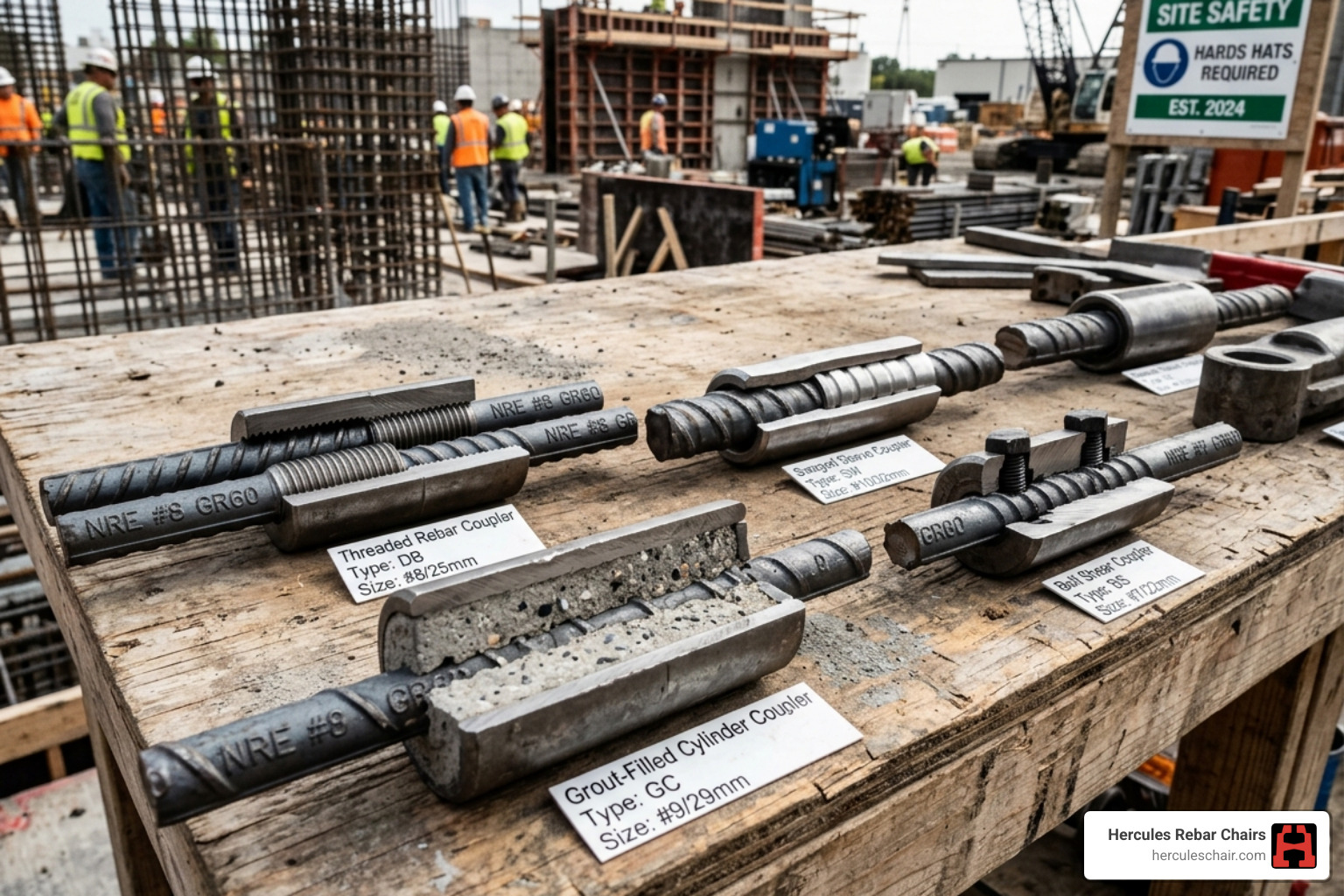
Beyond threading and bolting, there are several specialized “mechanical” systems. As defined by the MECHANICAL Definition & Meaning – Merriam-Webster, these systems use physical forces and machinery to achieve the bond.
- Swaged Sleeves: These use a hydraulic press to “cold-form” a steel sleeve around the rebar ends. The sleeve is squeezed so tightly that it deforms into the deformations (ribs) of the rebar. It is one of the oldest and most reliable methods, often requiring only two bar diameters of embedment to transfer full load.
- Grout-Filled Cylinders: Common in precast construction, these sleeves are cast into one concrete member. The rebar from the joining member is inserted into the sleeve, which is then filled with high-strength, non-shrink grout.
- Metal-Filled Splices: Often used in nuclear or blast-resistant structures, these involve pouring molten “filler metal” into a sleeve. This creates a bond that is virtually indestructible and has been tested in over 25,000 field tests by major manufacturers.
- Bar Terminators (Mechanical Anchors): While not technically a “splice” between two bars, these function similarly. They replace long, hooked rebar ends with a small, threaded nut or plate. This can reduce rebar congestion by a staggering 60% in beam-column joints.
Why Mechanical Splices Outperform Traditional Lap Splicing
We often get asked: “Is the extra cost of a coupler worth it?” In almost every complex project, the answer is a resounding yes. When you use lap splices, you are essentially doubling the amount of steel in the “lap zone.”
| Comparison Factor | Lap Splicing | Mechanical Couplers |
|---|---|---|
| Rebar Congestion | High (2x bars in splice zone) | Low (Butt-to-butt connection) |
| Concrete Flow | Difficult; risks “rock pockets” | Easy; ensures high-quality pours |
| Steel Usage | Wasteful (extra feet of lap) | Efficient (zero wasted overlap) |
| Large Bar Sizes | Not permitted for bars >#11 | Excellent for all sizes up to #18 |
| Reliability | Depends on concrete bond | Independent of concrete strength |
One of the biggest headaches on a jobsite is “congestion.” When you have too much rebar in a column, the concrete can’t flow between the bars, leading to voids or “honeycombing.” By using mechanical couplers, you eliminate that double layer of steel, providing more room for the aggregate to pass through.
Furthermore, for epoxy-coated bars, lap lengths must be up to 50% longer because the coating reduces bond friction. In these cases, switching to a coupler is almost always cheaper than buying the extra 5-10 feet of epoxy-coated rebar required for a single lap. You can browse various options for these at Rebar Splicers and Couplers – White Cap.
Installation Standards and Seismic Requirements
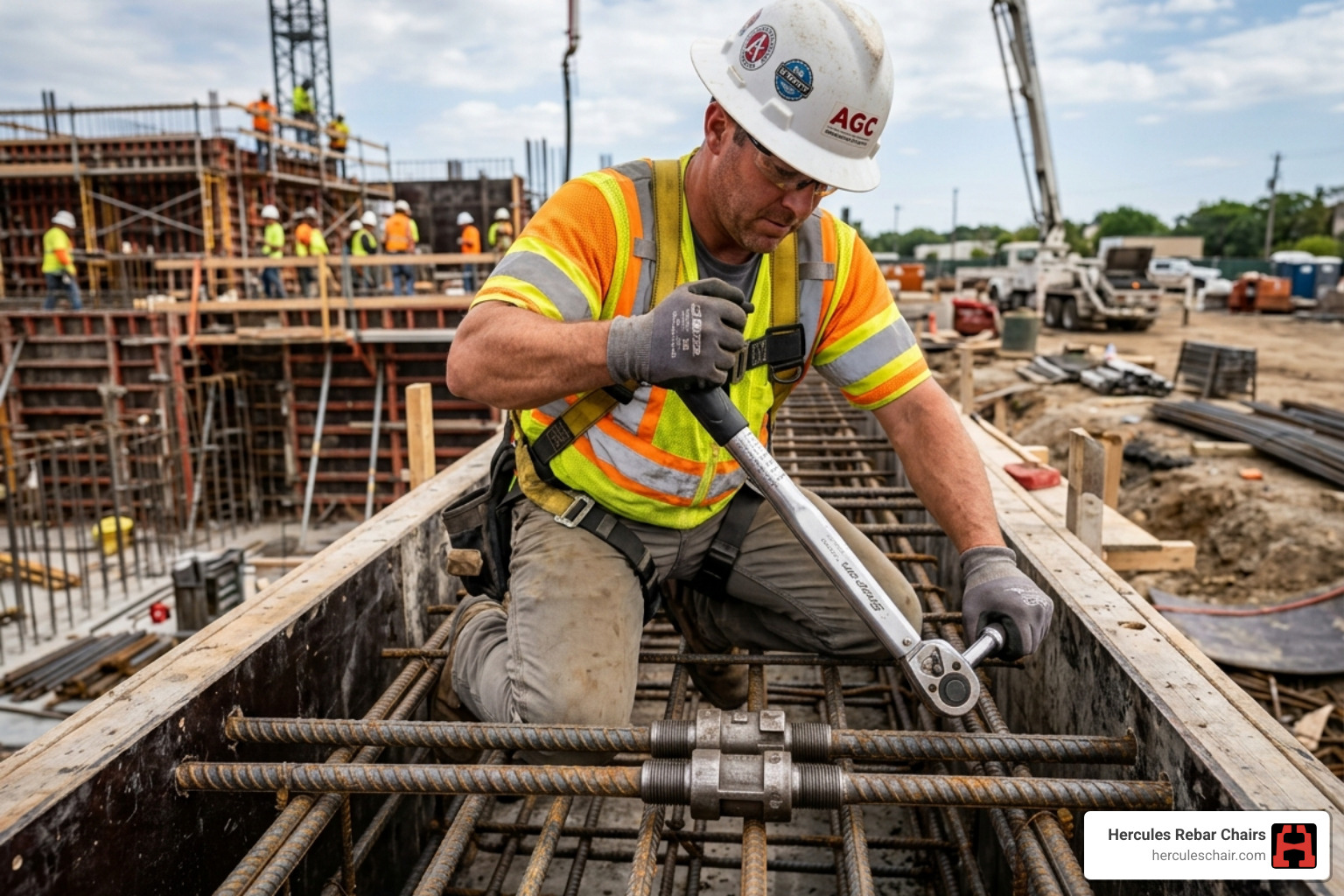
Installing mechanical couplers isn’t just about screwing things together; it’s about following strict code requirements to ensure the building stays standing during an earthquake.
Staggering Rules
Even though couplers are incredibly strong, ACI 318-19 clause 25.5.7.4 requires that mechanical splices in seismic zones (special moment frames) be staggered. Specifically, they must be offset by at least 30 inches (750 mm). This prevents a “weak plane” from forming in the concrete where all the stiff steel connectors are lined up in a single row.
Performance Criteria
To be approved for use—especially for Department of Transportation (DOT) projects—couplers must pass rigorous testing:
- Slip Criteria: The total “slip” or movement within the coupler must be less than 0.0039 inches (0.10 mm).
- Fatigue Limits: They must withstand thousands of cycles of loading and unloading without snapping.
- Corrosion Resistance: In coastal areas, couplers are often galvanized or epoxy-coated to match the rebar.
In states like California, the Steel Reinforcing Couplers | Caltrans – CA.gov maintains a list of pre-approved products that have met these grueling standards.
Frequently Asked Questions about Mechanical Splicing
What is the difference between Type 1 and Type 2 couplers?
A Type 1 coupler is designed for 125% of the bar’s yield strength and is used in non-seismic areas. A Type 2 coupler develops the full tensile strength of the bar and is required for seismic zones or “plastic hinge” regions where the building needs to flex during an earthquake.
When should I use mechanical couplers instead of lap splices?
You should switch to couplers when:
- Using bars larger than #11 (where lapping is often prohibited by code).
- Rebar congestion is preventing proper concrete vibration.
- You are building in a high-seismic zone.
- You are using expensive epoxy-coated or stainless rebar and want to save on material costs.
Do mechanical couplers require special rebar end preparation?
It depends on the type. Threaded couplers require the bar ends to be forged or cut with threads. Swaged couplers require no preparation other than a clean cut. Bolt/shear couplers are the most flexible, requiring only that the rebar is inserted into the sleeve—no special end prep needed.
Conclusion
At Hercules Rebar Chairs, we know that a strong structure starts with the right support. While we are famous for being “America’s #1” in rebar chairs—with over 14 million units sold and our signature red color making us easy to spot on the jobsite—we understand that the connections between your bars are just as vital as the chairs that hold them up.
Choosing the right mechanical couplers ensures your project meets ACI codes, stays on schedule, and remains structurally sound for decades. Whether you are dealing with a congested column or a critical seismic joint, moving away from traditional lap splices is a move toward efficiency and safety.
Ready to secure your next project? Explore our full range of support solutions and learn more about our commitment to saving you time and money at Our Products / Splicer. From the ground up, we’ve got you covered.