

The Right Way to Join Rebar: What Contractors Need to Know About Reinforcing Bar Couplers
Reinforcing bar couplers are high-strength mechanical connectors used to join two pieces of rebar end-to-end in reinforced concrete structures.
Quick answer — here’s what you need to know:
| Question | Answer |
|---|---|
| What are they? | Mechanical devices that splice rebar together without overlap |
| Main types | Threaded, shear bolt (Bar Lock®), and taper-lock |
| Key benefit | Stronger than lap splices, less steel, less congestion |
| Code compliance | ACI 318 Type 1 or Type 2, IBC, AASHTO |
| Rebar sizes | #4 (13mm) through #18 (57mm) |
| Finishes available | Plain, epoxy-coated, hot-dip galvanized, stainless steel |
| Typical price range | $3.49 to $87.99 per unit |
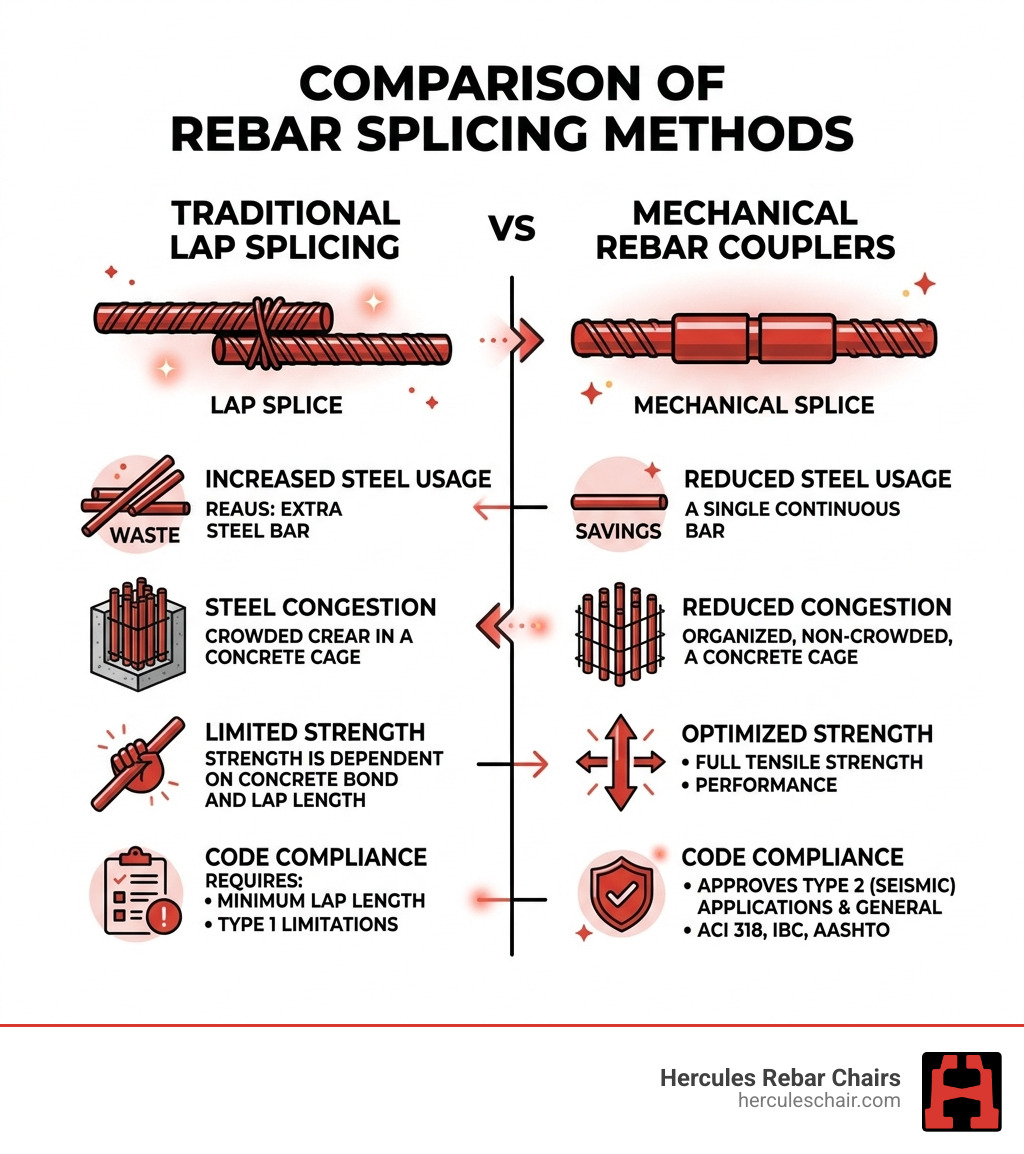
If you’ve ever wrestled with crowded rebar cages or burned through extra steel on lap splices, you already know the problem. Traditional lap splicing works — but it wastes material, creates congestion, and can fall short in high-stress or seismic applications. Mechanical couplers solve all three of those headaches.
They’re used across cast-in-place concrete, precast, tilt-up, and bridge construction. And when you need a splice that meets full tensile strength requirements — a Type 2 mechanical splice, for example — couplers are often the only option the code allows.
I’m Jordan Harris, a licensed Professional Engineer and structural engineer with hands-on experience designing large-scale concrete projects, and in this guide I’ll walk you through every major type of reinforcing bar coupler so you can choose the right one for your next pour.
Understanding Reinforcing Bar Couplers and Their Primary Purpose
When we talk about structural integrity in concrete, we are really talking about the continuity of the steel inside. Traditionally, we’ve relied on “lapping” bars—laying them side-by-side and letting the concrete transfer the load from one to the other. But as any veteran of the job site can tell you, lap splicing has its limits.
The primary purpose of reinforcing bar couplers is to create a seamless, end-to-end connection between two reinforcing bars. This transforms two separate pieces of steel into one continuous unit. This is vital for maintaining high performance in both tension and compression applications.
Why do we use them? First, they significantly reduce material waste. Think about a #11 bar; a standard lap might require five or six feet of extra steel just for the overlap. Multiply that by hundreds of connections, and you’re literally burying money in the dirt. Second, they solve the “congested cage” problem. In high-density areas like column-to-beam joints, there simply isn’t enough room for doubled-up bars. Couplers keep the steel slim, allowing the concrete to flow freely around the reinforcement.
For a deeper dive into how these connections impact your overall structure, check out rebar couplers your ultimate guide to connecting steel strong and our splice it right your handbook to mechanical lap and dowel bar splicers.
Main Types of Mechanical Splicing Systems
Not all couplers are created equal. The system you choose depends on whether you have access to threading equipment, the size of the bar, and whether you are working in a seismic zone.
| Coupler Type | Bar Prep Required | Installation Speed | Best For |
|---|---|---|---|
| Threaded | High (Threading/Forging) | Fast (at site) | New construction, high volume |
| Shear Bolt | None | Moderate | Rehab, field fixes, no power |
| Taper-Lock | Moderate (Tapered threads) | Fast | DOT projects, seismic zones |
| Weldable | None (on bar side) | Moderate | Connecting rebar to steel beams |
These systems are categorized by their performance. You will often hear us refer to “Type 1” and “Type 2” splices. Type 1 is a standard “service” splice, while Type 2 is designed to develop the full specified tensile strength of the bar—essential for seismic areas. For specific regional requirements, you can refer to the Steel Reinforcing Couplers | Caltrans – CA.gov list.
Threaded Reinforcing Bar Couplers
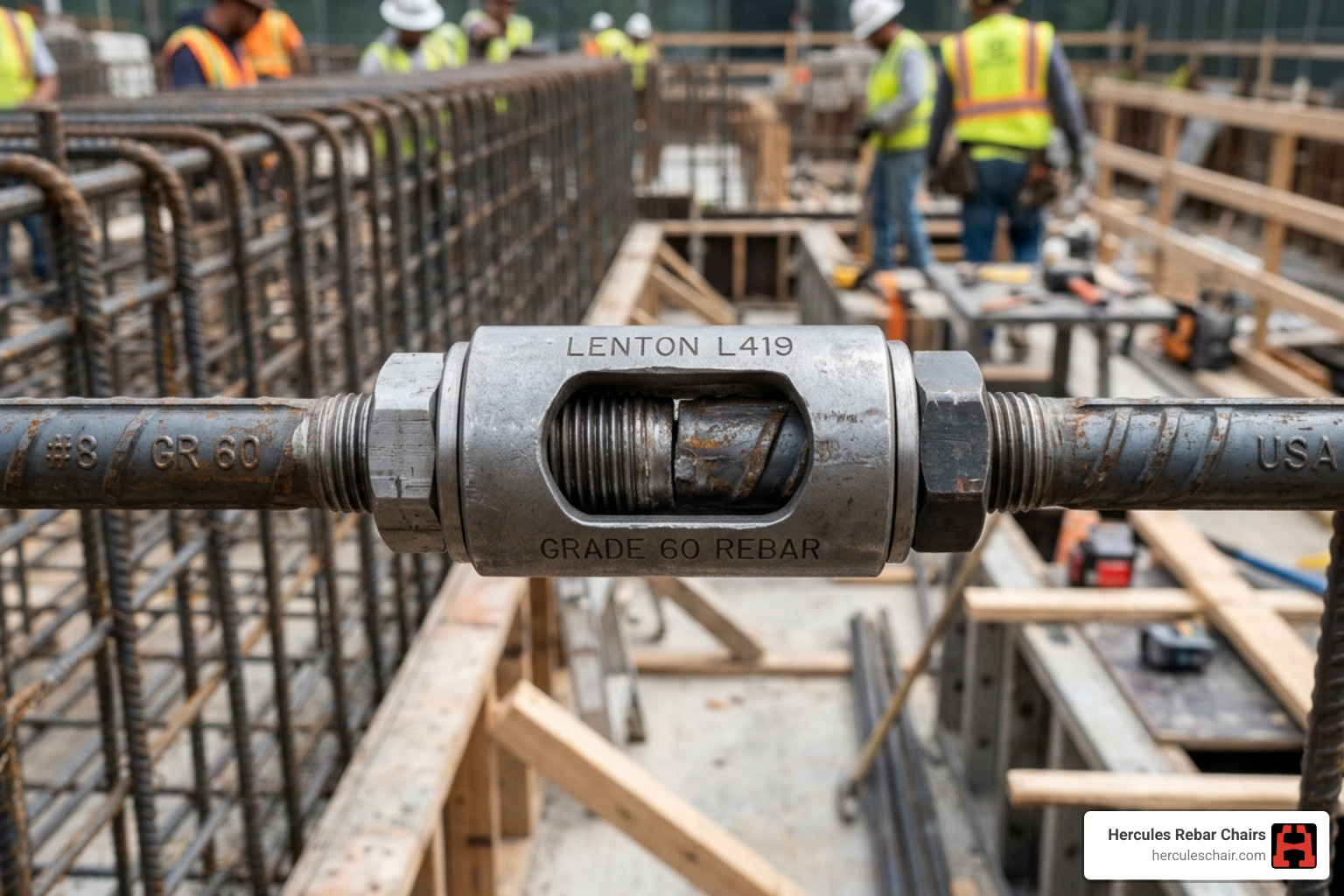
Threaded systems are the workhorses of the industry. These involve cutting or forging threads onto the end of the rebar, which then screw into a central sleeve.
Standard smooth threaded couplers often follow NC (National Coarse) specifications. For example, a #4 bar typically uses a 1/2-13 NC thread, while a massive #11 bar utilizes a 1-3/8-6 NC thread. These are available in sizes ranging from #4 all the way up to #18. Because they provide a very tight connection, they are excellent for projects requiring high precision. You can find more on these at Mechanical Rebar Splicing Systems | Serving NJ, NY, PA, and CT.
Shear Bolt and Tapered Reinforcing Bar Couplers
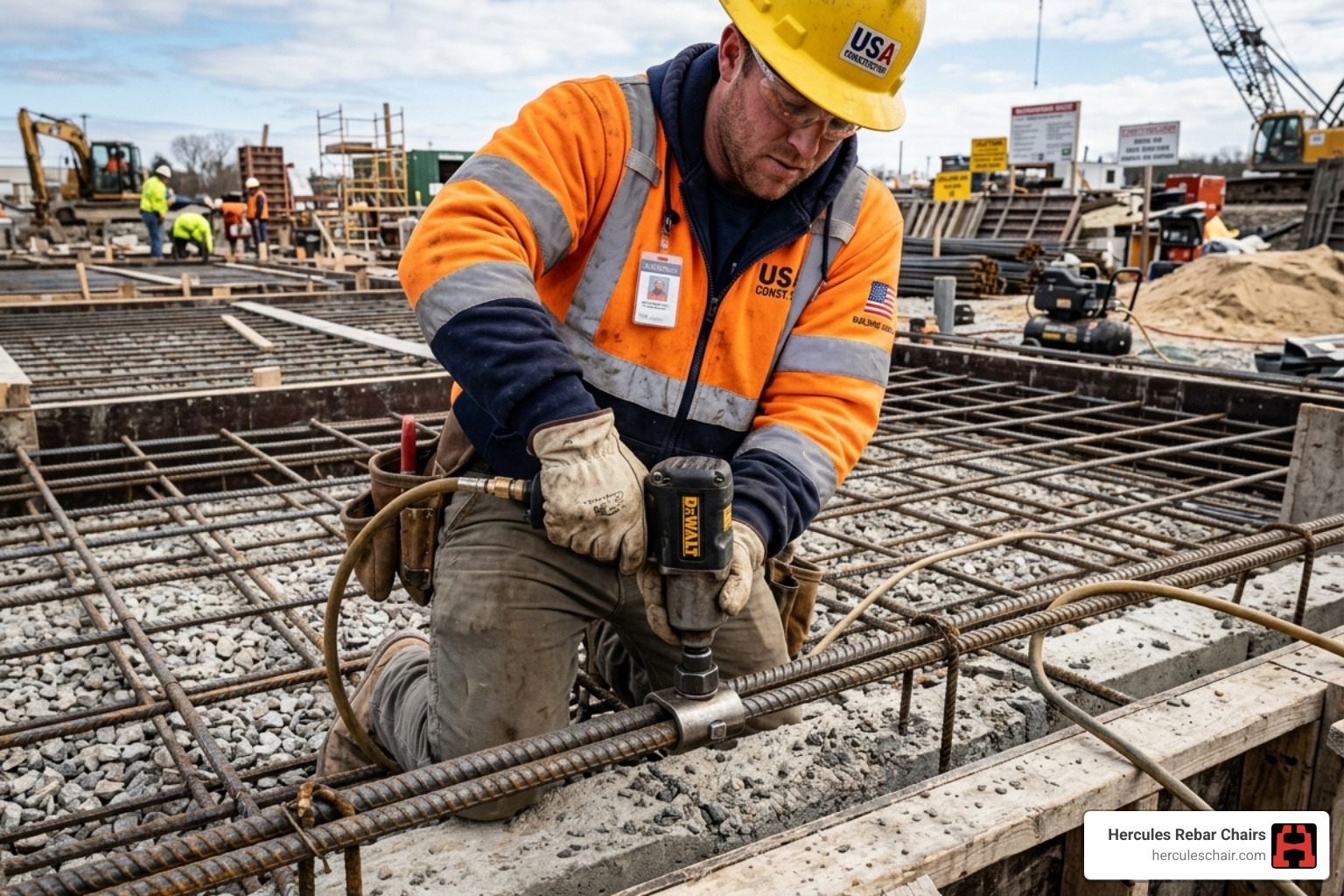
If you don’t want to deal with threading machines on-site, shear bolt couplers (like the Bar Lock® system) are a lifesaver. These use a thick-walled tube and special lock-shear bolts. As you tighten the bolts with an impact wrench, the serrated grip rails inside the coupler embed themselves into the rebar. Once the proper torque is reached, the bolt heads literally shear off, providing a built-in visual verification that the connection is secure.
Tapered couplers, like Taper-Lock®, use a specialized thread that narrows toward the end. This design makes it easier to “find” the thread during assembly and provides a high-strength connection that meets ACI 318 Type 2 standards. To see how these tools stack up against each other, see our a comprehensive guide to comparing rebar connection tools.
Performance Standards and Seismic Applications
“Good enough” doesn’t cut it. Reinforcing bar couplers must meet strict regulatory standards to ensure they won’t fail under pressure.
- ACI 318 Type 1: Must exceed 125% of the specified yield strength of the bar.
- ACI 318 Type 2: Must develop the full specified tensile strength of the spliced bar. This is the “gold standard” for seismic applications.
- ICC-ES ER-319: This is a common evaluation report that proves a system meets International Building Code (IBC) requirements.
For example, the Bar Lock® S/CA series is known to exceed 135% of the specified yield of Grade 60 rebar, while the L-Series can exceed 160%. This makes them ideal for seismic loading, where the structure must absorb and dissipate energy without the splices unzipping. Understanding these requirements is as critical as knowing how to master the rebar splice length formula.
Installation Requirements and Best Practices
Proper installation is the difference between a structural masterpiece and a safety hazard. For mechanical couplers like the Bar Lock® XL-Series, the process is straightforward but requires specific tools.
- Preparation: No bar-end prep is needed for shear bolt systems, but the bars should be relatively clean.
- Insertion: Slide the first bar into the coupler until it hits the center stop pin. Hand-tighten the bolts. Repeat for the second bar.
- Torquing: Use a high-quality 1-inch pneumatic impact wrench (for sizes #8-#18). You’ll need roughly 100 psig of air flow and 185 CFM.
- Pattern: Tighten the bolts in a random alternating pattern—just like you’re tightening the lug nuts on your truck.
- Shear Off: Continue tightening until all the bolt heads shear off. If the head is gone, the torque is right.
For bars with special finishes, like epoxy or galvanized coatings, ensure the coupler finish matches to prevent corrosion. Plain steel, epoxy, and hot-dip galvanized finishes are standard across most sizes from #4 to #18. For more details on these systems, you can view the Bar Lock® Couplers System | Order Bar Lock® Couplers Online – Dayton Superior page.
Frequently Asked Questions about Splicing Solutions
What rebar sizes and finishes are compatible with mechanical couplers?
Most systems are incredibly versatile. Standard couplers are available for rebar sizes #4 (13mm) through #18 (57mm). Regarding finishes, you can find them in plain steel, epoxy-coated (for bridges and coastal areas), hot-dip galvanized, and even Stainless Steel 2205 for extremely corrosive environments.
How do transition and weldable couplers differ?
A transition coupler is used when you need to join two different bar sizes (e.g., a #9 bar to a #11 bar). A weldable coupler (or weldable half-coupler) features a chamfered end designed to be welded directly to structural steel members, such as piles, beams, or weld plates. These are common in hybrid steel-concrete structures or precast applications.
What are the cost benefits of couplers over lap splicing?
While a coupler costs more than a piece of wire and a prayer, it saves money elsewhere. You reduce the total steel tonnage by eliminating long lap lengths. You also lower labor costs because assembly is often faster, and you eliminate the complex engineering time spent on rebar splice length calculations. According to data from White Cap, couplers are available in quantities ranging from single units to 1000-unit skids, allowing for flexible project scaling.
Conclusion
At Hercules Rebar Chairs, we know that the strength of your concrete depends on the precision of your support and the integrity of your steel. Whether you are working on a massive bridge deck or a high-rise foundation, using the right reinforcing bar couplers ensures your project is code-compliant, efficient, and built to last.
We’ve spent years becoming “America’s #1” by providing the industry with over 14 million units of high-quality concrete supports. While the couplers hold your steel together, our red rebar chairs keep it exactly where it needs to be during the pour. To see our full range of splicing accessories and supports, visit our products splicer page. Let’s build something strong together.