

What You Need to Know About 3/4 Rebar 10 ft Before Your Next Pour
If you’re sourcing 3/4 rebar 10 ft for an upcoming concrete pour, here’s the quick answer:
| Spec | Detail |
|---|---|
| Trade Size | #6 |
| Diameter | 3/4 inch (0.75″) |
| Length | 10 feet |
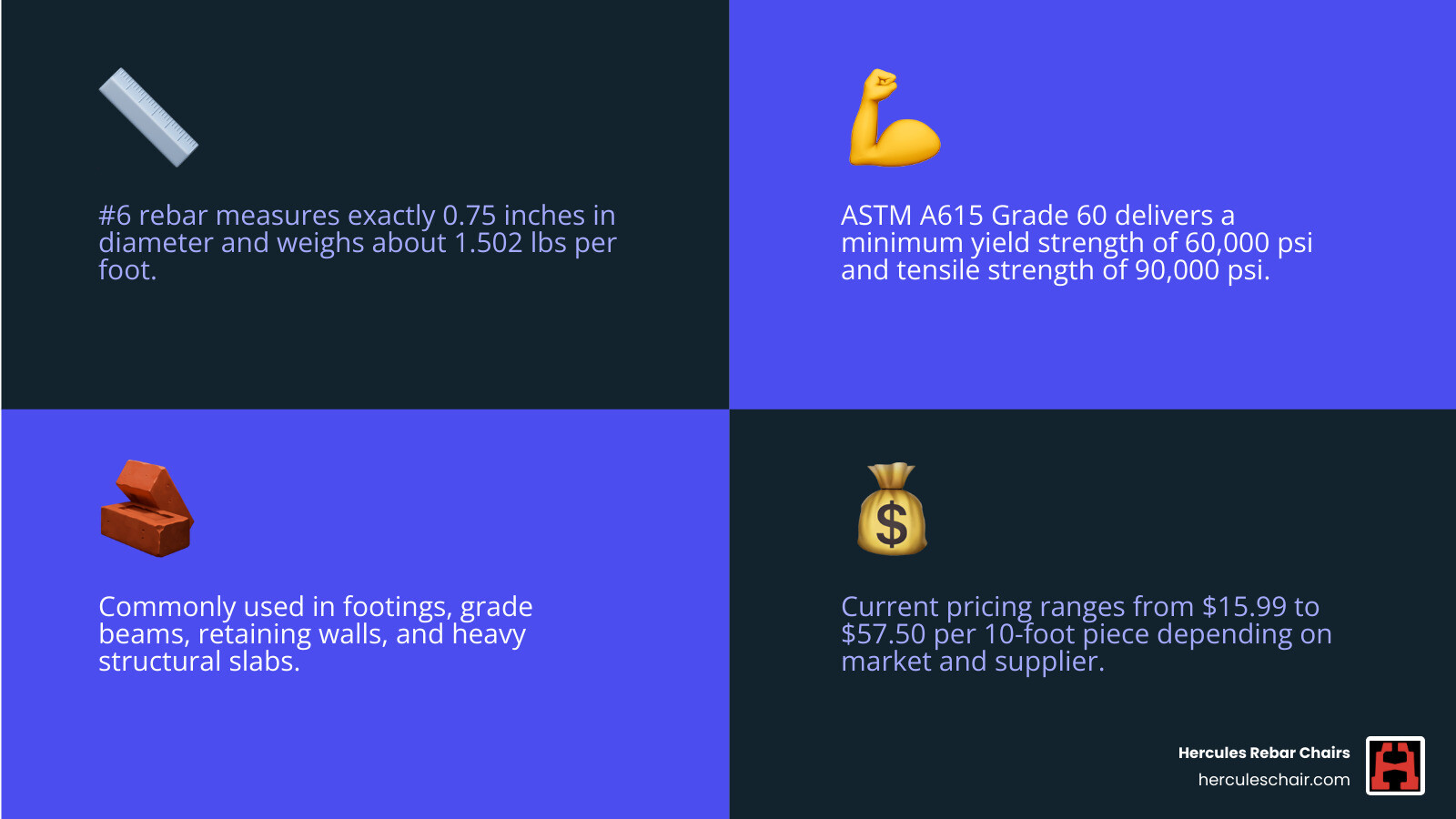
| Weight | ~15 lbs per piece (1.502 lbs/ft) |
| Common Grade | ASTM A615 Grade 60 |
| Yield Strength | 60,000 psi minimum |
| Tensile Strength | 90,000 psi minimum |
| Typical Price (2026) | $15.99 – $57.50 per piece |
| Common Uses | Footings, grade beams, retaining walls, heavy slabs |
That’s where a lot of pours go wrong.
Contractors often focus on sourcing the right rebar size and grade, then lose time and money on poor placement, wrong cover depth, or bars that shift during the pour. This guide walks you through everything you need — specs, applications, pricing, and installation basics — so you can order with confidence and pour with precision.
I’m Jordan Harris, a licensed Professional Engineer with a background in large-scale concrete and steel structures, and today I work with T.J. Harris Company developing rebar support products used on job sites across the country — including applications where 3/4 rebar 10 ft is a go-to choice for heavy structural work. Let’s break down exactly what this bar is, where it belongs, and how to use it right.
3 4 rebar 10 ft terms to learn:
What 3 4 rebar 10 ft Actually Means
When we talk about 3 4 rebar 10 ft, we are looking at a heavy-duty reinforcement bar that serves as the backbone for significant structural concrete. In the industry, this is officially known as “Trade Size #6.” The numbering system is actually quite simple: the number represents how many eighths of an inch make up the diameter. So, #6 is 6/8″, which simplifies to 3/4 of an inch.
These bars are typically made from carbon steel and feature “deformations”—those raised ridges you see along the surface. These aren’t just for decoration; they help the concrete “grip” the steel, creating a mechanical bond that allows the two materials to work together. While concrete is incredible at resisting compression (being squished), it’s notoriously weak under tension (being pulled apart). The 3 4 rebar 10 ft provides that missing tensile strength.

3 4 rebar 10 ft vs #3, #4, and #5 bars
Choosing the right bar size is a balancing act between structural requirements and cost. As we move from #3 up to #6, the load capacity increases significantly, but so does the weight and the difficulty of bending the bars on-site.
- #3 Rebar (3/8″): Often used for light residential work like patios, walkways, or driveways. It’s easy to bend but lacks the “heft” needed for heavy loads.
- #4 Rebar (1/2″): The “goldilocks” bar for residential footings and standard slabs. You’ll see 1/2 in. x 10 ft. #4 Rebar on almost every home construction site.
- #5 Rebar (5/8″): Stepping into light commercial territory, used for larger retaining walls and heavier structural slabs.
- #6 Rebar (3/4″): This is where things get serious. 3 4 rebar 10 ft is used when the engineering specs demand high tensile resistance, such as in bridge piers, heavy industrial floors, or deep foundation grade beams.
| Rebar Size | Diameter (in) | Weight (lb/ft) | Typical Use |
|---|---|---|---|
| #3 | 0.375″ | 0.376 | Patios, Sidewalks |
| #4 | 0.500″ | 0.668 | Residential Footings |
| #5 | 0.625″ | 1.043 | Retaining Walls |
| #6 | 0.750″ | 1.502 | Commercial Foundations |
Standard dimensions, weight, and grade specs for 3 4 rebar 10 ft
A single 10-foot stick of #6 rebar weighs approximately 15.02 lbs. This weight is important for two reasons: calculating your freight costs and ensuring your crew can handle the material safely.
Most 3 4 rebar 10 ft found in the USA is manufactured to ASTM A615 Grade 60 standards. This means it has a minimum yield strength of 60,000 psi and a tensile strength of at least 90,000 psi. In some specialized industrial tests, #6 rebar has even shown tensile strengths ranging from 95,000 to 118,000 psi. These specs ensure that the steel will stretch slightly under extreme loads rather than snapping suddenly, which is a critical safety feature in building design.
Specs That Matter Before You Buy 3 4 rebar 10 ft
When you order 3 4 rebar 10 ft, you aren’t just buying “metal sticks.” You are buying a specific engineering component. You need to look for consistent rib patterns and ensure the bars are free from excessive flaking rust (though a little surface rust is actually helpful for the concrete bond).
Length tolerance is also a factor. While a “10 ft” bar is the standard, slight variations can occur during cutting at the mill. If your project requires exact precision, you may need to account for a small margin or plan for lapping and splicing.

Why ASTM A615 Grade 60 is the common benchmark
ASTM A615 is the standard specification for deformed and plain carbon-steel bars for concrete reinforcement. Grade 60 has become the industry benchmark because it offers the best balance of strength and ductility for most modern construction codes.
Whether you are pouring a thick commercial slab or a structural column, Grade 60 provides the reliability that inspectors look for. It’s the “safe bet” for engineers because its properties are highly predictable under stress.
Steel vs fiberglass options for similar reinforcement needs
While carbon steel is the king of the job site, there are times when you might consider alternatives like 3EQ 10 mm 10 ft. Fiberglass Rebar.
Fiberglass (GFRP) rebar is completely corrosion-resistant, making it a favorite for coastal projects where salt air would eat through standard steel in years. It is also significantly lighter than steel, which can save on labor. However, fiberglass cannot be bent in the field—you have to order pre-bent shapes from the factory. For most standard structural projects using 3 4 rebar 10 ft, traditional steel remains the more versatile and cost-effective choice.
Where 3/4 Inch Rebar Is Used and Why It Adds Strength
The primary job of 3 4 rebar 10 ft is to handle the heavy lifting. Because of its 3/4-inch thickness, it is significantly stiffer than smaller bars. This makes it ideal for:
- Grade Beams: The deep concrete beams that support the weight of a building’s walls.
- Retaining Walls: Especially those over 6 feet tall that must hold back massive amounts of soil pressure.
- Bridge Decks and Piers: Where vibration and heavy vehicle loads are constant.
- Heavy Equipment Pads: In industrial settings where machinery creates intense point loads.
Best project types for 3 4 rebar 10 ft
If you are building a simple backyard shed, #6 rebar is likely overkill. However, we recommend 3 4 rebar 10 ft for foundation work involving poor soil conditions or heavy multi-story loads. It is also the go-to for vertical reinforcement in masonry cores (filling the holes in CMU blocks) when building high-strength walls.
How #6 rebar improves crack control and structural durability
Concrete shrinks as it cures. It also expands and contracts with the seasons. Without reinforcement, this movement leads to large, structural cracks. The placement of rebar distributes these stresses throughout the slab.
By using a thicker bar like the 3 4 rebar 10 ft, you increase the “bond area.” The more surface area the steel has in contact with the concrete, the better it can pull the structure together, keeping those tiny hairline cracks from becoming major structural failures.
Price Range, Availability, and Buying Options
As of May 2026, the market for steel remains dynamic. Pricing for 3 4 rebar 10 ft can vary wildly based on your location and the quantity you purchase.
- Individual Pieces: If you’re just grabbing a few sticks for a small repair, expect to pay between $15.99 and $25.00 at a local hardware store like Shell Lumber.
- Specialty/High-End: Some specialized suppliers or regions with high freight costs might list pieces as high as $57.50.
- Bulk Orders: For large projects, buying by the ton from a steel distributor will significantly drop the “per piece” price.
What 3/4 x 10 ft rebar typically costs in 2026
When budgeting for your 2026 projects, always factor in a 10-15% buffer for steel price fluctuations. Regional availability is the biggest driver of cost. If you are in a state like Texas or Florida with high construction volume, prices are often more competitive than in remote areas where shipping Rebar 3/4 X 10′ adds a premium.
Where to purchase 3/4 inch x 10 ft rebar
You have a few main avenues for sourcing:
- Big Box Stores: Home Depot and Lowe’s usually stock 10-foot lengths, though they may carry more #3 and #4 than #6.
- Local Lumber Yards: Places like AW Graham Lumber or Ring’s End often have better structural inventories.
- Steel Service Centers: If you need more than 50 pieces, go straight to a distributor. They can often provide mill certs for your inspector.
How to Choose and Install 3/4 Inch Rebar Correctly
Installation is where the “rubber meets the road”—or rather, where the steel meets the mud. The most common mistake we see is rebar being placed directly on the ground. If the steel touches the dirt, it will moisture-wick, rust, and eventually cause the concrete to “spall” or pop off.
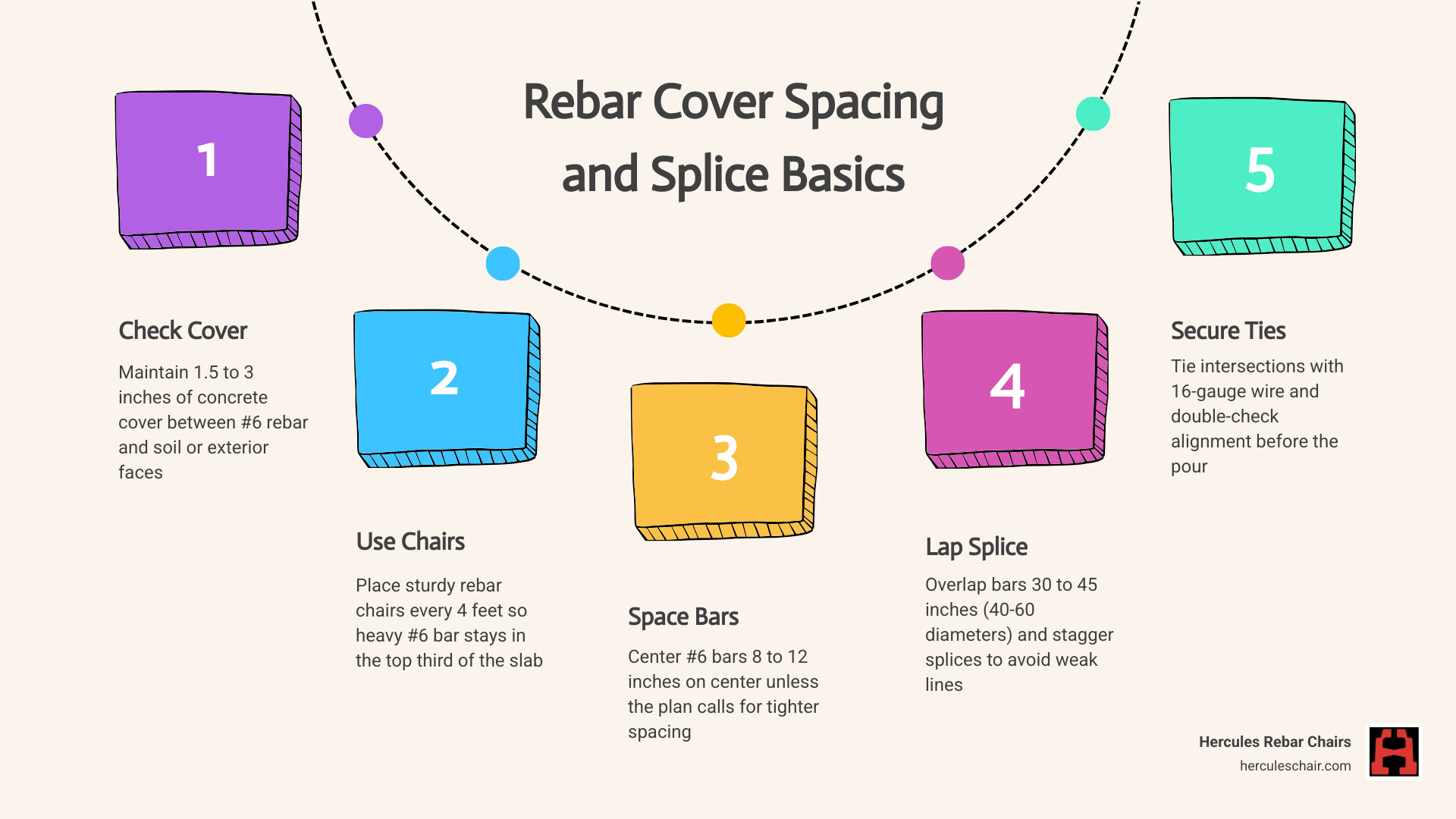
To avoid this, you must use rebar chairs. At Hercules Rebar Chairs, we manufacture the bright red supports that keep your 3 4 rebar 10 ft exactly where it belongs—usually in the top third or center of the pour, depending on the engineering. Our chairs ensure you maintain the proper “concrete cover” (the distance between the steel and the edge of the concrete), which is vital for code compliance and long-term durability.
Selection checklist for the right bar, grade, and environment
Before you finalize your order, run through this quick checklist:
- Does the plan call for Grade 60? (Most modern projects do).
- How many sticks do I need? Use a rebar calculator to account for waste and overlaps.
- Do I have the right supports? Heavy #6 bar requires sturdy chairs that won’t crush under the weight of the steel and the crew walking on it.
- What is the lap splice requirement? Usually, you need to overlap bars by about 40 to 60 times the diameter (for #6, that’s roughly 30 to 45 inches).
Installation mistakes to avoid with 3 4 rebar 10 ft
- The “Hook and Pull” Method: Don’t let your crew lay the rebar on the ground and try to “hook” it up into the wet concrete with a shovel. It never stays in the right place. Use proper chairs from the start.
- Poor Tying: #6 rebar is heavy. If you don’t use enough tie wire at the intersections, the bars will shift when the concrete pump starts blasting material into the forms.
- Ignoring the Splice: If you are running a long footing, ensure your splice lengths meet the local building code. A weak splice is a weak point in your entire foundation.
Frequently Asked Questions About 3 4 rebar 10 ft
How much does one 10 ft piece of #6 rebar weigh?
A single 10-foot stick of 3 4 rebar 10 ft weighs exactly 15.02 lbs. This makes it light enough for one person to carry a few sticks at a time, but heavy enough that a full bundle of 50-100 bars will require a forklift or crane.
Is #6 rebar too much for a patio or driveway?
In most cases, yes. For a standard 4-inch residential driveway, #3 or #4 rebar is usually sufficient. Using 3 4 rebar 10 ft for a patio is like using a sledgehammer to hang a picture frame—it’s overkill and a waste of money. However, if you are parking a semi-truck or heavy tractor on that slab, the #6 bar might be exactly what the engineer ordered.
Can 3/4 inch rebar be used in corrosive or coastal environments?
Standard carbon steel 3 4 rebar 10 ft will rust if exposed to salt and moisture. For coastal work, you should look into epoxy-coated rebar, galvanized steel, or the fiberglass alternatives mentioned earlier. Regardless of the material, maintaining at least 3 inches of concrete cover in high-salt environments is a must.
Conclusion
Mastering the use of 3 4 rebar 10 ft is a milestone for any serious builder. It represents a step up into heavy-duty structural work that is built to last for generations. By understanding the specs—from its 1.502 lb/ft weight to its Grade 60 strength—you ensure your project starts on a solid foundation.
But remember, the best steel in the world is useless if it’s sitting in the mud at the bottom of your pour. Use a length calculator to get your quantities right, and always support your #6 bars with high-quality, American-made Hercules Rebar Chairs. We’ve sold over 14 million units because they save contractors time and keep projects code-compliant.
Ready to start your next big pour? Check out our 3 4 rebar for sale guide to find the best local suppliers and get your project off the ground—literally.