

Why Concrete Formwork Accessories Are Essential to Every Pour
Concrete formwork accessories are the hardware components — ties, wedges, brackets, stakes, and clamps — that hold your forms in place while concrete is poured and cured. Without them, forms shift, walls blow out, and pours fail.
Here are the core accessory types you’ll encounter on most jobs:
| Accessory Type | Primary Function |
|---|---|
| Snap ties | Hold opposing form panels at the correct wall thickness |
| Coil & loop ties | Connect heavy-duty forms under high concrete pressure |
| Wedges & brackets | Lock ties in place and distribute load across walers |
| Stakes & screed hooks | Anchor flatwork forms and set slab elevation |
| Overhang brackets | Support bridge deck and slab edge formwork |
| Climbing cones | Handle shear and lateral forces in climbing formwork |
Every structural concrete pour depends on these components working together. A single failure point — a loose wedge, an undersized tie, a missing clamp — can compromise the entire form and the structure behind it.
The construction industry has developed hundreds of specialized accessories to address this. One leading supplier alone stocks over 940 concrete formwork and falsework products, covering everything from light residential walls to heavy infrastructure bridges. That range exists because no two pours are the same.
I’m Jordan Harris, a licensed Professional Engineer with a background in large-scale concrete and structural projects, and through my work with concrete formwork accessories both in the field and in product development at T.J. Harris Company, I’ve seen how the right hardware separates a clean, efficient pour from a costly failure. In this guide, I’ll walk you through every major accessory category so you can make confident, code-compliant choices on your next project.
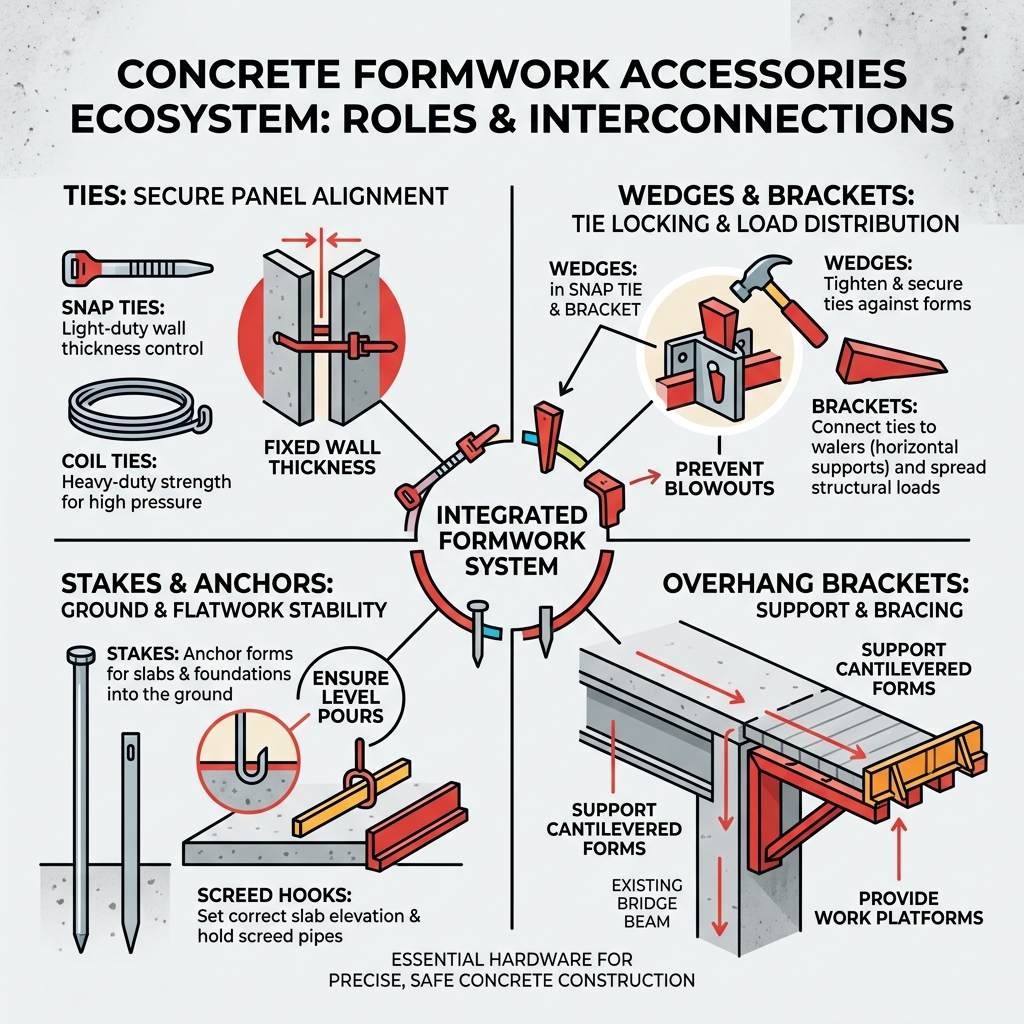
Concrete formwork accessories terminology:
The Role of Concrete Formwork Accessories in Modern Construction
In modern construction, the “form” is only half the story. The real work is done by the hardware that keeps that form from exploding under the weight of wet concrete. When we pour a wall, the concrete exerts hydrostatic pressure—a heavy, outward force that increases with the height of the pour. Concrete formwork accessories are engineered specifically to counteract this pressure, ensuring that a 10-foot wall stays exactly 10 feet tall and perfectly plumb.
These accessories manage load distribution by transferring the weight of the concrete from the plywood or steel face to the walers (horizontal supports) and studs (vertical supports). Without high-quality hardware, the forms would bow or “pillowing” would occur, leading to structural weaknesses and an unsightly finish. If you want to dive deeper into how these supports function within the broader scope of a project, check out our guide on everything you need to know about concrete form supports.

Material Durability: Steel vs. Plastic Concrete Formwork Accessories
When selecting your concrete formwork accessories, the material choice often comes down to a balance between cost, durability, and the specific requirements of the finish.
- Galvanized Steel: This is the industry standard for high-load components like snap tie wedges, brackets, and heavy-duty ties. Steel offers the highest tensile strength and is often galvanized to prevent rust. For example, many heavy-duty snap tie brackets are fabricated from high-strength steel to ensure they don’t deform under pressure.
- Plastic: High-density plastic is frequently used for “lost” accessories—parts that stay embedded in the concrete. Plastic cones on the ends of snap ties act as spreaders to maintain wall thickness and allow for a clean “breakback” of the metal tie. Plastic is also common in rebar chairs and spacers because it won’t rust or bleed through the surface of the finished concrete.
- 11 Gauge Steel: Often used for wire ties and smaller clips, providing enough flexibility for installation while maintaining a high safe working load.
Why Precision Accessories are Essential for Safety
Safety in concrete forming isn’t just about wearing a hard hat; it’s about the “Safe Working Load” (SWL) of your hardware. A standard snap tie, for instance, typically has an SWL of 2,250 lbs. If a contractor uses fewer ties than specified by the engineering plan, the remaining ties are forced to carry loads beyond their capacity.
Precision engineering ensures that every bracket fits the lumber perfectly. If a wedge is too loose or a bracket doesn’t sit flush against the waler, the load isn’t distributed evenly. This can lead to localized failures, blowouts, and, in the worst-case scenarios, structural collapse during the pour. Using code-compliant, precision-made accessories is the only way to guarantee the safety of the crew and the integrity of the building.
Essential Tie Systems: Snap, Coil, and Loop Ties
Ties are the “connective tissue” of formwork. They pass through the concrete and hold the two sides of the form together. While there are many variations, three types dominate the job site: snap ties, coil ties, and loop ties. Understanding the nuances of these is vital for any builder. You can find more on this in our article beyond the mix: what every builder needs to know about accessories.
Understanding Snap Tie Variations: Short, Long, and Odd Ends
Snap ties are perhaps the most common accessory in light-to-medium residential and commercial wall forming. They feature an integral head and an anti-turn device to ensure that when it’s time to strip the forms, the tie breaks off cleanly at a nominal 1″ breakback point inside the concrete.
The “end” length refers to how far the tie extends past the plywood form to accommodate different bracing methods:
- Short End Snap Ties: Usually 4-3/4″ long. These are designed for use with a single horizontal waler and a Jahn-style bracket. They are a staple for 8-inch or 12-inch walls.
- Long End Snap Ties: Typically 8-1/4″ long. These provide extra room for double waler systems or “strongbacks,” which are used when extra reinforcement is needed for taller or heavier pours.
- Odd End Snap Ties: Used for specialized forming where the lumber thickness differs on each side of the wall.
Heavy-Duty Coil and Loop Ties for High-Pressure Pours
For projects that go beyond standard wall heights—like bridge piers or industrial foundations—we turn to coil and loop ties.
- Coil Ties: These feature a coarse, self-cleaning internal thread. They are incredibly versatile because they can be used with coil rods of almost any length. They are often used in “heavy forming” categories where the pressure exceeds the 2,250 lb limit of a standard snap tie.
- Loop Ties: Often sold in massive quantities (like 5,000 unit bundles), loop ties are made of 16-gauge steel. They are designed for “stay-in-place” or light-duty modular forms. They are simple to install and cost-effective for high-volume, low-pressure applications.
Hardware for Stability: Brackets, Wedges, and Clamps
If ties are the tendons, then brackets and wedges are the joints. These pieces of hardware lock the ties to the external lumber, creating a rigid skeleton. For a complete list of what you should have on hand, see the concrete contractors toolkit.
Maximizing Efficiency with Reusable Concrete Formwork Accessories
Efficiency on a job site is often measured by how quickly you can “strip” the forms and move to the next section. Reusable hardware like Jahn A and Jahn C Brackets are game-changers here.
- Jahn A Brackets: These are designed for single waler applications. They slip over the end of a snap tie and lock into place with an eccentric wedge. Because they don’t require nailing to the waler, they can be popped off in seconds once the concrete is cured.
- Jahn C Brackets: These are used for vertical studs or double waler applications. They provide the same quick-release benefits as the “A” bracket but are shaped to handle different lumber orientations.
- Snap Tie Wedges (Pigs Foot): These are simple, high-strength steel wedges used to tension snap ties against the walers. They are virtually indestructible and can be used on hundreds of pours.
Specialized Clamps and Alignment Tools
Even with the best ties and brackets, a wall can still lean. That’s where alignment tools come in:
- Turnbuckle Aligners: These allow for micro-adjustments to the vertical plumb of a wall form. By twisting the turnbuckle, you can push or pull the form into perfect alignment.
- Spreader Cleats: These are used at the top or bottom of a form to ensure the wall thickness remains consistent where ties might not be present.
- Column Clamps: Specific to square or rectangular columns, these adjustable steel arms wrap around the form to prevent the high pressure of a vertical column pour from bursting the wood.
Specialized Components for Slabs, Walls, and Bridges
Not all concrete is a vertical wall. Slabs, curbs, and bridge decks require their own set of concrete formwork accessories.
Supporting Bridge Decks and Heavy Infrastructure
Infrastructure projects like bridges require massive support structures called “falsework.”
- Overhang Brackets: These are heavy-duty steel triangles that bolt to the side of a bridge beam (steel or concrete) to support the walkway and the “overhang” portion of the deck.
- Beam Hangers: These sit on top of the bridge beams and hold the interior deck forms in place.
- Climbing Cones: In high-rise construction, “climbing formwork” moves up the building as it’s built. Climbing cones are specialized anchors that deviate shear and lateral forces—forces that standard threadbars and green concrete cannot absorb on their own. They are typically rated for shear loads up to 50 kN.
Flatwork Essentials: Stakes and Screed Hooks
For sidewalks, driveways, and floor slabs, the focus shifts to elevation and edge retention.
- Steel Stakes: Available in various lengths (12″, 18″, 24″), these are driven into the ground to hold wood or metal forms in place. High-quality stakes feature multiple nail holes for easy attachment.
- Screed Hooks: These are used to hold the “screed pipe” or rail that guides the leveling of the concrete surface. You can find them in single, double, or wire configurations depending on the precision required. For more on the reinforcement side of flatwork, read from rebar to mesh: essential reinforcement products.
Installation, Safety, and Maintenance Best Practices
The best hardware in the world won’t save a project if it’s installed incorrectly. Below is a quick reference for the capacities of common systems.
| System Component | Material | Typical Load Capacity |
|---|---|---|
| Standard Snap Tie | Steel/Plastic | 2,250 lbs (SWL) |
| Climbing Cone (15mm) | Galvanized Steel | 30 kN (Shear) |
| Climbing Cone (26mm) | Galvanized Steel | 50 kN (Shear) |
| Jahn A Bracket | High-Strength Steel | Matches Tie SWL |
Proper Installation of Snap Tie Systems
To install a standard snap tie system correctly, follow these steps:
- Drill and Thread: Drill holes through your plywood forms (standard spacing is usually 12″ or 24″ on center). Thread the snap tie through both sides.
- Place Walers: Position your horizontal 2×4 walers.
- Lock with Brackets: Slide the Jahn A bracket over the snap tie head. Ensure the bracket is seated firmly against the waler.
- Engage the Wedge: Hammer the eccentric wedge on the bracket until the form is tight. This spreads the plastic cones inside the form, locking the wall thickness.
- Pour and Strip: After the pour, once the concrete reaches a minimum strength (often 10 N/mm² for safe stripping), remove the brackets and walers.
- Breakback: Use a snap tie wrench or a hammer to “snap” the tie head off. Thanks to the anti-turn device, the tie should break exactly 1″ inside the wall, leaving a small hole that can be patched for a smooth finish.
Maintenance and Storage for Longevity
While many concrete formwork accessories are rugged, they aren’t invincible.
- Cleaning: Always scrape off excess concrete or “splatter” from brackets and wedges after stripping. Hardened concrete prevents the hardware from seating properly on the next job.
- Rust Prevention: While most items are galvanized, a light coating of form release oil can help prevent surface rust during long-term storage.
- Inspection: Check for bent wedges or cracked brackets. If a snap tie bracket’s sliding wedge is deformed, it won’t provide a secure lock, risking a blowout.
- Organization: Store ties in their original boxes (e.g., 100 pcs per carton) and keep brackets in bins. This makes inventory management easier and ensures you don’t run out of critical parts mid-pour.
Frequently Asked Questions about Concrete Formwork Accessories
Where can I buy high-quality formwork accessories and what is the typical pricing?
High-quality accessories are usually sourced from specialized construction supply houses or wholesale distributors. Pricing varies significantly by volume. For example, a single heavy-duty snap tie bracket might cost around $3.30, but if you buy in bulk (4,000+ pieces), that price can drop to approximately $2.68 per unit. Always look for suppliers that offer bulk discounts if you are managing a large-scale project.
How do snap ties work in a single waler system?
In a single waler system, the snap tie passes through the plywood and the horizontal 2×4 waler. A Jahn A bracket is placed over the tie end, and its eccentric wedge is tightened. This “pinches” the waler against the plywood. It’s an incredibly efficient system because it uses less lumber than double-waler systems and allows for faster assembly and stripping.
What are the safety considerations for climbing formwork?
The primary concern with climbing formwork is the shear force. Because the forms are suspended from the previous pour, you must use climbing cones to deviate lateral forces that the concrete and threadbars cannot absorb. Ensure the concrete has reached the specified minimum strength (usually 10 N/mm² or higher) before jumping the forms. Only qualified and experienced workmen should handle the installation of climbing hardware.
Conclusion
Building a structure that lasts starts with the details. While the concrete mix and the rebar get most of the glory, the concrete formwork accessories are the unsung heroes that ensure those materials end up exactly where they belong. By choosing the right ties, brackets, and stakes, you aren’t just building a wall; you’re building a foundation for a safe and efficient job site.
At Hercules Rebar Chairs, we understand the importance of precision and reliability. As America’s #1 manufacturer of concrete supports, we’ve sold over 14 million units to contractors who value time, money, and code compliance. Whether you’re setting up a residential foundation or a complex bridge deck, our iconic red rebar chairs and footer stands are designed to work seamlessly with your formwork hardware to ensure the longevity of your project.
Ready to secure your next pour? Order Hercules 3-Bar Footer Stands today and experience the difference that professional-grade supports make.