

Why Concrete Reinforcing Accessories Make or Break Your Pour
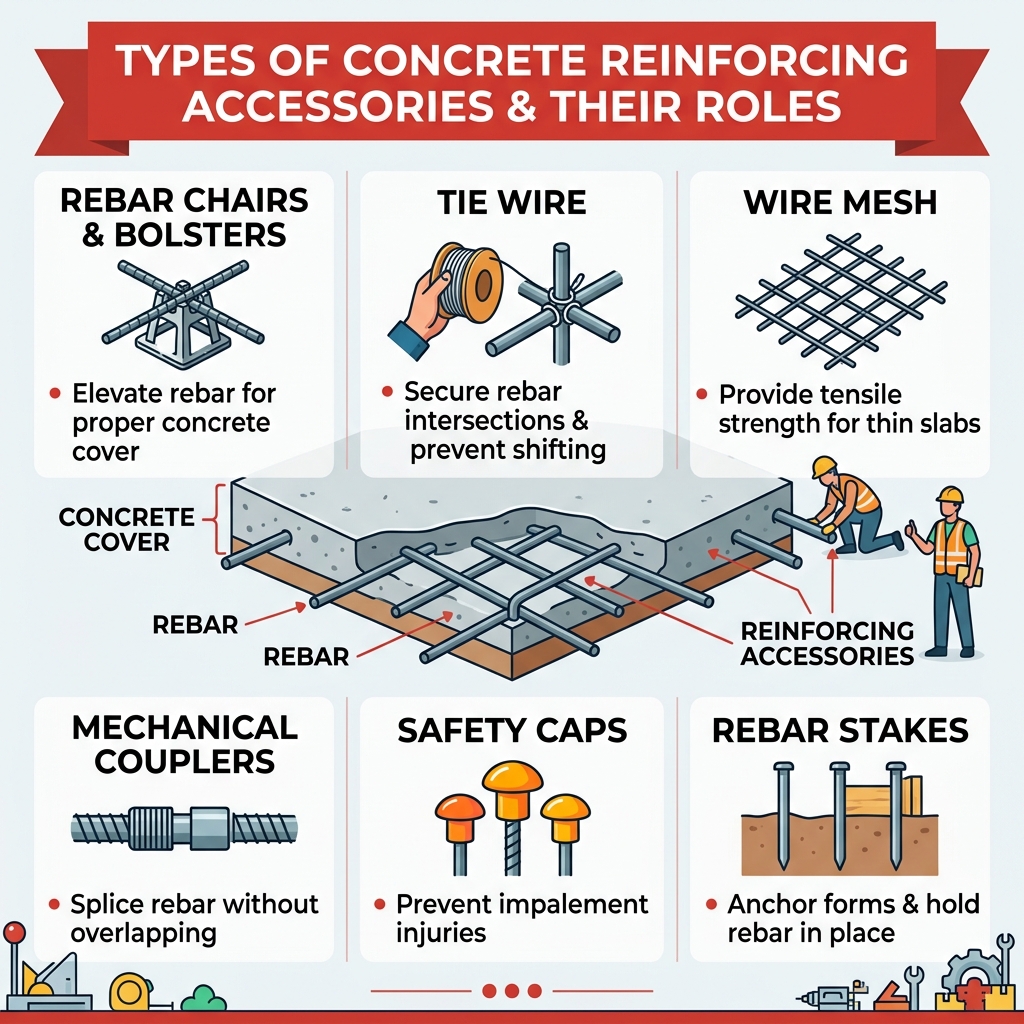
Concrete reinforcing accessories are the hardware, supports, ties, couplers, and safety products that hold rebar and wire mesh in the right position — before and during a concrete pour.
Here’s a quick overview of the most common types:
| Accessory Type | What It Does |
|---|---|
| Rebar chairs and bolsters | Elevate rebar to the correct height for proper concrete cover |
| Wire mesh and tie wire | Connect and secure rebar intersections |
| Mechanical couplers | Splice two pieces of rebar without overlap |
| Safety caps | Cover exposed rebar ends to prevent impalement injuries |
| Rebar stakes | Anchor forms and hold rebar in place |
| Tying tools | Speed up the process of securing rebar connections |
Get these accessories right, and your concrete pour has a fighting chance at meeting code and lasting decades. Get them wrong, and you’re looking at rework, failed inspections, or worse — structural failure down the road.
The difference between a solid slab and a compromised one often comes down to the small stuff. Whether it’s maintaining the correct concrete cover required by ACI 318, keeping rebar from shifting during a pour, or safely capping exposed bar ends on a busy job site — every accessory in your toolkit has a job to do.
I’m Jordan Harris, a licensed Professional Engineer with a master’s in structural engineering and hands-on experience designing large-scale concrete structures. As part of the T.J. Harris Company team, I work every day on concrete reinforcing accessories — specifically rebar support systems engineered to perform when it counts.
Essential Types of Concrete Reinforcing Accessories
When we talk about the “skeleton” of a building, we are talking about the reinforcement steel. But even the strongest skeleton needs joints and supports to stay upright. In concrete, those “joints and supports” are the concrete reinforcing accessories. Without them, rebar is just heavy sticks of metal sitting in the mud.
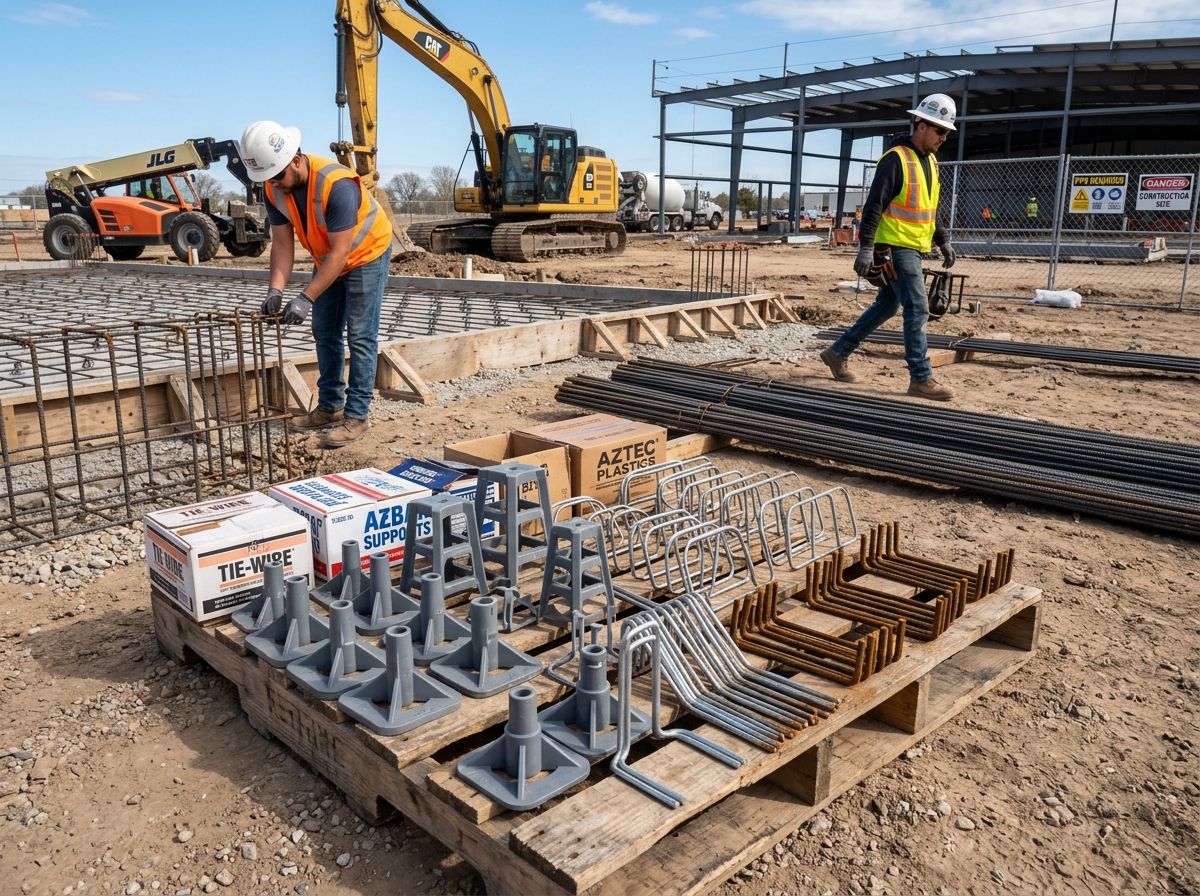
To build something that lasts, you need a full toolkit of essential reinforcement products. This ecosystem includes everything from the ties that bind the steel to the chairs that lift it.
Key players in this category include:
- Slab Bolsters: Long, continuous supports used to maintain the height of reinforcing steel in concrete slabs.
- High Chairs: Individual supports used to hold upper layers of rebar in thick slabs or deep beams.
- Mesh Chairs: Specialized supports designed specifically to grip and elevate wire mesh (remesh) so it doesn’t end up at the bottom of the pour.
- Spacer Wheels: Often used in vertical applications like columns or walls to ensure the rebar remains centered and maintains the required “concrete cover” from the forms.
- Beam Bolsters: Heavy-duty continuous supports designed to carry the significant weight of rebar cages in structural beams.
Rebar Supports and Slab Bolsters
The primary goal of any support is elevation and stability. If your rebar isn’t at the right height, it isn’t doing its job. In fact, if rebar is placed too low in a slab, the structural capacity of that slab can drop significantly.
Everything you need to know about rebar supports starts with understanding the difference between individual and continuous supports. Individual high chairs are great for point-loading and navigating tight spaces, while continuous slab bolsters provide a steady line of support that prevents the steel from sagging between points. Our Hercules Rebar Chairs are engineered to provide this stability with a “never-fail” mentality, ensuring that once you set your steel, it stays exactly where you put it.
Ensuring Structural Integrity and Longevity
Structural integrity isn’t just a buzzword; it’s the difference between a bridge that stands for a century and a parking garage that needs millions in repairs after ten years. Concrete reinforcing accessories play a silent but violent role in this longevity.
Achieving Optimal Concrete Cover and Spacing
“Concrete cover” refers to the distance between the outer surface of the concrete and the reinforcing steel. This layer of concrete protects the steel from moisture, chlorides, and oxygen—the three ingredients for rust.
When rebar is positioned with uniform elevation and precise spacing, the load is distributed evenly across the structure. This is a core requirement of ACI 318 (the American Concrete Institute’s building code). If the rebar is displaced during the pour—perhaps because a worker stepped on it or the vibration of the concrete moved it—the cover is compromised. Using high-quality concrete reinforcing accessories ensures that the “theoretical” design matches the “actual” build.
Material Selection for Rebar Supports
Choosing the right material for your accessories is just as important as the rebar itself. In the old days, people used rocks or “dobies” (concrete blocks). Today, we have much better options.
| Feature | Plastic Supports (Hercules Style) | Metal/Steel Supports |
|---|---|---|
| Corrosion Resistance | 100% Rust-proof; won’t bleed through concrete | Can rust if cover is thin; may require galvanizing |
| Conductivity | Non-conductive | Conductive |
| Weight | Lightweight and easy to transport | Heavy and bulky |
| Bonding | Designed to bond with concrete | Can create “shadows” or voids if not shaped correctly |
| Best For | Slabs, decks, and corrosive environments | Heavy industrial mats and bridge decks |
While metal supports have their place in heavy-duty bridge construction, the industry has seen a massive shift toward plastic. The role of plastic rebar chairs has expanded because they offer superior corrosion resistance. You don’t want “rust spots” appearing on the ceiling of a beautiful new structure because a metal chair started to oxidize.
Furthermore, the ultimate guide to rebar chair sizing highlights that precision matters. Whether you need a 1-inch lift for a sidewalk or a 3-inch lift for a heavy foundation, using a chair specifically sized for that height is critical for ACI compliance.
Maximizing Job Site Efficiency and Compliance
Time is money on a job site. If your crew is fumbling with flimsy supports or re-tying rebar that shifted, you’re losing profit.
Streamlining Rebar Placement with Quality Supports
Quality concrete reinforcing accessories are designed for speed. For example, a chair that “snaps” onto the rebar allows a worker to walk along a grid and secure supports in seconds, rather than minutes.
When you use Hercules Rebar Chairs, you’re benefiting from:
- Faster Setup: Our chairs are designed for intuitive, quick placement.
- Consistent Elevation: No more guessing if the bar is level; the chair does the work for you.
- Reduced Rework: Because our supports are stable, the rebar doesn’t move when the concrete is pumped in.
- Identifiability: Our signature red color makes it easy for inspectors to see that the supports are in place from a distance.
Adhering to Code and Safety Standards
Compliance isn’t optional. Most projects in the USA must adhere to the International Building Code (IBC) and ACI 318. For infrastructure projects, DOT (Department of Transportation) and AASHTO approvals are the gold standard.
But safety isn’t just about the structure; it’s about the people. OSHA requires that all protruding reinforcing steel be guarded to eliminate the hazard of impalement. This is where safety accessories like:
- Mushroom Caps: Simple plastic caps for #3 to #8 rebar.
- Impalement Covers: Larger, steel-reinforced troughs or caps designed to withstand the impact of a falling worker.
Using these concrete reinforcing accessories doesn’t just keep you legal—it keeps your crew going home safe at the end of the day.
Specialized Accessories: Splicing and Forming
Sometimes, you can’t just overlap rebar (lap splicing) because the cage is already too congested. This is common in high-rise columns or bridge piers. In these cases, we turn to mechanical couplers.
Mechanical Rebar Couplers
Systems like the Bar Lock® Coupler provide a Type 2 mechanical splice. These are incredibly useful because they require no special bar-end preparation (like threading or forging). You simply slide the coupler over the rebar and tighten the shear bolts until the heads snap off. This provides a visual confirmation that the connection is secure. These are ideal for seismic applications where structural integrity is non-negotiable.
Form Savers and Snap Ties
In concrete forming, we use form savers (like the D51A DBR™) to create a threaded connection point at the face of the concrete. This allows you to “save” the formwork from having holes drilled through it and makes it easy to connect the next phase of rebar later. Snap ties and spreader cleats are also essential for keeping wall forms at the correct width during the immense pressure of a concrete pour.
Frequently Asked Questions about Concrete Reinforcing
What is the difference between a rebar chair and a slab bolster?
Think of a rebar chair as a “stool” and a slab bolster as a “bench.” A chair is an individual support point, whereas a slab bolster is a long, continuous strip (usually 5 to 30 inches long) that supports the rebar along a greater distance. Bolsters are excellent for maintaining a perfectly straight line of steel in large slabs.
How do Hercules Rebar Chairs contribute to project longevity and structural integrity?
Our chairs are engineered to be “America’s #1” for a reason. By providing a stable, non-corrosive base, they ensure that the rebar stays in the exact center of the “tension zone” of the concrete. This prevents the steel from rusting and ensures the slab can handle the loads it was designed for. With over 14 million units sold, our track record for reliability is unmatched.
What are the key considerations when choosing the right rebar supports for a project?
You should consider:
- The Height: What is the required concrete cover?
- The Load: How heavy is the rebar cage? (Plastic is great for most slabs; steel is used for extreme heavy-duty bridge work).
- The Environment: Is it a coastal area? If so, use plastic or epoxy-coated accessories to prevent rust.
- The Surface: Are you pouring on vapor barrier, sand, or hard ground? This determines if you need a “sand plate” or a wide-base chair.
Conclusion
At the end of the day, concrete reinforcing accessories are the unsung heroes of the construction site. They may be small, and they may eventually be buried under tons of concrete, but their impact on the safety and durability of our infrastructure is massive.
At Hercules Rebar Chairs (T.J. Harris Co.), we take that responsibility seriously. We are proud to be America’s #1 choice for rebar supports, with 14 million units helping build everything from backyard patios to massive industrial warehouses. Our signature red chairs are a symbol of quality, code compliance, and time-saving efficiency.
If you are ready to ensure your next project is built to last, don’t settle for generic supports. Choose the brand that engineers and contractors trust nationwide.