

Why the Lap Splice Length for Rebar Chart Matters on Every Pour
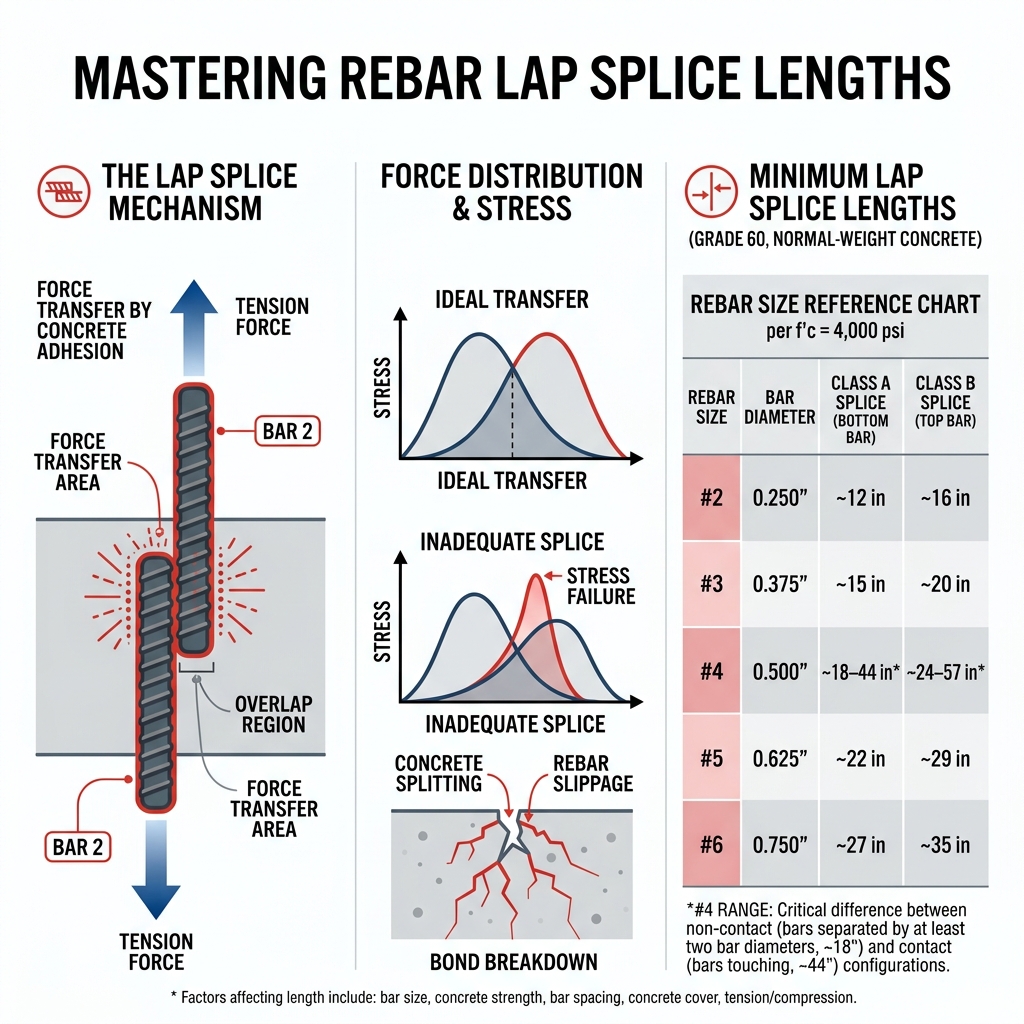
A lap splice length for rebar chart gives you the minimum overlap distance required when two rebar pieces meet — so the connection transfers load as reliably as a single continuous bar. Here are the most common minimum lap splice lengths for Grade 60 rebar in normal-weight concrete (f’c = 4,000 psi):
| Rebar Size | Bar Diameter | Class A Splice (Bottom Bar) | Class B Splice (Top Bar) |
|---|---|---|---|
| #2 | 0.250″ | ~12 in | ~16 in |
| #3 | 0.375″ | ~15 in | ~20 in |
| #4 | 0.500″ | ~18–44 in* | ~24–57 in* |
| #5 | 0.625″ | ~22 in | ~29 in |
| #6 | 0.750″ | ~27 in | ~35 in |
*#4 range reflects the critical difference between non-contact (bars separated by at least two bar diameters, ~18″) and contact (bars touching, ~44″) configurations. See the full breakdown below.
The range in those numbers is not a typo. Lap splice length depends on several factors: bar size, concrete strength, bar spacing, concrete cover, and whether the bars are in tension or compression. Get it wrong and you risk rebar slippage, cracking, or worse — structural failure.
Most contractors know they need to overlap rebar. But how much overlap, and under what conditions, is where costly mistakes happen on the job site.
I’m Jordan Harris, a licensed Professional Engineer (PE) with a master’s degree in structural engineering and five years of hands-on experience designing large-scale concrete projects — exactly the kind of work where getting your lap splice length for rebar chart right is non-negotiable. Today, I’ll walk you through everything you need to calculate and apply these lengths with confidence.
Lap splice length for rebar chart glossary:
Understanding the Lap Splice Length for Rebar Chart
When we talk about a lap splice length for rebar chart, we are really talking about the physical application of ACI 318 (Building Code Requirements for Structural Concrete). In engineering, we don’t just “guess” how much steel needs to overlap. We rely on the concept of “development length”—the shortest distance a bar must be embedded in concrete to reach its full yield strength without pulling out.
A lap splice is essentially two development lengths working in tandem. There are two primary categories you’ll see on a professional chart:
- Class A Splices: These are used when the amount of steel provided is at least twice what is required by analysis, and the splices are staggered. The lap length is equal to 1.0 times the development length ($l_d$).
- Class B Splices: This is the industry “default.” If you aren’t sure, you’re likely using Class B. It requires a lap length of 1.3 times the development length.
Organizations like the Concrete Reinforcing Steel Institute (CRSI) provide the technical backbone for these charts, ensuring that every inch of overlap contributes to the structural integrity of the pour. For those of us in the field, following a Rebar Placement Guide is the best way to ensure these theoretical numbers translate into a safe, code-compliant structure.
Key Factors in a Lap Splice Length for Rebar Chart
Several variables can turn a simple 24-inch lap into a 48-inch headache if you aren’t paying attention. When you look at a lap splice length for rebar chart, these factors are baked into the math:
- Bar Diameter ($d_b$): This is the most obvious factor. A #6 bar has significantly more surface area and carries more load than a #3 bar, requiring more “runway” (overlap) to transfer that force into the surrounding concrete.
- Concrete Strength ($f’c$): Stronger concrete (e.g., 5,000 psi) grips the rebar tighter than weaker concrete (3,000 psi). This “bond strength” allows for shorter lap lengths in high-strength mixes.
- Concrete Cover: The amount of concrete surrounding the bar acts as a protective shell. If the cover is too thin, the concrete can “split” before the bar reaches its full strength. Doubling your cover from 0.75″ to 1.5″ can increase splice strength by 7% to 15%.
- Bar Spacing: If bars are crowded too closely together, the concrete cannot flow around them to create a solid bond. Proper spacing is vital for the “bond” to work.
To make sense of these variables on the fly, many pros use a Rebar Calculator to double-check their field requirements against the engineering specs.
Contact vs. Non-Contact Splice Requirements
One of the most debated topics on the job site is whether the overlapping bars should touch.
- Contact Splices: This is where the bars are wire-tied together. While common and preferred by many for security against displacement during the pour, it can actually be less efficient for bond strength.
- Non-Contact Splices: Research shows that leaving a gap of at least two bar diameters between the overlapping bars allows the concrete to fully encase each piece of steel. This creates a much stronger mechanical interlock. For example, a #4 bar might require a 44-inch overlap if the bars are touching, but only 18 inches if they are properly gapped.
However, you can’t just spread them as far as you want. Building codes (like the IRC and ACI) generally state that the gap cannot exceed one-fifth of the required lap length or 6 inches, whichever is smaller. This ensures the “truss action” of the force transfer still functions. In specialized fields like Monolithic Dome construction, these non-contact splices are often used to maximize efficiency while maintaining strict code compliance. For more on the tools used to maintain these connections, check out our guide to rebar connection tools.
Calculating Minimum Lap Lengths for Common Rebar Sizes
Calculating the right length is about finding the balance between safety and material costs. Over-lapping by several feet on every bar is a waste of money; under-lapping is a safety hazard.
For standard residential and light commercial work, the “24-inch rule” is often cited for horizontal bars, but this is a simplification. The actual required length scales with the bar size. For instance, #3 bars have about 19% higher bond strength than #6 bars for the same ratio of length to diameter, meaning smaller bars are “grippier” relative to their size.
| Rebar Size | 3,000 psi Concrete (Lap) | 5,000 psi Concrete (Lap) |
|---|---|---|
| #3 | 20″ | 16″ |
| #4 | 27″ | 21″ |
| #5 | 34″ | 26″ |
| #6 | 40″ | 31″ |
Note: Table assumes Grade 60, Class B tension splice, and standard cover.
When working on flatwork, knowing how to calculate rebar for a slab includes factoring in these overlaps to your total tonnage.
Why #4 Rebar Lap Splice Length for Rebar Chart Varies
The #4 bar is the workhorse of the American concrete industry, and it’s also where the most confusion lies regarding lap lengths.
If you look at a lap splice length for rebar chart, you might see two very different numbers for #4 steel. As mentioned earlier, if the bars touch, you might need a massive 44-inch overlap. Why? Because the concrete can’t get into the “nook” between the two round bars, reducing the effective surface area for the bond.
However, if you separate those same #4 bars by at least 1 inch (two bar diameters), the required lap can drop to 18 inches. That is a massive saving in steel—over 50%! This is why using high-quality supports like our Hercules Rebar Chairs is so important; they help you maintain the exact spacing and cover required to use these shorter, more efficient lap lengths.
Practical Application of the Lap Splice Length for Rebar Chart
In the field, you should always defer to the structural drawings. The engineer of record has already done the heavy lifting of calculating these lengths based on the specific loads the structure will face.
However, field verification is your last line of defense. Here is a quick checklist for applying your chart:
- Verify the Class: Are you doing a Class A or Class B splice? When in doubt, go with Class B (the longer one).
- Stagger Your Splices: Avoid having all your laps in the same spot. This creates a “plane of weakness.” Staggering them ensures that if one bond fails, the surrounding bars can pick up the slack.
- Check the “Top Bar” Effect: If you have more than 12 inches of fresh concrete cast below a horizontal bar, it’s considered a “top bar.” Air bubbles and excess water rise during vibration and settle under these bars, weakening the bond. You usually need to increase your lap length by 30% for top bars.
For more complex setups, such as using mechanical lap and dowel bar splicers, the rules change again, often allowing for much shorter connections.
Advanced Engineering Factors: Concrete Strength and Confinement
For the math nerds (like us), the relationship between concrete strength ($f’c$) and bond strength is fascinating. Traditionally, we used the square root of the concrete strength ($\sqrt{f’c}$) to calculate laps. However, modern research suggests that the fourth root ($\sqrt[4]{f’c}$) is actually a more accurate predictor of how rebar behaves as it tries to pull out of the concrete.
Confinement is the other “secret sauce.” When rebar is “confined” by transverse reinforcement—like stirrups or ties—it is much harder for the concrete to split.
- Transverse reinforcement can increase bond strength by 20% to 50%.
- Stirrups are most effective when concentrated at the ends of the lap splice rather than being spaced evenly across it.
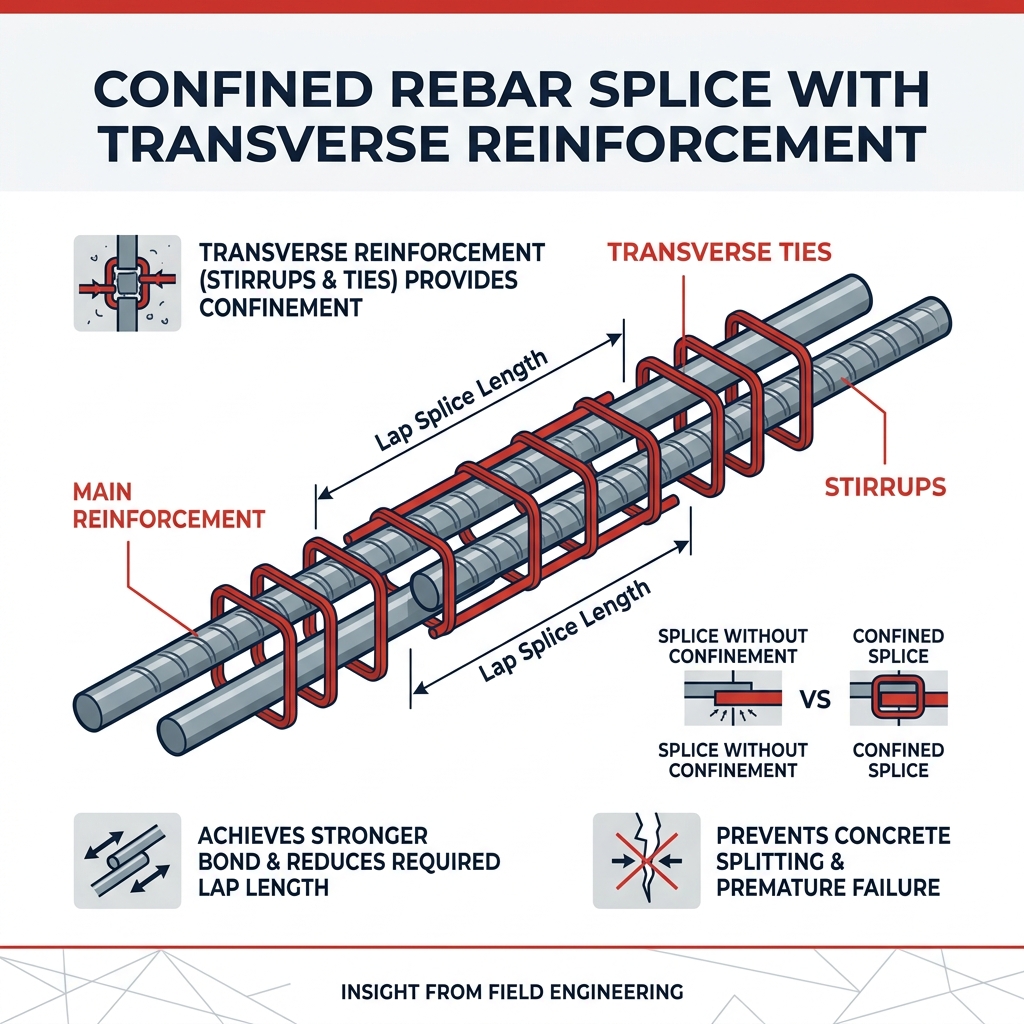
This is why you’ll see different requirements in the Caltrans LRFD Bridge Design Manual compared to a residential basement wall. Bridges deal with massive dynamic loads and require extreme confinement to prevent splice failure.
High-Strength Rebar and Welding Exceptions
As we push the limits of construction, we are seeing more Grade 80, Grade 100, and even Grade 120 rebar. These high-strength steels allow us to use less metal to carry the same load, but they require much longer lap lengths. For example, Grade 100 rebar requires about 1.48 times the development length of standard Grade 60.
What about welding? We get this question all the time. Generally, do not weld rebar. Standard rebar (A615) has a high carbon content that becomes brittle when heated, leading to snaps under stress. The only exception is ASTM A706 rebar, which is specifically formulated for weldability. Even then, it requires a certified welder and specific procedures. In most cases, it is cheaper and safer to use mechanical rebar couplers to connect high-strength bars.
Failure Modes and Prevention Strategies
Understanding how a splice fails helps you prevent it. There are two main ways a lap splice gives out:
- Splitting Failure: This is the most common. The rebar acts like a wedge, pushing outward until the concrete cover cracks and “splits” away, releasing the bar. This is prevented by having adequate cover and spacing.
- Pullout Failure: This happens in very confined or high-strength concrete where the bar simply slides out of its “tunnel” because the mechanical interlocking of the ribs failed.
To avoid these, focus on concrete consolidation. If you have “honeycombing” (voids) around your lap splice, the bond strength drops to near zero. Proper vibration is essential, especially around congested areas like footings.
Frequently Asked Questions about Rebar Splicing
Why is welding rebar generally not recommended?
As mentioned, standard Grade 60 rebar (ASTM A615) isn’t designed for the heat of welding. The process creates a “heat-affected zone” that changes the molecular structure of the steel, making it brittle. Under a seismic load or heavy vibration, a welded joint on A615 steel is likely to shatter. Unless you are using A706 “low-alloy” steel, stick to laps or mechanical couplers.
How does concrete cover affect splice strength?
Think of concrete cover as the “grip” of a hand. If you only hold a bar with your fingertips (thin cover), it’s easy to pull away. If you wrap your whole hand around it (thick cover), the grip is much stronger. Doubling the cover from 0.75″ to 1.5″ can increase the strength of a short splice by up to 15% because it provides more mass to resist the “splitting” forces generated by the rebar’s ribs. This is why using the right rebar chairs for concrete slabs is the easiest way to ensure your splices actually work.
Can you lap splice #14 or #18 bars?
Per ACI 318, no. You cannot lap splice #14 or #18 bars in tension. These bars are simply too large; the amount of overlap required would be impractical (sometimes over 10 feet!), and the force transfer would likely split any standard concrete member. The only exception is in compression-only applications where they are being spliced to #11 or smaller bars. For these large “jumbo” bars, you must use mechanical couplers or welded splices.
Conclusion
Mastering the lap splice length for rebar chart isn’t just about reading a table; it’s about understanding the “why” behind the numbers. Whether you’re separating #4 bars to save on steel or ensuring your #6 bars have the right Class B overlap, every inch counts toward the safety of your project.
At Hercules Rebar Chairs, we’ve seen it all. We’ve sold over 14 million units of our iconic red chairs because we know that a perfect splice starts with perfect positioning. Our products ensure you hit those cover and spacing requirements every single time, saving you time, money, and the headache of a failed inspection.
Ready to make your next pour “Hercules Strong”? Check out our specialized splicer products and see why we’re America’s #1 choice for rebar support. Stay safe out there, and remember: overlap with intent!