

Why Getting Concrete Wire Mesh Chair Spacing Right Matters From the Start
Concrete wire mesh chair spacing is one of the most important — and most overlooked — steps in pouring a durable concrete slab.
Here’s the quick answer most contractors need:
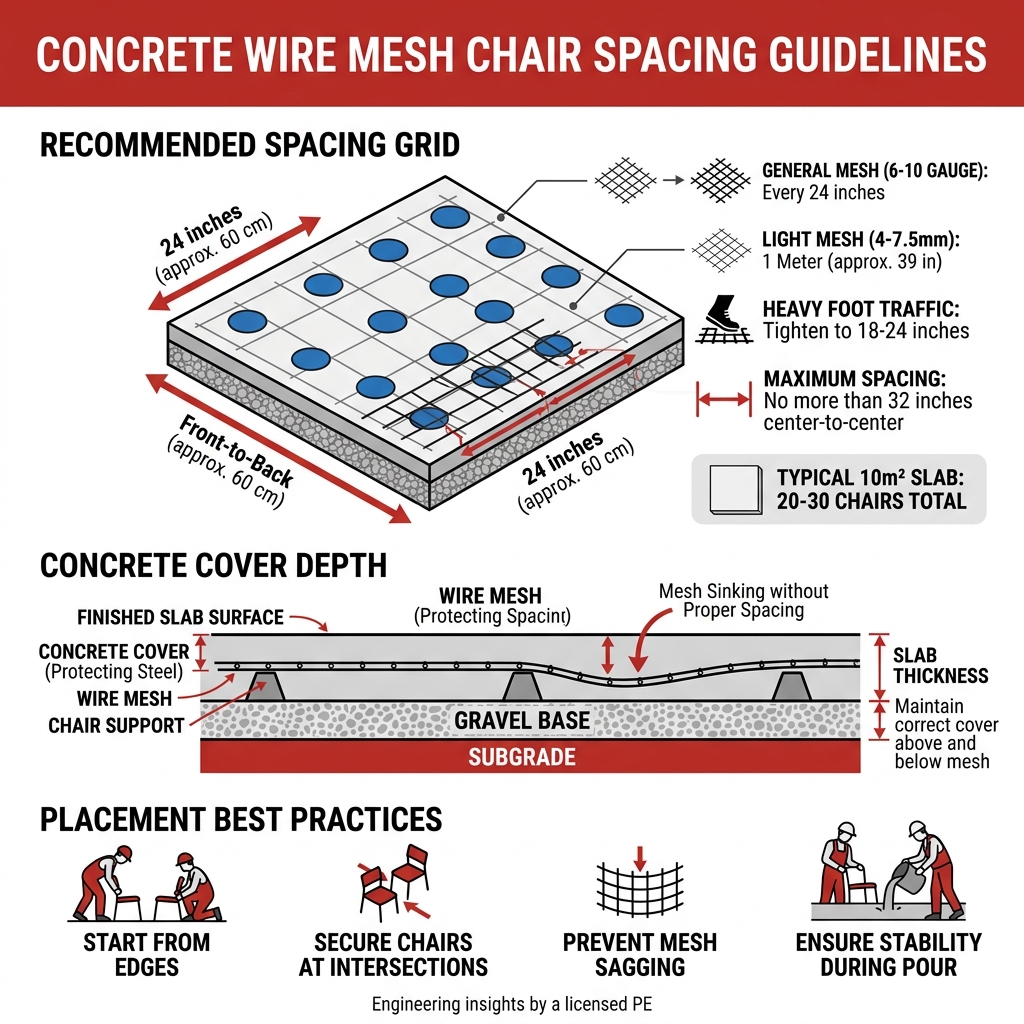
| Situation | Recommended Spacing |
|---|---|
| General mesh (6, 8, or 10 gauge) | Every 24 inches in each direction |
| Light mesh (4–7.5mm diameter) | 1 meter (approx. 39 in) centers |
| Heavy foot traffic or plywood walkboards | Tighten to 18–24 inches |
| Maximum spacing (any application) | No more than 32 inches center-to-center |
| Typical 10m² slab | 20–30 chairs total |
So for a standard residential slab, place one chair every 24 inches in both directions. That’s roughly one chair per 4 square feet of slab area.
Here’s the problem most people run into: wire mesh looks like it’s sitting in the right position before the pour starts. But the moment workers walk across it — or wet concrete starts flowing — that mesh shifts. It sinks. And once concrete sets, there’s no fixing it.
Mesh that ends up too low in the slab doesn’t control cracks. It doesn’t carry tensile loads. It just sits at the bottom, doing almost nothing useful.
That’s why chair spacing isn’t a detail you figure out on the fly. It’s a decision that directly affects whether your slab lasts 30 years or starts cracking in 5.
I’m Jordan Harris, a licensed Professional Engineer with a background in structural concrete and co-owner of the company behind the Hercules Chair — so I’ve seen how concrete wire mesh chair spacing affects real-world slab performance, from small patios to large industrial pours. Let’s walk through exactly how to get it right.
Why Proper concrete wire mesh chair spacing is Essential
When we talk about the “skeleton” of a concrete slab, we’re talking about the reinforcement. Whether you are using welded wire fabric (WWF) or rebar, the goal is the same: to give the concrete the tensile strength it lacks on its own. Concrete is fantastic at handling compression (weight pushing down), but it’s quite brittle when it comes to tension (pulling apart).
To make that reinforcement work, it has to live in a very specific “sweet spot” within the slab. If the concrete wire mesh chair spacing is too wide, the mesh will sag between the supports. When that happens, you lose your “concrete cover”—the protective layer of concrete that surrounds the steel.
The Danger of “Ghosting” and Sagging
Have you ever seen a sidewalk where you can actually see the outline of the wire mesh through the surface? We call those “ghosting cracks.” This happens when the mesh is too close to the surface. Conversely, if the mesh sags to the very bottom of the pour, it offers zero structural benefit. For a slab to be truly reinforced, the mesh should generally sit in the upper-middle third of the slab thickness.
Without proper spacing, you risk:
- Structural Failure: The slab can’t handle the loads it was designed for.
- Corrosion: If the steel is too close to the bottom or top, moisture can reach it, causing it to rust, expand, and pop the concrete apart (spalling).
- Ineffective Crack Control: Mesh only stops cracks from widening if it’s held firmly in place by the surrounding concrete.
By understanding Reinforcing Your Concrete: Everything You Need to Know About Wire Mesh, you realize that mesh is only as good as its placement. Using engineered supports rather than “pulling it up” with a hook during the pour ensures the mesh stays exactly where the engineer intended. For more on how these supports function, check out these Spacer Secrets: Unpacking the Role of Plastic Rebar Chairs.
When you Elevate Your Slab with Concrete Mesh Chairs, you are investing in the long-term health of the structure.
Standard Guidelines and Industry Codes for Spacing
In construction, “guessing” is a recipe for a lawsuit or a failed inspection. That’s why we look to industry leaders like ASTM International and the Concrete Reinforcing Steel Institute (CRSI) for guidance.
The general consensus across the Welded Wire Reinforcement Manual of Standard Practice is that supports must be spaced closely enough to prevent the reinforcement from sagging or shifting under the weight of wet concrete and the people placing it.
Industry Standards for concrete wire mesh chair spacing
While specific projects might have unique engineering requirements, the following are the industry-accepted “rules of thumb”:
- The 24-Inch Grid: This is the gold standard for most residential and light commercial slabs. By placing a chair every 24 inches in each direction, you create a stable “table” for the mesh to rest on.
- The 32-Inch Maximum: Most engineers specify that concrete wire mesh chair spacing should never exceed 32 inches center-to-center. Once you go beyond this, the mesh becomes too “bouncy” and is likely to be pushed to the subgrade when someone steps on it.
- Point Load Testing: High-quality chairs are tested to withstand specific weights. For example, standards like AS/NZS 2425:2015 (often used as a reference for quality) require chairs to exceed a 60kg (about 132 lbs) point load. Our Hercules chairs are designed to far exceed these basics to ensure they don’t crush under a worker’s boot.
Following the Rebar Chair Code: Ensuring Stability and Compliance isn’t just about passing inspection; it’s about professional pride. If you’re unsure about what size you need, you can learn How to Determine Bar Chair Sizes in 3 Easy Steps.
Factors That Influence Optimal Chair Placement
Not every slab is created equal. A thin garden path and a heavy-duty garage floor have very different needs when it comes to concrete wire mesh chair spacing.
1. Wire Gauge and Mesh Type
The “flimsiness” of your mesh dictates how many chairs you need.
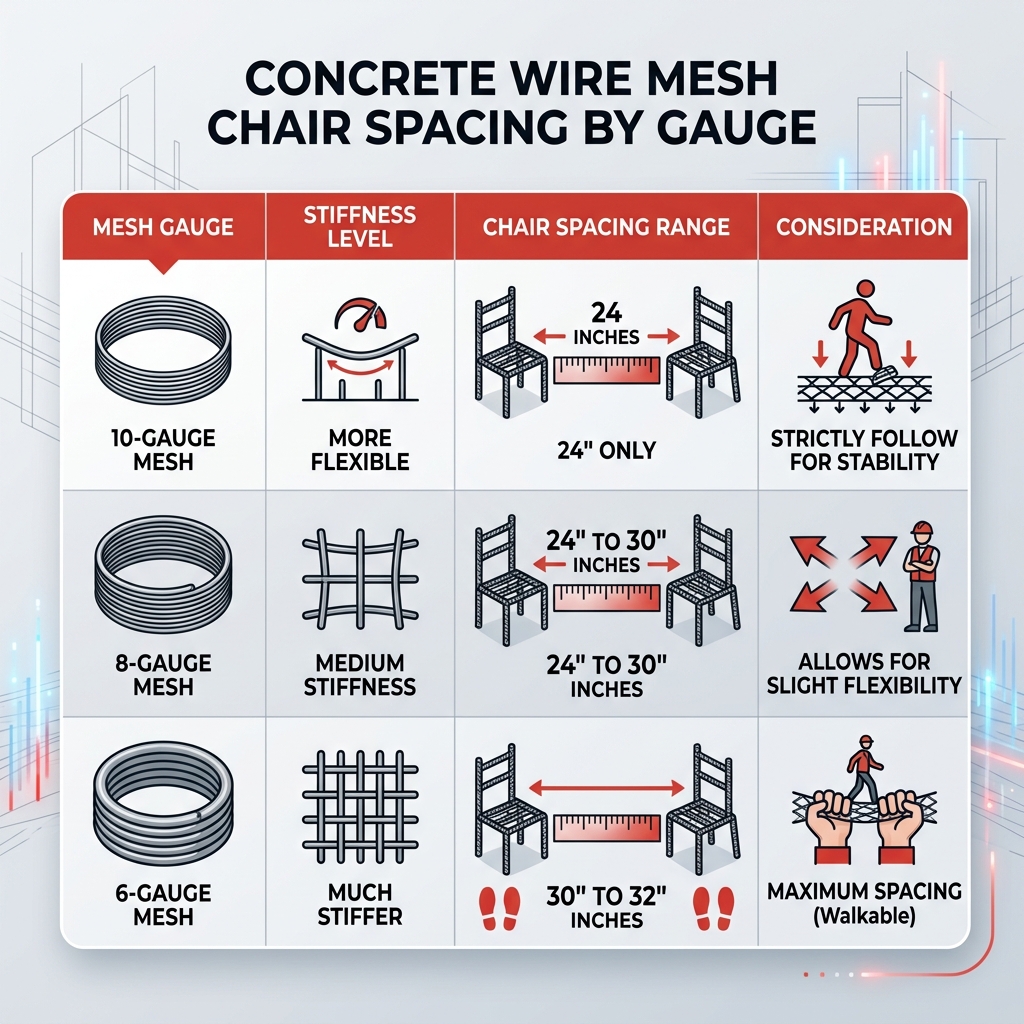
- 10-Gauge Mesh: This is relatively thin and prone to sagging. We strictly recommend a 24-inch spacing here.
- 6-Gauge Mesh: This is much stiffer. You might be able to stretch to 30 inches, but 24 inches remains the safest bet for a walkable surface.
2. Construction Loads (The “Worker Factor”)
This is where most DIYers go wrong. They space chairs based on the weight of the mesh alone. But you have to account for the 200-lb worker carrying a hose or a shovel. If you are using plywood walkboards to distribute weight during a pumped pour, we recommend tightening the spacing to 18–24 inches to prevent the mesh from deflecting permanently.
3. Subgrade Conditions
If you are pouring on a soft subgrade or granular fill (like pea gravel), your chairs need a wide base to prevent them from sinking. A chair with a narrow “peg” leg will simply punch into the dirt the moment you step on the mesh. This is why a Comprehensive Look at Rebar Chair Types is important—you need a chair designed for your specific base.
4. Slab Thickness
For a standard 4-inch residential slab, you generally want the mesh held 2 inches off the ground. This puts it right in the center. If you’re pouring a 6-inch slab for heavy equipment, you might use a taller chair or even a double-mat system. For more details on these variations, see The Ultimate Guide to Rebar Chairs: Types, Uses, and Sizing for Concrete Slabs.
Calculation and Installation Best Practices
Installing your chairs correctly is just as important as the spacing itself. We’ve seen plenty of projects where the chairs were spaced right, but they weren’t secured, leading to a “domino effect” during the pour.
The “Snap-On” Advantage
Modern engineered chairs, like our 2-inch Steel Mesh Chair Product 944, feature a snap-on clip. Instead of just resting the mesh on top of a support, you actually clip the chair onto the wire intersections. This creates a stable grid that won’t tip over when the concrete hose hits it.
Step-by-Step Installation:
- Prep the Subgrade: Ensure your vapor barrier or gravel is level and compacted.
- Lay the Mesh: Place your mesh sheets or rolls, ensuring the required overlap (usually one full square of the grid).
- Snap the Chairs: Start from one corner. Lift the mesh and snap a chair onto the wire intersection.
- Follow the Grid: Move 24 inches in one direction and snap the next. Repeat until the entire area is supported.
- Pre-Pour Inspection: Walk the mesh. If you see any areas sagging more than half an inch, add a “supplemental” chair.
Avoiding the “Hook” Method
Many old-school contractors still try to “hook” the mesh and pull it up into the wet concrete as they pour. We strongly advise against this. It is impossible to maintain a consistent depth this way. Half the time, the mesh just gets pushed back to the bottom when the workers walk back over the area to screed the surface.
You can Shop for 2-Inch Steel Mesh Chairs to ensure you have the right tools to do the job properly the first time.
Calculating concrete wire mesh chair spacing for Large Slabs
If you’re tackling a massive project, like a 5,000 sq. ft. warehouse floor, the math is simple but the numbers are big.
- At a 24-inch grid (one chair every 4 square feet), you will need 1,250 chairs.
- For a 10m² (approx. 107 sq. ft.) patio, you’ll need about 25–30 chairs.
We recommend buying in bulk. Our 100-pack options are designed for efficiency on these larger jobs, ensuring you don’t run out halfway through the prep.
Frequently Asked Questions about Mesh Spacing
Can I walk on the mesh after chairs are installed?
Yes, but with caution. High-quality chairs are designed with a “deflect and rebound” feature. When you step near a chair, the mesh will dip slightly, but it should spring back to its original height once you move. If you find the mesh is staying bent or the chairs are tipping, your concrete wire mesh chair spacing is likely too wide, or you need to use plywood walkboards to spread your weight.
Should I use chairs or just pull the mesh up during the pour?
Always use chairs. Manual lifting (hooking) is notoriously unreliable. Research shows that “pulled” mesh almost always ends up in the bottom inch of the slab, where it provides almost no structural reinforcement. Chairs provide a permanent, engineered solution that stays put regardless of foot traffic or concrete flow.
Do the chairs stay in the concrete?
Absolutely. Concrete chairs are permanent fixtures. They are made from materials (like high-strength plastic or galvanized steel) that bond with the concrete and won’t corrode over time. Once the concrete is poured, they become a hidden part of the slab’s internal structure.
Conclusion
At the end of the day, concrete wire mesh chair spacing is about one thing: peace of mind. You want to know that when that heavy concrete truck pulls away, the reinforcement you paid for is actually doing its job.
At Hercules Rebar Chairs (T.J. Harris Co.), we take that mission seriously. We are proud to be America’s #1 choice for concrete supports, with over 14 million units sold across the United States. Our iconic red chairs are designed to save you time and money while ensuring your project stays in full code compliance.
Whether you are pouring a small DIY patio in Ohio or a massive commercial slab in Texas, don’t settle for “good enough.” Use the 24-inch rule, choose the right chair for your gauge, and build a foundation that lasts a lifetime.
Ready to get started? Buy Rebar Chairs today and see why the pros choose the red chair.