

Why Rebar Splicing Matters: Traditional vs. Mechanical Methods
Bar splice products are mechanical devices used to connect reinforcing steel bars (rebar) in concrete structures. They provide structural continuity without extensive overlapping or welding. These products, including threaded couplers, shear bolt systems, and swaged sleeves, join rebar ends to transfer loads effectively.
If you’ve ever seen a congested rebar cage and wondered if there’s a better way than overlapping bars, you’re right. While the construction industry has long relied on lap splicing, mechanical bar splice products are changing how we build—making it faster, stronger, and with less material waste.
Traditional splicing methods have trade-offs. Lap splicing requires significant rebar overlap (often 40+ bar diameters), creating congestion that hinders concrete placement. Welding demands skilled labor, rigorous inspection, and can compromise rebar strength. Both methods can increase time and budget on complex projects.
Mechanical splicing offers a modern alternative. These systems create full-strength connections without the drawbacks of traditional methods. They reduce rebar congestion, speed up installation, and maintain structural integrity, even in seismic zones. With many systems having widespread DOT approval and being engineered to exceed 125% of rebar yield strength, mechanical splices are a go-to solution for commercial buildings, bridges, and high-rises.
I’m Jordan Harris, a structural engineer and PE in Tennessee. I’ve spent years designing large-scale concrete structures and now work with our family’s manufacturing business, developing solutions that improve jobsite efficiency. Throughout my career, I’ve seen how the right splicing method can make or break a project schedule.
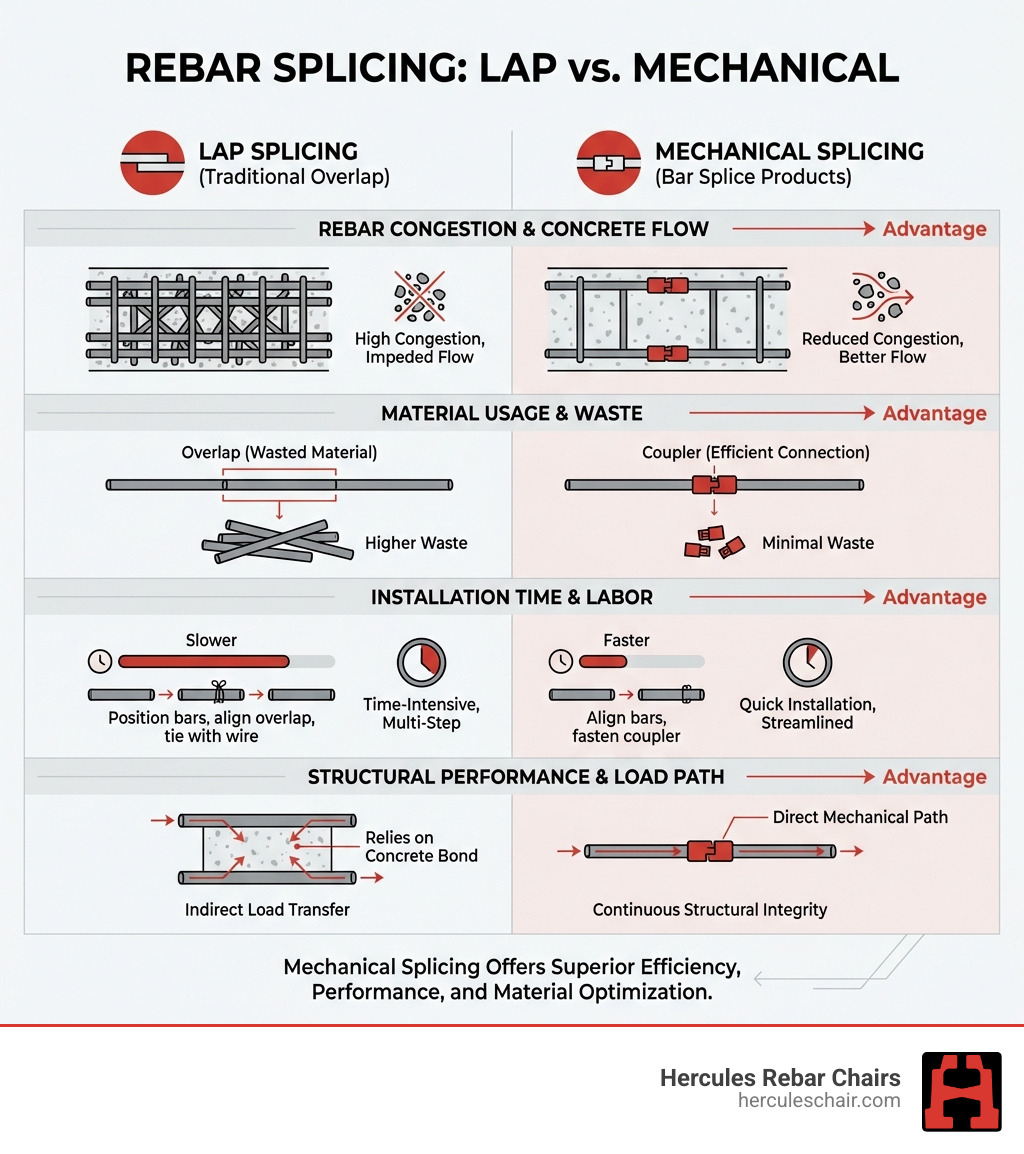
Connecting rebar creates continuity in the reinforcing steel, ensuring the structure acts as a single unit. This is critical for distributing loads, especially in seismic regions. Choosing the right splicing method balances structural integrity, efficiency, and cost. Let’s dig into the specifics.
Lap Splicing: The Overlap Method
Lap splicing is the traditional method of connecting rebar. Two bars are overlapped for a specified length, and the load transfers through the surrounding concrete. The required overlap, dictated by codes like ACI standards, can be substantial—sometimes over 40 bar diameters. This increases rebar usage and material costs.
More critically, extensive laps cause severe rebar congestion. This “forest of steel” makes it difficult for concrete to flow and encapsulate the rebar, leading to potential voids (honeycombing) that compromise structural integrity. Proper concrete consolidation becomes a major challenge, slowing construction and increasing labor costs.
Welded Splices: Fusing Steel
Welding connects rebar by fusing the ends, creating a strong connection that can reduce congestion. However, welding rebar is complex. The heat can alter the steel’s properties, potentially reducing its strength or making it brittle. The American Welding Society (AWS) provides specific guidelines (AWS D1.4) that must be strictly followed.
Successful welded splices require highly skilled, certified welders and rigorous inspection, adding time and cost. Welding is also a slower process and not always suitable for all site conditions. Due to these demands, it’s a less common choice for routine splicing on many projects.
The Modern Alternative: Mechanical Splicing
Enter mechanical splicing, the modern workhorse of rebar connection. This method uses engineered couplers to join rebar ends, creating a full-strength connection that avoids the issues of lapping and welding.
One of the biggest advantages is the significant reduction in rebar congestion. By eliminating long overlaps, there’s more space for concrete placement and consolidation, leading to better quality and improved structural performance. This is especially beneficial in densely reinforced areas like columns and beams.
Mechanical splicing also boosts project efficiency and savings. Installation is faster than traditional methods, reducing labor costs and helping keep projects on schedule. Many systems are designed for quick assembly, often without special equipment.
Furthermore, mechanical splices are engineered for reliable performance. Many systems are designed to be stronger than the rebar itself, exceeding 125% of the rebar’s specified yield strength. This robust performance is critical for structural integrity, especially in high-profile projects or seismic zones.
Let’s look at a quick comparison:
| Factor | Lap Splicing | Welding | Mechanical Splicing |
|---|---|---|---|
| Installation Speed | Moderate (requires careful measuring) | Slow (skilled labor, inspection) | Fast (engineered solutions, quick assembly) |
| Material Cost | High (more rebar due to overlap) | Moderate (less rebar, but welding materials) | Moderate (coupler cost, less rebar) |
| Labor Skill | Low to Moderate | High (certified welders, inspectors) | Moderate (trained installers) |
| Rebar Congestion | High (significant overlap) | Low (direct connection) | Low (compact connection) |
| Performance in Seismic Zones | Reduced (can be problematic with congestion) | Variable (depends on weld quality, rebar type) | Excellent (full strength, predictable performance) |
A Deep Dive into Mechanical Bar Splice Products
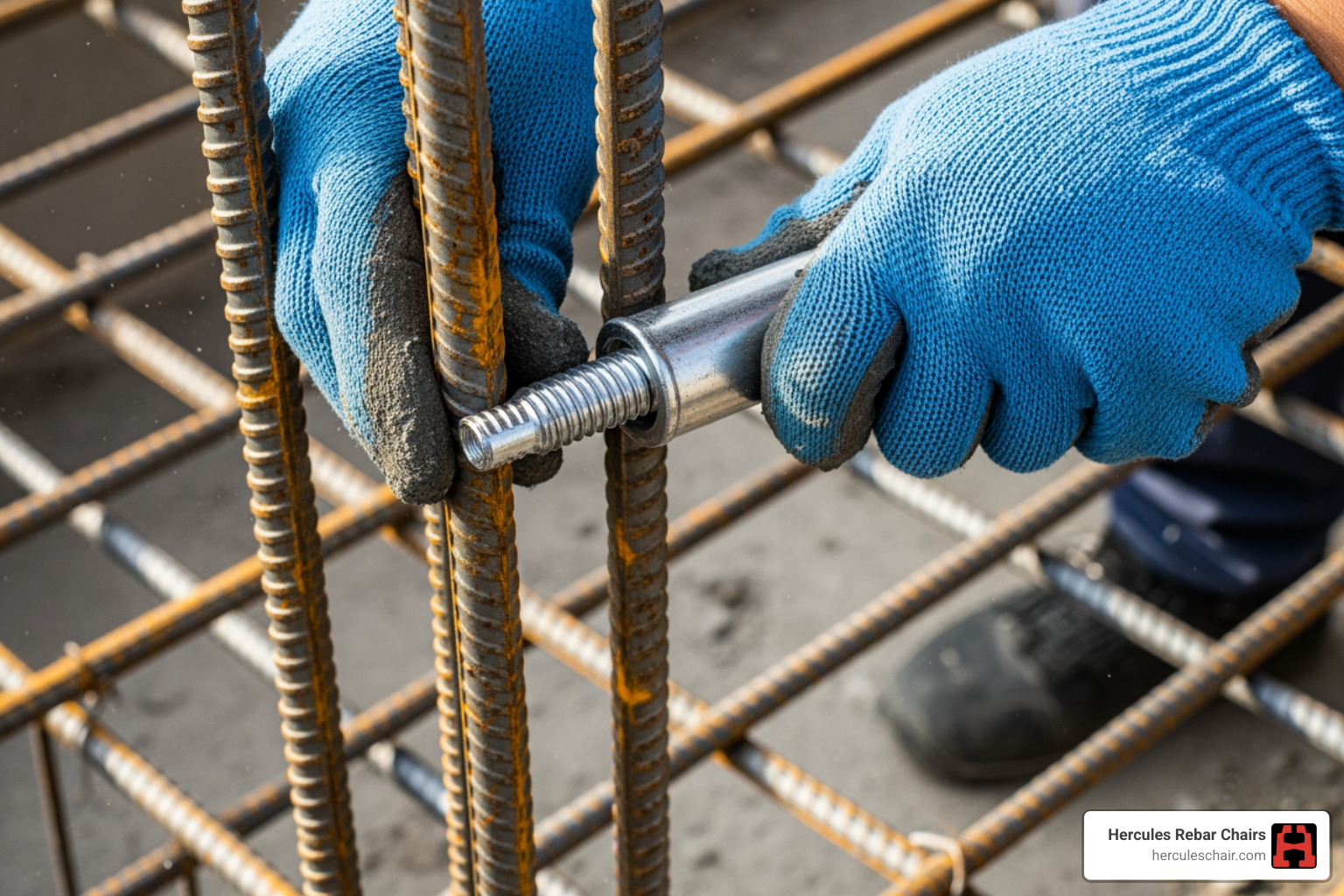
Now that we understand why mechanical splicing is a game-changer, let’s explore the different types of bar splice products available. Each system offers unique advantages for specific construction challenges. Our goal is to help you understand the best splicing technology for your reinforced concrete projects.
Threaded Coupler Systems
Threaded coupler systems are among the most common mechanical splices. They involve threading rebar ends and connecting them with a threaded coupler, making them ideal for projects requiring precise connections.
There are two main types of threaded systems:
- Parallel Threads: These systems use parallel threads on the rebar and coupler. Many are made with rolled threads, a process that avoids removing material and weakening the bar, unlike cut threads. This results in a splice that often exceeds the rebar’s strength. These are also ideal for dowel bar replacement in staged construction like bridges.
- Taper Threads: Tapered threads offer a self-aligning, quick-connecting solution that can speed up installation.
Threaded systems are excellent for dowel bar replacement, precast connections, and concrete paving. Some systems feature an integrated nail plate for easy attachment to formwork, which eliminates protruding dowels, improves jobsite safety, and prevents formwork damage. These systems provide robust rebar continuity for mid-rise and high-rise construction, parking garages, and DOT projects.
For those looking to integrate these solutions, we have resources available. You can explore our complementary products that support these systems on our Our Products page.
Shear Bolt & Grip-Type Couplers
Shear bolt and grip-type couplers focus on speed and simplicity, often without needing special bar end preparation. These systems are known for their field efficiency.
This type of system typically uses lock-shear bolts and serrated grip rails. After inserting the rebar, the bolts are tightened, causing the serrated rails to embed into the rebar and create a strong mechanical bond. A key quality assurance feature is that the bolt heads shear off at a prescribed torque, giving a clear visual sign of proper installation.
One of the biggest advantages is that these systems usually require no bar end preparation beyond cutting it to length, saving valuable time on site. They are versatile, suitable for tension and compression, and can be used as ‘positional’ couplers where rebar cannot rotate. This makes them ideal for new construction, rehab projects, and repair applications where time is critical.
Swaged & Headed Bar Systems
Swaged and headed bar systems offer specialized solutions for connection and anchorage, playing a key role in reducing congestion and improving concrete consolidation.
Cold-swaged sleeves use a hydraulic press to deform a steel sleeve around rebar ends, creating a tight, permanent connection. This cold-forming process ensures the rebar’s metallurgical properties remain unchanged. These systems are an economical mechanical splice option and are field-installed with portable presses.
Headed reinforcement uses rebar with factory-fabricated enlarged ends (heads) that replace traditional hook bars for anchorage. These systems are a fantastic way to reduce rebar congestion in crowded areas like column-beam joints or shear walls. By eliminating the long tails of hooked bars, there is more room for concrete placement and better consolidation. This leads to improved structural performance and can be more economical than traditional hooks. Field-installed threaded termination devices are also available, further alleviating congestion and speeding up assembly.
Choosing the Right Splice: Applications and Selection Criteria
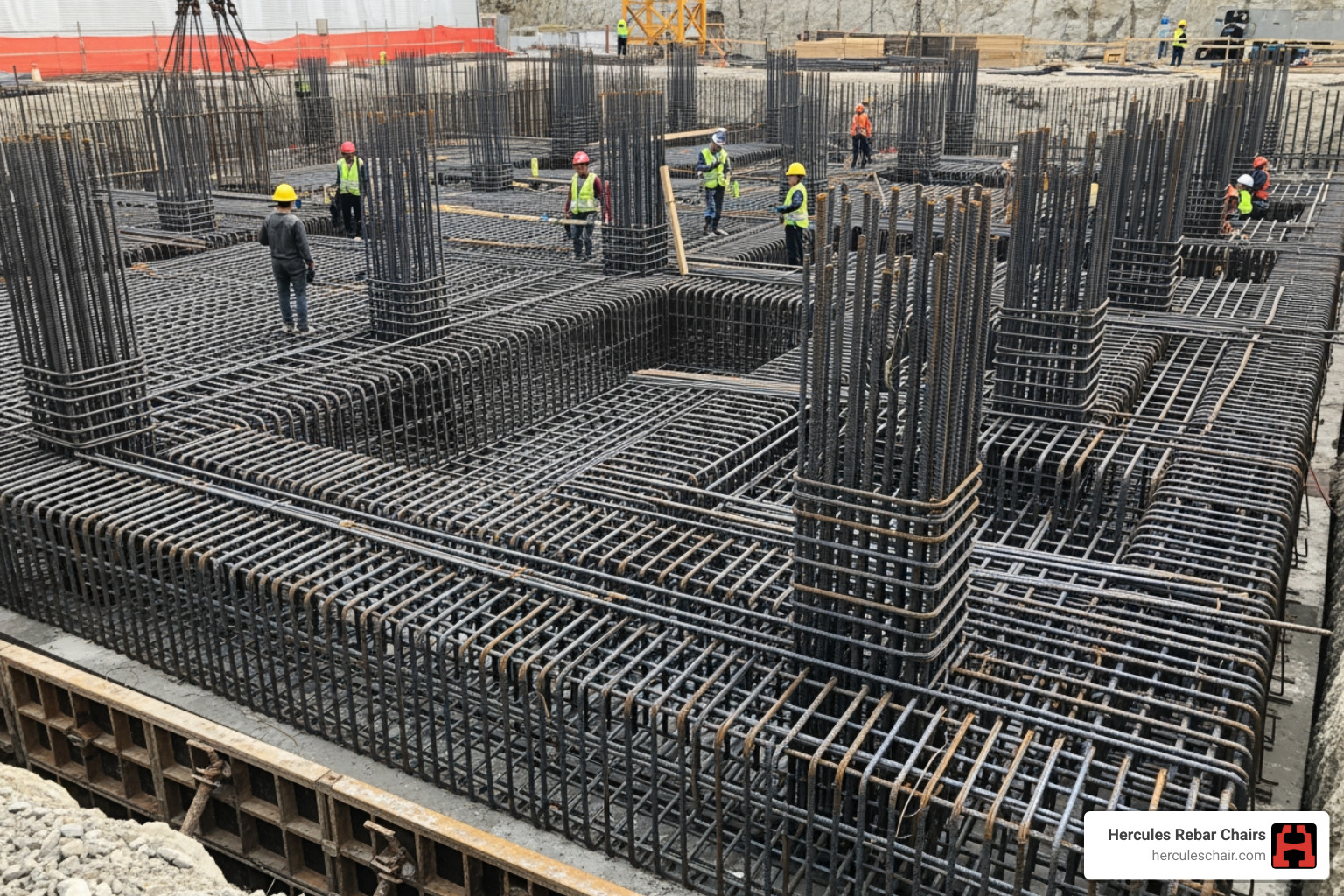
Selecting the right bar splice product is a strategic choice that depends on your project’s specific demands, structural requirements, and site conditions. It’s about picking the right tool for the job.
Matching the Splice to the Project
The application dictates the best splicing solution. Different project types present unique challenges:
- Commercial Buildings: In parking garages, offices, and condos, reducing rebar congestion is key. Threaded couplers and headed reinforcement are often favored for their compact design and speed.
- DOT Projects: Bridges and mass transit systems require robust, reliable connections. Widespread DOT approval is a non-negotiable requirement for any system used in these critical projects.
- High-Rise Structures: In tall buildings, especially in seismic regions, the continuity and strength of rebar connections are critical. Mechanical splices that exceed 125% of the rebar’s yield strength are essential.
- Precast Panels: For precast elements, specialized couplers ensure precise alignment and connection. Dowel bar replacement systems are excellent for these applications, facilitating future expansion.
- Restoration and Repair: When working on existing structures, flexibility is key. Mechanical splices that require no bar end preparation are invaluable for extending steel or connecting bars in tight spaces.
Understanding these applications helps you find the most effective solutions. For more details, refer to our guide on More info about rebar couplers.
Key Considerations for Bar Splice Products
Beyond project type, several technical factors influence the selection of a bar splice product:
- Rebar Size and Grade: Different splices are designed for specific rebar sizes and grades. It’s crucial to match the splice to the rebar properties to ensure adequate load transfer.
- Strength Requirements: For critical elements, always choose systems designed to exceed 125% of the rebar’s specified yield strength, ensuring the splice is never the weak link.
- Seismic Applications: In earthquake-prone areas, splices must meet specific ductility and strength requirements to allow the structure to deform without brittle failure.
- Positional Couplers: When one or both bars cannot be rotated, positional couplers are indispensable, allowing a connection to be made without turning the rebar.
- Installation Environment: Consider the available space, labor skills, and site conditions. The ease of installation can significantly impact project timelines and costs.
The Importance of Technical Documentation
Using bar splice products without proper technical documentation is a recipe for disaster. Comprehensive documentation is critical for quality, compliance, and successful execution.
Key documents to look for include:
- Evaluation Reports (e.g., IAPMO, ICC): These provide third-party verification that a product meets building code requirements and performance standards.
- Installation Instructions: Clear, step-by-step instructions are vital for correct field installation, outlining tools, procedures, and pitfalls to avoid.
- Technical Data Sheets (TDS): These provide detailed product specifications, including material properties, dimensions, and load capacities.
- Guide Specifications: These help engineers incorporate the product into project documents, ensuring contractors understand the requirements.
This documentation is the backbone of quality assurance. When designing or overseeing projects, especially in states with rigorous building codes like Florida or Washington, having these resources is non-negotiable. For a deeper dive into technical specifics, our Data Sheet section provides valuable insights.
Ensuring Quality: Compliance, Testing, and Documentation
Quality is the bedrock of safety and durability in construction. For bar splice products, ensuring quality means adhering to stringent standards, rigorous testing, and transparent documentation. At Hercules Rebar Chairs, we understand this deeply, as our own products are built on a foundation of quality and compliance.
Navigating Quality Control and Testing Standards
The performance of any rebar splice is critical to structural integrity. Therefore, robust quality control and testing standards are paramount.
- ASTM Standards: Compliance with ASTM (American Society for Testing and Materials) standards is a cornerstone of quality. For rebar, ASTM A615 is often referenced. Mechanical splices are tested to ensure they meet or exceed the rebar’s performance under these standards. Many systems proudly exceed 125%fy of ASTM A615 grade 60 rebar, indicating superior strength.
- Exceeding Rebar Yield Strength: A key benchmark for high-performance mechanical splices is developing at least 125% of the rebar’s specified yield strength (125%fy). This ensures that under extreme loads, the rebar will yield before the splice fails, providing a ductile response essential for safety.
- DOT Approval: For infrastructure projects, DOT approval is a critical stamp of quality. Many coupler systems have DOT approval in all 50 states, from Maine to Hawaii, signifying their proven performance for demanding applications like bridges and highways.
- Made in USA: The origin of materials and manufacturing is also a quality indicator. Many leading bar splice products are proudly made in the USA, using American-made steel and adhering to high standards. This supports local industries and ensures a high level of quality control. We advocate for supporting American manufacturing and encourage you to learn more about the Commitment to American Steel.
The Role of Industry Certifications and Affiliations
Broader industry certifications and affiliations establish trust and ensure compliance. These organizations set best practices, conduct research, and provide educational resources.
- ACI Guidelines: The American Concrete Institute (ACI) publishes codes and specifications governing concrete design, including requirements for rebar splicing. Adherence to ACI 318 is fundamental to quality construction.
- CRSI Standards: The Concrete Reinforcing Steel Institute (CRSI) is another vital organization providing technical resources and standards for reinforcing steel. Their guidelines inform best practices for rebar fabrication, placement, and splicing.
- PCI for Precast: For projects with precast concrete, the Precast/Prestressed Concrete Institute (PCI) sets standards. Ensuring splice products comply with PCI guidelines is essential for integrating precast elements.
- What Certifications Mean: These affiliations show a manufacturer’s commitment to best practices and safety. Choosing products from affiliated companies means tapping into a collective wealth of knowledge and a commitment to excellence that benefits your project.
Frequently Asked Questions about Rebar Splicing
We hear a lot of questions about rebar splicing, and for good reason! It’s a critical component of any reinforced concrete structure. Let’s tackle some of the most common inquiries we receive.
How do mechanical splices save time and money on a project?
Mechanical splices offer significant time and cost savings by streamlining the construction process. First, they drastically reduce the amount of rebar needed compared to lap splicing, which translates directly into material cost reductions. No more long overlaps means less steel to purchase and transport. Second, their installation is generally much faster. Imagine not having to measure and carefully tie off three feet of overlapping rebar; instead, you’re simply threading or bolting a coupler. This reduces labor hours, frees up skilled workers for other tasks, and accelerates the overall construction timeline. Less congestion also means concrete can be poured more quickly and efficiently, minimizing delays and potential rework. Mechanical splices help us build smarter, faster, and more economically, keeping projects like those in busy Florida or growing North Carolina on schedule and within budget.
Are mechanical splices as strong as the rebar itself?
Absolutely, and often even stronger! High-quality mechanical splices are specifically engineered to meet or exceed the specified strength of the rebar they connect. In fact, many advanced systems are designed to develop at least 125% of the rebar’s specified yield strength (125%fy). This means the splice itself is not the weakest point in the structural system. If the structure is ever pushed to its limits, the rebar will yield (stretch) before the splice fails, contributing to the overall ductility and safety of the concrete element. This level of performance is critical for ensuring structural integrity, especially in demanding applications such as high-rise buildings in seismic zones or heavy-duty bridge construction.
Can you use different types of splices on the same project?
Yes, it’s very common and often the most efficient approach to use a combination of splicing methods on a single project. Engineers frequently specify a hybrid approach to optimize both cost and structural performance. For example, in non-critical areas with lighter reinforcement and plenty of space, traditional lap splices might be used. However, in areas with heavy rebar congestion, such as column-beam junctions, shear walls, or foundations, mechanical splices are almost always preferred to ensure proper concrete consolidation and full load transfer. Similarly, for elements requiring future expansion or specific construction sequencing, dowel bar replacement systems might be chosen. The key is careful planning and specification by the structural engineer, ensuring that each splicing method is appropriate for its location and meets all relevant building codes and project requirements. This flexibility allows us to tailor solutions to the unique demands of each part of a project, from the basements of Georgia to the rooftops of Oregon.
Conclusion: Building Stronger, Smarter, and Faster
As we’ve explored, bar splice products offers a fascinating array of solutions that are fundamentally changing how we build. From the traditional, but often challenging, methods of lap splicing and welding to the innovative and efficient mechanical systems, the choice of rebar connection significantly impacts project outcomes. We’ve seen how mechanical splices, whether threaded couplers, shear-bolt systems, or swaged and headed bars, consistently deliver superior structural performance, reduce rebar congestion, and contribute to substantial efficiencies in construction timelines and costs.
The advancements in splicing technology directly address challenges like rebar congestion, make seismic applications more reliable, and provide robust solutions for repair and restoration projects. The commitment to quality, evidenced by rigorous testing, adherence to ASTM standards, widespread DOT approvals across our great nation, and strong industry affiliations, ensures that these products are not just faster, but also safer and more durable.
At Hercules Rebar Chairs, we believe in supporting the construction industry with quality components that stand the test of time. Just as our red rebar chairs ensure precise rebar placement and concrete cover, the right bar splice products ensure the continuity and strength of your reinforcement. By embracing these modern solutions, we build stronger, smarter, and faster, paving the way for the next generation of resilient infrastructure and buildings.
We encourage you to dig deeper into these innovative solutions and consider how they can lift your next project. Explore our advanced splicer solutions and other products to see how we can help you build with confidence. Explore our advanced splicer solutions