

Introduction: The Unsung Heroes of Concrete Construction
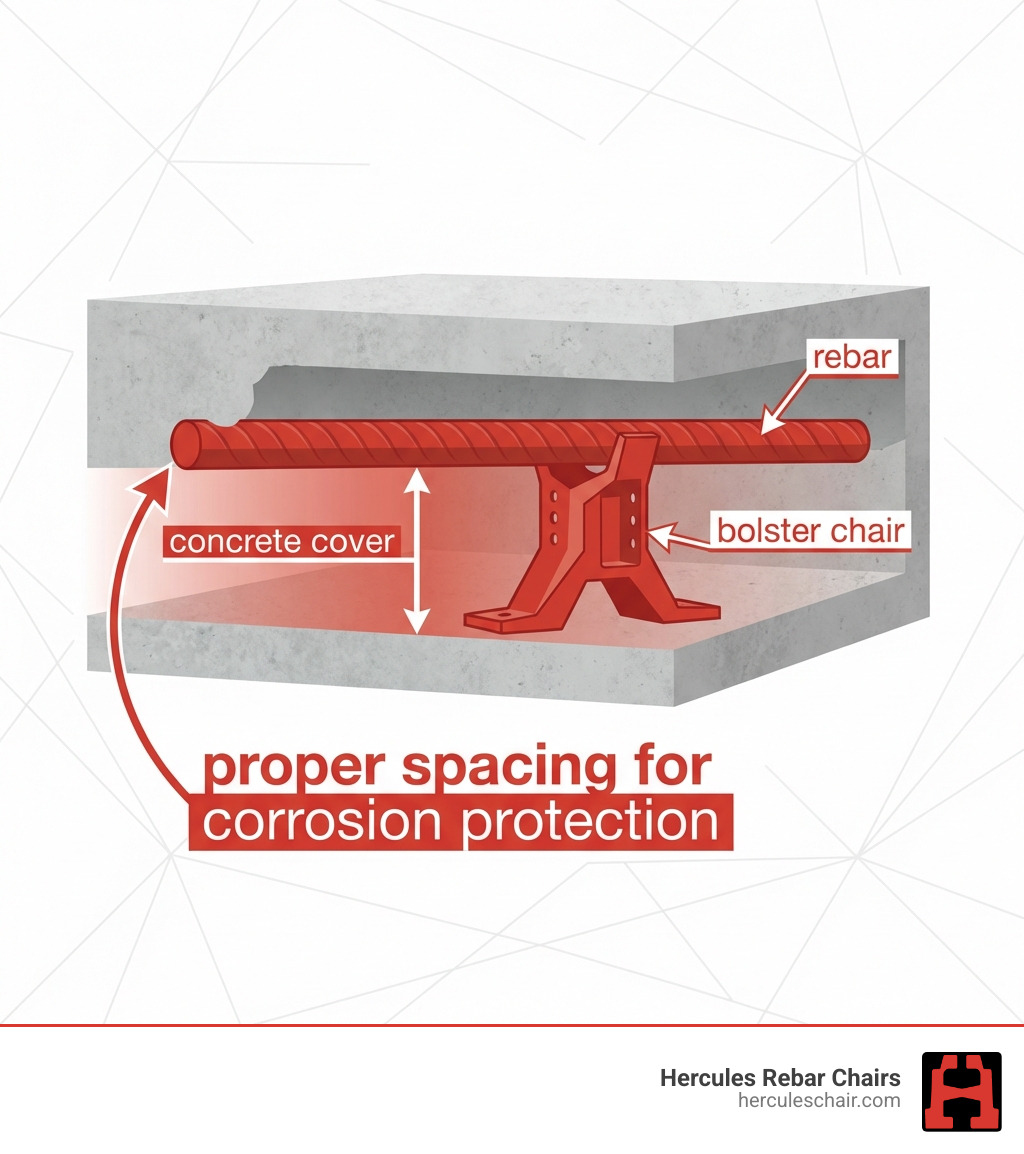
Concrete bolster chairs are essential supports used in reinforced concrete construction to lift and position rebar at the correct height within forms. These critical devices ensure rebar has proper spacing from the surface, known as “concrete cover.” This cover protects the steel from corrosion and ensures the structural integrity of the finished element.
Quick Answer: What You Need to Know About Concrete Bolster Chairs
- What they are: Plastic or metal supports that hold rebar at a specific height during concrete pours
- Why they matter: They ensure proper concrete cover, preventing corrosion and structural failure
- Main types: Continuous bolsters (long runners) and individual chairs (single-point supports)
- Material options: Plastic (non-corrosive, lightweight) or metal (high strength, various finishes)
- Height ranges: Typically 3/4″ to 12″+ depending on application
- Common uses: Slabs, beams, walls, footers, tilt-up panels, and precast elements
Without bolster chairs, rebar would rest on the ground or form, leaving it too close to the surface. This leads to premature corrosion, cracking, and structural failure. The right bolster chair protects your investment and ensures code compliance.
Bolster chairs come in dozens of configurations. Continuous slab bolsters run 5 to 10 feet long and support horizontal rebar in slabs. Individual chairs like high chairs, castle chairs, and tilt chairs provide point support for specific applications. Materials range from galvanized steel to virgin polypropylene plastic, each suited to different project requirements.
The stakes are high. Improper rebar placement is a leading cause of concrete failures and costly repairs. That’s why organizations from the US Marine Corps to the Forest Service rely on quality bolster chairs to maintain structural standards in critical infrastructure.
I’m Jordan Harris, a licensed Professional Engineer and current leader at T.J. Harris Company, where we’ve manufactured over 14 million Hercules Chair rebar supports since 2002. My background in structural engineering for large-scale concrete projects gives me knowledge of how concrete bolster chairs directly impact construction quality and long-term durability.
Why Bolster Chairs are Crucial for Concrete Durability and Integrity
In concrete, concrete bolster chairs are part of the essential foundation, ensuring structures last. Their primary function is to precisely position reinforcing steel (rebar) within concrete forms before a pour. This ensures the rebar is encased in the correct amount of concrete, a measurement called “concrete cover.”
Proper concrete cover is critical. When rebar is too close to the surface, it’s vulnerable to moisture and corrosive elements, leading to rust. Rusting rebar expands, causing the concrete to crack, spall, and disintegrate—a process known as rebar corrosion and a leading cause of premature structural failure. By maintaining the specified cover, bolster chairs shield the rebar from these aggressors, extending the concrete’s lifespan.
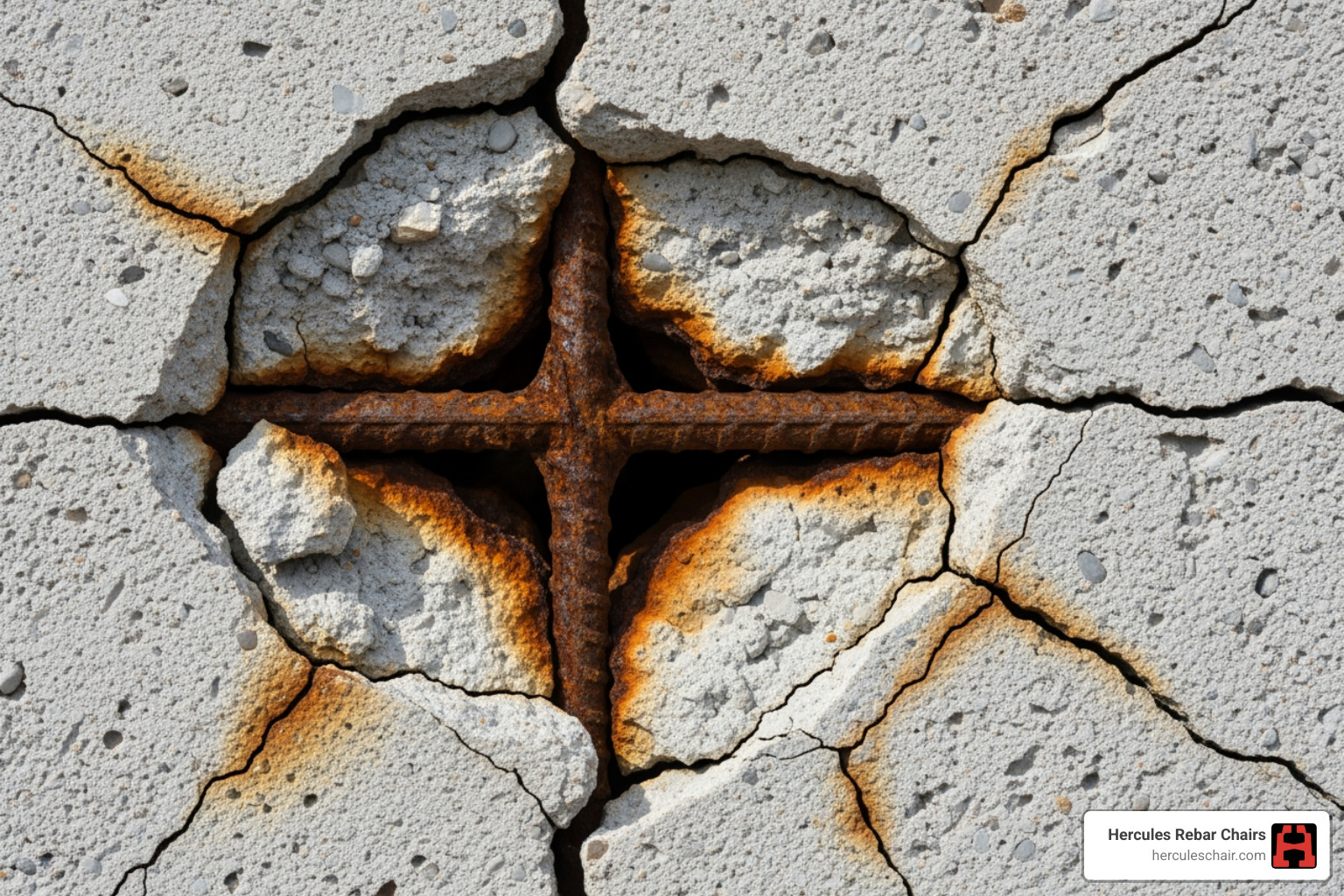
Beyond corrosion prevention, concrete bolster chairs are vital for structural integrity. Reinforced concrete relies on concrete and steel working together. The rebar must be in its designed position to resist tensile forces. If rebar sags or shifts during the pour, it compromises the structure’s strength and safety. Bolster chairs ensure the rebar stays put, allowing the concrete to achieve its full design strength.
We adhere strictly to industry standards set by organizations like the American Concrete Institute (ACI) and the Concrete Reinforcing Steel Institute (CRSI). These standards, such as ACI-50-66, ACI-315, and ACI-315R, provide guidelines for proper rebar placement and concrete cover, which bolster chairs help us meet. Using compliant supports is not just about best practices; it’s often a legal requirement to ensure the safety and longevity of construction projects.
Proper rebar placement also improves project efficiency and reduces labor costs. A stable support system helps crews set rebar faster and more accurately, minimizing rework and repairs, which saves time and money. At Hercules Rebar Chairs, we know a well-supported rebar cage leads to a more efficient job site. For more details, check out our More info on rebar placement.
A Guide to the Different Types of Concrete Bolster Chairs
The concrete industry uses a specialized range of concrete bolster chairs for every construction scenario. Understanding these types is key to a project’s success.
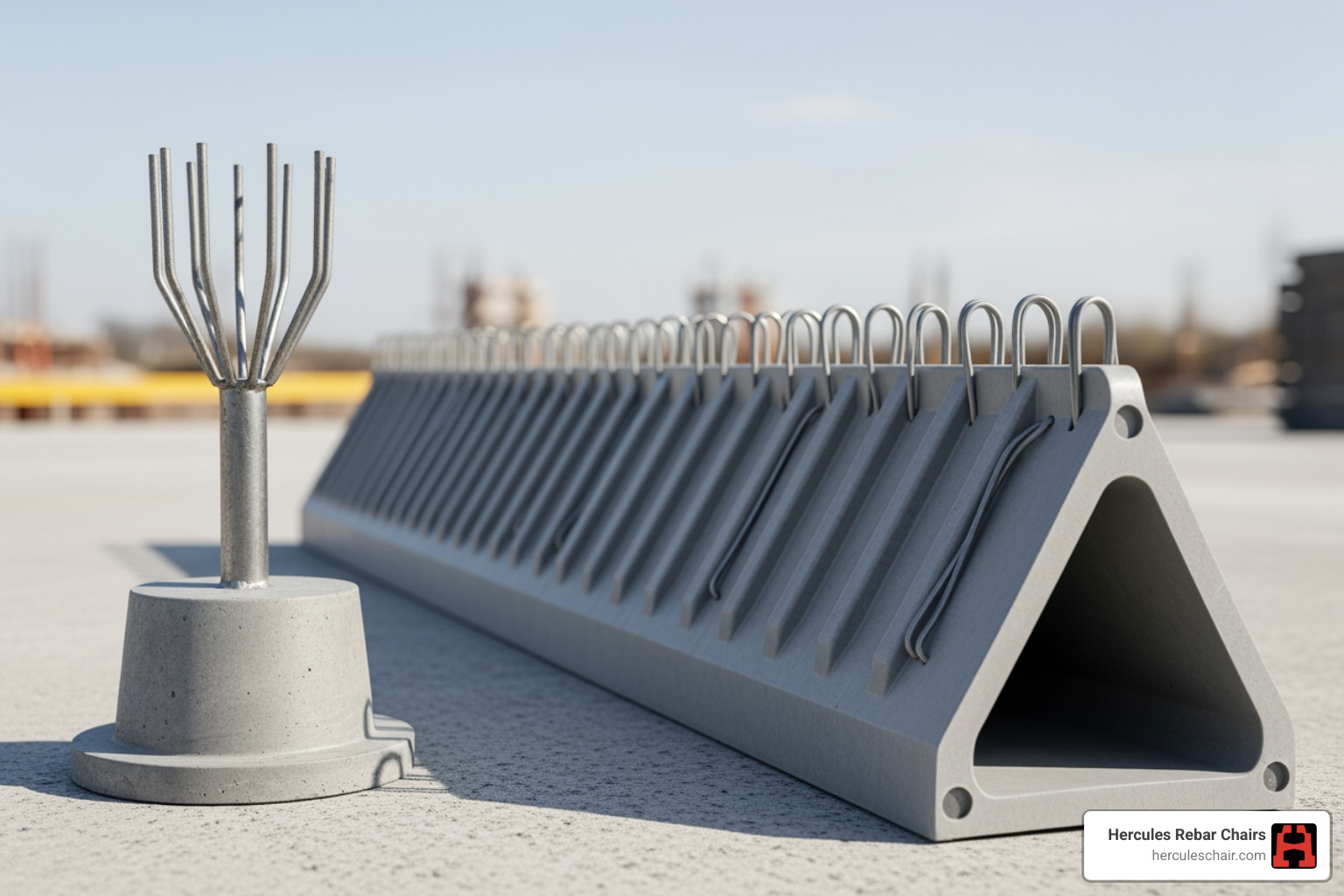
At Hercules Rebar Chairs, we offer a comprehensive line of supports, categorized as individual chairs and continuous supports. Individual chairs (e.g., high chairs, mesh chairs) provide point support, while continuous supports (e.g., slab bolsters) offer a stable base for long runs of rebar. Each type is designed for specific applications and loads.
Continuous vs. Individual Chairs: When to Use Each
The choice between continuous and individual bolster chairs often depends on the specific concrete element being poured and the rebar layout.
-
Continuous Bolsters: These are long, linear supports designed to hold rebar over a considerable length. They are perfect for applications where you need consistent elevation across a wide area.
- Slab Bolsters (SB, SBU, SBP): Ideal for flat work, these support lower slab steel with consistent elevation. They are available in heights from 3/4″ to 4″. Upper slab bolsters (SBU) are used to support a second layer of steel or for use on soft surfaces, with heights from 3/4″ to 5″. Some plastic versions offer quick setup and blend into the concrete.
- Beam Bolsters (BB, BBU, BBP): Designed for beams, these support lower beam steel from the form. They are available in heights from 1″ to 5″.
- Continuous High Chairs (CHC, CHCU, CHCP): These provide continuous support for upper rebar layers, with heights from 2″ to 14″ and standard 5-ft lengths.
-
Individual Chairs: These provide single-point support and are ideal for areas requiring specific rebar configurations or where continuous supports might be impractical.
- Tilt Chairs: With heights from 3/4″ to 6″, these are excellent for tilt-up and precast concrete where an architectural finish is needed. They feature a wide, stable base, and some offer two cover heights in one chair to save inventory.
- Castle Chairs (Slab-On-Grade Chairs): These plastic supports hold rebar and mesh in floors and pavements. They are non-corrosive, and some offer two heights with a simple quarter-turn.
- Tower Chairs: Suitable for deep slabs, these chairs reach heights from 3″ to over 12″.
- Mesh Chairs (with base): Designed to support wire mesh or light rebar in heights from 1″ to 6″.
- F-Chair and H-Chair: These are other individual chair variations with specific leg configurations and height ranges.
Here’s a quick list of common applications:
- Continuous Chairs: Liftd slabs, precast slabs, wall panels, bridge decks, post-tensioned slabs, foundations, concrete patios, and sidewalks.
- Individual Chairs: Tilt-up buildings, precast concrete where an architectural footprint is needed, deep slabs, areas with complex rebar cages, and supporting mesh.
Material Matters: Plastic vs. Metal Bolster Chairs
When choosing a bolster chair, the material is a critical consideration, each offering distinct advantages and disadvantages.
Plastic Concrete Bolster Chairs:
We see a lot of innovation in plastic supports. Many are made from durable, non-corrosive polycarbonate material or virgin polypropylene. Some plastic chairs even use 100% recycled material, which is a win for sustainability.
-
Advantages:
- Non-corrosive: Plastic won’t rust, making it ideal for corrosive environments and preventing rust stains on architectural concrete.
- Lightweight: Easy to transport and install, reducing labor costs.
- Architectural Finish: Leaves a minimal footprint on exposed concrete, preventing blemishes.
- Vapor Barrier Friendly: Integrated bases provide stability on soft surfaces without damaging moisture barriers.
- Dual-Height Capability: Some chairs offer two heights, reducing on-site inventory.
-
Disadvantages:
- Load Capacity: Generally have lower load capacities than metal, especially for heavy rebar or high foot traffic.
- Temperature Sensitivity: Extreme temperatures can affect material properties, though modern plastics are robust.
Metal Concrete Bolster Chairs:
Historically, metal chairs have been the backbone of rebar support. Our Hercules steel chairs are made from robust 6-gauge steel, ensuring exceptional strength and resilience.
-
Advantages:
- High Load Capacity: Can support significant weight, making them ideal for heavy rebar and high foot traffic.
- Durability: Steel is tough and resistant to impact and abrasion.
- Versatility: Available in a wide range of heights and configurations.
- Cost-Effective: Often economical for high-volume, standard applications.
-
Disadvantages:
- Corrosion Potential: Untreated metal can rust, staining concrete and potentially causing rebar corrosion if cover is insufficient.
- Weight: Heavier than plastic, impacting transport and handling.
- Surface Blemishes: Can leave rust marks, making them less ideal for architectural concrete.
Here’s a quick comparison:
| Feature | Plastic Bolster Chairs | Metal Bolster Chairs |
|---|---|---|
| Cost | Generally moderate, good value for specific benefits | Often more economical for standard applications |
| Corrosion | Non-corrosive, ideal for aggressive environments | Can rust if not treated; various finishes mitigate risk |
| Strength | Good for most applications, but lower load capacity | High load capacity, very robust |
| Weight | Lightweight, easy to handle | Heavier, more substantial |
| Surface Finish | Minimizes architectural footprint, no rust staining | Can cause rust staining if not properly covered/finished |
| Best Use Cases | Architectural concrete, corrosive environments, soft forms, vapor barriers | Heavy rebar, high load applications, general construction |
Understanding Finishes on Metal Concrete Bolster Chairs
For metal concrete bolster chairs, the finish is a critical factor in their performance and corrosion resistance. The environment dictates the level of protection needed, and industry standards define classifications for rust prevention.
The primary finishes we encounter are:
- Plain Wire: Untreated, economical steel wire (CRSI Class 3). It’s suitable for applications where the rebar is deeply embedded and rust staining is not a concern.
- Galvanized: A zinc coating provides good corrosion resistance for moderate moisture exposure (CRSI Class 2).
- Epoxy-Coated: A non-metallic barrier providing excellent corrosion protection (CRSI Class 1A). They are designed for use with epoxy-coated rebar to prevent galvanic corrosion.
- Plastic-Dipped (or Plastic-Tipped): The chair’s legs are dipped in plastic to prevent rust stains on exposed concrete surfaces (CRSI Class 1). This is ideal for tilt-wall or precast elements.
- Stainless Steel: The premium choice for aggressive environments, stainless steel inherently resists rust (CRSI Class 2).
Choosing the right finish is paramount. For architectural concrete, use plastic-dipped or all-plastic chairs (CRSI Class 1) to avoid rust stains. For projects with epoxy-coated rebar, an epoxy-coated chair (CRSI Class 1A) is required to maintain the corrosion protection system.
How to Select the Right Bolster Chair for Your Project
Choosing the right concrete bolster chair involves carefully considering your project requirements, environmental factors, and design needs. Getting this right ensures optimal structural performance, code compliance, and cost-effectiveness. We’re here to help you make informed decisions. Learn More about our products to see our full range.
Key Selection Criteria: Height, Load, and Material
When we’re looking at a project, a few critical features immediately jump out as decision-makers for bolster chair selection:
- Cover Height: This is the most fundamental criterion. The engineer-specified concrete cover determines the required chair height to protect rebar from corrosion. Our chairs are available in a vast array of heights to meet diverse needs, from 3/4″ to over 12″. This selection ensures a perfect fit for any project. If you’re pondering the right size, our The Goldilocks Guide to Concrete Bar Chair Sizes: Not Too Big, Not Too Small is a great resource.
- Load Capacity: Consider the weight the chair must support, including the rebar, workers, and forces from the concrete pour. For heavy rebar (e.g., #3 to #11 sizes) or high-traffic areas, high-capacity chairs, often made from steel, are essential. Due to advancements in plastic technology, some plastic chairs can also support significant loads, sometimes up to 500 lbs.
- Material: As we discussed, the choice between plastic and metal (and their respective finishes) depends heavily on the project’s environment and aesthetic requirements. For corrosive environments or exposed concrete, plastic or specially finished metal chairs are preferred. For sheer strength and economy in non-critical aesthetic areas, plain steel often suffices.
Common Applications and Chair Recommendations
The application of the concrete element is a major driver in chair selection:
- Slabs-on-Grade & Liftd Slabs: Continuous slab bolsters are frequently used for the bottom rebar layer. For upper layers or double mats, use slab bolster uppers or continuous high chairs. Plastic slab bolsters are popular for their non-corrosive properties.
- Tilt-Up Walls & Precast Elements: These require supports that leave minimal marks. Plastic chairs or plastic-dipped metal chairs (CRSI Class 1) are excellent choices. Tilt chairs are specifically designed for these applications, with features that minimize their footprint on the finished surface.
- Foundations & Footers: For these substantial elements, robust metal chairs like our Foundation Footer Chairs or sturdy individual high chairs are typically employed to support heavy rebar cages. Our Footer Stand Placement Guide provides further details.
- Architectural Concrete: Where the surface finish is paramount, such as in decorative floors or exposed walls, plastic chairs or metal chairs with plastic-dipped legs are crucial to prevent rust stains or visible footprints from the supports. This ensures the aesthetic quality of the finished product.
Special Considerations: Soft Surfaces and Uneven Ground
Working on soft or uneven surfaces presents its own set of challenges, but thankfully, concrete bolster chairs have evolved to meet these demands.
When pouring on soft surfaces like sand, vapor barriers, or foam insulation, standard chairs can sink or tear the membrane. Specialized chairs with sand plates or wide bases are engineered to distribute the load over a larger area for stability. Many plastic chairs have an integrated base that won’t damage delicate surfaces. Some can even be fastened down for extra security.
The ability of bolster chairs to adapt to challenging ground conditions significantly facilitates efficient installation and reduces labor costs on construction sites. Instead of spending time improvising solutions to stabilize rebar on soft ground, crews can quickly place purpose-built chairs, knowing they will maintain the correct rebar elevation throughout the pour. This speeds up the process, minimizes material waste, and helps keep projects on schedule and within budget.
Frequently Asked Questions about Bolster Chairs
We often get asked specific questions about concrete bolster chairs – and for good reason! It’s a specialized area, and getting the details right makes all the difference.
What is the difference between a slab bolster and a beam bolster?
This is a common question, and the distinction is quite important for proper rebar placement.
- A slab bolster supports the lower rebar in horizontal slabs like floors or decks. They are typically continuous for even support. Slab bolster uppers are used to support a second layer of steel in a double mat.
- A beam bolster is designed to support the lower rebar in a concrete beam, lifting it from the bottom of the form. Beams are critical structural elements, and these bolsters ensure the rebar is positioned correctly.
While both serve to lift rebar, their design and application are custom to the specific structural element they support.
What are the industry standards for rebar supports?
When it comes to the structural integrity of concrete, standards are not just suggestions; they are mandates. The primary industry standards that apply to concrete bolster chairs and other rebar supports in the United States are:
- Concrete Reinforcing Steel Institute (CRSI): CRSI provides specifications for bar supports, including classifications for rust prevention (Class 1, 1A, 2, 3) that guide the selection of finishes for different conditions. Our Hercules chairs are designed to meet or exceed these requirements.
- American Concrete Institute (ACI): ACI produces codes and standards (e.g., ACI-315, ACI-315R) that govern concrete design and construction, including proper rebar placement and cover. Our supports help projects comply with these vital standards.
Adhering to these standards ensures that the rebar is correctly positioned, protected, and capable of performing its structural function for the designed lifespan of the concrete element. It’s our commitment to quality and safety.
How far apart should concrete bolster chairs be spaced?
The spacing of concrete bolster chairs is critical for rebar cage stability and maintaining proper cover. There is no single answer, as spacing depends on several factors:
- Project Specifications and Engineering Plans: Always follow the structural engineer’s plans, which specify the exact spacing required.
- Rebar Size and Weight: Heavier rebar requires closer spacing to prevent sagging.
- Concrete Element Type: Spacing requirements differ for slabs, beams, and walls.
- Type of Bolster Chair: Spacing differs between continuous bolsters and individual chairs.
- Industry Guidelines: CRSI provides general guidelines, but project specifications always take precedence. For example, continuous supports have their own built-in leg spacing.
The goal is to provide enough support to prevent rebar movement during construction and concrete placement. Insufficient spacing can lead to sagging and compromise structural integrity. The project’s engineer determines the correct balance. Proper spacing also makes installation more efficient, optimizing rebar tying and concrete flow to reduce labor costs.
Conclusion: Build Stronger with the Right Foundation
In the grand scheme of concrete construction, concrete bolster chairs may seem like minor components, but as we’ve explored, their role is anything but small. These unassuming supports are the silent guardians of your concrete’s longevity and strength, ensuring that the reinforcing steel is precisely where it needs to be.
By providing proper concrete cover, bolster chairs actively prevent rebar corrosion, a leading cause of structural failure. They uphold the rigorous standards set by organizations like CRSI and ACI, guaranteeing that your projects are not only durable but also compliant with critical safety regulations. Whether you’re building a simple slab, a complex precast element, or a towering structure, the right bolster chair is an investment in the long-term integrity of your work.
At Hercules Rebar Chairs, we are proud to contribute to the strength and durability of America’s infrastructure. Our commitment to American-made quality means that every red Hercules chair you place on your job site is designed to save you time and money while ensuring your concrete stands strong for decades to come.
Ready to build with confidence? Explore our range of high-quality, code-compliant concrete bolster chairs and give your next project the solid foundation it deserves. Buy Rebar Chairs and experience the Hercules difference.