

Understanding Rebar Chair Support: The Foundation of Quality Concrete Work
Rebar chair support is a critical component in concrete construction. It lifts reinforcing steel (rebar) off the ground or formwork, holding it at the correct height during the concrete pour. These supports ensure proper concrete cover, protecting rebar from corrosion and maintaining the structure’s integrity.
Key Facts About Rebar Chair Support:
- Primary Function: Maintains correct rebar position and concrete cover depth during pours
- Spacing Requirements: Maximum 800mm (31.5 inches) for buildings; 600mm (23.6 inches) for residential pavements in Australia; generally 2-3 feet apart in the US
- Height Range: Available from 1.5 inches to 6 inches to accommodate different slab thicknesses
- Rebar Compatibility: Designed to fit rebar sizes #3 to #5 (or 4mm to 40mm diameter)
- Cost: Approximately $30-35 per 50-pack or $60 per 100-pack
- Key Benefit: Eliminates wire tying, saving significant time and labor costs
Rebar chairs are the unsung heroes of concrete construction. They prevent rebar corrosion, keep the steel in position during the pour, and eliminate labor-intensive wire tying. Without proper support, rebar can shift, compromising the structure’s strength and durability.
Common types include standard chairs for slabs and footings, multi-level chairs for multiple rebar layers, spacer wheels for walls and columns, and tip spacers for vertical applications. The right choice depends on your specific application, rebar size, and required concrete cover height.
I’m Jordan Harris, a licensed Professional Engineer. After five years in structural engineering on large-scale concrete projects, I joined the family business, T.J. Harris Company, in 2021. Here, I apply my real-world knowledge to develop and improve our Hercules Chair rebar chair support products, creating reliable supports contractors can trust.
The Foundation of Strength: Why Rebar Supports are Non-Negotiable
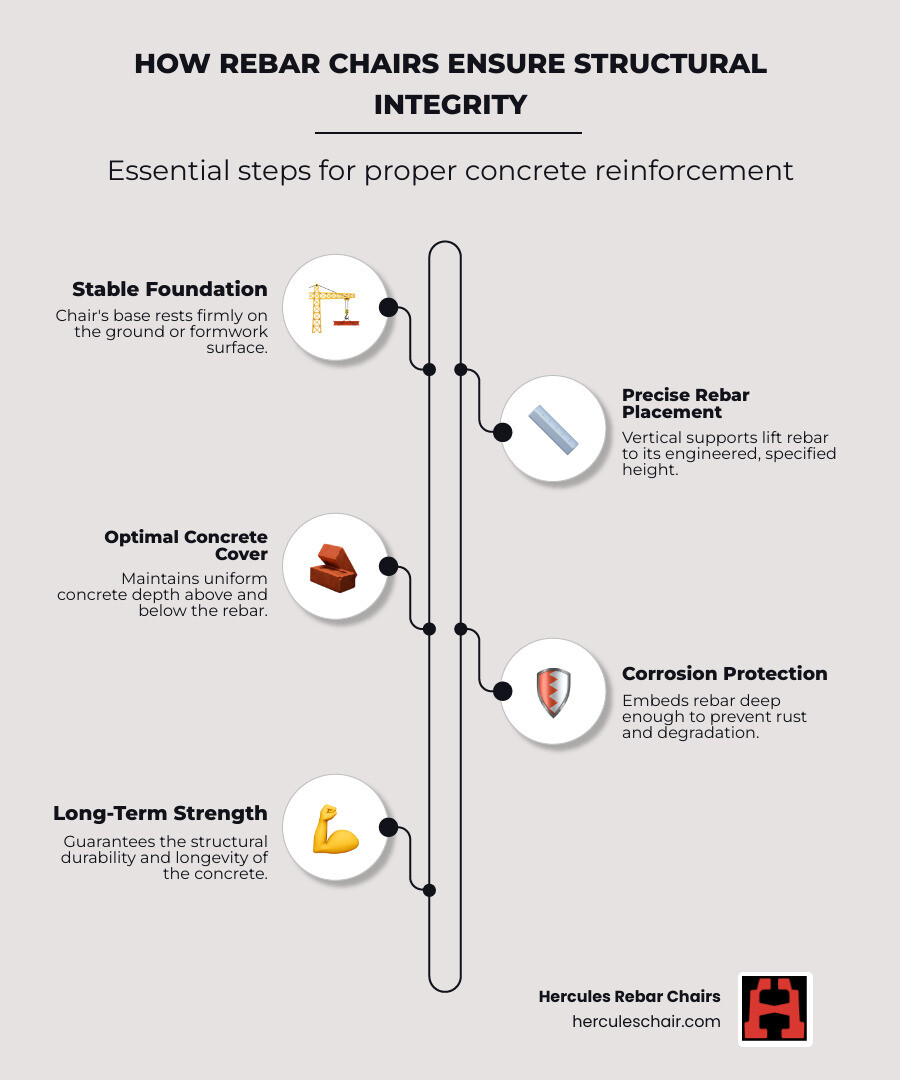
The strength and longevity of any concrete structure depend on the reinforcing steel (rebar) hidden within. For rebar to be effective, it needs rebar chair support to act as the silent guardian of structural integrity. By holding rebar in its engineered position, supports ensure the steel can take on tensile loads, contributing directly to the concrete’s strength. Using reliable rebar chair support also helps meet stringent building codes, providing peace of mind for everyone involved. For more insights on the benefits of proper support, we encourage you to consult our Rebar Placement Guide.
The Primary Function of Rebar Chairs
The primary function of a rebar chair support is to lift and maintain the rebar’s precise position during a concrete pour. This ensures the rebar is embedded at a specific depth, achieving the “concrete cover” necessary for performance and durability.
Proper concrete cover is vital for several reasons:
- Corrosion Protection: Concrete’s alkaline environment protects steel from rust, and sufficient cover makes this protective layer robust.
- Fire Resistance: Deeper cover improves the fire resistance of the steel reinforcement.
- Structural Bond: Correct positioning maximizes the bond between rebar and concrete, allowing them to work together to resist stress.
- Load Distribution: Maintaining the rebar’s configuration helps distribute loads evenly, preventing stress concentrations.
- Stability: During a pour, rebar can shift. Chairs provide a stable system that prevents movement and maintains structural integrity.
Rebar chairs are the guardians of the rebar cage, ensuring it stays exactly where the engineers designed it to be.
Benefits Over Traditional Methods
Traditional methods like wire tying or using scrap materials are time-consuming and unreliable. Modern rebar chair support offers compelling advantages:
- Eliminating Wire Tying: Hercules Rebar Chairs allow rebar to “snap into place, no more wire tying.” This drastically reduces labor hours.
- Faster Installation: With no need for individual ties, rebar placement is quicker, accelerating project timelines and saving costs.
- Consistent Height and Cover: Manufactured to precise heights, chairs ensure uniform concrete cover, a consistency difficult to achieve manually.
- Stability During Pour: Our sturdy Hercules Rebar Chairs are engineered not to collapse, preventing rebar from shifting under the weight of wet concrete and workers.
- Reduced Labor Costs: Simplifying rebar placement directly cuts labor costs, making quality chairs a smart investment.
With over 14 million units used across America, our rebar chair support products consistently help contractors save time and money while ensuring code compliance.
Mastering Placement: A Guide to Rebar Chair Spacing
Proper placement of rebar chair support is just as critical as using the right materials. If supports are too far apart, the rebar grid can sag, compromising the structure. Incorrect spacing can lead to weaknesses in the concrete, as the rebar is displaced and cannot properly resist tensile forces. The goal is to achieve even load distribution across the entire rebar grid.
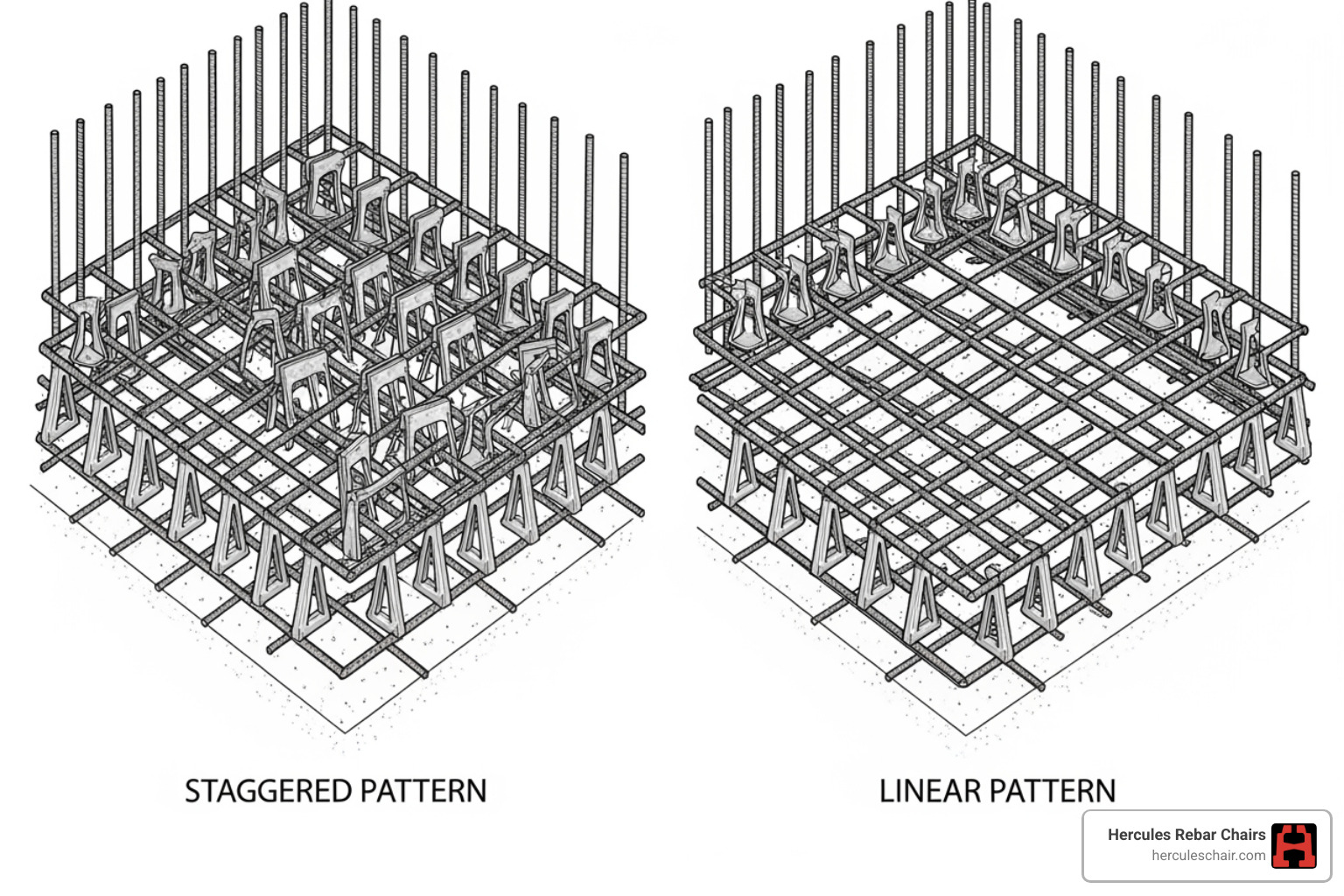
While specific codes vary by region (e.g., Australian standards mandate 600mm-800mm spacing), a general rule in the US is to space rebar chair support 2 to 3 feet apart. A practical rule of thumb is to use one chair per square meter (or one per ~10 sq. ft.). However, always adhere to your local building codes and engineering specifications.
General Rules and Maximum Spacing
While specific rules vary by region, some general principles apply. For example, Australian standards may require spacing of 600mm (23.6 in) to 800mm (31.5 in). In the United States, a widely accepted guideline is to space rebar chair support 2 to 3 feet (24 to 36 inches) apart. This ensures the rebar remains stable and at the correct height during the pour.
A helpful rule of thumb for estimating is to use one rebar chair support per square meter (about 10.76 sq. ft.). It’s also vital to respect position tolerance—how precisely the rebar must be placed. The rebar must be held firmly within engineered parameters to perform correctly. For exact requirements, always consult your project’s engineering drawings and local building codes. You can find more detailed information on this topic in articles like “Details about Rebar Support and Chair Spacing.”
Common Placement and Spacing Mistakes to Avoid
Even the best rebar chair support products can be undermined by improper placement. Learning from common mistakes can save time and money.
Here are some pitfalls to avoid:
- Exceeding Maximum Spacing: Spacing chairs too far apart (beyond 2-3 feet) allows rebar to sag, creating inconsistent cover and structural weaknesses.
- Insufficient Edge Support: Forgetting to support rebar near formwork edges can leave it too close to the surface, risking corrosion.
- Linear Arrangement Risk: Arranging chairs in long, straight lines can create planes of weakness. Instead, stagger supports by offsetting adjacent rows by at least 8 inches (200mm) to prevent linear cracking.
- Inadequate Chair Quantity: Using too few chairs provides inadequate support and can be unsafe for workers. It’s better to use slightly more than too few.
- Incorrect Height Selection: Using the wrong chair height results in incorrect concrete cover. Always match the chair height to your project’s specifications.
Avoiding these mistakes is crucial for structural integrity. For guidance on specific applications, our Footer Stand Placement Guide offers valuable insights.
How to Choose the Right Rebar Chair Support
Selecting the right rebar chair support is a critical decision that depends on your project’s unique factors. The correct choice ensures the durability of your concrete structure. Key considerations include the application type (slab, wall, footing), rebar size, required concrete cover height, and chair material.
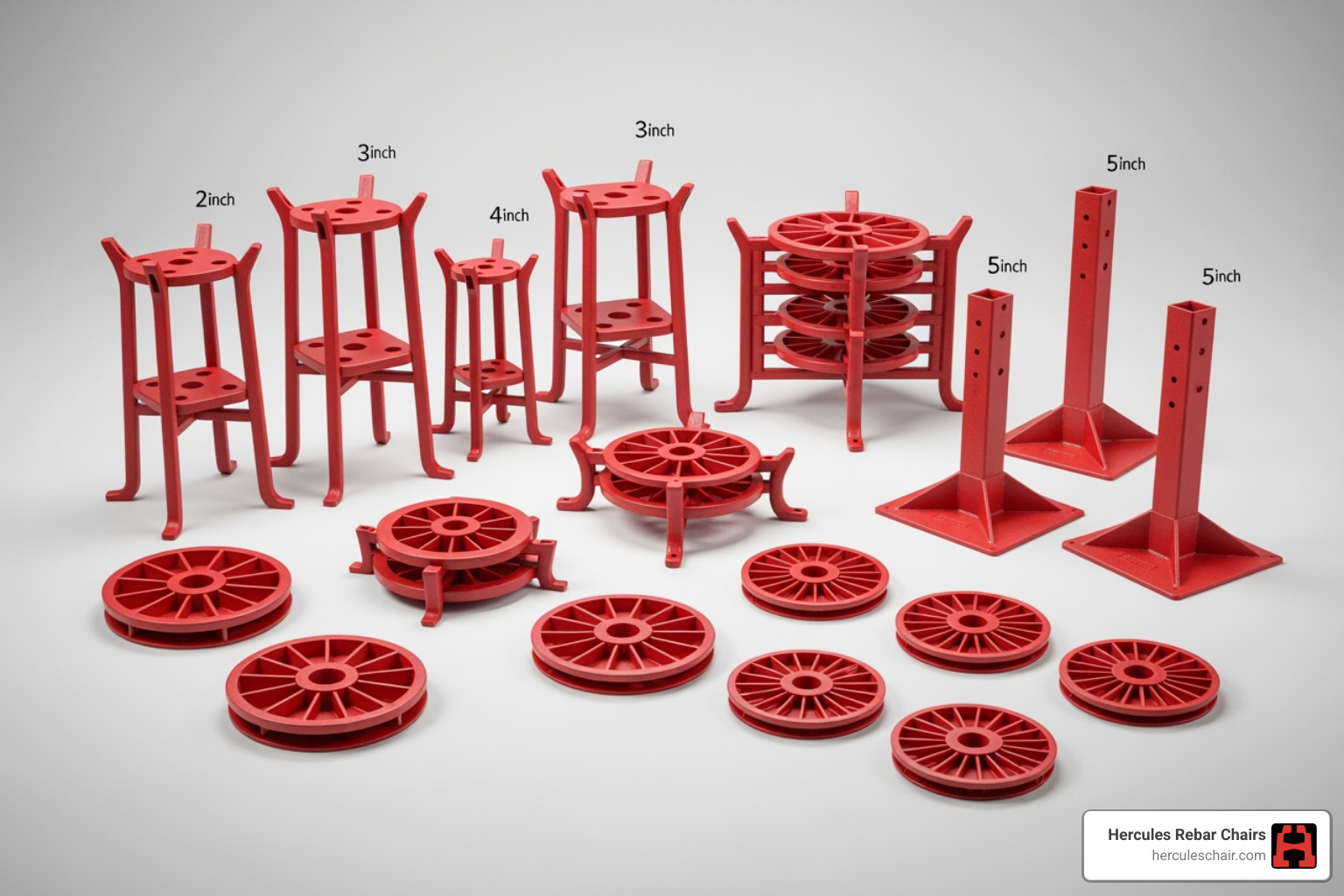
Project specifications are your guide, detailing the rebar sizes (e.g., #3 to #5) and required cover. This dictates the chair’s height, which can range from 1.5 to 6 inches. The chair must also be compatible with your rebar diameter. Finally, the chair’s material—typically plastic or steel—impacts corrosion resistance, strength, and cost.
Understanding Different Types of Hercules Rebar Chair Support
At Hercules, our signature red rebar chair support products are engineered for specific applications. Key types include:
- Standard Chairs: Our workhorse for flatwork like slabs, footings, and sidewalks. They lift rebar off the sub-base and typically support #3 to #5 rebar.
- Multi-Level Chairs: Designed for complex structures with multiple layers of rebar at different heights.
- Flat Base Chairs: Ideal for protecting vapor barriers or for use on soft ground, providing a stable base that won’t puncture membranes.
- Tip (Round-Cap) Spacers: Used for vertical rebar in columns and walls, their design ensures precise cover and smooth concrete flow.
- Spacer Wheels: These clip-on plastic spacers are for vertical applications like columns and beams, maintaining consistent cover from formwork.
Each type is crucial for sound construction. Explore our full range on our Our Products page.
Key Factors for Selecting a Rebar Chair Support
To choose the correct rebar chair support, consider these key factors:
- Reinforcement Weight: Heavier rebar requires stronger, more robust chairs to prevent sagging or breakage.
- Application Type: The concrete element (slab, wall, column) dictates the chair design. Use standard chairs for flatwork, spacer wheels for vertical elements, and multi-level chairs for complex mats.
- Cover Height: This is a critical dimension. Chairs are available in heights from 1.5 inches to 6 inches to achieve the exact concrete cover specified in your plans.
- Sub-Base Surface: A soft sub-base may require chairs with a wider base to prevent sinking, while a hard surface allows for a smaller footprint.
- Rebar Size Compatibility: Ensure the chair’s slot size matches your rebar diameter (typically #3 to #5) for a secure fit.
Making the right choice ensures your rebar stays in position. For a deeper dive into selecting the right sizes, check out The Goldilocks Guide to Concrete Bar Chair Sizes: Not Too Big, Not Too Small.
Estimating Needs and Costs
Accurate estimation is key for budgeting. As a rule of thumb, place chairs 2 to 3 feet apart, which averages to about one chair per square meter (or ~10 sq. ft.). Calculate your total area to determine the quantity needed, and add a small buffer.
Rebar chair support is an affordable investment. A 50-pack typically costs $30-$35, and a 100-pack is around $60. Prices vary by chair type and height, but the return on investment from labor savings is significant.
To simplify this process, use our Hercules Rebar Chair Estimator to quickly determine the number of chairs needed for your project.
Frequently Asked Questions about Rebar Chairs
We often hear similar questions from contractors and builders about rebar chair support. Here, we address some of the most common concerns.
What are the most common problems with rebar chairs and how are they mitigated?
Common issues with rebar chair support are preventable:
- Tipping Over: Chairs can overturn if the cover height is excessive or the base is too narrow.
- Mitigation: Use more chairs for stability or choose chairs with a wider base.
- Breaking Under Load: Chairs can break if spaced too far apart or if they aren’t strong enough for the rebar weight.
- Mitigation: Follow proper spacing (2-3 feet) and select a chair with an adequate strength rating.
- Bending Rebar: Rebar can sag between widely spaced supports.
- Mitigation: Adhere to recommended spacing guidelines to prevent sag.
- Corrosion from Damaged Tips: On steel chairs, damaged plastic tips can expose steel, leading to rust.
- Mitigation: Inspect chairs before installation or use all-plastic chairs to eliminate corrosion risk.
How do factors like rebar size and weight influence spacing needs?
Rebar size and weight directly impact the required spacing for rebar chair support.
- Heavier Rebar: Larger diameter rebar (#5, #6) is heavier and requires robust, often closer, support to prevent sagging and maintain elevation.
- Lighter Rebar: Smaller diameter rebar (#3, #4) is more flexible and prone to drooping, so proper spacing is still crucial to prevent sag and maintain concrete cover.
The primary goal is to prevent any sag in the rebar grid. Always follow the manufacturer’s recommendations and your project’s engineering specifications for guidance on spacing based on rebar size and weight.
Why are plastic rebar chairs often preferred?
Plastic rebar chair support has become popular for several key advantages over steel:
- Corrosion Resistance: Plastic does not rust, eliminating the risk of rust stains on the concrete surface and ensuring long-term structural integrity.
- Durability: Engineered from high-strength polymers, modern plastic chairs withstand the rigors of a job site and the weight of wet concrete.
- Cost-Effectiveness: Plastic chairs are generally more affordable than their steel counterparts.
- Lightweight: Being lighter than steel makes them easier to transport, handle, and install, saving time and labor.
- Non-Staining: With no risk of corrosion, there are no unsightly rust stains, which is crucial for exposed concrete finishes.
All-plastic chairs are often a safer bet for long-term performance than steel chairs with plastic tips that can detach. For more details on rebar support options, you can read “How to Properly Support Rebar When Pouring Concrete.”
Conclusion
As we’ve explored, rebar chair support might be an “unsung hero” in concrete construction, but its role is undeniably critical. From ensuring precise concrete cover and preventing corrosion to maintaining the structural integrity and tensile strength of your concrete elements, these small but mighty components are indispensable.
Choosing the right type and height of rebar chair support—whether it’s a standard chair for a slab, a multi-level chair for a complex mat, or a spacer wheel for a column—is paramount. Equally important is mastering proper spacing, adhering to local codes and engineering specifications to prevent issues like rebar sag or structural weakness. By understanding the factors that influence your selection and avoiding common placement mistakes, you’re laying the groundwork for a concrete structure that stands the test of time.
At Hercules Rebar Chairs, part of T.J. Harris Co., we’re proud to be America’s #1 choice, with over 14 million units sold. Our identifiable red chairs are a symbol of strength, reliability, and our commitment to helping you save time and money while ensuring code compliance on every project. We’re dedicated to providing the highest quality rebar chair support that you can trust to perform when it matters most.
Ready to build with confidence? Explore our range of robust rebar chair support solutions.